
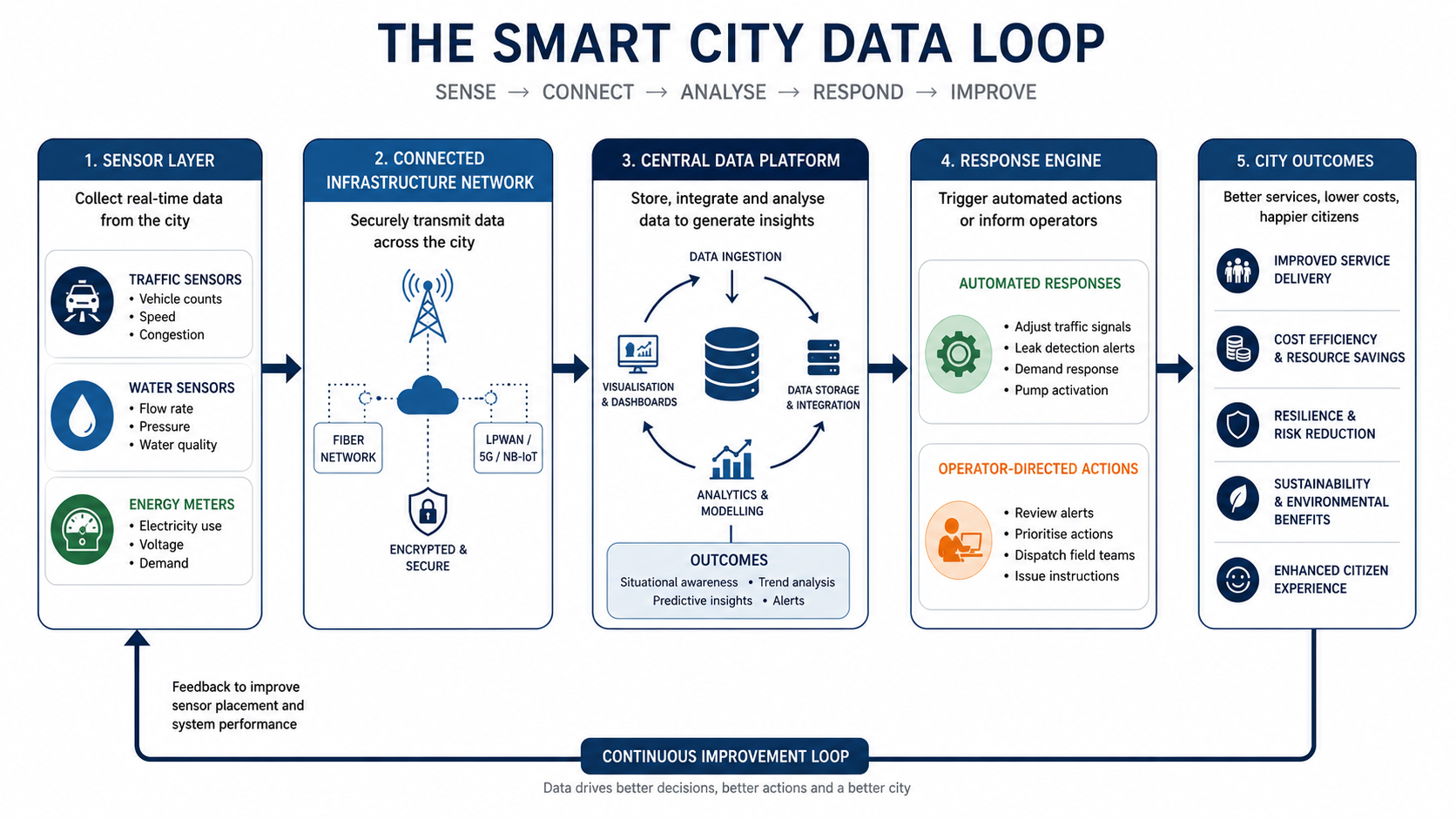
Lagos loses an estimated 3 billion naira a year in fuel and productivity to traffic congestion that could be reduced with better signal timing and real-time route data. Dubai’s RTA tracks metro ridership, road sensor data, and parking occupancy on a single dashboard used to retime signals within minutes rather than months. Both cities are drawing on the same underlying idea: smart cities. If you work in civil, structural, or infrastructure engineering, this model is no longer confined to pilot projects in Songdo or Masdar — it is showing up in your project briefs, your utility coordination meetings, and your client’s KPI dashboards. This guide breaks down what smart cities actually mean at the systems level, the technology stack behind them, how the concept applies across Nigerian, UK, and Gulf markets, and the practical challenges you need to plan for before recommending a smart cities component on your next project.
Smart Cities: Quick Answer
Smart cities are urban areas that use networked sensors, data platforms, and connected infrastructure to monitor and manage services such as traffic, water, energy, and waste in real time. The goal is measurable efficiency: faster incident response, lower resource waste, and infrastructure that adjusts to actual demand rather than fixed schedules.
What Is a Smart City, at the Systems Level?
Smart cities are, at their core, an information problem before they are a technology problem. A conventional city runs on infrastructure designed around projected demand: a water network sized for a design population, a road network signal-timed on fixed intervals, a drainage system built to a rainfall return period. This approach adds a feedback layer on top of that same physical infrastructure — sensors, meters, and cameras that report actual conditions back to a data platform, which then adjusts operations or flags an engineer to intervene.
This distinction matters for anyone specifying infrastructure. You are not designing a different bridge or a different pump station for this kind of project — the reinforced concrete, the geotechnical bearing capacity calculations, and the hydraulic design still follow BS 8110, BS 8004, or the Eurocode equivalents your jurisdiction has adopted. What changes is the instrumentation layer bolted onto that infrastructure and the software that consumes its output.
The Three Layers of a Smart City System
Every functioning smart city deployment, regardless of scale, is built from three layers you can inspect independently when reviewing a project brief:
- Sensing layer — physical devices: traffic loop detectors, smart water meters, air quality monitors, structural health sensors on bridges, CCTV with analytics.
- Connectivity layer — the connected infrastructure network carrying that data, typically a mix of fibre backbone, LoRaWAN or NB-IoT for low-power sensors, and 4G/5G for higher-bandwidth feeds.
- Platform layer — the software that ingests, stores, and visualises data, and in more mature deployments, triggers automated responses such as adaptive traffic signal retiming.
A useful diagnostic question when a client says they want a “smart” version of a project: which of these three layers are they actually asking for, and which do they assume already exists? Many project failures trace back to a client wanting platform-layer analytics without having funded the sensing or connectivity layer underneath it.
Smart Cities Versus Digital Twins
These terms get used interchangeably, but they are not the same thing. A digital twin is a live virtual model of a specific asset — a building, a bridge, a network of pipes — synchronised with real sensor data. The broader operating environment in which many digital twins, sensor networks, and service platforms sit side by side is what this article is about. You can build a digital twin of a single water treatment plant without any citywide connected programme; you cannot run a citywide smart mobility programme without something functioning like a network of connected asset models underneath it.
How Smart City Technology Works in Practice
The technical backbone of this kind of deployment rests on the Internet of Things, or IoT, combined with data platforms capable of handling continuous streams rather than periodic reports. A traffic sensor reporting vehicle counts every 30 seconds generates roughly 2.8 million data points a year per intersection. At city scale across hundreds of intersections, that volume requires purpose-built time-series databases, not the relational systems used for conventional asset registers.
Traffic and Mobility Systems
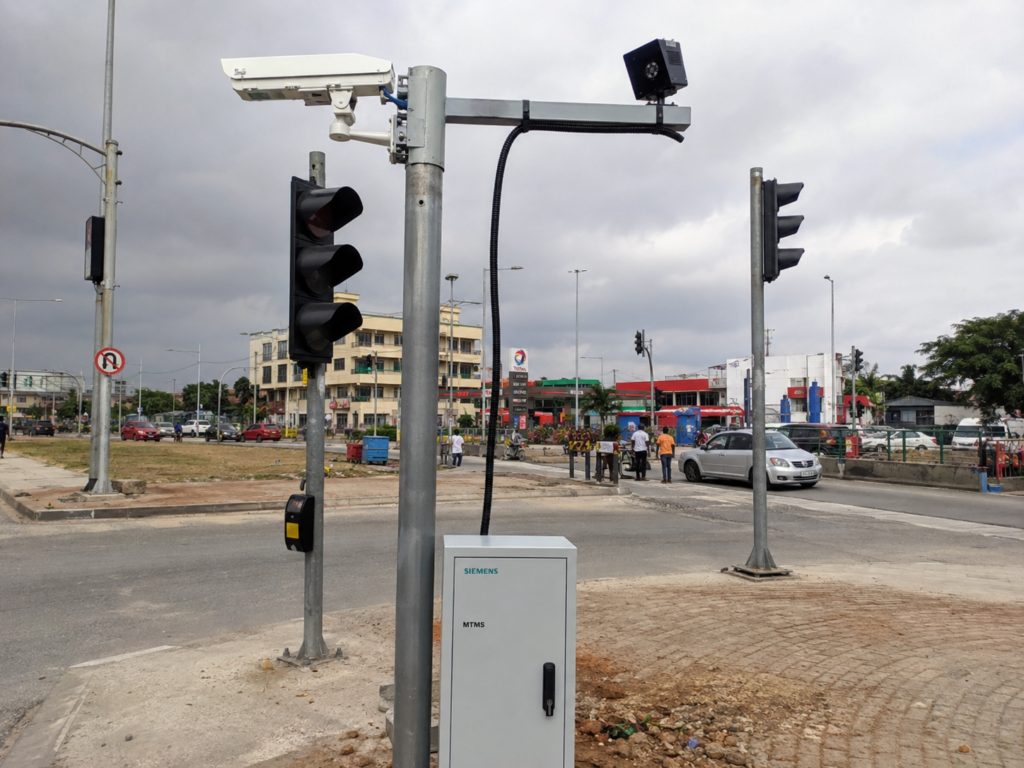
Adaptive traffic control is the most mature application of this kind globally. Inductive loop detectors or overhead radar units feed real-time vehicle counts to a signal control system, which recalculates green-phase timing every cycle rather than running a fixed 90-second plan set during the original traffic study. Singapore’s Land Transport Authority reports average delay reductions in the range of 10 to 15 percent at retrofitted junctions. For a Nigerian context, Lagos’s BRT corridor management and the Lagos Traffic Radio initiative are early, lower-cost versions of the same feedback principle, using traveller reports rather than sensor networks to redirect flow.
Utilities and Resource Management
Smart water metering identifies leakage that would otherwise go undetected for months. A district metered area approach — instrumenting zones of the network with flow meters at the boundaries — lets a utility compare input volume against billed consumption and calculate non-revenue water losses in near real time rather than through an annual audit. In many West African utility networks, non-revenue water exceeds 40 percent; even partial district metering can identify the highest-loss zones for prioritised pipe replacement, which is a far cheaper intervention than blanket network renewal.
Energy grids follow a similar logic through smart meters and distribution automation, letting a utility isolate a fault to a single transformer feeder within minutes instead of dispatching a crew to walk the line. Distribution automation switches, paired with fault indicators along the feeder, allow a control room operator to reroute supply around a fault section while a repair crew is still travelling to site, which shortens outage duration from hours to minutes on networks that have the automation in place.
Waste management is the least glamorous but often the fastest-payback application in this category. Fill-level sensors mounted in communal bins report capacity to a routing platform, which generates collection routes based on which bins are actually full rather than a fixed weekly schedule. For a mid-sized urban district, this typically cuts collection vehicle mileage by 20 to 30 percent, which matters directly to a civil engineer sizing access roads and turning circles for waste fleets — a route optimised around sensor data may require fewer large-vehicle turning points than a conventional fixed-route design would assume.
Structural and Asset Health Monitoring
A less visible but increasingly common application is structural health monitoring on bridges, flyovers, and high-rise foundations. Strain gauges, accelerometers, and tilt sensors mounted on a bridge deck feed continuous load and vibration data to a monitoring platform, flagging deviations from the baseline behaviour established at commissioning. This extends conventional structural inspection regimes rather than replacing them — a sensor network does not remove the requirement for periodic visual inspection under BS EN 1990 principles or equivalent local codes, but it narrows down where an inspecting engineer should look first. On aging infrastructure in coastal or high-humidity environments, such as bridges along Nigeria’s coastal corridors or marine structures in the Gulf, continuous corrosion and load monitoring can extend the interval between full structural surveys without increasing risk, provided the sensor calibration and data retention meet the standard your professional indemnity insurer expects.
Smart Cities in Regional Practice: Nigeria, UK, and the Gulf
The regulatory and funding environment for these projects differs sharply by market, and this shapes what an engineer can realistically recommend.
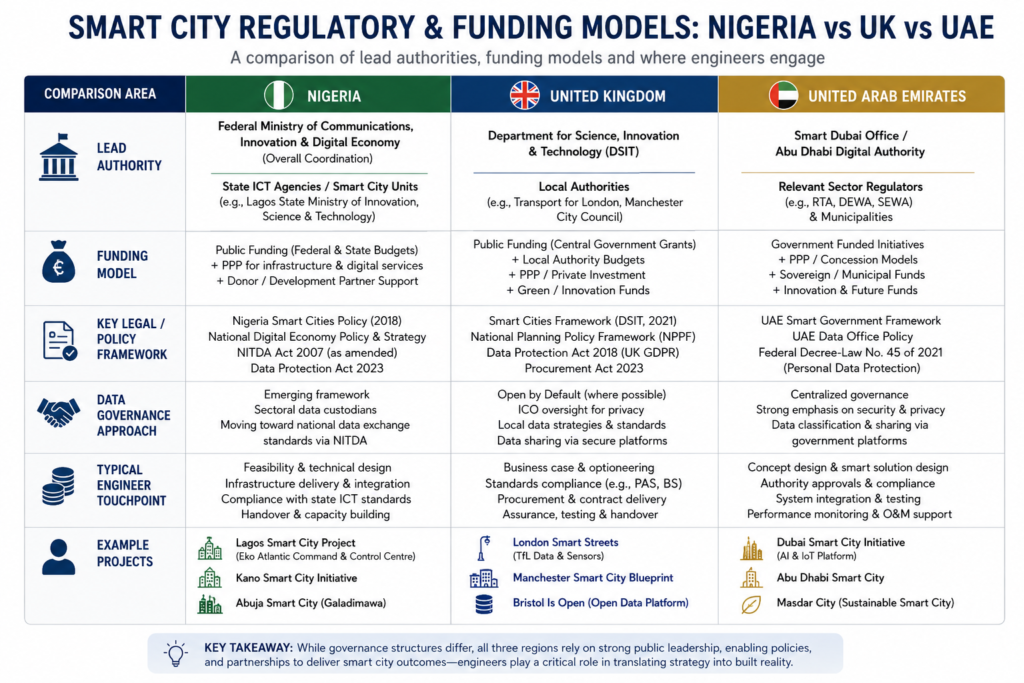
In the United Arab Emirates, Dubai’s smart city programme is government-led and centrally funded, with Dubai Municipality and the Smart Dubai office setting data standards that private developments are expected to connect into. A structural or MEP consultant working on a Dubai development will typically encounter mandated integration points for building management systems to feed into a citywide platform, and Dubai Municipality’s building permit process increasingly references these connectivity requirements at design stage.
In the UK, smart city investment tends to be project-specific rather than nationwide, delivered through local authority partnerships and often tied to urban mobility upgrades funded through the Department for Transport’s Active Travel and bus service improvement grants. RIBA’s Plan of Work now explicitly references digital infrastructure planning at Stage 2, meaning connectivity requirements should be scoped before concept design is finalised, not retrofitted afterward.
In Nigeria, smart city initiatives are more fragmented and largely state-led — Lagos State’s traffic management systems, the Eko Atlantic development’s private utility network, and various e-government portals operate as separate systems rather than a single integrated platform. COREN-registered engineers working on Nigerian smart infrastructure projects should expect to coordinate directly with state ministries of works and, where applicable, NCC guidance on telecommunications infrastructure siting, since there is no single national smart cities regulatory body equivalent to Smart Dubai.
Saudi Arabia’s giga-projects, particularly NEOM and the Riyadh master plan under Vision 2030, represent a third Gulf model distinct from Dubai’s retrofit-and-integrate approach: infrastructure and smart systems are specified together from the earliest masterplanning stage, meaning consultants join a connected infrastructure programme already embedded in the geotechnical and structural brief rather than adding it after base infrastructure is designed. Engineers moving between UAE and Saudi projects should expect materially different coordination sequencing as a result — Saudi giga-projects generally require sensing and connectivity design to be signed off alongside the structural scheme, not after it.
Common Challenges and Cost Factors
Smart city components add cost and complexity that a conventional project brief does not always budget for correctly. Four factors consistently drive cost overruns on smart infrastructure projects.
Sensor and network maintenance is recurring, not capital, cost. A client budgeting for smart water meters as a one-time capital purchase will be surprised by the ongoing cost of battery replacement, communication module firmware updates, and meter recalibration — typically 8 to 12 percent of the initial hardware cost annually.
Interoperability between vendors is rarely free. Traffic sensor vendors, water metering vendors, and platform providers frequently use proprietary data formats. Specifying open standards such as those aligned with ISO 37120 and ISO 37122 city indicator frameworks at the tender stage avoids a costly middleware integration project later.
Connectivity infrastructure is a civil works item, not just an IT line item. Fibre backbone trenching, duct banks, and cabinet foundations for network equipment need the same geotechnical and structural sign-off as any other buried service — a detail that gets missed when smart city scope is treated as separate from the civil works package.
Data governance and cybersecurity add a compliance layer. Connected traffic and utility systems are critical infrastructure targets. Projects in the UAE fall under Dubai’s data protection framework, while UK projects sit within UK GDPR and the National Cyber Security Centre’s critical infrastructure guidance — both require sign-off that is easy to underestimate at proposal stage.
Power resilience is a design load, not an assumption. Sensors, gateways, and control cabinets need continuous power to function, and a citywide network is only as reliable as its weakest supply point. In markets with less consistent grid reliability, including parts of Nigeria, specifying battery backup or solar trickle-charging at each remote sensor node is not an optional extra — a sensor network that drops offline during the exact grid outage it was meant to help manage delivers no operational value at the moment it matters most.
Best Practices for Specifying Smart City Components
You do not need to become a data engineer to specify these elements competently, but you do need a checklist that keeps scope, cost, and coordination visible from the start. The measurable benefits of smart cities — reduced congestion, lower non-revenue water, faster fault response — only materialise when the sensing, connectivity, and platform layers are specified together at the outset, rather than assembled piecemeal as budget allows. Our smart cities guide covers the procurement and phasing side of this in more depth; the checklist below focuses on what to lock down before a design freeze.
- Confirm which of the three system layers — sensing, connectivity, or platform — the client is actually funding, in writing, before design begins.
- Specify open, vendor-neutral data standards in the tender documents rather than leaving format selection to the successful contractor.
- Treat connectivity trenching, duct banks, and equipment cabinets as civil works items requiring the same structural and geotechnical review as any buried service.
- Budget maintenance and recalibration costs as a recurring operational line, not a one-time capital cost.
- Coordinate early with the relevant regulatory body — Smart Dubai, the local UK authority’s digital infrastructure lead, or the applicable Nigerian state ministry — before finalising connectivity routing.
- Build in a data governance and cybersecurity review as a formal design stage gate, not a post-completion add-on.
Frequently Asked Questions About Smart Cities
Q: What is a smart city in civil engineering terms?
A: In civil engineering terms, a smart city is conventional urban infrastructure — roads, water networks, power grids, and buildings — fitted with sensors and connected to a data platform that reports real conditions and, in more advanced systems, adjusts operations automatically. The underlying structural and geotechnical design standards do not change; the instrumentation and data layer is added on top.
Q: How does a smart city traffic system actually work?
A: Loop detectors, radar units, or camera-based sensors count vehicles at each approach to an intersection and send that data to a signal control system every cycle, typically every 60 to 120 seconds. The system recalculates green-phase timing based on real demand instead of running a fixed plan, which is why adaptive systems like those used by Singapore’s LTA report 10 to 15 percent average delay reductions at retrofitted junctions.
Q: What are the smart cities requirements for a new development in Dubai?
A: Developments in Dubai are increasingly expected to provide connectivity points that allow building management systems to feed data into Smart Dubai’s citywide platform, in line with Dubai Municipality’s building permit process. Requirements vary by development type, so consultants should confirm the current connectivity specification directly with Dubai Municipality at concept design stage rather than assuming a fixed standard applies across all projects.
Q: How much does smart city infrastructure cost compared to conventional infrastructure?
A: The sensing and connectivity layer typically adds 3 to 8 percent to a conventional infrastructure project’s capital cost, depending on sensor density and network type, plus an ongoing operational cost of roughly 8 to 12 percent of hardware cost annually for maintenance and recalibration. Costs rise sharply if data standards are not specified at tender stage, since retrofitting interoperability between incompatible vendor systems is a common source of budget overrun.
Q: What is the difference between a smart city and a digital twin?
A: A digital twin is a live virtual model of one specific asset — a bridge, a building, a treatment plant — synchronised with sensor data from that asset alone. A smart city is the wider urban system in which multiple digital twins, sensor networks, and service platforms operate together to manage traffic, utilities, and public services across an entire district or city.
Conclusion: Planning for Smart Cities as an Engineer
Smart cities are not a separate discipline bolted onto conventional infrastructure — they are conventional infrastructure with a feedback loop added, built from a sensing layer, a connectivity layer, and a platform layer that each carry their own cost, maintenance, and regulatory implications. Whether you are working under Smart Dubai’s centralised model, the UK’s project-specific approach through RIBA-aligned digital infrastructure planning, or Nigeria’s more fragmented state-led initiatives, the fundamentals are the same: confirm which layer your client is funding, specify open data standards early, and treat connectivity works as civil works. If your current project brief includes a smart cities component and you need help scoping the sensing, connectivity, or structural coordination involved, StruviaCore’s engineering team can review your specification before it goes to tender.
Leave a Reply