

A structural engineer managing a bridge rehabilitation in Lagos or a project manager overseeing a new transit terminal in Dubai faces the same question: how do you know the asset is performing as designed once it leaves the drawing board and starts carrying real loads in real conditions? Traditional inspection schedules give you snapshots. A digital twin gives you a continuous feed.
The concept has moved well beyond pilot projects. Governments in the UK, UAE, and sub-Saharan Africa are embedding digital twin requirements into infrastructure procurement frameworks. ISO 23247 provides the reference architecture. The BS EN ISO 19650 series sets the information management foundations for UK deployments. Knowing the standards is not the same as knowing how to stand one up on your project.
This guide breaks down the digital twins checklist — the specific steps, decisions, and technical configurations needed to take a project from concept to a functioning real-time asset model. It covers core system components, the data governance questions that surface too late on most projects, and a structured six-phase implementation sequence built for engineering work of real complexity.
Digital Twins Checklist: Quick Answer
A digital twins checklist is a structured implementation sequence covering geometric model setup, IoT sensor integration, real-time data pipelines, simulation layer configuration, and governance protocols. Applied to civil and structural engineering projects, it confirms that asset data flows from physical systems into a live virtual model accurately enough to support operational decision-making and predictive maintenance planning.
What Is a Digital Twin in Engineering?
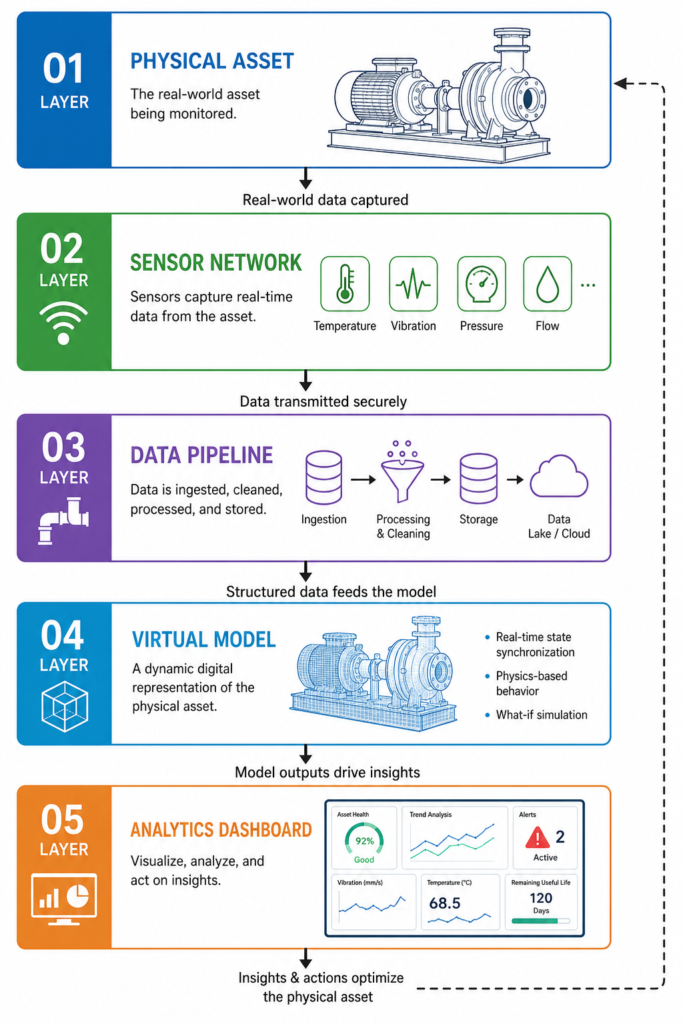
A digital twin is a virtual representation of a physical asset, system, or process that receives continuous data from its real-world counterpart and uses that data to simulate, predict, and optimise performance. In civil and structural engineering, the asset might be a bridge, a wastewater treatment plant, a highway corridor, a high-rise structure, or an entire urban district. The virtual model is not a static CAD file — it is a live system that updates as conditions on the ground change.
The term was formalised within NASA’s spacecraft lifecycle management programme, but the construction and infrastructure sector adopted the concept through the lens of Building Information Modelling. A BIM model built to LOD 350 or higher carries the geometric and system data that forms the structural foundation of a digital twin. What separates a digital twin from a BIM model is the live data feed — the connection to physical sensors, operational systems, and monitoring instruments that makes the virtual model dynamic rather than historical.
ISO 23247 defines the framework for digital twins and provides the reference architecture most engineering teams adapt for infrastructure applications. In the UK, the Centre for Digital Built Britain (CDBB) has extended that framework through the National Digital Twin Programme, publishing the Gemini Principles and the Information Management Framework (IMF) to govern how data from different assets and systems can be federated into a single interoperable model. That federation architecture becomes particularly relevant for complex infrastructure — rail networks, port facilities, urban drainage catchments — where no single asset exists in isolation.
The range of practical applications is wide. A digital twin can monitor the dynamic response of a steel-frame high-rise in a wind-exposed coastal location, track settlement of a road embankment over soft alluvial ground, manage energy consumption across a commercial development, or simulate flood behaviour in a catchment to support emergency response planning. Across all these applications, the governing principle is the same: the virtual model must reflect real conditions with sufficient accuracy and currency to support decisions that carry consequences.
How Digital Twins Differ from BIM
BIM is the foundation; a digital twin is the operational layer built on top of it. A BIM model produced during design and construction documents what was planned and — after as-built surveys — what was delivered. It holds geometric data, component specifications, maintenance schedules, and system layouts. In its standard form, it does not update automatically as the asset ages, deforms under load, or changes operational state.
A digital twin closes that gap. It ingests sensor readings — from structural health monitoring (SHM) sensors embedded in a bridge deck, or from a building management system (BMS) in a commercial building — and uses those readings to update the model’s status in near real time. This means the twin can flag when a monitored deflection on a primary beam exceeds the design threshold defined in the structural calculations, triggering an inspection before visible damage appears. It can also detect when a drainage structure is operating near capacity based on flow sensor data, allowing maintenance intervention before a blockage causes flooding upstream.
For teams establishing this distinction at a foundational level, the full overview of what a digital twin is and how it functions sets out the core definitions and use cases. For teams approaching this BIM-first, the Building Information Modelling implementation guide details the information management processes that feed directly into a digital twin at project handover.
The Four Core Layers of a Digital Twin System
Every functioning digital twin in engineering relies on four distinct technical layers. Failing to plan any one of them correctly undermines the entire system. The checklist approach works precisely because it forces teams to define, configure, and test each layer before advancing to the next — rather than discovering configuration gaps during commissioning, when corrections carry real cost and programme impact.
Layer 1: Data Acquisition
This is where the physical world connects to the virtual model. The data acquisition layer consists of sensors, monitoring instruments, and existing operational data systems that generate readings about the asset’s condition and its environment.
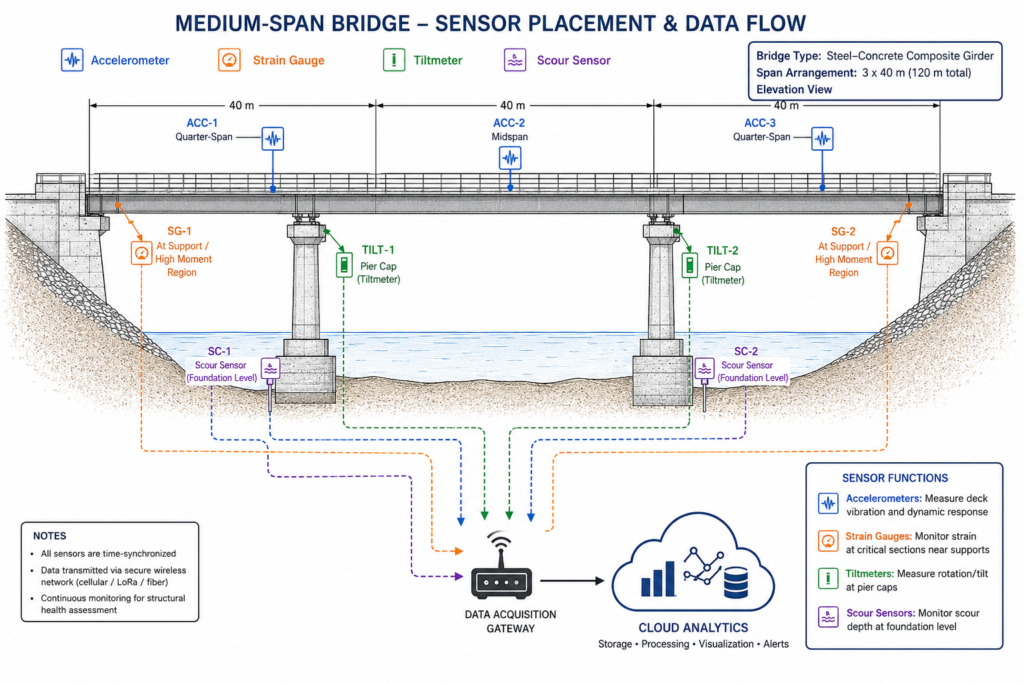
For structural applications, the layer typically includes vibration sensors and accelerometers measuring dynamic response under live load, strain gauges at critical cross-sections, tiltmeters and inclinometers tracking differential settlement or rotation, and crack gauges at monitored locations in concrete or masonry elements. In marine or chemically aggressive environments — including coastal Lagos or Abu Dhabi waterfront infrastructure — corrosion potential probes provide early warning of reinforcement degradation that visual inspection will not detect until cover cracking has already begun.
For road and bridge assets, the data layer may also draw from SCADA (Supervisory Control and Data Acquisition) systems already installed for operational control, traffic management sensor arrays, weigh-in-motion (WIM) equipment recording actual vehicle loads, and satellite-based InSAR (Interferometric Synthetic Aperture Radar) data used for large-scale ground settlement monitoring. A federal highway corridor in Nigeria’s Niger Delta — where road embankments over saturated clays present chronic maintenance challenges — is exactly the scenario where distributed settlement sensors combined with periodic InSAR analysis generates the data richness a digital twin requires for meaningful predictive analysis.
Sensor placement is a structural engineering decision, not an IT decision. The engineering team must identify which members and connections are critical, which failure modes are being monitored, and what sampling frequency each sensor needs to detect meaningful change. A vibration accelerometer on a bridge deck may require a sampling rate of 100 Hz or higher to capture modal frequencies accurately. A settlement reference point on a building foundation may need only a daily reading. Defining these parameters before procurement is non-negotiable in any digital twins checklist.
Layer 2: Connectivity and Data Transport
Raw sensor data must travel reliably from the physical asset to the processing platform. For permanent installations in structures with mains power access, wired connections — Ethernet, fibre, or dedicated signal cables — offer the most reliable data transport. For distributed assets such as road networks, railway corridors, or geographically dispersed monitoring points, wireless protocols become the practical alternative. LoRaWAN (Long Range Wide Area Network) supports sensor networks across several kilometres with low power draw, making it well suited to road and pipeline monitoring in areas where fixed communications infrastructure is limited. NB-IoT (Narrowband Internet of Things) uses existing cellular networks and operates effectively in low-signal environments. Hybrid architectures — wired collection nodes feeding wireless gateway links — are common on complex infrastructure assets.
Layer 3: Analytics and Simulation
Data without analysis is noise. The analytics layer validates incoming readings, applies engineering models to translate raw sensor outputs into structural performance indicators, and generates actionable information for operators and asset managers. At minimum it performs data validation — filtering sensor noise and flagging erroneous readings — followed by threshold alerting that compares real-time readings against the design limits set by the structural engineer. Trend analysis detects slow-developing changes in structural behaviour that sit below alerting thresholds but signal progressive deterioration over months or years.
Physics-based finite element models (FEM), calibrated against the as-built drawings and updated with validated sensor data, form the simulation backbone for structural digital twins. Platforms such as Bentley iTwin Services, ANSYS Twin Builder, and Siemens Teamcenter Simulation handle this integration at enterprise scale. Critically, the structural engineer must define model boundary conditions, load cases, material parameters, and acceptable tolerance bands. The software handles computation; engineering judgement defines what the computation results mean.
Layer 4: Visualisation and Decision Support
The final layer presents processed, model-updated data to the people who need to act on it — a web dashboard showing live structural performance indicators for an operations team, a 3D model viewer allowing engineers to interrogate specific components and their current sensor readings, or automated reports for an asset owner reviewing condition across a portfolio. The interface must be designed around the decisions it supports, not the data it displays. An operations centre managing a motorway network needs a geospatial view showing alert locations relative to asset geography. A structural engineer reviewing foundation performance needs access to time-series settlement graphs at each monitored point.
Digital Twins in Global Infrastructure: Real Applications
Digital twin deployment has moved from conference presentations to contractual requirements in several major procurement frameworks. Understanding where and how it is being applied gives engineering teams a realistic benchmark — and a way to calibrate the maturity level appropriate for their asset type and available budget.
In the UK, National Highways has developed a digital twin programme for the Strategic Road Network, integrating pavement condition surveys, drainage inspection records, and bridge assessment data into a federated model that prioritises maintenance across the motorway and A-road network. Network Rail has deployed structural monitoring twins on a number of bridges, with sensor feeds informing management decisions aligned to the Network Rail GRIP (Governance for Railway Investment Projects) framework. Teams managing comparable infrastructure programmes can apply the same governance logic — the project delivery framework guide covers the programme structures that support large-scale digital twin rollouts across multi-asset portfolios.
In the UAE, Dubai’s Roads and Transport Authority (RTA) has deployed digital twins for key transport infrastructure as part of the Smart Dubai initiative. The models integrate live traffic data, structural monitoring feeds, and environmental sensor outputs for major bridges and interchanges. Dubai’s conditions — sustained summer temperatures above 45°C, salt-laden coastal air, and concrete exposed to high humidity and carbonation — create data requirements the twin must account for explicitly: thermal expansion monitoring for steel structures, corrosion sensor arrays for coastal assets, and pavement surface temperature logging to model heavy-vehicle rutting potential.
In Nigeria, adoption is advancing from an earlier base. The Federal Ministry of Works and Housing’s infrastructure asset management agenda has introduced structured data collection requirements for federal roads and bridges. World Bank-financed transport corridors are among the first assets operating with condition monitoring frameworks that lay the groundwork for full digital twin integration. COREN (Council for the Regulation of Engineering in Nigeria) has indicated interest in digital infrastructure management as part of its continuing professional development agenda, and several private-sector developments in Lagos and Abuja now specify BIM-to-digital-twin handover requirements at project inception.
At the urban scale, Singapore’s Virtual Singapore model demonstrates what a city-wide digital twin can support: solar energy potential mapping across the urban roofscape, emergency response route optimisation, and noise propagation modelling for planning decisions. The layered data architecture — federated from individual asset twins — scales to city-wide systems when the information governance is designed with interoperability as a first principle. Our overview of smart city infrastructure programmes explores how this federation is being achieved in practice.
Common Implementation Challenges and How to Address Them
The gap between a well-conceived digital twin and a functional one is consistently found in four problem areas: data quality, interoperability, cybersecurity, and organisational readiness. Addressing each in the planning phase prevents corrections during commissioning, when the cost of change is highest.
Data quality is the most consistent failure point. A digital twin is only as reliable as the data feeding it. Poorly calibrated sensors, incompatible data formats from different monitoring systems, and gaps in the as-built geometric model all degrade the accuracy of the virtual representation. The mitigation is a data validation protocol written before any sensors are ordered: acceptable ranges for each monitored parameter, sampling frequencies, calibration schedules, and gap-handling procedures. Redundant sensors at critical monitoring points — two accelerometers rather than one at a bridge midspan — provide cross-verification and continuity if one instrument fails.
Interoperability becomes a serious problem when the structural model, sensor management platform, asset management system, and analytics dashboard originate from different vendors using incompatible schemas. IFC (Industry Foundation Classes) for building and structural data, and CityGML for urban-scale geographic models, provide open standards for data exchange, but not all platforms support them without data loss. Confirm during procurement that every system in the digital twin stack can export and import in open formats — or accept that a custom middleware integration layer will be required, which adds both cost and long-term maintenance responsibility.
Cybersecurity is non-negotiable for any digital twin connected to operational infrastructure. Sensors linked to cloud platforms create attack surfaces. A water treatment facility or bridge management system accessible through an inadequately secured API represents a genuine infrastructure risk. The UK National Cyber Security Centre (NCSC) Cyber Assessment Framework (CAF) and IEC 62443 for industrial control system security both apply to digital twin deployments on critical assets. Procurement documents should require vendors to demonstrate compliance with these frameworks as a condition of contract award.
Organisational readiness is most frequently underestimated. A digital twin generates continuous data that requires skilled people to interpret and act on it. If the operations team lacks the technical capability, the internal processes, or the decision-making authority to respond to alerts the twin generates, those alerts go unanswered. Continuous unheeded alerts from a technically functioning system breed operational complacency — an outcome worse than having no monitoring at all. Budget for structured training, define escalation procedures, and confirm the post-handover owner of the digital twin before the project begins, not at practical completion.
Digital Twins Checklist: Step-by-Step Implementation Framework
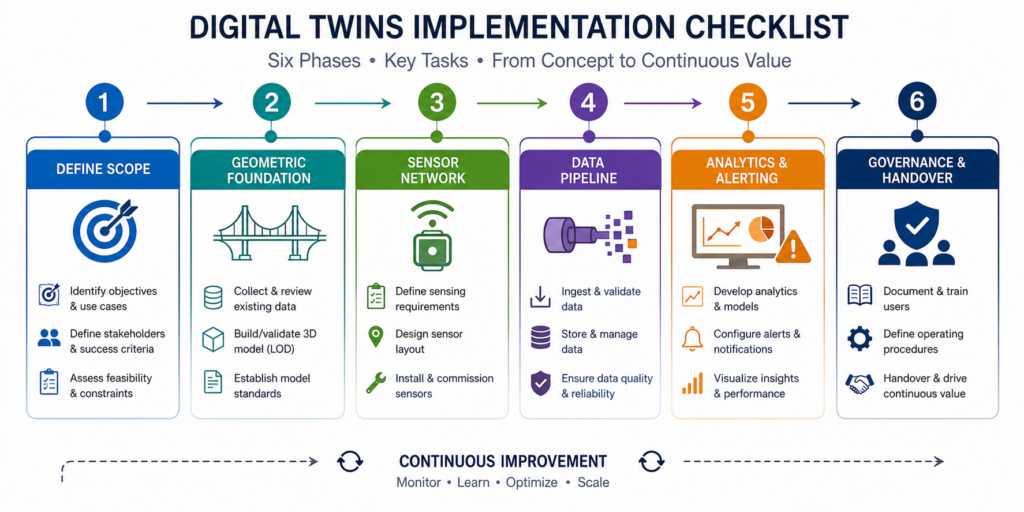
Work through this framework in sequence. Each phase depends on decisions made in the previous one. Adapt sensor types and platform choices to your asset class, but treat the sequence as fixed — the shortcuts taken between phases surface as defects during commissioning, when correcting them is more expensive than following the process would have been.
Phase 1 — Define Scope and Use Case
- Confirm the primary use case: structural health monitoring, predictive maintenance, operational optimisation, or regulatory compliance reporting
- Identify asset boundaries — which physical systems are in scope and what is explicitly excluded from the model
- Define the Level of Development (LOD) required for the geometric model, aligned with BS EN ISO 19650 information requirements for this asset class
- Set measurable KPIs: alert response time targets, model update frequency, structural reading accuracy tolerance
- Identify the post-handover owner of the digital twin and confirm their technical capability to operate and maintain it
Phase 2 — Establish the Geometric Foundation
- Audit the existing BIM model for completeness — confirm it reflects as-built conditions, not pre-construction design intent
- Commission a point cloud survey using terrestrial LiDAR or close-range photogrammetry if the as-built model has not been updated since practical completion
- Verify that the model coordinate system aligns with site survey control points and the GIS reference frame used for external data integration
- Confirm the model is authored in an IFC-compatible format and can be exported to the digital twin platform without geometric or attribute data loss
- Populate component-level attribute data: material specifications, design load ratings, installation dates, and manufacturer references for plant and equipment
Phase 3 — Design the Sensor Network
- Produce a structural risk assessment identifying which members, connections, or systems carry the highest consequence of undetected failure
- Map sensor types to each monitored parameter: strain, vibration, rotation, crack width, temperature, moisture content, and corrosion potential as the asset type requires
- Define sampling frequencies based on the dynamic characteristics of the asset and the specific failure modes under surveillance
- Specify the communication protocol: wired for permanent installations with mains power access; LoRaWAN or NB-IoT for distributed remote monitoring; hybrid where necessary
- Confirm power supply strategy — mains, battery with defined replacement intervals, or energy harvesting — and document maintenance access requirements for each node
- Write calibration procedures and re-calibration intervals for each sensor type before procurement commences
Phase 4 — Build the Data Pipeline
- Select a data ingestion platform rated for the expected volume and velocity of your sensor network’s data output
- Define the data schema and tagging convention — every sensor reading must map to a specific asset component in the geometric model using a consistent identifier
- Implement validation rules at the point of ingestion: range checks, rate-of-change limits, and cross-sensor consistency checks where redundant monitoring exists
- Verify the pipeline stores raw data alongside processed readings — you need the raw data to re-run analysis when validation parameters change
- Load-test the pipeline under simulated peak-data conditions before connecting live sensors on site
Phase 5 — Configure Analytics and Alerting
- Load structural design thresholds from the as-built calculations into the alerting system — define warning thresholds (triggering inspection) and critical thresholds (triggering emergency response) separately
- Build the finite element simulation model, calibrate it against static readings from the as-built survey, and validate outputs against initial field measurements after sensor installation
- Configure trend analysis to detect gradual deterioration — a 3 mm increase in midspan deflection over 18 months may not breach any threshold but must appear clearly in monthly trend reports reviewed by the structural team
- Set up automated reporting: daily dashboards for operations staff, monthly condition summaries for asset owners, and immediate SMS or platform notifications for threshold breaches
Phase 6 — Governance, Security, and Handover
- Apply cybersecurity controls aligned to IEC 62443 or the NCSC CAF for critical infrastructure digital twins
- Define data ownership, access control levels by role, and data retention periods — confirm alignment with applicable data protection legislation in the project jurisdiction
- Prepare operations and maintenance documentation specific to the digital twin: sensor maintenance schedules, software update procedures, and model update protocols for future structural changes or repairs
- Deliver structured handover training to the operations team — a minimum of four hours of hands-on system training per active operator, with written operating procedures provided for ongoing reference
- Schedule a 12-month post-handover performance review to assess outcomes against the KPIs defined in Phase 1 and identify any configuration adjustments required
Frequently Asked Questions About Digital Twins
Q: What is a digital twin in civil engineering?
A: In civil engineering, a digital twin is a virtual model of a physical asset — such as a bridge, building, highway corridor, or drainage network — connected to real-time data from sensors and operational systems installed on or near the physical structure. The model updates continuously, enabling engineers and asset managers to monitor structural condition, predict maintenance requirements before failures occur, and simulate the effect of changed loads or design modifications without altering the physical asset. Unlike a BIM model, which reflects conditions at the point of handover, a digital twin reflects current asset conditions at any given moment during its operating life.
Q: How does a digital twin differ from a BIM model?
A: A BIM model documents what was designed and what was built. It is produced during design and construction phases, updated after as-built surveys, and used as a static reference during operation. A digital twin takes that geometric foundation and adds a live connection to sensor data, operational systems, and physics-based simulation — making the model dynamic. A BIM model at LOD 350 or above is typically the geometric starting point for a digital twin; what the twin adds is real-time data integration, continuous model updating, and predictive analytics that a static BIM model cannot provide on its own.
Q: What standards govern digital twins for engineering projects?
A: ISO 23247 provides the reference architecture for digital twin systems. In the UK, BS EN ISO 19650 governs information management for construction and infrastructure and defines the handover information requirements that feed a digital twin at practical completion. The CDBB’s Gemini Principles set the ethical and functional framework for the National Digital Twin Programme. For connected system cybersecurity, IEC 62443 applies to the industrial control and sensor components within a digital twin. In Nigeria, COREN has not yet published specific digital twin standards, but projects with public funding increasingly reference ISO or UK frameworks as the applicable baseline, and private-sector clients in Lagos and Abuja are beginning to specify BS EN ISO 19650 compliance at project inception.
Q: How much does it cost to implement a digital twin for an infrastructure asset?
A: Costs depend significantly on asset type, monitoring scope, and the maturity of existing data infrastructure. A structural health monitoring digital twin for a medium-span bridge in the UK — covering 20 to 30 sensors, data platform setup, model integration, and 12 months of analytics licensing — typically falls in the £150,000 to £400,000 range for initial implementation, with annual operating costs of £30,000 to £80,000. Projects where a BIM model already exists at the required LOD spend less on the geometric foundation phase and more on sensor specification and pipeline configuration. Return on investment is typically measured through reduced unplanned maintenance expenditure, extended asset service life, and avoided emergency interventions — each of which can be quantified against baseline inspection and repair costs from previous years.
Q: Can digital twins be retrofitted to existing structures?
A: Yes — and in practice, most implementations are retrofits, since the majority of the global infrastructure stock predates digital twin technology. Retrofitting requires a condition survey to establish current asset state, a point cloud or photogrammetric survey to build the as-built geometric model if one does not exist, and sensor installation on a structure not originally designed to accommodate embedded monitoring. The structural engineer must assess sensor mounting locations, cable routing, and any penetrations or fixings required — confirming that the installation does not affect the structural performance of the asset. Wireless sensor networks have made retrofit projects significantly more practical over the past five years by eliminating the need for extensive cable runs through existing structures, and they now operate reliably across a growing range of asset types including masonry arch bridges, cast-iron frame buildings, and reinforced concrete harbour walls.
Making the Digital Twins Checklist Work on Your Project
A digital twins checklist is not a procurement shortcut — it is a project management discipline that forces the engineering decisions teams most commonly defer until commissioning, when changing course carries real programme and cost consequences. The six-phase framework in this guide covers the full sequence from scope definition through governance and handover, and each phase reflects a lesson learned from projects where the gap between the promised digital twin and the delivered one came down to a planning omission, not a technology failure.
The technology itself — distributed sensor networks, FEM platforms, cloud data pipelines, real-time dashboards — is commercially mature. The variables that determine whether a digital twin delivers sustained operational value are engineering ones: which parameters matter for this specific asset, what failure modes are being managed, who owns the data after handover, and what decisions the twin is actually designed to support. Answering those questions at the start, in writing, in the project brief, determines everything that follows.
StruviaCore brings structural engineering experience and digital delivery capability to infrastructure projects across the UK, West Africa, and the UAE. If your project requires a digital twin feasibility assessment, sensor network specification, or BIM-to-digital-twin transition planning, contact the StruviaCore team to discuss your asset’s specific requirements. For the connectivity infrastructure that underpins every functioning digital twin, our guide to IoT sensor networks in engineering and construction is a practical next step.
Leave a Reply