

A tower crane operator on a high-rise site in Lekki gets a warning on his handset before his supervisor even radios him: a strain gauge fitted to the crane’s jib has logged a load reading outside its rated envelope. No one climbed the mast to check a dial. IoT, or the Internet of Things, is the network of physical sensors, controllers, and connected devices that collect data from construction sites, structures, and equipment and transmit it — usually in real time — to a platform where engineers can act on it. On a project in Lagos, Abuja, or Port Harcourt, that might mean a vibration sensor bolted to a bridge pier, a moisture probe embedded in curing concrete, or a GPS tracker fitted to a fleet of concrete mixers. This piece sets out how IoT systems work on construction and infrastructure projects, where they add the most value in civil and structural engineering, what deployment costs on a typical Nigerian site, and how COREN-registered practices are adopting the technology within existing regulatory and site-safety frameworks.
IoT: Quick Answer
IoT in construction means networked sensors, controllers, and connected devices that capture structural, environmental, and equipment data and send it to a central platform for engineers to review. Typical uses include structural health monitoring, fleet telematics, moisture and vibration sensing, and automated safety alerts on active sites in Nigeria and beyond.
What Is IoT in Construction and How It Works
IoT is not a single product bought off a shelf. It is an architecture: a sensor captures a physical measurement, a network transmits that measurement, and a platform stores, processes, and displays it so a person — or another automated system — can act on it. On a construction site, the sensor might be an accelerometer bolted to a formwork panel, the network might be a low-power wide-area (LPWA) radio link, and the platform might be a dashboard the site engineer checks each morning alongside the daily progress report. The value of the system comes from what happens after the data arrives, not from the sensor itself.
Core Components of a Construction IoT System
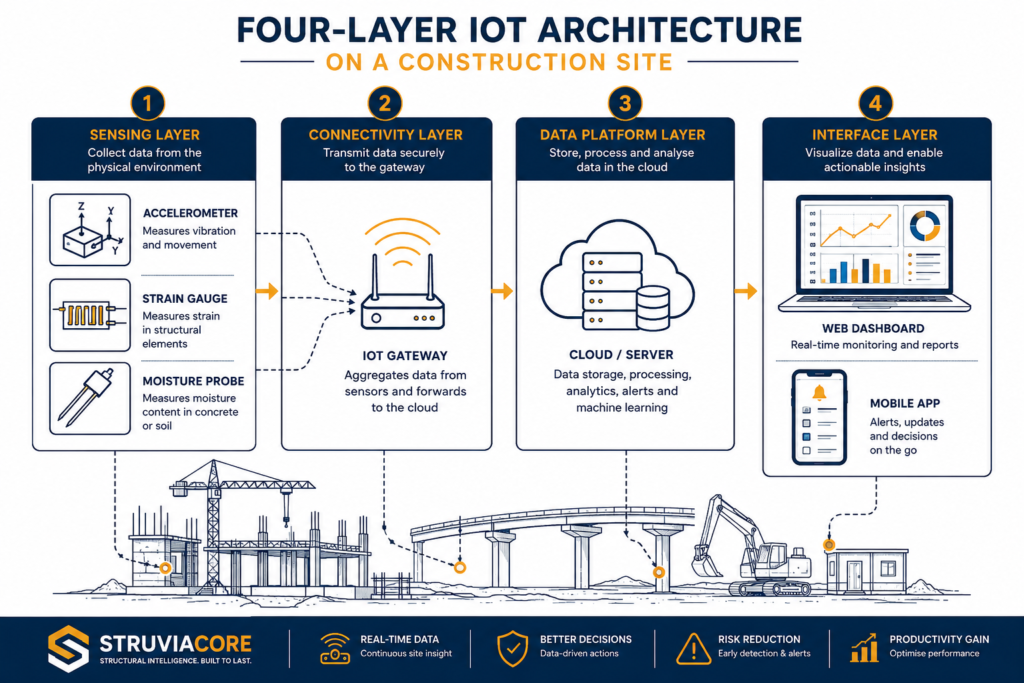
Every functioning IoT deployment on a job site rests on four layers. The first is the sensing layer — accelerometers, strain gauges, tiltmeters, moisture probes, GPS units, or RFID tags that physically measure a condition. The second is the connectivity layer, which moves that reading off the sensor using Wi-Fi, cellular data, Bluetooth mesh, or an LPWA protocol such as LoRaWAN, chosen largely by how far the signal needs to travel and how much power the sensor battery can spare. The third is the data platform, where readings are stored, time-stamped, and compared against threshold values the design engineer sets during commissioning. The fourth is the interface — a dashboard, an app, or an automated alert — that puts the reading in front of a decision-maker. Remove any one layer and the other three become wasted capital.
How IoT Data Reaches the Engineer
A typical reading travels in seconds, not hours. A tiltmeter on a retaining wall logs a movement of 2mm, the sensor’s onboard chip compares that figure against a pre-set trigger value, and if the trigger is breached, the reading passes through a gateway device on site to a cloud server. From there, the platform pushes a notification to the resident engineer’s phone and logs the event permanently against that structure’s monitoring record. On projects that also run a building information model, that same reading can populate the model directly, so the design team reviews the live structural condition against the as-built geometry rather than a static drawing pinned to a site-office wall.
Types of IoT Applications in Civil and Structural Engineering
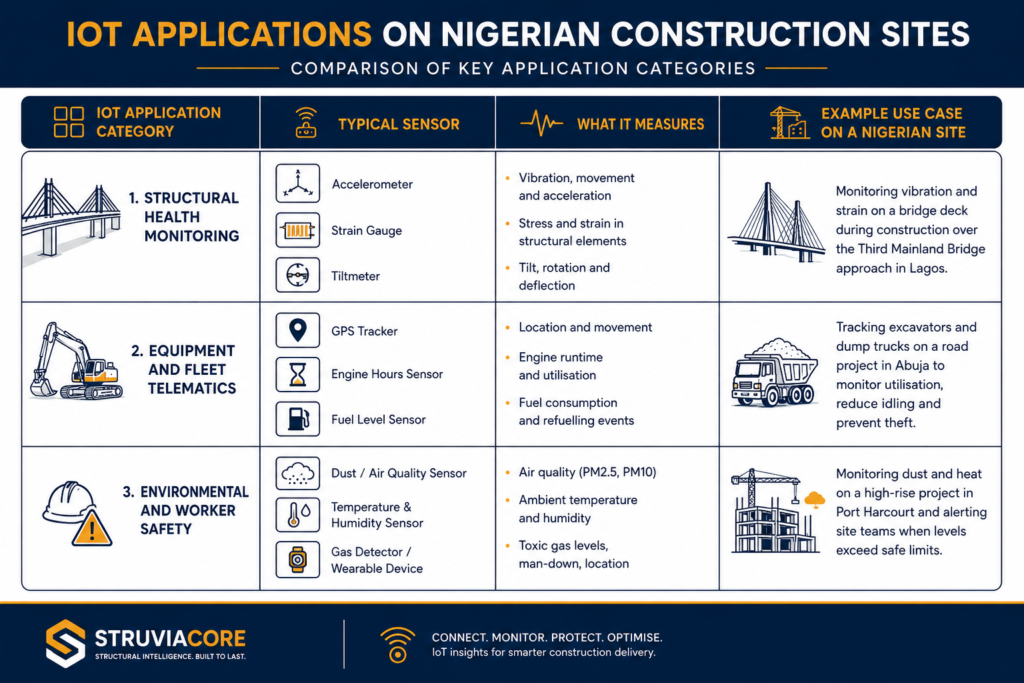
IoT sensors on a construction or infrastructure project fall into three broad groups, split by what they measure rather than by the brand of hardware. A site engineer planning a deployment usually starts with the highest-risk element first — the structure itself — before extending sensors to plant, fleet, and the surrounding environment.
Structural Health Monitoring
Structural health monitoring (SHM) uses strain gauges, accelerometers, tiltmeters, and crack meters fixed to a structure to track how it behaves under load, over time, or during construction stages that put it under temporary stress. On a bridge such as the Third Mainland corridor, accelerometers on the deck can flag abnormal vibration patterns that indicate bearing wear long before the deflection becomes visible to a site inspection. On a tall building in Victoria Island, tiltmeters embedded during the piling stage track settlement against the values predicted in the geotechnical report, giving the structural engineer a continuous record rather than a single reading taken at handover. This data also feeds directly into a project’s digital twin, where the live sensor feed is mapped onto the 3D model so anomalies show up against the exact structural element affected.
Equipment and Fleet Telematics
Telematics sensors track the location, fuel consumption, engine hours, and load status of plant and vehicles — concrete mixers, excavators, tower cranes, and dumper trucks. A fleet manager running fifteen mixer trucks between a batching plant in Ikorodu and a site in Ajah can use GPS telematics to confirm pour timing against concrete’s workability window, rather than relying on a driver’s phone call. Engine-hour data also drives predictive maintenance schedules, flagging a service interval before a gearbox failure stops a pour mid-cycle. On tower cranes, load-moment sensors combine with wind-speed data to lock out lifts automatically once a safe working limit is reached, removing the judgment call from the operator in marginal conditions.
Environmental and Worker Safety Sensors
Environmental sensors measure dust, noise, vibration, and gas levels around a site, both to protect workers and to demonstrate compliance with NESREA environmental thresholds on projects near residential areas. Particulate sensors near a batching plant log PM10 readings continuously rather than at the point of a scheduled inspection, giving the contractor a defensible record if a community complaint is raised. Wearable proximity sensors alert plant operators and workers on foot when they move within a set radius of moving excavators or reversing trucks, addressing one of the more common causes of site fatalities. Gas detectors in confined excavation works — manholes, tunnel headings, deep basements — continuously sample for oxygen depletion and toxic gas, replacing a single spot-check with continuous coverage for the duration of the works.
IoT Deployment and Regulation on Nigerian Projects
Deploying IoT on a Nigerian site sits inside two overlapping regulatory concerns: engineering practice and data governance. COREN registration remains the baseline requirement for the engineer who specifies monitoring thresholds and signs off on the structural interpretation of sensor data — the sensor network itself does not replace the professional judgment the Council requires. Where a project uses cellular or LPWA connectivity, the Nigerian Communications Commission (NCC) governs the radio spectrum those devices operate on, and contractors importing bulk IoT hardware need to confirm type-approval status before deployment rather than after a shipment clears customs. Data protection is the newer consideration: the Nigeria Data Protection Act (NDPA) 2023 applies to any system that captures worker location or biometric data through wearables or geofencing, which means a contractor’s IoT rollout plan needs a lawful basis for that data and a retention policy, not just a sensor budget.
Site conditions across Lagos, Abuja, and Port Harcourt also shape hardware specification more than the underlying technology does. Coastal humidity in Lagos and Port Harcourt pushes most external sensor housings toward an IP65 or IP67 rating as a minimum, since a lower-rated enclosure corrodes or floods within a single rainy season. Dust loading during the Harmattan period in Abuja and the northern corridors affects both particulate sensors — which need periodic recalibration once they are exposed to dust they are meant to be measuring — and solar-powered gateway units, whose panels require regular cleaning to maintain charge. NiMet weather-station feeds are increasingly integrated into concrete pour planning, giving the site team an automated trigger to delay a pour when a rain cell is tracking toward the site within the concrete’s initial set window.
Liability follows directly from this data trail. Where a monitoring system logs a structural warning that a design team fails to act on, that log becomes discoverable evidence in a professional indemnity claim, which is one reason many Nigerian consulting agreements now name who reviews IoT alerts and within what timeframe. International clients commissioning projects that span Nigeria, the UK, and the UAE typically request the monitoring platform’s data export format at contract stage, since compliance reporting requirements differ by jurisdiction even where the underlying sensor hardware is identical across all three markets.
Common Challenges and Cost Factors When Deploying IoT
Power reliability is the most consistent obstacle to IoT deployment on Nigerian sites. A sensor network built around mains power fails the moment the site loses grid supply, so most deployments specify battery backup with a minimum 72-hour runtime, or a small solar-plus-battery unit at the gateway, adding roughly 15-25% to the hardware budget over a mains-only design. Connectivity gaps present a related problem on remote infrastructure projects — a rural road or pipeline route may sit entirely outside cellular coverage, which pushes the design toward satellite backhaul or a mesh network of repeater nodes, both of which raise the per-sensor connectivity cost well above an urban deployment.
Sensor drift and calibration is a technical rather than a budget problem, but it carries a real cost if ignored. A strain gauge or tiltmeter left uncalibrated for eighteen months can drift by a margin large enough to trigger false alerts or, worse, to mask a genuine movement trend, so a maintenance contract with quarterly calibration visits belongs in the original scope rather than as a retrofit. Data overload is the other recurring failure mode: a site that installs forty sensors without setting clear threshold values simply generates a stream of numbers no one reviews, which defeats the purpose of the investment. The most cost-effective deployments define the decision each sensor is meant to support before procurement, in the same way a well-run project defines the benefits of automation before selecting equipment, rather than installing hardware first and asking what to do with the data afterward.
On typical Nigerian commercial projects, IoT deployment cost ranges from roughly ₦150,000 to ₦450,000 per monitoring point for structural health sensors, including installation and one year of platform subscription, with fleet telematics running lower per unit — typically ₦60,000 to ₦120,000 per vehicle annually — because the hardware and connectivity requirements are simpler than a structural sensor’s.
Vendor lock-in adds a longer-term cost that rarely shows up in the initial quotation. A platform that stores readings in a proprietary format makes it expensive to switch suppliers or add a second vendor’s sensors to the same dashboard later, so specifying an open data export format — a documented API or a plain CSV export — at procurement stage protects the project’s monitoring record independent of any single supplier staying in business for the life of the structure.
Best Practices for Implementing IoT on Your Projects
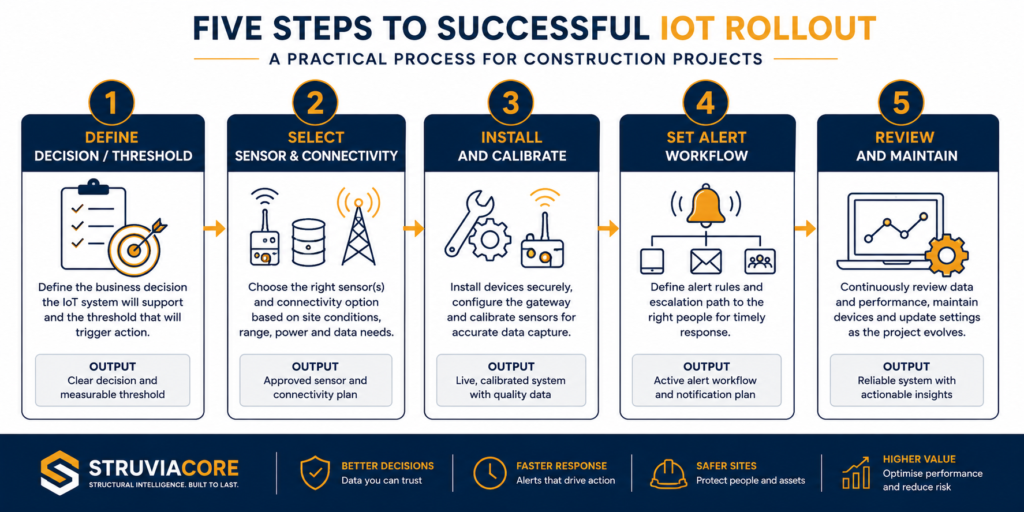
You get the most value from an IoT rollout by treating it as an extension of your monitoring and quality plan, not as a separate technology project bolted on afterward. Start by identifying the specific engineering decisions the data needs to inform — a settlement trigger for underpinning works, a load limit for a temporary structure, a dust threshold tied to a NESREA compliance report — before you select hardware. Once you know the decision, you can size the sensor network, connectivity, and alert thresholds around it rather than around a vendor’s standard package.
- Define trigger thresholds with the design engineer before installation, not after the first alert fires.
- Specify IP65 or higher enclosures for any sensor exposed to Lagos or Port Harcourt humidity, and dust-rated units for Harmattan-affected sites.
- Budget for battery or solar backup at every gateway, sized for at least 72 hours of grid outage.
- Build a quarterly calibration schedule into the maintenance contract from day one.
- Assign a named engineer to review dashboard data on a set schedule — an unmonitored dashboard is no better than no sensor at all.
- Confirm the platform’s data retention and access policy against NDPA 2023 requirements before you connect any device that tracks worker location.
- Pair continuous sensor coverage with periodic drone inspections for defects a fixed sensor cannot detect directly, such as surface spalling or corrosion staining.
Where a project also uses construction robotics or autonomous plant, integrate the IoT platform with that equipment’s control system early in the design rather than as a later add-on — a crane’s load sensors and a robotic rebar-tying unit both generate data that is far more useful cross-referenced on a single dashboard than reviewed on separate screens by separate teams. Scheduling drone flights against the same interval as your sensor calibration visits keeps both data streams current without doubling the number of site visits your monitoring programme requires.
Frequently Asked Questions About IoT
Q: What is IoT in civil engineering?
A: IoT in civil engineering refers to networked sensors and connected devices — strain gauges, accelerometers, tiltmeters, GPS trackers — fitted to structures, plant, or sites to collect real-time data. Engineers use that data for structural health monitoring, fleet management, and safety compliance rather than relying only on periodic manual inspection.
Q: How does IoT structural monitoring work on an existing building?
A: Sensors such as tiltmeters and crack monitors are fixed to the structure at points identified by the structural engineer, usually where prior settlement or cracking has been observed. Readings transmit to a platform at set intervals, and the system flags any reading that crosses the threshold the engineer defined during commissioning, prompting a physical inspection.
Q: What connectivity does construction IoT use in areas with weak cellular coverage?
A: Sites outside reliable cellular coverage typically use LoRaWAN or another LPWA protocol for short-to-medium range sensor links back to a site gateway, with the gateway itself relaying data via satellite backhaul where fixed-line or cellular backhaul is not available. This combination keeps individual sensor power draw low while still reaching a central platform.
Q: How much does IoT deployment cost on a Nigerian construction project?
A: Structural health monitoring points typically cost ₦150,000 to ₦450,000 each, covering hardware, installation, and a year of platform access, while fleet telematics units run ₦60,000 to ₦120,000 per vehicle annually. Actual figures depend on sensor type, site accessibility, and whether the project needs satellite backhaul.
Q: What is the difference between IoT sensors and a digital twin?
A: An IoT sensor is a physical device that measures a single condition, such as strain or vibration, and reports that reading. A digital twin is the software model of the structure or asset that ingests readings from many sensors and displays them against the 3D geometry, letting an engineer see live conditions mapped onto the design rather than reviewing raw numbers in isolation.
Q: What is the difference between IoT and structural health monitoring?
A: IoT is the broader technology category — networked sensors and connected devices used across construction for purposes ranging from fleet tracking to environmental compliance. Structural health monitoring (SHM) is one specific IoT application, focused narrowly on tracking a structure’s own condition — strain, tilt, vibration, and cracking — through construction and into its service life.
IoT gives civil and structural engineers a continuous data record where they previously had periodic inspections and best-effort assumptions, whether the application is a strain gauge on a bridge pier, a telematics unit on a mixer truck, or a dust sensor near a residential boundary. The technology adds value only where the design team defines the decision it needs to support before procurement, budgets for Nigeria’s power and connectivity conditions, and keeps calibration and data governance in the maintenance plan rather than as an afterthought. If your practice is scoping an IoT deployment for an active or upcoming project, StruviaCore’s structural engineering team can help you define sensor placement, thresholds, and platform requirements against your project’s actual risk profile — contact us to discuss your site.
Leave a Reply