

A site engineer in Lekki checks a crack that appeared in a retaining wall three months after handover. The as-built drawings are two revisions out of date, the geotechnical report is in a filing cabinet in Abuja, and nobody can say for certain what the soil bearing capacity was at that exact chainage. This is the problem a digital twin is built to solve: a live, data-linked model of a structure that updates as the asset ages, instead of a static drawing set that goes stale the day construction finishes. This digital twins guide explains what the technology actually does on a construction project, how it works technically, what it costs to deploy in West Africa, and how to avoid the mistakes that turn an expensive 3D model into an expensive, unused 3D model.
Digital Twins: Quick Answer
A digital twin is a live digital replica of a physical structure or infrastructure asset, continuously updated with sensor data, inspection records, and operational information. Unlike a static BIM model, it reflects real-time condition and performance. In construction, digital twins support structural health monitoring, maintenance scheduling, and design validation across the asset lifecycle, from design through demolition.
What Is a Digital Twin in Construction?
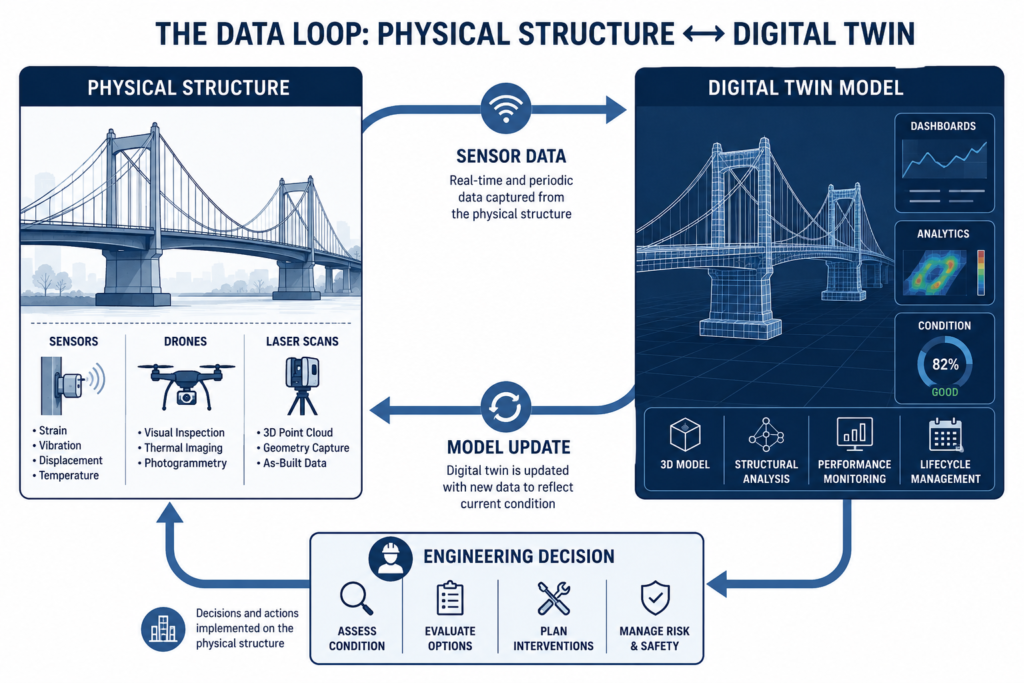
A digital twin is a live digital replica of a physical asset, kept synchronised with that asset through continuous data feeds rather than a one-time export. That distinction matters more than most introductions to the topic admit. A Revit or ArchiCAD model produced during design is a static representation: accurate on the day it is issued, and progressively wrong as the building is value-engineered, as contractors substitute materials, and as the structure settles, weathers, and gets modified over its service life. A digital twin closes that gap by linking the model to sensors, inspection data, and operational records so the digital version tracks the physical one.
The concept did not originate in construction. NASA used twinned physical and digital systems for spacecraft monitoring as early as the Apollo program, and the term was formalised by Michael Grieves at the University of Michigan in 2002 for product lifecycle management. Manufacturing adopted it first, at component and machine scale. The built environment adopted it later and at a much larger scale, because a bridge or a twelve-storey commercial tower generates orders of magnitude more geometric and structural complexity than a jet engine.
For clarity, it helps to separate three terms that get used loosely: a BIM model is the geometric and information-rich 3D representation created during design and construction; a digital twin is that model kept alive with real-world data after handover; and a digital shadow sits in between, where data flows one way from the physical asset to the model without the model feeding decisions back automatically. Most projects in Nigeria today, where digital twin adoption exists at all, are running digital shadows rather than full twins, and that is a reasonable starting point rather than a failure.
Digital Twin vs. Traditional 3D Model
A traditional 3D model, even a well-developed one produced to building information modelling standards, is a design and coordination tool. It answers “what was designed” and, if maintained through construction, “what was built.” A digital twin answers a different question: “what is the current condition, right now, and what is likely to happen next.” That forward-looking, condition-aware function is what separates it from BIM, even though BIM is almost always the geometric foundation a digital twin is built on.
Digital Twin vs. Digital Shadow vs. Digital Model
The three-tier distinction (digital model, digital shadow, digital twin) comes from manufacturing literature and maps cleanly onto construction. A digital model has no automated data connection in either direction. A digital shadow receives automatic updates from the physical asset but does not push changes back. A full digital twin has bidirectional flow: sensor data updates the model, and the model’s analysis (a predicted overload condition, for example) can trigger an automated alert or even an automated response, such as closing a lane on a bridge before a structural engineer has manually reviewed the data.
How Digital Twins Work: Technology and Data Flow
A construction digital twin is not a single piece of software. It is a stack of five components working together, and understanding each layer is what allows an engineer to specify a system that fits the project rather than buying an off-the-shelf platform that promises more than the data infrastructure can support.
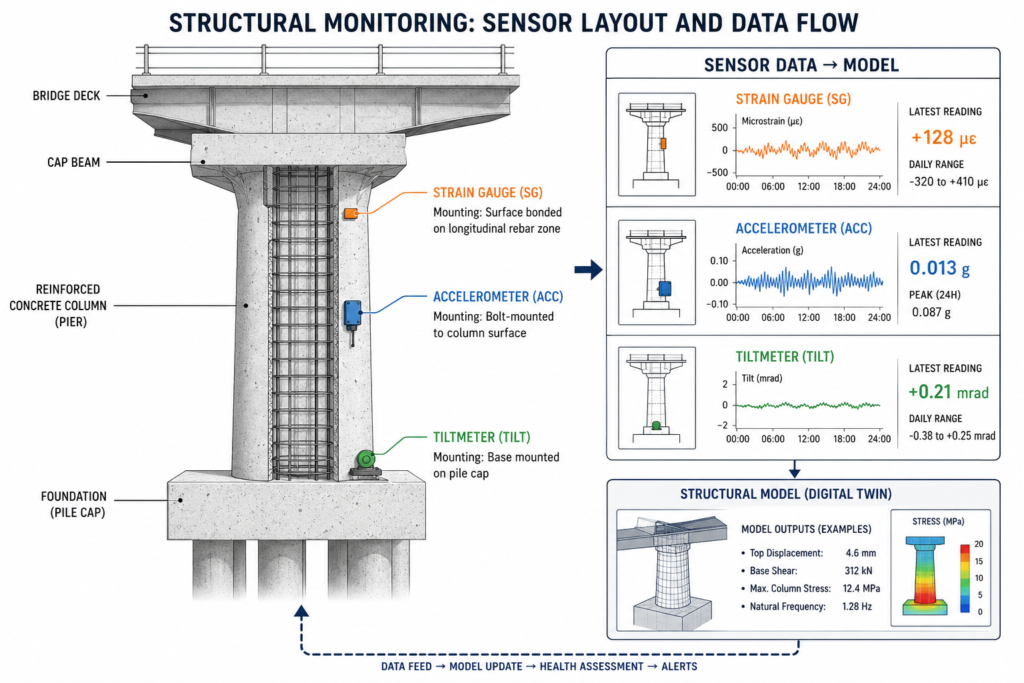
The first layer is data capture. This includes structural sensors (strain gauges, accelerometers, tiltmeters, vibrating wire piezometers for pore pressure in geotechnical applications), laser scanning and photogrammetry for geometric capture, and increasingly, IoT-enabled monitoring devices that report continuously rather than at scheduled inspection intervals. The second layer is the data pipeline: the network and protocols (commonly MQTT or OPC-UA for industrial sensor networks) that move readings from site to server without loss or excessive latency. The third layer is the model itself, typically built on an IFC-compliant BIM foundation so the geometric and material data is interoperable across software vendors, following the ISO 19650 information management framework. The fourth layer is the analytics engine, which compares live readings against design assumptions and flags deviation. The fifth layer is the interface, the dashboard an engineer or asset manager actually uses to make decisions.
Structural digital twins draw heavily on an existing discipline: structural health monitoring. What digital twin platforms add is not the sensors themselves but the ability to run those readings against a live structural model in near real time, rather than exporting data to a spreadsheet for manual review weeks later. ISO 23247, published in 2021, provides a reference architecture for digital twin manufacturing frameworks, and construction-specific standards bodies, including buildingSMART, have extended similar interoperability principles to the built environment through IFC 4.3, which added infrastructure elements such as bridges, roads, and rail alignments.
Real-Time vs. Periodic Digital Twins
Not every digital twin needs to update in real time, and specifying continuous monitoring where periodic capture would do is one of the most common cost mistakes on a project. A real-time twin, updating every few seconds, makes sense for a long-span bridge where wind loading and traffic-induced vibration change constantly and where an early warning of unusual behaviour has genuine safety value. A periodic twin, updated through quarterly laser scans and manual inspection uploads, is usually sufficient for a commercial building where the primary use case is facilities management, maintenance scheduling, and renovation planning rather than structural safety monitoring.
Digital Twins in the Nigerian and West African Construction Context
Deployment in Nigeria is still early, but it is not theoretical. Lagos and Abuja have both seen digital twin pilots on large commercial and infrastructure projects, generally led by international consultants working alongside local structural engineering teams, and the Lagos State Building Control Agency has shown increasing interest in structural monitoring data as part of post-occupancy compliance following high-profile building collapses. COREN does not yet issue specific guidance on digital twin monitoring for structural certification, but the underlying structural health monitoring practice fits within existing COREN requirements for periodic structural assessment of buildings, particularly under the Building Collapse Prevention Guild’s recommendations following the 2021 Ikoyi collapse.
The practical constraint in most Nigerian deployments is not appetite but infrastructure. Continuous sensor data depends on reliable connectivity and power, and a site in Port Harcourt or a remote highway alignment in the North East cannot assume either. This is why the digital shadow model, periodic data capture rather than continuous streaming, tends to be the realistic entry point for Nigerian projects: a monthly drone survey combined with quarterly structural inspection data uploaded manually, rather than a fully wired sensor network requiring uninterrupted 4G or fibre connectivity.
Geotechnical conditions typical to Lagos, particularly the soft marine clays and reclaimed land common along the Lekki-Epe corridor, make settlement monitoring one of the highest-value early applications of digital twin thinking, even at the digital shadow level. A model that tracks settlement readings against the original geotechnical report’s predicted consolidation curve gives an engineer an early, quantified signal of differential settlement, well before visible cracking appears in finishes.
Challenges and Cost Factors in Digital Twin Adoption
The most frequent failure mode is not technical. It is organisational: a digital twin gets commissioned, populated with an initial data capture, and then abandoned because nobody owns the ongoing data pipeline. A digital twin is only as current as its last update, and a stale twin is worse than no twin, because it creates false confidence in outdated information.
Cost varies widely depending on scope. For a single mid-rise commercial building in Lagos, a digital shadow built on an existing BIM model, populated with quarterly laser scans and basic structural sensors on critical elements, typically runs from a few million to low tens of millions of naira in setup cost, with ongoing data management as the larger long-term expense rather than the initial sensor hardware. For a bridge or major infrastructure asset requiring continuous monitoring, real-time sensor networks, and a dedicated analytics dashboard, project costs scale into the equivalent of a significant consulting engagement, often justified by the avoided cost of unplanned closures or emergency repairs on a strategic asset.
Several specific challenges recur across projects:
- Data ownership disputes between client, contractor, and digital twin vendor over who controls the live model after handover, which should be resolved contractually before the platform is selected, not after.
- Legacy asset gaps, where a building constructed before digital twin adoption has no as-built BIM model to twin from, requiring a full re-survey and model reconstruction before any monitoring can begin.
- Sensor calibration drift over time, which without a maintenance schedule produces readings that quietly diverge from actual structural behaviour.
- Connectivity and power reliability on sites outside major urban centres, which pushes many Nigerian projects toward periodic rather than continuous data capture.
- Skills availability, since interpreting digital twin analytics output requires a structural engineer who understands both the underlying engineering and the platform’s data model, a combination still relatively scarce in the local market.
Best Practices for Implementing Digital Twins
You do not need a full real-time sensor network to get value from digital twin thinking. Start with the data you already have, and build outward.
A Practical Implementation Sequence
- Confirm the BIM model exists and is IFC-compliant before specifying any monitoring layer; a digital twin without an accurate geometric foundation produces analytics you cannot trust.
- Define the decision the twin needs to support before selecting sensors. Settlement monitoring, vibration monitoring, and energy performance monitoring each require different sensor types and update frequencies.
- Assign data ownership and update responsibility in the contract, naming the party responsible for keeping the twin current after practical completion.
- Start with a digital shadow (periodic capture) rather than a full real-time twin unless the asset’s risk profile specifically justifies continuous monitoring.
- Set a sensor calibration and maintenance schedule from day one, not as an afterthought once readings start looking inconsistent.
- Budget for the data platform’s ongoing cost, not just the initial hardware and modelling cost; this is where most digital twin budgets are underestimated.
For structural teams already producing detailed foundation design documentation and geotechnical reports, the incremental step to a basic settlement-monitoring digital shadow is smaller than it appears. The geotechnical predictions already exist; a digital twin simply gives you a live comparison against them instead of waiting for a five-year post-occupancy inspection to find out whether the prediction held.

Frequently Asked Questions About Digital Twins
Q: What is a digital twin in civil engineering?
A: A digital twin in civil engineering is a live digital replica of a structure or infrastructure asset, continuously updated with sensor data, inspection records, and condition information. It differs from a standard BIM model because it reflects real-time or near-real-time asset condition rather than a fixed design snapshot.
Q: How does a digital twin work on a construction project?
A: It works through a five-layer stack: sensors and scanning capture physical data, a network transmits it, an IFC-compliant BIM model provides the geometric base, an analytics engine compares live readings against design assumptions, and a dashboard presents the results to engineers. Update frequency ranges from real-time streaming to quarterly manual capture, depending on the asset’s risk profile.
Q: How much does a digital twin cost for a building in Nigeria?
A: A basic digital shadow for a mid-rise commercial building, built from an existing BIM model with quarterly scans and limited structural sensors, typically costs a few million to low tens of millions of naira to set up, with data management as the main ongoing cost. Full real-time monitoring on major infrastructure assets costs significantly more and scales with sensor density and network complexity.
Q: What is the difference between a digital twin and a digital shadow?
A: A digital shadow receives automatic data updates from the physical asset but does not feed information back to trigger automated decisions; a full digital twin has bidirectional data flow, where model analysis can trigger alerts or automated responses. Most Nigerian construction projects currently operate at the digital shadow level due to connectivity and infrastructure constraints.
Q: Do I need a digital twin if I already have a BIM model?
A: A BIM model alone becomes progressively less accurate after handover as the structure ages, is modified, or settles, so it does not answer questions about current condition. A digital twin extends that BIM model into the operational phase by keeping it synchronised with real-world data, making the two complementary rather than interchangeable.
A digital twin is not a luxury add-on to a construction project; it is a live answer to a question every asset owner eventually has to face: what is the actual condition of this structure, right now. This digital twins guide has covered the technical stack behind that answer, the realistic entry point for Nigerian projects through digital shadows rather than full real-time monitoring, and the cost and organisational factors that determine whether a digital twin delivers value or becomes an expensive, unmaintained model. Start with the data you already have from your BIM model and geotechnical reports, define the specific decision you need the twin to support, and build outward from there. If you are planning a digital twin or structural monitoring strategy for an active or upcoming project, StruviaCore’s structural engineering team can help you scope a system that matches your asset’s actual risk profile and your site’s infrastructure realities.
Leave a Reply