
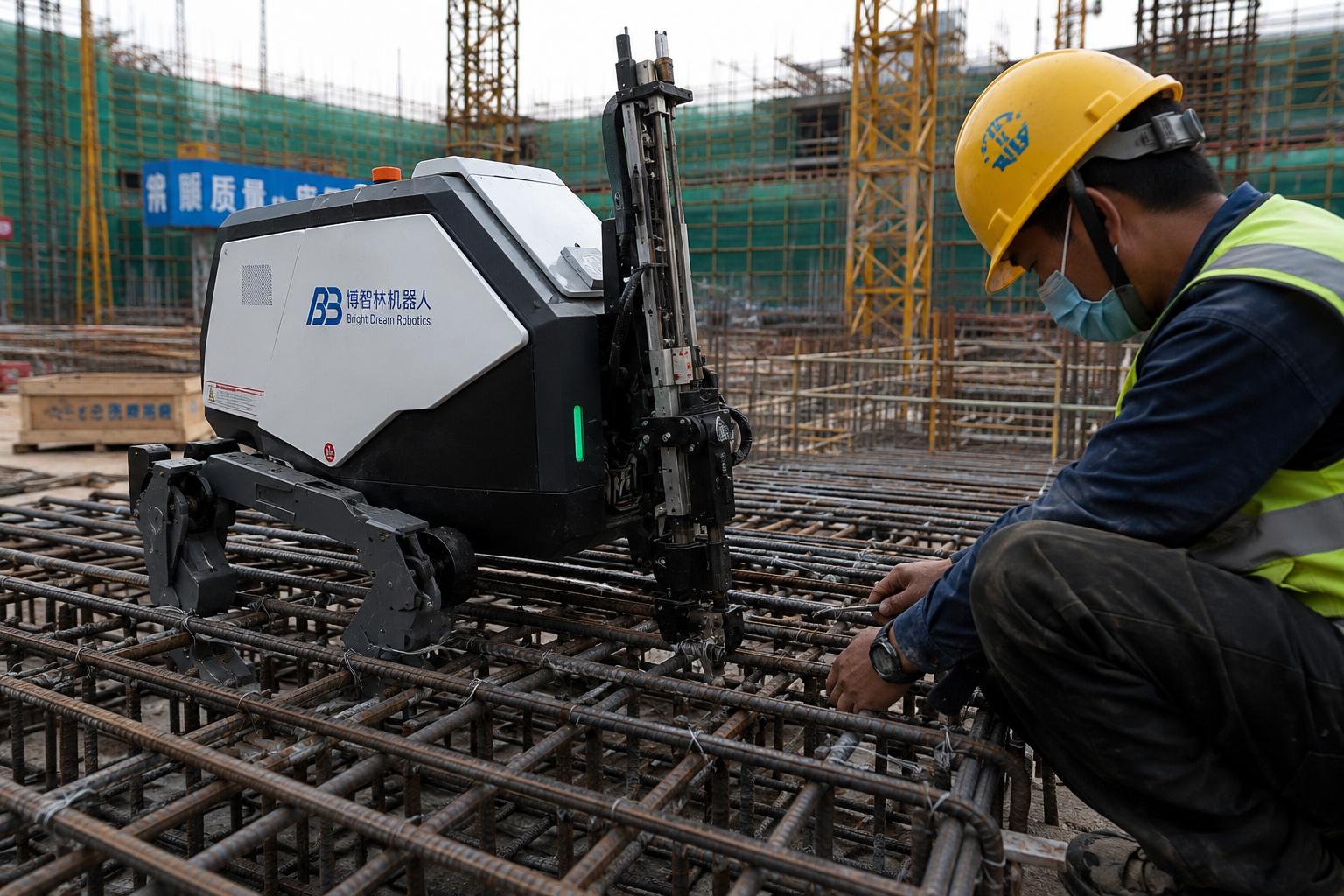
A site foreman in Lagos watches two steel fixers spend a full day hand-tying a single rebar cage for a transfer beam, while three more cages wait in the yard and the pour date does not move. The bottleneck is not concrete supply or crane availability — it is skilled labour. Across the UK, the UAE, and Nigeria, contractors are hitting the same wall: ageing trade skills, rising day rates, and programmes that no longer tolerate a two-week gap between design sign-off and steel fixing on site. Construction robotics did not emerge from a fascination with machines. It emerged from exactly this kind of bottleneck, where one narrow, repetitive task eats days a project cannot spare.
What follows sets out what construction robotics actually covers on a live site, how the systems work, where UK, UAE, and Nigerian contractors are already using construction robotics, what adoption costs, and how to run a first pilot without disrupting your programme. If you specify, manage, or sign off construction methods, this is the practical layer beneath the headlines about robots on site.
Construction Robotics: Quick Answer
Construction robotics is the use of programmable, sensor-guided machines — robotic arms, mobile platforms, and retrofitted heavy equipment — to carry out repetitive or hazardous construction tasks such as bricklaying, rebar tying, excavation, and site scanning. Systems typically execute BIM-derived instructions under ISO 10218:2025 safety requirements, working alongside human crews rather than replacing them outright.

What Is Construction Robotics? Core Concept and Key Categories
Construction robotics refers to programmable physical machines — fixed-base arms, wheeled or tracked mobile platforms, and retrofitted heavy equipment — that carry out defined construction tasks with minimal continuous human input. A system in this category combines three layers: a mechanical platform (the arm, chassis, or attachment), a sensing and control layer (cameras, LiDAR, inertial sensors, and an onboard controller), and a task-specific end effector — a trowel, a rebar-tying head, a print nozzle, a demolition breaker. Remove any one layer and what remains is a static machine, not a robot.
It helps to separate construction robotics from the wider category of construction automation. Automation covers any system that reduces manual decision-making — scheduling software, automated concrete batching, sensor-triggered ventilation control. Construction robotics is the subset of automation that moves and acts in physical space. Every construction robot is an automation tool; not every automation tool is a robot.
On a live project, construction robotics shows up at four points in the programme: substructure and groundworks (autonomous compaction and excavation retrofits), superstructure (bricklaying, rebar tying, structural steel positioning), finishes and MEP (drylining, painting, conduit routing), and site intelligence (reality capture, progress tracking, defect detection). Some construction robotics systems are teleoperated, with a technician driving the machine remotely through a task too repetitive or hazardous to perform by hand. Others run semi-autonomously inside a defined work cell, following a pre-loaded path and stopping the instant a sensor detects an unplanned obstruction.
None of this replaces the site team. A rebar-tying robot still needs a steel fixer to place and align the cage before it ties; a bricklaying robot still needs a mason to point, cut, and finish corners the machine cannot reach. The realistic framing — and the one this guide uses throughout — is that construction robotics extends a smaller crew’s output on narrow, repetitive, high-volume tasks. It does not substitute for supervision, judgement, or trade skill.
How Construction Robots Work: Systems, Sensors and Standards
Understanding construction robotics on a technical level starts with three questions every system has to answer: where am I, what do I do next, and how do I stop safely if something changes. The first is answered by localisation — LiDAR scanning, photogrammetry, or fixed site beacons that place the machine within a few millimetres of its intended position. The second is answered by the control architecture, which ranges from full teleoperation to supervised autonomy, where the robot executes a pre-approved sequence and flags exceptions to a human operator rather than acting on them alone. The third — the safety question — is where ISO 10218-1:2025 and ISO 10218-2:2025 now sit. The revised standard, published after an eight-year review process, folded the former collaborative-robot guidance in ISO/TS 15066 directly into Part 2, giving integrators one document that covers robot design and safe integration into a work cell, including the protective-stop and speed-monitoring functions that let a robot share space with a person.
Core Components: Sensors, End Effectors and Control Systems
Strip any construction robot down and the same three subsystems appear. The sensing suite typically pairs LiDAR or stereo cameras for spatial awareness with an inertial measurement unit for orientation, plus, on collaborative systems, force-torque sensors that detect unexpected contact and trigger a protective stop within milliseconds. The control system runs on a defined duty cycle — teach, verify, execute, log — so every action traces back to an approved instruction rather than an improvised one. The end effector is where construction robotics diverges most from factory robotics: a car-plant arm might keep the same welding gun for years, while a site robot is often reconfigured task by task, from a mortar-dispensing trowel to a rebar-tying head to a demolition breaker.
Categories of Construction Robots in Use Today
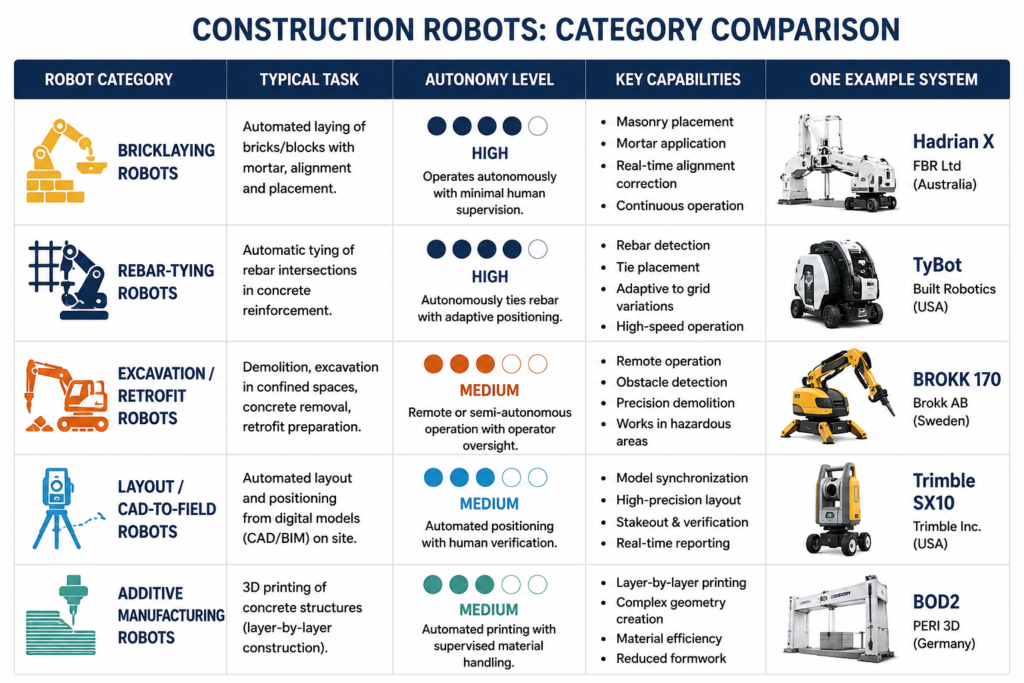
Five categories account for almost all current construction robotics deployments. Bricklaying systems, such as the SAM (Semi-Automated Mason) platform, place courses of brick at a rate no manual crew can sustain over a full shift, though a mason still finishes corners, openings, and closures by hand. Rebar-tying robots, including TyBot and IronBot, automate the tie points on flat rebar mats and bridge decks — a task that is repetitive, physically taxing, and a common source of hand and wrist injury when done manually all day. Excavation-retrofit systems, pioneered by firms like Built Robotics, bolt autonomous guidance onto a standard excavator or dozer, turning existing plant into a robot rather than replacing the fleet. Layout and CAD-to-field robots, such as Hadrian X, translate a BIM-derived 3D model directly into a build sequence, which means a drawing error becomes a construction error at machine speed unless the model is checked before the robot runs. Additive-manufacturing systems extrude a fast-setting, pumpable concrete mix layer by layer to print walls in hours rather than days — a materials question as much as a robotics one, worth reading alongside StruviaCore’s advanced materials guide before specifying a printable mix.
Construction Robotics in Practice: UK, UAE and Nigeria
Global investment in construction robotics tells a specific story. Venture funding into construction-robotics start-ups more than doubled in 2025 against 2024, and industry analysis from Zacua Ventures puts the sector at under 0.03% of global construction spend — a small base, but one where case studies in layout, rebar tying, and reality capture are already showing labour savings of 30–50% and cycle times 15–25% faster on the specific scopes involved. That pattern holds across StruviaCore’s three core markets, though each is adopting construction robotics at a different pace and through a different regulatory route.
United Kingdom: Regulatory Clarity Catching Up With Site Reality
The UK ranks 24th globally for industrial robot density — about half the EU average — despite hosting some of the world’s leading academic robotics research. Industry estimates suggest 15–20% of automation enquiries stall simply because buyers are unsure how existing law applies to a robot on site. That gap is starting to close: in June 2026, the Health and Safety Executive launched a joint project with the Regulatory Innovation Office, Automate UK, and the Manufacturing Technology Centre to produce the UK’s first dedicated guidance on collaborative robots, with the first phase covering cobot compliance due later in 2026. Until that guidance lands, construction robotics on a UK site is governed indirectly, through the Health and Safety at Work etc. Act 1974, the Provision and Use of Work Equipment Regulations 1998, and CDM 2015 — frameworks written for conventional plant, not autonomous decision-making. Contractors including Tilbury Douglas and McLaren are already trialling site robots for rebar and monitoring tasks, capturing 360-degree imagery and point-cloud data that feed straight into a project’s digital twin and its Building Safety Act 2022 golden-thread record, rather than sitting in a separate app nobody opens after handover.
United Arab Emirates: Government-Led Industrial Scale-Up
The UAE is building construction robotics adoption from the top down. Dubai’s Robotics and Automation Programme targets 200,000 deployed robots and a 9% contribution to Dubai’s GDP by 2032. In January 2026, Dubai Municipality launched a global challenge, run through its 04 ConTech Valley innovation centre at Expo City Dubai and backed by more than 25 technology firms and universities, to deliver the world’s first residential villa built entirely through robotic construction. That sits alongside the Municipality’s 70-70 Strategy with Sobha Realty, which targets 70% of construction moved off-site into factories and 70% of factory output automated by 2030. On live sites, general-purpose robots from FieldAI are now deployed at Majid Al Futtaim’s Ghaf Woods development, and a widely reported Abu Dhabi project used roughly 200 robots to assemble a 15-storey building in under two weeks. Regulatory oversight runs mainly through Dubai Municipality’s project-by-project accreditation of specific systems — it recently accredited China State Construction Engineering Corporation’s modular construction system — rather than through one codified robotics standard, which gives the emirate speed at the cost of a settled rulebook.
Nigeria and West Africa: Early-Stage, High-Potential Adoption
Nigeria’s housing deficit runs into the tens of millions of units, and that gap, more than any labour-cost argument, is what makes speed-focused construction robotics commercially interesting here. Lafarge Africa Plc has run the country’s most concrete trial to date, 3D-printing wall sections for a project near the Sagamu interchange in Ogun State using a lightweight, high-strength cementitious mix. The pan-African firm 14Trees, a joint venture between Holcim and British International Investment, has built affordable 3D-printed housing and schools across Kenya and Malawi and has named Nigeria’s far larger shortfall as a market it intends to enter. A skills base is starting to form behind this: the NITDA Innovation Hub commissioned at Obafemi Awolowo University in May 2026 includes dedicated robotics, AI, and additive-manufacturing labs. Nigeria has no robotics-specific construction code yet, so a project deploying construction robotics today works within COREN’s general engineering practice codes and NESREA’s environmental and safety requirements, applied by extension rather than by dedicated statute — the same regulation-catching-up-to-technology pattern visible in the UK and UAE. Unreliable grid power and patchy broadband remain the sharper practical constraint: most task-specific construction robotics systems run fine on generator or battery power, but continuous remote monitoring and teleoperated systems need connectivity that many sites cannot yet guarantee.
Common Challenges and Cost Factors in Construction Robotics
Cost is rarely the first obstacle contractors expect from construction robotics, and rarely the one that actually stops adoption. Purchase or lease pricing for a task-specific robot varies enormously by application, but the more useful comparison is total cost of ownership against the labour-hours the machine displaces on that specific task — which is why the strongest business cases so far involve narrow, high-repetition tasks rather than general-purpose machines. Robots-as-a-service leasing models are lowering the entry barrier for contractors who are not ready to commit capital to a machine they may only need on two or three projects a year.
Power and connectivity reliability matter more to construction robotics than most feasibility studies assume, particularly outside dense urban sites. A rebar-tying or bricklaying robot running a pre-loaded sequence copes fine on generator power, but a teleoperated system or one streaming point-cloud data to a remote dashboard needs a connection it can depend on for the length of the shift — a real constraint on sites in Nigeria’s secondary cities and a growing consideration even on UK and UAE projects with heavy site traffic competing for bandwidth.
A skills gap sits behind both of these constraints. Running construction robotics safely takes a competent operator, a maintenance route for the machine itself, and a site team that can read its output — none of which a single vendor training day covers. Investment such as the UK’s £40 million robotics adoption hub funding and Nigeria’s new NITDA robotics labs signals that this pipeline is being built, but it remains thin relative to demand today.
Liability is the least resolved factor in construction robotics. No UK, UAE, or Nigerian jurisdiction yet has a dedicated legal framework for autonomous construction equipment, which means responsibility for an error the robot makes, or for a decision made using data the robot captured, still runs through existing plant, work-equipment, and professional-negligence law rather than a purpose-built statute. Before mobilising any construction robotics system, update your site safety method statement and exclusion-zone plan to name the robot specifically — most current RAMS documents were written before autonomous plant was a live possibility on the schedule.
Best Practices for Adopting Construction Robotics on Your Projects
If you are weighing construction robotics for an upcoming project, the sequence below is what separates a pilot that scales from one that quietly gets shelved after month three.
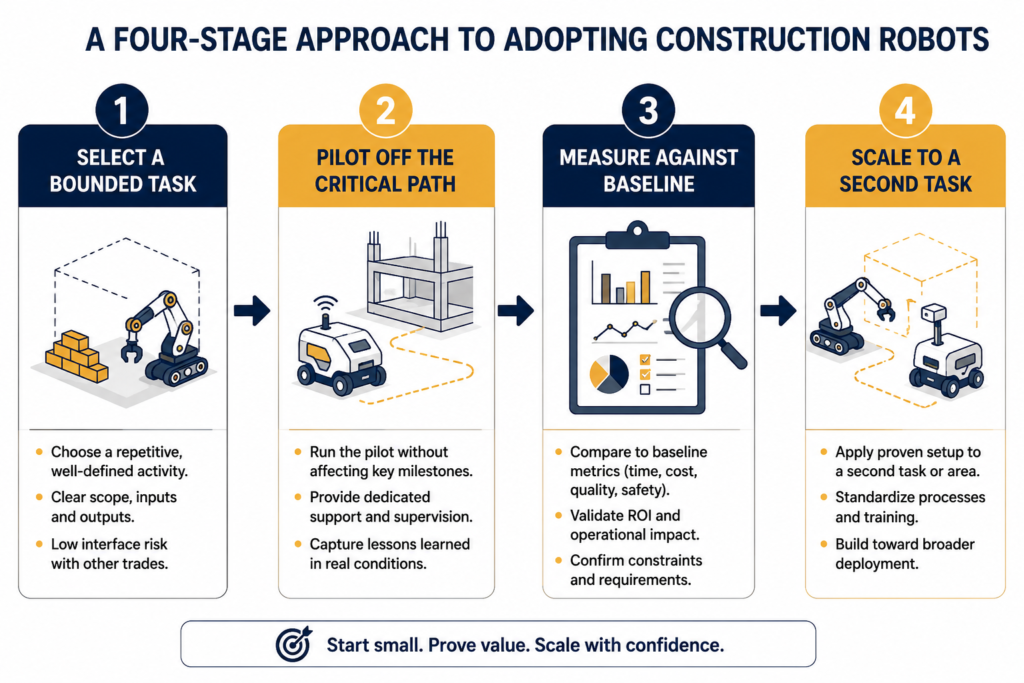
- Start narrow. Pick a single, bounded, high-repetition task for your first construction robotics pilot — rebar tying on a repetitive flat-slab layout, or reality-capture scanning on a multi-storey frame — rather than a general-purpose system you hope will do several jobs adequately. The clearest labour and time savings today come from robots doing one thing extremely well.
- Run the pilot off the critical path. A robot’s first weeks on any new site involve calibration, unexpected obstructions, and a learning curve for your team. Keep that learning curve away from your programme’s critical path.
- Update your documentation before you mobilise, not after. You need a method statement and risk assessment naming the specific robot, its exclusion zone, its stop functions, and the competent person responsible for it — under CDM 2015 in the UK, Dubai Municipality’s permit conditions in the UAE, or COREN’s professional practice requirements in Nigeria.
- Measure against a real baseline. Before you scale construction robotics from one task to a second, capture labour-hours displaced, cycle time, and rework rate on the pilot task against your normal method — not a vendor’s marketing figures.
- Fold the output into your existing workflow. Point-cloud scans and progress logs are only useful once they sit inside your project’s BIM model and reporting structure, not in a standalone app your team checks once and forgets.
Frequently Asked Questions About Robotics
Q: What is construction robotics in civil engineering?
A: Construction robotics is the application of programmable, sensor-guided machines to physical construction tasks — bricklaying, rebar tying, excavation, layout, 3D-printing, and site scanning are the categories in active use today. In civil and structural engineering specifically, construction robotics is applied most often to tasks that are repetitive, dimensionally precise, or physically hazardous when performed manually for a full shift.
Q: How does a construction robot differ from a cobot?
A: A cobot, or collaborative robot, is designed and safety-rated to share workspace with a person without a physical guard fence, following requirements now set out in ISO 10218-2:2025. Conventional construction robotics systems may still need an exclusion zone, a fenced cell, or a trained spotter, depending on speed, payload, and the task performed.
Q: What safety standards apply to construction robots in the UK, UAE, and Nigeria?
A: ISO 10218-1:2025 and ISO 10218-2:2025 form the common technical baseline for construction robotics design and safe integration across all three markets. On top of that, UK deployments sit under PUWER 1998, CDM 2015, and forthcoming HSE cobot guidance; UAE deployments run through Dubai Municipality’s project accreditation process; and Nigerian deployments currently work within COREN’s general engineering practice codes and NESREA’s environmental and safety requirements, since none of the three has published a dedicated construction-robotics statute yet.
Q: How much does construction robotics cost to adopt?
A: Purchase and lease pricing varies too widely by task and manufacturer to quote a single figure, but the economics of construction robotics are increasingly favourable: industry case studies report labour savings of 30–50% and cycle times 15–25% faster on the specific tasks robots handle well. Robots-as-a-service leasing models are also lowering the upfront capital needed to run a first pilot.
Q: Can construction robots operate without stable power or internet access?
A: Most task-specific construction robotics systems — rebar tiers, bricklaying systems, layout robots — run on battery or generator power and execute a pre-loaded sequence without needing a live internet connection. Continuous connectivity matters mainly for teleoperated systems and for robots streaming live monitoring data, which makes power reliability a bigger practical constraint than broadband on many Nigerian sites.
Q: What construction tasks are best suited to robotics today?
A: Bounded, repetitive, high-volume tasks suit construction robotics best: rebar tying, bricklaying, layout marking, and reality-capture scanning are the four categories with the most documented deployments and the clearest measured returns. General-purpose, multi-task robots remain the less proven investment for most contractors in 2026.
Construction robotics rewards discipline, not enthusiasm. The projects seeing genuine labour savings and faster cycle times are the ones that picked one bounded, repetitive task — rebar tying, bricklaying, layout, or site scanning — measured it properly, and only then considered a second application. Regulation in the UK, UAE, and Nigeria is still catching up to construction robotics: HSE’s cobot guidance, Dubai Municipality’s project-by-project accreditation, and COREN’s general engineering codes each cover robots by extension rather than by dedicated statute, which puts the burden of a sound method statement on your design and site team. The fundamentals of structural design, load transfer, and site safety still apply whether a robot executes the work or a crew does — the robot is a tool, not a substitute for the engineering behind it. StruviaCore’s engineers can review a proposed construction robotics method against your project’s structural and regulatory requirements before you commit capital to it.
Leave a Reply