
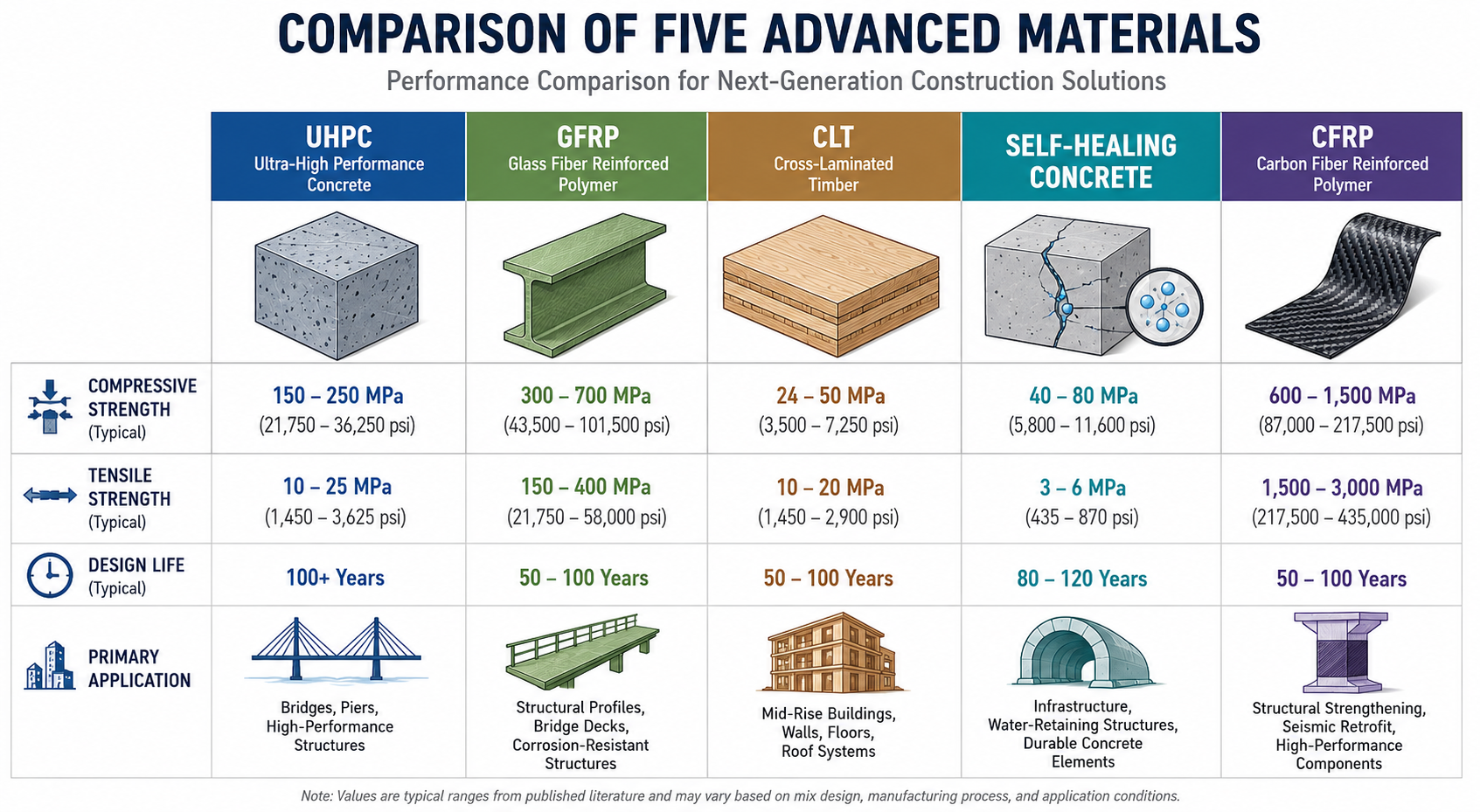
When a contractor on a bridge rehabilitation project asks why the specified repair mortar costs four times more than standard C40 concrete, the answer usually comes down to material science. Advanced materials are not a premium indulgence — they are an engineered response to performance requirements that conventional materials cannot meet. A reinforced concrete deck in a coastal environment may have a 25-year design life before chloride-induced corrosion triggers a major intervention. Specify ultra-high performance concrete or a glass fibre reinforced polymer deck instead, and that same structure could reach 75 to 100 years with minimal maintenance. The cost equation changes entirely.
This article covers the most widely used advanced materials examples in civil and structural engineering — what they are, how they perform, where they are being applied across global projects, and what practitioners need to understand before specifying them.
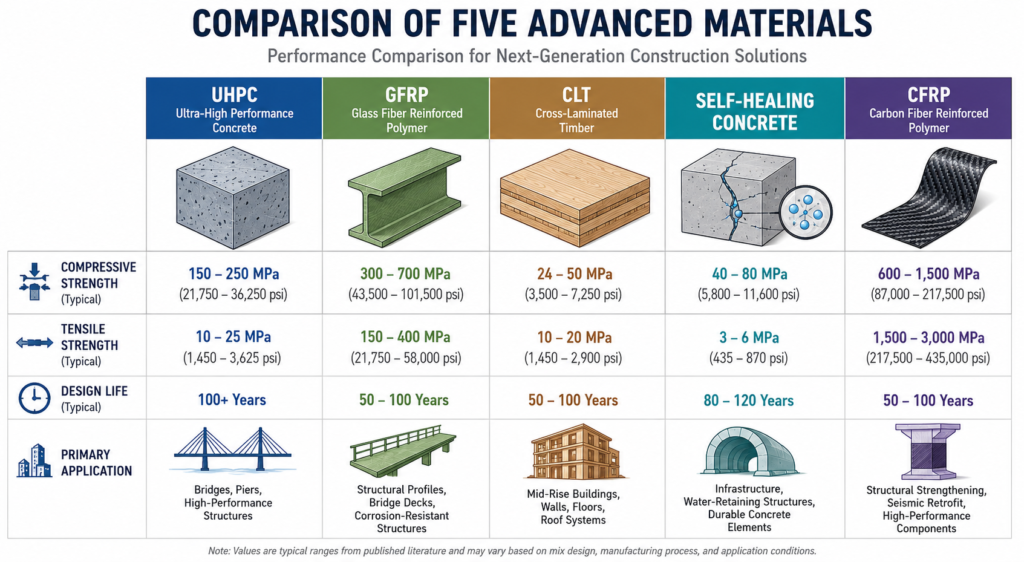
Advanced materials in civil engineering include ultra-high performance concrete (UHPC), glass fibre reinforced polymer (GFRP), cross-laminated timber (CLT), self-healing concrete, and carbon fibre reinforced polymer (CFRP). Each material delivers measurable gains in strength, durability, or sustainability over conventional alternatives, and is selected when standard concrete or steel cannot meet the performance specification.
What Are Advanced Materials in Civil Engineering
Advanced materials are engineering materials engineered or processed to achieve performance characteristics — mechanical, chemical, thermal, or durability-related — that conventional construction materials cannot match at equivalent dosage or section size. The term covers a broad family: fibre-reinforced polymers, high-performance and ultra-high performance concretes, engineered timber products, and materials with autonomous repair capability.
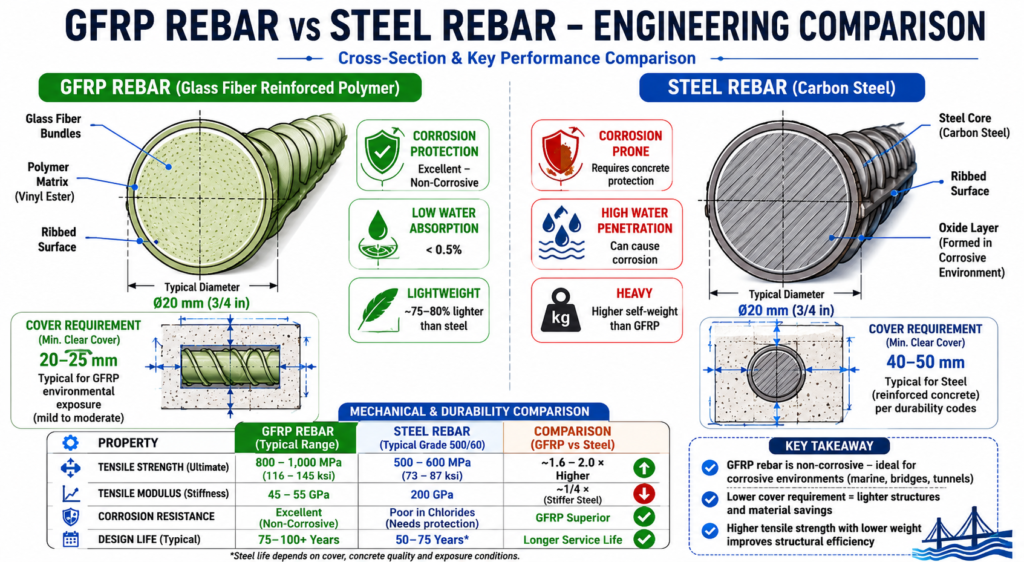
The distinction from standard materials is not merely one of cost. A standard C30/37 concrete mix to BS EN 206 will achieve 30 N/mm² characteristic compressive strength. UHPC, by contrast, reaches compressive strengths of 150 to 200 N/mm² or more, with flexural tensile strengths of 15 to 40 N/mm² — figures that allow radically thinner sections and the elimination of passive reinforcement in some applications. Similarly, a steel reinforcement bar in a marine splash zone will require 75mm of cover concrete to resist chloride ingress over a 60-year design life per BS EN 1992-1-1. A GFRP bar in the same position needs no corrosion cover at all, because the material does not corrode.
What connects all advanced materials examples is this principle: the material is selected because it resolves a specific technical constraint that drives cost, maintenance, or risk in a conventional design. The selection must be evidence-based — informed by material datasheets, independent testing data, and relevant standards such as BS EN 14651 for fibre reinforced concrete, fib Model Code 2020 guidance on FRP, or the UK NHBC Technical Standards and TRADA guidance on CLT.
How Advanced Materials Differ From Conventional Construction Products
Conventional construction materials — reinforced concrete, structural steel, clay brickwork — are mature technologies with well-understood failure modes, extensive code coverage, and a deep supply chain. Advanced materials, by contrast, may have more limited code coverage, require specialist detailing, and demand tighter quality assurance during manufacturing and installation.
That does not make them riskier in practice — it makes the procurement and specification process more demanding. A structural engineer specifying CFRP plate bonding for a beam strengthening scheme under BS EN 1992-1-1 and CIRIA C595 must verify the adhesive bond, the laminate modulus, and the fibre alignment tolerances. The performance outcome — restoring full moment capacity to a deteriorated beam without disturbing the existing structure — is frequently the only viable option on a live rail or highway overbridge, where propping is not permitted and closure costs are prohibitive.
Key Advanced Materials Examples and Their Engineering Applications
The following materials each address a different set of engineering constraints. Understanding where each sits in the performance spectrum is what allows a competent engineer to make the right selection early in the design process, before contractor procurement locks in a specification that may be difficult to change.
Ultra-High Performance Concrete (UHPC)
UHPC is a cement-based composite typically containing Portland cement, silica fume, quartz powder, steel or synthetic fibres, a high-range water reducer, and a water-to-binder ratio below 0.25. The result is a material with compressive strengths in the range of 150 to 250 N/mm², near-zero permeability, and flexural tensile strength high enough to eliminate conventional passive reinforcement in pedestrian bridge deck applications.
In the UK and internationally, UHPC has found its most consistent application in bridge construction and rehabilitation. Thin-shell deck panels of 30 to 50mm — compared to 200mm or more for reinforced concrete — reduce dead load by up to 70%, which either extends the viable span of an existing substructure or reduces the size and cost of new foundations. Designers working under the Eurocodes must currently use the fib Model Code or manufacturer-specific technical approval documentation to justify UHPC properties, as BS EN 1992 does not yet include a dedicated UHPC chapter. The UK National Highways Design Manual for Roads and Bridges (DMRB) and BD 44/15 provide the framework for assessment of existing structures where UHPC repair is used.
Where UHPC delivers the clearest value is in marine and aggressive exposure environments. Its chloride diffusion coefficient — typically below 0.02 × 10⁻¹² m²/s compared to 3 to 8 × 10⁻¹² m²/s for ordinary concrete — makes it the material of choice for jetty decks, coastal retaining walls, and breakwater copings where BS 6349 design lives of 50 to 100 years are specified. For more on how advanced materials intersect with bridge design and maintenance, see the StruviaCore bridges guide.
Glass Fibre Reinforced Polymer (GFRP)
GFRP rebar and structural profiles replace steel in applications where corrosion is the primary design constraint. The material is non-conductive, non-magnetic, and immune to chloride and carbonation-driven corrosion — the two mechanisms responsible for the majority of reinforced concrete infrastructure deterioration in the UK and coastal West Africa.
GFRP rebar has a tensile strength of 600 to 1,000 N/mm² depending on fibre content and resin system, compared to 500 N/mm² for B500B steel. Its elastic modulus, however, is approximately 40 to 50 GPa — roughly one fifth that of steel — which means deflection and crack width control govern design rather than ultimate strength. Engineers specifying GFRP to ACI 440.1R or the more recently published BS EN ISO 10406 series must account for this directly: section depths or fibre volumes typically increase relative to an equivalent steel design to control serviceability limit states.
The economic case for GFRP is most compelling over a whole-life cost analysis. In the UAE, where chloride-contaminated ground and aggressive humidity drive reinforced concrete deterioration within 15 to 20 years on some infrastructure, GFRP-reinforced elements have demonstrated design lives of 75 years with negligible maintenance. In Nigeria, coastal infrastructure in Lagos and Port Harcourt faces similar chloride exposure compounded by variable concrete quality control, making GFRP a technically sound alternative where client risk appetite and procurement capability allow.
Cross-Laminated Timber (CLT)
CLT is an engineered timber panel product manufactured by bonding successive layers of structural timber boards at perpendicular orientations, typically in 3, 5, or 7 plies, to produce a two-way spanning structural element with predictable stiffness and strength properties. Under BS EN 16351 and the associated UK TRADA design guides, CLT panels achieve characteristic bending strengths of 16 to 24 N/mm² depending on grade, with a density of approximately 480 to 500 kg/m³.
CLT’s primary application in civil and structural engineering is in mid-rise residential and commercial buildings, where it serves as floor slabs, shear walls, and roof elements. Its embedded carbon footprint — approximately 200 to 250 kgCO₂e/m³ compared to around 350 to 450 kgCO₂e/m³ for reinforced concrete — makes it highly relevant to projects targeting net-zero operational and embodied carbon, increasingly a contractual requirement on UK public-sector projects under the Government Construction Strategy. For projects pursuing low-carbon construction, the green building guide provides a broader framework for specification decisions.
Fire performance is the most frequently raised concern with CLT. In practice, CLT chars at a predictable rate of approximately 0.65 mm/min per EN 1995-1-2, forming a protective char layer that insulates the residual structural section. A correctly designed CLT element can achieve 60-minute fire resistance without applied protection — a specification outcome that compares favourably with unprotected steel, which typically requires intumescent coating or board protection to reach 60 minutes.
Self-Healing Concrete
Self-healing concrete is a category of engineered cementitious materials capable of autonomously sealing cracks through one of several mechanisms: bacterial calcium carbonate precipitation (biogenic healing), encapsulated healing agents released when a crack propagates, or autogenous healing via continued hydration of unhydrated cement particles in the presence of water.
The bacterial variant — developed commercially from research at Delft University of Technology and now offered by several specialist suppliers — incorporates dormant Bacillus spores and a calcium lactate nutrient source into the concrete mix. When a crack opens and water ingress activates the spores, calcium carbonate precipitates and seals cracks up to 0.8mm wide. Independent testing has demonstrated self-sealing within 28 days of crack formation in controlled conditions. While BS EN 206 does not yet contain a dedicated specification pathway for self-healing concrete, the UK Concrete Society Technical Report TR74 and fib Bulletin 74 provide reference frameworks for specifiers.
The application case is strongest in below-ground and buried infrastructure — water-retaining structures, tunnels, basement slabs — where crack widths in the range of 0.1 to 0.3mm would otherwise require post-construction injection grouting at significant cost and programme disruption. On a typical basement slab or cut-and-cover tunnel box, the premium for self-healing admixtures runs at £15 to £40/m³, against injection grouting costs that frequently reach £80 to £150/m² for each crack treatment cycle. The structural engineering considerations around concrete specification are covered in more depth in the StruviaCore structural engineering guide.
Carbon Fibre Reinforced Polymer (CFRP)
CFRP delivers the highest strength-to-weight ratio of any structural composite in common civil engineering use. Carbon fibre in a high-modulus resin matrix achieves tensile strengths of 1,500 to 3,500 N/mm² and elastic moduli of 150 to 640 GPa — up to three times the stiffness of steel at one fifth the weight. These properties make CFRP the material of choice for structural strengthening schemes where dead load addition is constrained and access is limited.
Externally bonded CFRP plates for flexural strengthening of beams and slabs, and CFRP wraps for column confinement, are now mainstream interventions on UK highway and rail structures. Design under CIRIA C595 and the ICE Manual of Bridge Engineering requires verification of the bond interface between CFRP and substrate — typically tested by pull-off to BS EN 1542 — and assessment of the failure mode hierarchy (preferred: CFRP tensile rupture; avoided: debonding at the FRP-concrete interface). Where an overbridge beam needs its moment capacity increased by 30 to 40% to accommodate increased traffic loading under the current assessment standard BD 44/15, a CFRP strengthening scheme can be designed, installed, and inspected within a single weekend possession, whereas any form of concrete beam replacement would require months of road closure or major works.
Regulatory and Procurement Context for Advanced Materials
Specifying advanced materials requires the engineer to navigate a more complex approval landscape than conventional materials. In the UK, the Building Safety Act 2022 has increased scrutiny of novel construction products, and the Construction Products Regulation (CPR) transition — following the UK’s departure from the EU regime — means that CE marking alone is no longer sufficient proof of compliance for many specialist products. UKCA marking, third-party certification from bodies such as BBA (British Board of Agrément), or product-specific National Technical Approval is increasingly required for FRP and UHPC products used on public-sector projects.
Under the Eurocodes, UHPC design currently falls outside the material coverage of BS EN 1992-1-1:2023 (the revised Eurocode 2, which introduces some high-strength concrete provisions). Designers must supplement the Eurocode with fib Model Code 2020 guidance or manufacturer-supplied design documentation that has been reviewed by the relevant checking authority. On UK highway structures, this requires pre-agreement with National Highways or the relevant local authority bridge engineer before design submission.
In Nigeria, advanced material specifications require COREN-registered engineers to take responsibility for any departure from established standards under the COREN Act and the NIS 444 series for cement-based materials. Procurement through the BPP framework for public-sector contracts requires that any novel material specification is supported by technical justification documented in the design basis report. For a practical overview of sustainable material selection within this regulatory context, the sustainable materials guide is a useful companion resource.
Common Specification Errors and Cost Factors
Advanced materials projects fail — or fail to deliver — most often not because of material performance but because of specification errors, procurement mismatches, or installation quality control failures. The following patterns appear repeatedly in forensic reviews of underperforming schemes.
Over-specifying the material. UHPC at £800 to £1,200/m³ is not the right response to a requirement for C40/50 concrete in a low-exposure, sheltered environment. The impulse to specify the highest-performing material available — without a life-cycle cost analysis — inflates project cost without improving the outcome. A rigorous application of BS EN 1990 Annex B for reliability-differentiated design should drive the material selection, not enthusiasm for novel products.
Failing to account for specialist supply chains. UHPC mixes typically require controlled factory or site batching with tight water-to-binder ratio control — a steam-curing regime of 90°C for 48 hours may be specified to achieve full strength development. In Nigeria and across West Africa, this infrastructure may not exist within viable logistics distance of a project site. Specifying a material without confirming the supply chain adds programme and cost risk that can dwarf the material premium.
Ignoring installation tolerances. CFRP bonded plates require substrate preparation to a minimum tensile pull-off strength of 1.5 N/mm² per CIRIA C595, with a carbonation-free, dry substrate. On a live bridge parapet or soffit, achieving and verifying these conditions in a restricted access window is a significant quality risk. The engineer must specify the inspection hold points, not leave them to the contractor’s quality plan.
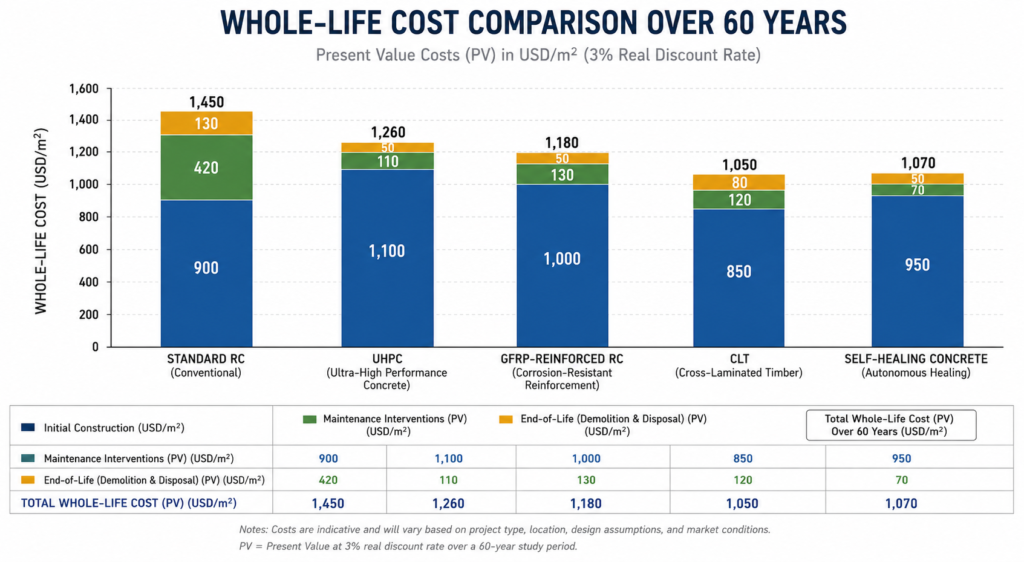
Whole-life cost vs. capital cost tension. Most project clients, particularly in the public sector, face capital budget constraints that make a higher first-cost advanced material specification difficult to justify at gateway review, even when the whole-life saving is demonstrable. Engineers must present the total cost of ownership — initial cost, maintenance cost, end-of-life cost, discounted at an appropriate rate per HM Treasury Green Book methodology — to make the case effectively.
Best Practices for Specifying Advanced Materials
Successful specification of advanced materials follows a sequence that experienced practitioners rarely shortcut. Apply this approach on any project where a departure from standard concrete or steel is under consideration.
Define the performance requirement first. Write the material-neutral performance specification — design life, exposure class per BS EN 206, structural load case, fire resistance period, and sustainability target — before selecting a material family. Let the performance requirement pull the material selection, not the reverse.
Confirm code coverage and approval status. For each candidate material, identify the applicable design standard, check whether the relevant national annex covers the material, and confirm what third-party approval documentation exists. For FRP products in the UK, check the BBA certificate scope. For UHPC on highway structures, contact the National Highways Materials Helpdesk early.
Run a whole-life cost analysis. Use a minimum 60-year appraisal period for infrastructure and 30 years for buildings, applying a 3.5% real discount rate per HM Treasury Green Book. Quantify the maintenance intervention frequency and cost for the conventional and advanced material options. The advanced material will rarely win on initial cost — it must win on total cost.
Specify the supply chain, not just the product. Name the acceptable manufacturing processes, batch testing requirements, and on-site quality control hold points in the specification. For UHPC, specify the curing regime and acceptance testing to ASTM C1856 or equivalent. For GFRP, specify the fibre volume fraction tolerance and the required Certificate of Conformance for each delivery batch.
Build in redundant inspection. Advanced materials used in primary structural roles require more rigorous inspection than standard materials — not because they are less reliable, but because failure modes differ. For bonded CFRP, specify acoustic emission monitoring or thermographic inspection post-installation. For CLT connections, specify a moisture content check at installation and at 12-month post-occupation. The advanced materials guide provides additional reference on inspection and testing frameworks for specialist material types.
Engage the contractor early. On projects using NEC4 or JCT Design and Build contracts, early contractor involvement in material selection — particularly for UHPC and CLT where off-site manufacturing lead times of 10 to 16 weeks are typical — prevents the programme compression that forces substitution decisions under pressure.
Frequently Asked Questions About Advanced Materials
Q: What is the difference between UHPC and high-strength concrete in civil engineering?
A: High-strength concrete (HSC) is generally defined as concrete with a characteristic compressive strength above 50 N/mm² per BS EN 206, typically achieved through low water-to-cement ratios and supplementary cementitious materials. UHPC exceeds this — typically 150 to 250 N/mm² — and includes steel or synthetic fibres that give tensile and flexural performance far beyond HSC. UHPC also has near-zero permeability, making it a fundamentally different material for durability-critical applications rather than simply a stronger version of HSC.
Q: Can GFRP rebar be used as a direct substitute for steel reinforcement?
A: GFRP rebar cannot be directly substituted for steel on a bar-for-bar basis. Its tensile strength is higher than steel, but its elastic modulus is approximately 40 to 50 GPa compared to 200 GPa for steel, meaning deflection and crack width control — not ultimate strength — typically govern the design. Engineers must redesign the section using ACI 440.1R, BS EN ISO 10406, or manufacturer design guides, which generally results in increased bar diameter or spacing adjustment.
Q: How does self-healing concrete work in practice?
A: The most commercially available self-healing concrete uses dormant bacterial spores (typically Bacillus pseudofirmus or similar alkali-tolerant species) suspended in the concrete matrix alongside a calcium lactate nutrient source. When a crack forms and water enters, the spores activate, metabolise the nutrient, and precipitate calcium carbonate crystals that progressively fill the crack. The process typically seals cracks up to 0.8mm wide within 28 days under wet conditions. It does not repair structural damage — it seals micro-cracks before they develop into durability pathways.
Q: How much does UHPC cost compared to standard reinforced concrete in the UK?
A: As of current market pricing, supplied and placed UHPC typically costs £800 to £1,500/m³ depending on mix complexity, curing requirements, and project scale, compared to £120 to £200/m³ for standard C32/40 reinforced concrete. However, section thicknesses in UHPC are often 30 to 60% of equivalent RC sections, and the elimination of passive reinforcement in some applications reduces overall material volume and labour cost. Whole-life cost comparisons over a 60-year design life frequently show UHPC as cost-neutral or cost-positive in aggressive exposure environments.
Q: Are advanced materials suitable for projects in Nigeria or West Africa?
A: Yes, but supply chain and quality control verification are the primary constraints. GFRP rebar and CFRP strengthening systems are available through international suppliers with regional distribution, and the engineering case for their use in chloride-aggressive coastal environments — Lagos, Port Harcourt — is strong. UHPC is less commonly available in-country and typically requires importation of pre-cast elements or specialist batching plant mobilisation, which adds cost. COREN-registered engineers must document the technical justification for any non-standard material specification in the project design basis, in line with NIS standards and COREN’s professional practice guidelines.
Conclusion
Advanced materials examples — UHPC, GFRP, CLT, self-healing concrete, and CFRP — each represent a specific engineering solution to a specific engineering problem. They are not interchangeable, and they are not universally superior to conventional materials. What they share is a measurable, demonstrable performance advantage in the application for which they are designed: compressive and tensile strength well above standard concrete, immunity to corrosion, competitive embodied carbon, or autonomous crack repair.
Specifying them correctly demands that the engineer starts from the performance requirement, confirms the supply chain, applies the correct design standard, and presents the whole-life cost case clearly to the client. When that process is followed rigorously, advanced materials frequently deliver better structural outcomes and lower total project cost than conventional alternatives — particularly in the aggressive exposure environments that characterise coastal West Africa, the Arabian Gulf, and the UK’s ageing infrastructure estate.
If your project involves advanced material specification, structural assessment, or design justification for a novel product, contact StruviaCore to discuss how we can support the technical and procurement process from feasibility through to construction oversight.
Leave a Reply