
A site engineer in Lekki checks a piling rig’s load data on a tablet while a structural model on the same screen updates itself in real time, flagging a deviation between designed and as-built pile depth before the concrete truck arrives. That is not a demonstration reel. It is what a working digital twin does on an active project, and it is why digital twins trends 2026 matter to anyone specifying, building, or maintaining infrastructure this year. Contractors, asset owners, and consultants across Lagos, Abuja, Dubai, and London are moving digital twins from pilot projects into standard practice on mid-size and large jobs.
This piece breaks down what a digital twin actually is, the technology stack behind it, how regulatory bodies like COREN and standards bodies like BSI are responding, where implementation still goes wrong, and a practical adoption checklist you can apply on your next project. It draws on how digital twins are actually specified and used on active civil and structural works, not vendor marketing copy.
Digital Twins Trends 2026: Quick Answer
A digital twin is a live, data-linked virtual replica of a physical asset, updated continuously through sensors, BIM models, and site data. In 2026, the dominant trend is convergence: digital twins are merging with IoT sensor networks, predictive maintenance software, and BIM platforms built on ISO 19650, moving from static 3D visualisation toward operational decision-making tools used daily by site and facilities teams.

What Is a Digital Twin in Construction?
A digital twin is a dynamic digital representation of a physical structure, kept synchronised with that structure through continuous data feeds. This is the definition that separates a digital twin from a rendering or a static BIM export: the model updates as the asset changes, and the asset can, in some setups, respond to insight generated by the model. A pedestrian bridge in Abuja fitted with strain gauges and displacement sensors feeds that data back into its twin every few minutes, so an engineer reviewing deflection under live load does not need to visit site to know something has shifted.
Three characteristics define a genuine digital twin rather than a marketing label attached to a 3D model. First, it carries geometry tied to real coordinates and tolerances, usually inherited from a BIM model built to ISO 19650 information management principles. Second, it ingests live or near-live data from sensors, drones, or laser scans rather than relying on a single as-built survey. Third, it supports a decision — maintenance scheduling, load rating, energy optimisation — rather than existing purely for visualisation. A model missing any of these three is a 3D asset, not a twin.
Digital Twin vs BIM Model
Confusing a digital twin with a BIM model is the most common misstep on Nigerian and Gulf projects adopting this technology for the first time. A BIM model, built in Revit or Civil 3D, is a coordinated design and construction record — geometry, quantities, clash detection, and documentation, largely fixed once the design freezes. A digital twin takes that same geometric base and keeps it alive after handover, layering in occupancy data, structural health monitoring, and operational performance. Put simply: BIM tells you how the building was designed and built; a digital twin tells you how it is behaving right now. Most digital twin programmes in 2026 are built directly on top of existing BIM deliverables rather than starting from scratch, which is why clients increasingly write BIM-to-twin handover requirements into their BIM execution plans at project outset.
How Real-Time Data Feeds the Twin
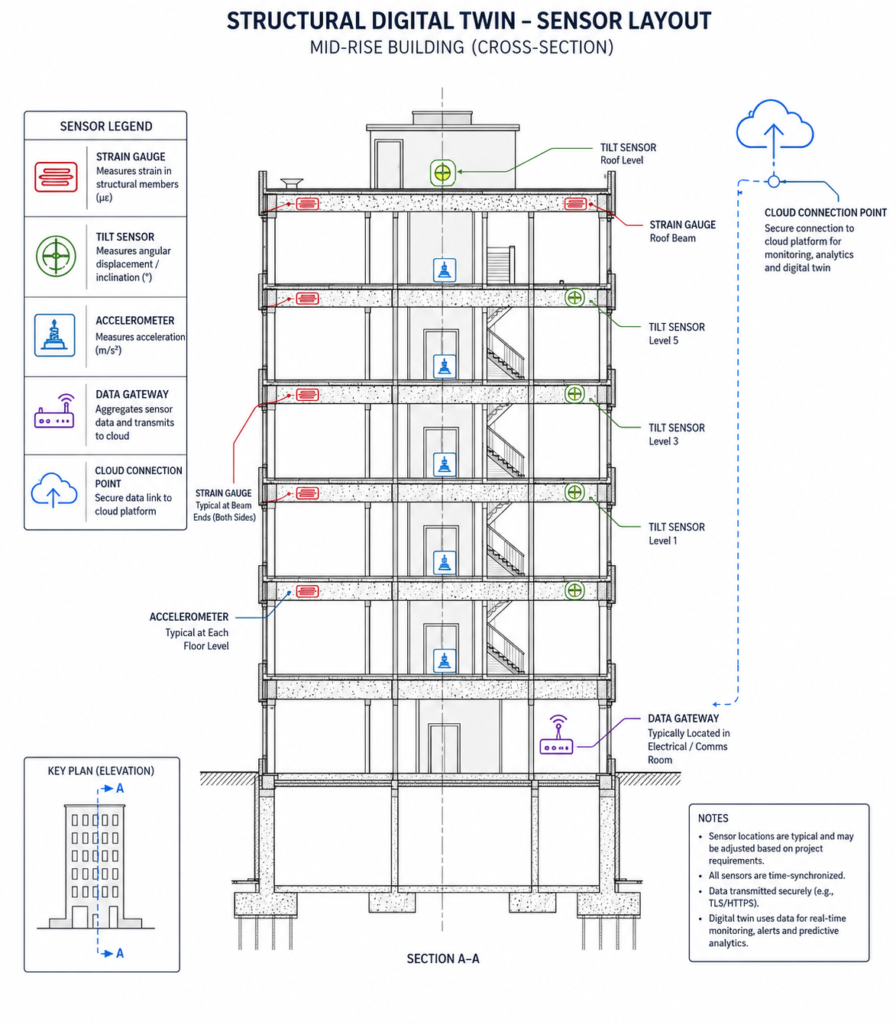
Data reaches a digital twin through four main channels: fixed sensors (strain gauges, accelerometers, tilt meters, thermocouples), mobile capture (drone photogrammetry, terrestrial laser scanning, mobile LiDAR), building management system feeds (HVAC load, energy consumption, occupancy counters), and manual site input logged through mobile forms. Each channel updates the twin on a different cycle — structural sensors might report every 60 seconds during construction, while a full laser scan for progress verification happens weekly. A well-specified twin defines these update intervals explicitly in the project’s information requirements document, rather than leaving data frequency to whichever subcontractor happens to own the sensor package.
The Technology Stack Behind Digital Twins Trends 2026
Four layers make up a working digital twin deployment, and weakness in any one layer undermines the whole system. The sensor layer captures physical data. The connectivity layer moves that data off site. The platform layer stores, models, and visualises it. The analytics layer turns raw numbers into decisions. Understanding these layers matters because most failed digital twin projects fail at the connectivity or analytics layer, not the sensor layer that gets the most budget attention.
IoT Sensors and Data Capture
Internet of Things sensors form the nervous system of any digital twin. On structural applications, the standard sensor package includes vibrating wire strain gauges embedded in concrete during pour, tilt sensors on retaining structures, piezometers for groundwater pressure in geotechnically sensitive sites such as reclaimed land around Lekki and Victoria Island, and accelerometers for dynamic response on bridges and tall buildings. Sensor cost has fallen enough that instrumenting a mid-rise commercial building now runs a modest fraction of the overall structural health monitoring budget it would have five years ago, which is the single biggest driver behind wider adoption outside flagship projects. For a deeper look at sensor selection and network design, see this explanation of IoT fundamentals in construction.
Cloud Platforms and Interoperability
Data is only useful if it moves between systems without manual re-entry, and 2026’s defining shift is away from closed, single-vendor twin platforms toward open, IFC-based data exchange. Projects specifying digital twins now routinely mandate open data formats — Industry Foundation Classes (IFC) for geometry, and open APIs for sensor telemetry — so that the twin is not locked to one software vendor for the life of the asset, often 40 to 60 years for a reinforced concrete structure. This matters commercially: an asset owner who accepts a closed platform at handover can face vendor lock-in costs at every subsequent software refresh. Consultants writing employer’s information requirements in 2026 are building interoperability clauses directly into procurement documents rather than treating them as a technical afterthought.
AI and Predictive Analytics
The analytics layer is where digital twins earn their keep financially. Predictive maintenance models trained on sensor history flag anomalies — a bearing pad showing unusual thermal cycling, a drainage channel silting faster than design assumptions — before they become failures requiring emergency repair. On a water treatment facility in Port Harcourt, a twin fed with pump vibration and flow data can flag bearing wear weeks ahead of failure, turning an unplanned shutdown into a scheduled maintenance window. This is the trend line worth tracking through 2026: digital twins moving from passive monitoring dashboards toward active recommendation engines that tell a facilities manager what to inspect this week, not just what happened last month.
Regional Adoption and Regulatory Context
Digital twin adoption is not uniform across markets, and the regulatory backdrop shapes how fast each region moves. In Nigeria, COREN’s push toward mandatory BIM adoption on public infrastructure projects over a certain contract value is creating the data foundation digital twins depend on — you cannot build a twin on top of 2D CAD drawings and site diaries alone. The Nigerian Industrial Standards (NIS) framework does not yet reference digital twins directly, but structural monitoring requirements under NIS and design practice aligned to BS 8110 and its Eurocode successors give engineers a basis for specifying sensor-based verification on high-risk structures such as bridges over the Niger Delta waterways.
The UK and EU markets are furthest ahead on formal standards, with the BSI-published PAS 1192 lineage evolving into ISO 19650 parts covering information management across the full asset lifecycle, including operational twin data. The UAE’s mandate for BIM on government projects, combined with Dubai Municipality’s digital infrastructure push, has made digital twins close to standard practice on major developments rather than an optional add-on. In each market, the pattern is consistent: digital twin adoption accelerates once BIM mandates create a reliable geometric and data baseline to build the twin on top of. Saudi Arabia’s giga-project pipeline is pushing the same logic further, with master-planned developments specifying twin infrastructure as a design requirement from concept stage rather than retrofitting it once construction is under way, a sequencing that avoids much of the data-baseline rework described later in this article. Engineers working across these markets increasingly reference our explainer on what a digital twin actually is when briefing clients unfamiliar with the distinction from standard BIM deliverables.
Cross-border project teams face a practical complication here: a digital twin specified to UK ISO 19650 data standards does not automatically satisfy a Nigerian client’s local reporting requirements, or vice versa. Structural engineers working on multinational contracting teams need to agree data schema and reporting formats at contract stage, not after the sensor network is already installed and generating data in an incompatible format.
Common Challenges and Cost Factors
Stakeholder buy-in is a fourth challenge, and it is often underestimated relative to the technical hurdles. Site teams accustomed to paper diaries and hand-marked drawings can resist sensor-driven monitoring, particularly when alerts contradict their own judgement of a structure’s condition. Facilities managers inheriting a twin at handover sometimes receive no training on the platform at all, leaving a fully instrumented building running on a dashboard nobody opens after month three. Addressing this requires treating the twin’s handover the same way a design team treats structural handover documentation: with a defined training session, a named responsible party, and a written escalation procedure for alerts, rather than an assumption that intuitive software explains itself.
Digital twin projects run into predictable obstacles, and naming them upfront saves budget arguments later. Data quality is the first and most damaging. A twin built on inconsistent, poorly geo-referenced legacy drawings inherits every one of those errors, and no amount of sensor investment fixes a foundation model that was never accurately surveyed. Retrofitting an existing asset with a digital twin almost always requires a fresh laser scan or drone survey to establish an accurate baseline, adding cost that clients frequently underestimate at proposal stage.
Connectivity is the second recurring problem, particularly on sites outside major Nigerian and Gulf city centres where cellular data coverage is inconsistent. A sensor network that cannot reliably transmit data is worse than no sensor network at all, because it creates false confidence in monitoring coverage that does not actually exist. Projects in areas with unreliable connectivity need edge computing solutions that store and process data locally, syncing to the cloud platform when connectivity allows, rather than assuming constant live transmission.
Cost is the third factor, and it breaks into three components worth separating in any proposal: sensor hardware and installation (typically the smallest line item), software platform licensing (often billed as an annual subscription tied to data volume and user seats), and data management and analytics staffing (frequently the largest ongoing cost and the one clients budget for least). A structural health monitoring package on a mid-size commercial building in Lagos might run a modest capital cost for sensors and installation, with an ongoing annual platform and staffing cost that clients need to plan for across the asset’s operational life, not just at construction handover. Skills shortage compounds this: few structural engineering teams currently have staff trained to interpret twin analytics output, which means training budget belongs in the proposal alongside hardware costs. See our detailed breakdown of common digital twin implementation challenges for a fuller treatment of each obstacle.
Best Practices for Implementing a Digital Twin
You reduce the risk of a stalled or abandoned digital twin project by sequencing implementation correctly rather than buying sensors first and figuring out data strategy later. Follow this order on your next project:
- Define the decision the twin will support before specifying hardware. A twin built to support predictive maintenance needs a different sensor package than one built to verify design assumptions during construction. Write this decision down before approaching vendors.
- Audit your existing data baseline. Check whether your BIM model, as-built drawings, and survey data are accurate and geo-referenced enough to support a live twin. Budget for a fresh scan if they are not.
- Specify open data formats in procurement documents. Require IFC-compliant geometry exchange and open API access to sensor telemetry, so you are not locked into a single software vendor for the asset’s operational life.
- Pilot on a single system before scaling. Instrument one structural element, one floor, or one piece of plant first. Confirm data quality and connectivity work reliably before committing budget to a facility-wide rollout.
- Assign ownership of the analytics output. Decide who reviews twin-generated alerts, on what schedule, and what authority they have to act on them. A twin generating alerts nobody reviews delivers zero value regardless of sensor quality.
- Budget for the full asset lifecycle, not just installation. Include platform subscription costs, sensor calibration and replacement, and staff training in your five-year cost projection, not just the capital cost at handover.

Frequently Asked Questions About Digital Twins
Q: What is a digital twin in civil engineering?
A: A digital twin in civil engineering is a continuously updated virtual model of a physical asset, such as a bridge, building, or pipeline network, that receives live data from sensors, drones, or BIM sources. Unlike a static 3D model, it reflects the current condition of the structure and supports decisions such as maintenance scheduling or load rating.
Q: How does a digital twin work on a construction site?
A: Sensors embedded in structural elements or mounted on plant collect data such as strain, displacement, temperature, and vibration. This data transmits through a gateway to a cloud platform, where it updates a 3D model built from the project’s BIM data, giving site teams a live view of structural performance against design assumptions.
Q: How much does a digital twin cost on a typical project?
A: Costs vary widely by project scale and sensor density, but three components apply on every project: sensor hardware and installation, platform software licensing (usually a recurring annual fee), and data analytics staffing. On a mid-size commercial building, the largest ongoing cost is typically staffing and platform subscription rather than the initial sensor hardware.
Q: What is the difference between a digital twin and BIM?
A: BIM is a coordinated design and construction model used primarily up to project handover, documenting how an asset was designed and built. A digital twin uses that BIM geometry as a starting point but stays live after handover, continuously updated with sensor and operational data to reflect the asset’s current, real-world condition.
Q: Do digital twins require IoT sensors to function?
A: A basic digital twin can operate on periodic data updates from laser scans or drone surveys without permanent IoT sensors, but most 2026 implementations pair the model with IoT sensors for continuous monitoring. Fixed sensors are what allow a twin to move from a periodic snapshot tool to a real-time decision-support system.
Digital twins trends 2026 point toward one clear direction: twins are becoming operational tools rather than visualisation exercises, built on open data standards and integrated tightly with BIM and IoT sensor networks. The projects seeing genuine return are the ones that defined the decision the twin needed to support before buying hardware, and that budgeted for the full data lifecycle rather than just the sensor installation. Whether you are specifying structural health monitoring on a new bridge or planning a retrofit twin for an existing facility, the fundamentals — accurate data baselines, open interoperability, and clear analytics ownership — matter more than any single vendor’s platform. If you are scoping a digital twin strategy for an upcoming project, StruviaCore’s structural and civil engineering team can help you define the right sensor package, data standard, and implementation sequence for your site conditions.
Leave a Reply