
A municipal engineer in Lagos is asked to specify a new drainage network that must also feed real-time flood-sensor data to a control room. A consultant in Dubai is briefed to design a district cooling system that reports its own energy performance to Smart Dubai’s platform. A project manager in Manchester has to fold a 5G small-cell rollout into a highway widening scheme without blowing the utilities budget. All three are wrestling with the same discipline: future cities engineering, where physical infrastructure and digital systems are designed together rather than bolted on afterwards.
This piece sets out the best practices for future cities that hold up on a live construction programme, not just in a masterplan render. It covers the technical building blocks, the regulatory terrain across the UK, UAE, and Nigeria, and the mistakes that turn a promising smart-infrastructure brief into a stalled pilot project.
Future cities: Quick Answer
Future cities are urban areas engineered to integrate digital sensing, data networks, and automated control into core infrastructure such as transport, utilities, and buildings. Best practices for future cities include phased deployment, open data standards such as ISO 37122, resilient connectivity, and clear governance for who owns and maintains the sensor network after handover.
What Is a Future City in Civil Engineering Terms?
Future cities is the term used across the smart-cities cluster for urban development that treats data infrastructure as a utility, on par with water, power, and roads. In practice, this means every major asset — a bridge, a pump station, a substation, a road junction — is specified with embedded sensing and a defined data pathway from day one, rather than retrofitted once the asset is already in service.
This distinguishes a future city from a merely “connected” one. A city can install thousands of CCTV cameras and still not be a future city if none of that data feeds structured decision-making. The defining feature is closed-loop control: sensor data informs an automated or semi-automated response, whether that’s a traffic signal re-timing itself, a pump station adjusting output ahead of forecast rainfall, or a building management system shedding load during a grid constraint event.
How Future Cities Differ from Traditional Smart Utilities Projects
A standalone smart water meter rollout is a smart utilities project. It becomes a future cities initiative when that metering data is exposed through an open API that transport planners, emergency services, and utility companies can all draw from, governed by a shared data standard. The distinction matters for procurement: future cities contracts increasingly specify data interoperability requirements alongside conventional civil and MEP deliverables, and engineers who miss that clause during tender review end up redesigning the SCADA architecture mid-project.
Why This Matters for West African and Gulf Markets
In Lagos and Abuja, future cities investment is being driven largely by flood resilience and traffic congestion rather than by consumer-facing smart-home features. In the UAE, Smart Dubai and Abu Dhabi’s Ghadan 21 programme have pushed future cities requirements into mainstream tender documents for transport and utilities packages, meaning contractors without IoT integration experience are increasingly screened out at prequalification stage.
Core Technologies and Methods Behind Future Cities
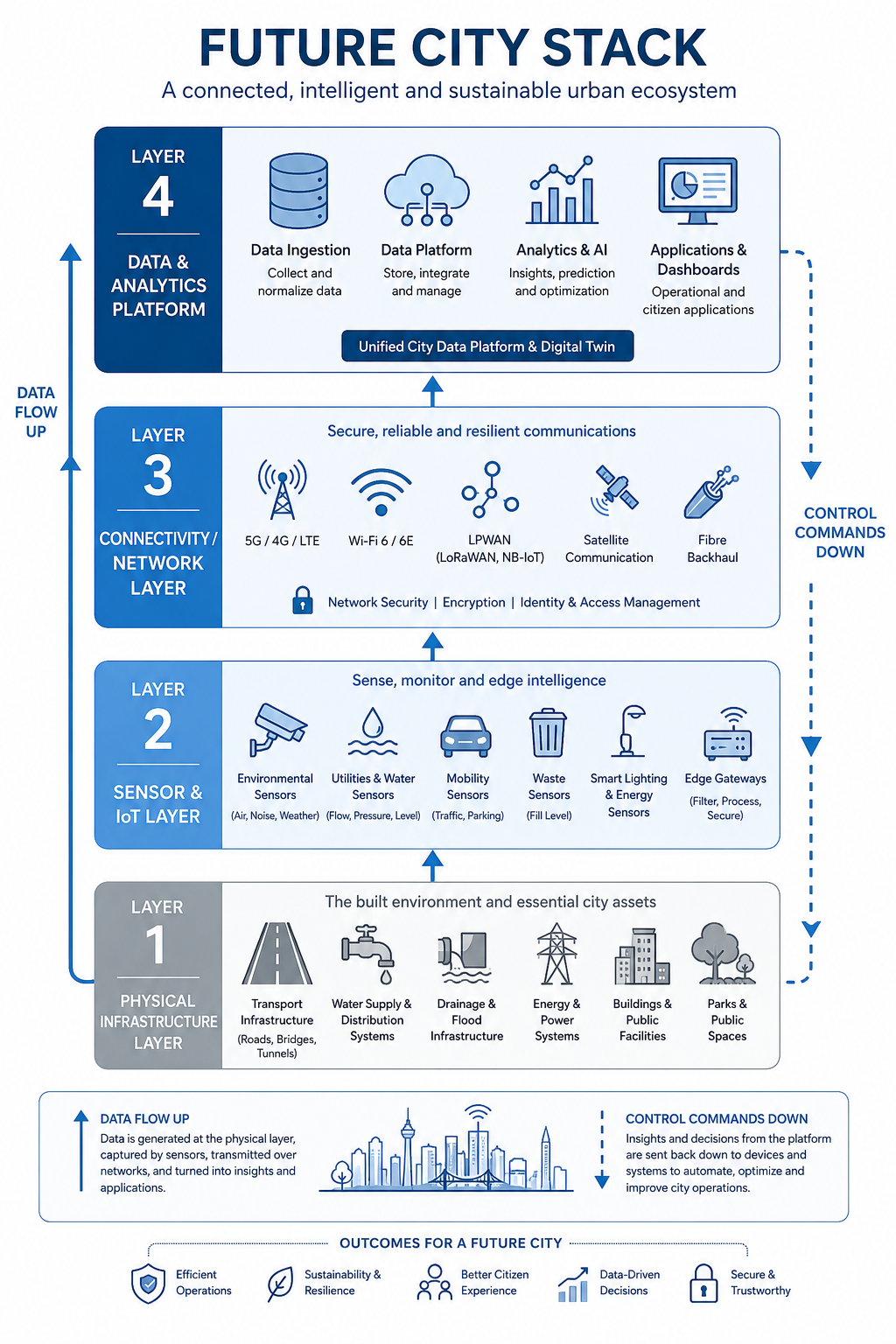
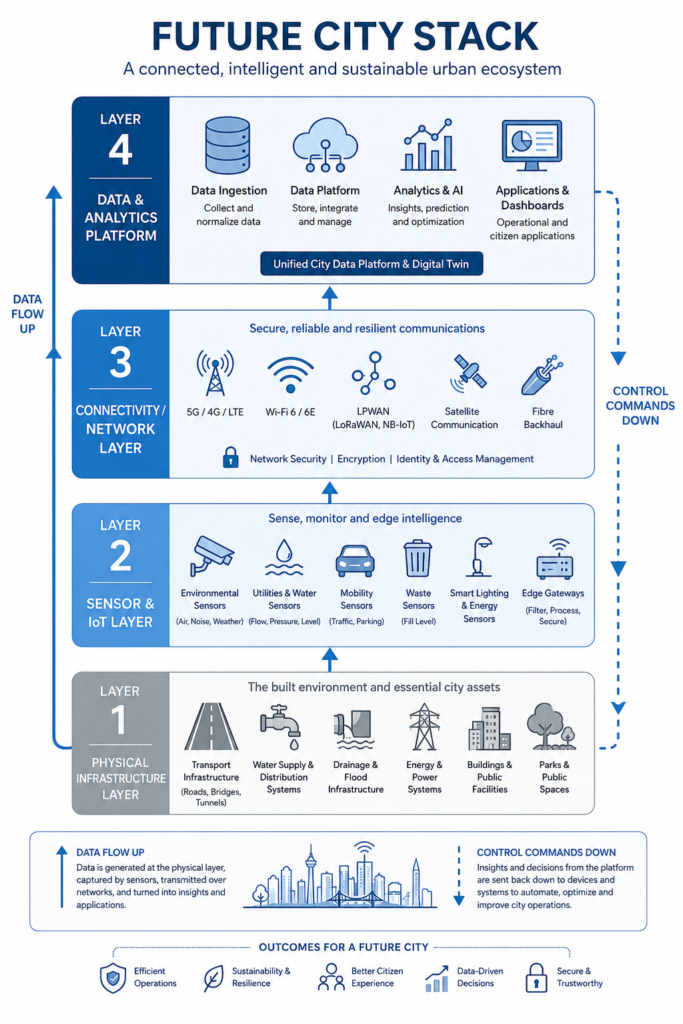
Four technical layers recur across nearly every future cities project, and understanding how they interact determines whether a design survives contact with a real construction programme.
Sensing and IoT Layer
This is the physical instrumentation: water level sensors in drainage culverts, vibration sensors on bridge bearings, air quality monitors on lamp columns, occupancy counters in public buildings. Specify sensor density based on the decision the data will inform, not on what’s cheapest to procure — a flood-warning network needs sensors at every critical pinch point in the drainage catchment, typically at 200–400 metre intervals along primary channels, while a building energy monitoring system can work with far coarser coverage.
Connectivity Layer
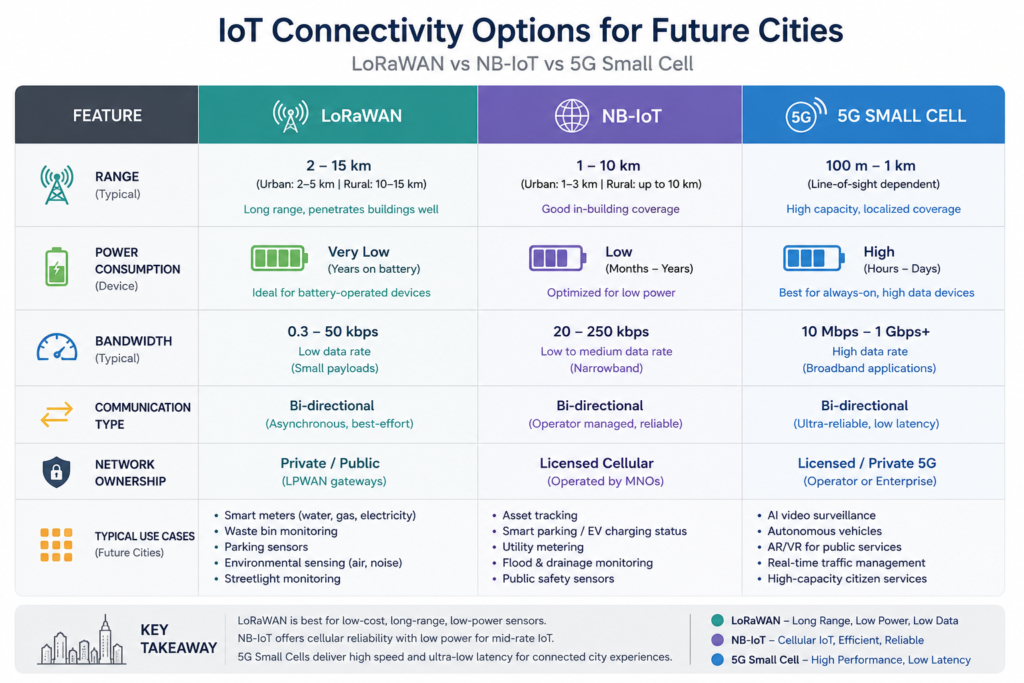
LPWAN protocols such as LoRaWAN and NB-IoT dominate for low-bandwidth, battery-powered sensors because they can run for years on a single cell and tolerate the signal attenuation typical of dense urban cores. High-bandwidth applications — traffic cameras, adaptive lighting with video analytics — need fibre backhaul or 5G small cells. Mixing protocols without a clear network architecture diagram is a common source of scope creep once the M&E contractor discovers gaps during commissioning.
Data Platform and Interoperability
ISO 37120 and ISO 37122 provide the reference indicator sets most future cities platforms are now built against, covering everything from response times for emergency services to the percentage of streetlights that are smart-enabled. Specifying compliance with these standards in the employer’s requirements gives the design team a defensible basis for platform selection and avoids vendor lock-in on proprietary formats that can’t talk to a neighbouring authority’s system.
Governance and Asset Ownership
The layer most frequently left out of the design brief is who owns the data once the contractor demobilises. A drainage sensor network installed under a design-and-build contract needs an operator named before handover — otherwise sensors fail silently within eighteen months because no maintenance budget line exists for calibration and battery replacement.
Regulatory Context: Building Future Cities Across the UK, UAE, and Nigeria
Regulatory obligations for future cities work sit on top of, not instead of, conventional construction law, and engineers who treat smart infrastructure as exempt from standard compliance regimes create real liability exposure.
In the UK, future cities projects remain fully subject to CDM 2015 for health and safety management, and structural elements — sensor gantries, mast foundations, control-room fit-outs — still need to satisfy the relevant Eurocodes, particularly BS EN 1997 for foundation design of lightweight telecoms structures. Data protection sits under UK GDPR, which matters directly for any sensor network capturing footfall or vehicle movement patterns that could identify individuals.
In the UAE, the General Civil Aviation Authority (GCAA) governs airspace clearance for any sensor mast or drone-based monitoring near flight paths, a routine issue for future cities projects near Dubai International or Al Maktoum. Dubai Municipality requires future cities components within its jurisdiction to align with the Smart Dubai data-sharing framework, and building permits for structures housing control equipment follow the same Dubai Municipality building code process as conventional MEP plant rooms.
In Nigeria, COREN registration requirements apply to the structural and civil design of any future cities infrastructure exactly as they would to a conventional building or bridge — a sensor gantry is still a structure requiring a COREN-registered engineer’s sign-off. NESREA environmental compliance becomes relevant where sensor networks support environmental monitoring mandates, and NCAA airspace approval is required for any elevated monitoring equipment near Lagos or Abuja flight corridors, mirroring the UAE’s GCAA process.
Common Challenges and Cost Factors in Future Cities Projects
Three cost drivers dominate future cities budgets, and underestimating any one of them is the most frequent cause of programmes stalling after the pilot phase.
- Retrofitting existing infrastructure costs substantially more than specifying sensors into new-build assets, because cabling routes, power supply, and structural fixings all need to be added into completed structures rather than cast or embedded during construction.
- Long-term data platform licensing is routinely under-budgeted at feasibility stage, since teams price the capital cost of sensors and networks but overlook the recurring subscription cost of the analytics platform that makes the data usable.
- Cybersecurity hardening for operational technology — the SCADA and control systems managing water and traffic infrastructure — adds a specialist cost line that conventional civil engineering budgets rarely include by default.
Beyond cost, the recurring technical challenge is power resilience. A sensor network that fails during a grid outage or flood event — precisely when its data matters most — has failed at its core purpose. Specifying battery backup or solar trickle-charging for critical nodes, particularly flood and structural monitoring sensors, is not optional in markets with unreliable grid supply, which includes large parts of Nigeria’s urban centres.
A second recurring challenge is stakeholder fragmentation. A future cities transport corridor project in Lagos, for example, typically needs coordination across the state Ministry of Works, the utility company relocating services, and the telecoms provider installing 5G infrastructure — three organisations with different procurement timelines that a single project programme has to reconcile.
Best Practices for Future Cities: A Step-by-Step Approach
Apply these steps in sequence when you’re briefed on a future cities component, whether it’s a single smart junction or a full district-scale programme.
- Define the decision, not the dataset. Before specifying any sensor, write down the operational decision it will inform. If you can’t name the decision, the sensor is instrumentation for its own sake and will be first to go when budgets tighten.
- Select connectivity based on data volume and power constraints, not on what the incumbent telecoms contractor already has installed nearby. Match LPWAN to low-frequency readings and reserve fibre or 5G for real-time video and control-critical links.
- Build in interoperability from the tender stage by referencing ISO 37122 indicators and open API requirements in the employer’s requirements document, so platform selection doesn’t lock the client into a single vendor.
- Name the asset owner before handover. Confirm in writing which department or contractor holds the maintenance budget for sensor calibration, battery replacement, and platform licensing renewal.
- Specify power resilience for safety-critical nodes, including flood, structural health, and public safety sensors, with backup power rated for at least 72 hours of autonomous operation.
- Phase the rollout. Pilot a single corridor or district, validate the data pipeline end to end, and only then scale — a citywide rollout that skips the pilot stage tends to surface integration failures across every node simultaneously.
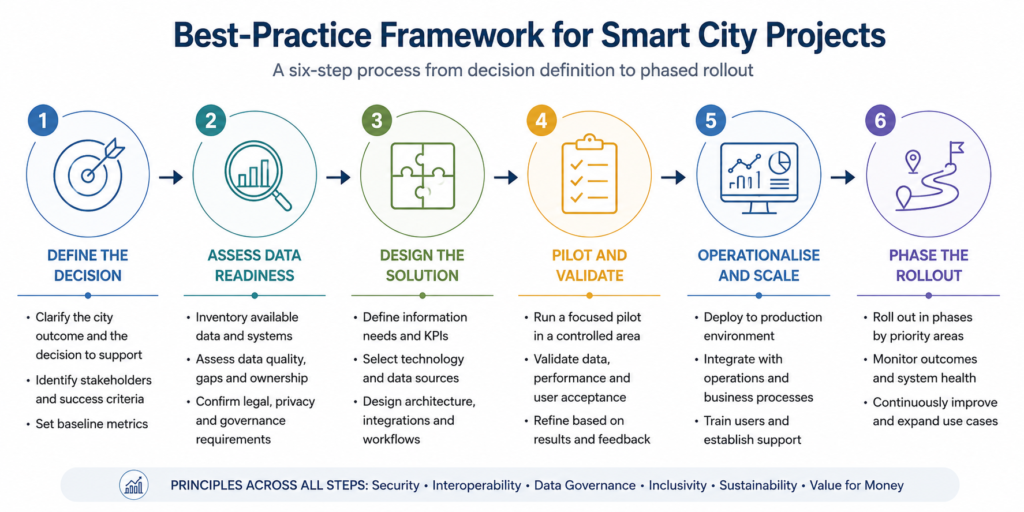
You’ll get the most value from this sequence by walking it through with the client’s operations team before the design freeze, since steps four and five in particular expose budget gaps that are far cheaper to resolve on paper than after installation.
Frequently Asked Questions About Future Cities
Q: What is a future city in civil engineering terms?
A: A future city is an urban development where physical infrastructure — roads, drainage, buildings, utilities — is designed with integrated sensing and data networks from the outset, enabling closed-loop responses such as automated traffic signal timing or predictive flood warnings, rather than data collection with no operational follow-through.
Q: How does a future cities data platform work?
A: Sensors transmit readings over a connectivity layer such as LoRaWAN, NB-IoT, or 5G to a central data platform, which normalises the data against a standard such as ISO 37122 and makes it available through open APIs to authorised departments, contractors, or the public, depending on the governance model set by the city authority.
Q: What are the regulatory requirements for future cities infrastructure in Nigeria?
A: Structural elements of future cities infrastructure in Nigeria require sign-off from a COREN-registered engineer, environmental monitoring components fall under NESREA oversight, and any elevated sensor mast or monitoring equipment near flight corridors in Lagos or Abuja requires NCAA airspace clearance before installation.
Q: How much does a future cities sensor network cost per kilometre?
A: Costs vary widely by sensor density and connectivity type, but a typical urban corridor deployment combining traffic, air quality, and drainage sensors on LPWAN connectivity generally runs from $15,000 to $45,000 per kilometre for hardware and installation, excluding the recurring data platform licensing fee, which is frequently the larger long-term cost.
Q: What is the difference between a smart city and a future city?
A: “Smart city” is often used loosely to describe any urban area with digital technology deployed somewhere in its infrastructure, while “future city” specifically describes a development where data infrastructure is treated as a core utility with defined governance, interoperability standards, and closed-loop automated responses built in from the design stage.
Future cities engineering succeeds or fails on decisions made well before the first sensor is installed: what decision each data point serves, who connects it, who owns it after handover, and how it survives a power outage. The best practices for future cities outlined here — decision-led sensor specification, interoperable data standards, named asset ownership, and phased rollout — turn a smart-infrastructure brief from a pilot that quietly stalls into a system the city actually runs on for the next decade.
If you’re scoping a future cities component for a transport corridor, utilities network, or public building, StruviaCore’s structural and civil engineering team can review your employer’s requirements before tender to flag interoperability and governance gaps early. Explore our related guidance on smart cities infrastructure planning or get in touch to discuss your project brief.
Leave a Reply