

A three-storey commercial building in a fast-growing Nigerian city develops a visible crack along its rear wall on a Tuesday afternoon. By the time a structural engineer is called in, tenants have been occupying the building for six months with no monitoring in place — no strain gauges, no tilt sensors, no early alert to the facility manager. This scenario repeats across expanding urban centres because most buildings and public spaces still rely on visual inspection alone. The public safety benefits of embedding sensors, data networks, and automated alert systems into urban infrastructure are not theoretical — they are measurable in reduced response times, earlier detection of structural distress, and fewer preventable casualties. This article sets out what those benefits are, how the underlying systems work, and how they fit into Nigerian and international regulatory frameworks.
Public Safety Benefits: Quick Answer
Public safety benefits from smart city engineering include faster emergency response through connected dispatch systems, earlier detection of structural or geotechnical failure through continuous monitoring, and reduced flood and fire casualties through automated alerts. These systems combine sensors, data networks, and predefined response protocols so that hazards are identified and acted on before they escalate into loss of life or property.
What Public Safety Means in Smart City Engineering
Public safety is the set of engineered systems, protocols, and infrastructure design decisions that reduce the likelihood and severity of harm to people from structural failure, natural hazards, fire, or crime within the built environment. In a traditional construction context, public safety is addressed at the design stage — adequate factors of safety in structural members, fire-rated compartmentation, and code-compliant means of escape. In a smart city context, that design-stage safety is extended through continuous, real-time monitoring that catches conditions the original design assumptions did not anticipate: unexpected settlement, corrosion-driven section loss, drainage capacity exceeded by an unusually intense rainfall event, or occupancy loads beyond what the building was designed for.
The distinction matters because static design compliance — a structure that met BS EN 1990 and BS EN 1992 requirements at handover — does not guarantee the structure remains safe over a 50-year design life. Materials degrade, soil conditions shift, and usage patterns change. Public safety engineering closes that gap by treating a building or a piece of infrastructure as a live system that reports its own condition, rather than a finished product that is assumed safe until it visibly fails.
Structural Health Monitoring as the Foundation
Structural health monitoring (SHM) is the technical backbone of most public safety systems in the built environment. Accelerometers, strain gauges, tiltmeters, and crack-width transducers are installed at critical structural nodes — transfer beams, foundation-to-column connections, expansion joints — and stream data to a central platform. A deflection change of as little as 2mm on a monitored transfer beam, or a tilt shift of 0.5 degrees on a retaining structure, can trigger an alert long before the change is visible to the naked eye. For a firm working across Nigeria’s varied geotechnical conditions — expansive lateritic soils in the north, soft alluvial deposits in the Niger Delta, and weathered basement complex rock common around Abeokuta and similar basement-complex terrain — this early warning capacity is the difference between a planned remediation and an emergency evacuation.
Emergency Communication and Command Integration
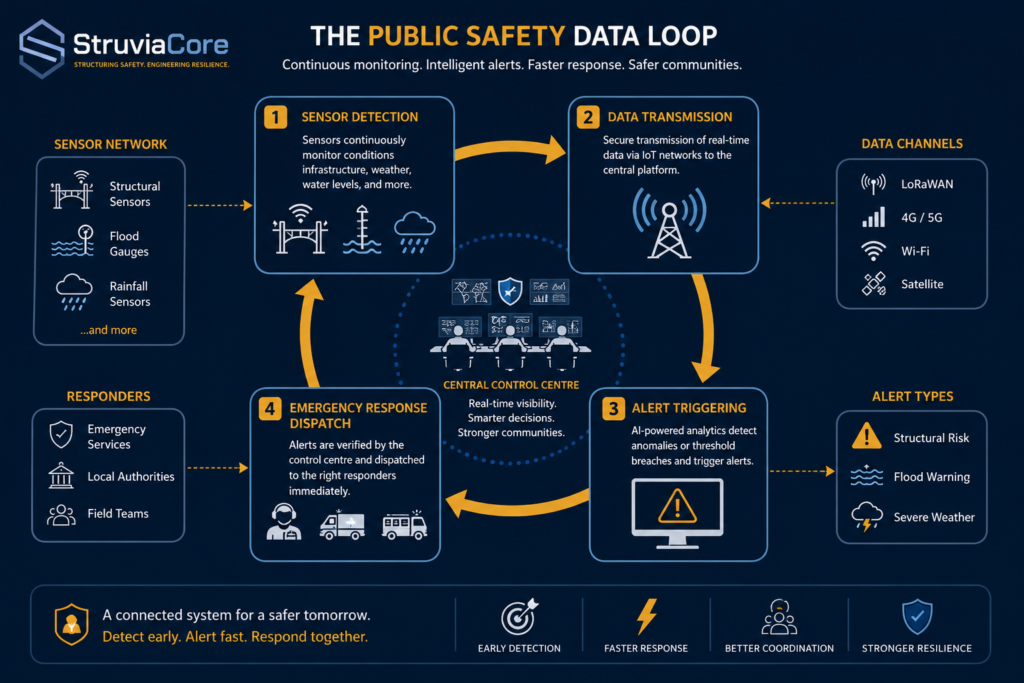
Sensor data is only useful if it reaches the people who can act on it within minutes, not hours. A mature public safety system routes alerts through a tiered communication structure: facility management first, structural engineer of record second, and municipal emergency services third if thresholds indicate imminent risk. This mirrors the connected infrastructure backbone that links traffic sensors, utility SCADA systems, and emergency dispatch into a single operational picture at the city level, rather than isolated building-by-building monitoring with no wider situational awareness.
How Smart Public Safety Systems Work
The technical architecture behind public safety benefits follows a consistent pattern regardless of hazard type: sense, transmit, analyse, alert, respond. Understanding each stage helps a project team specify a system that matches the actual risk profile of a site, rather than over-engineering a low-risk building or under-specifying a high-occupancy one.
Structural and Geotechnical Monitoring
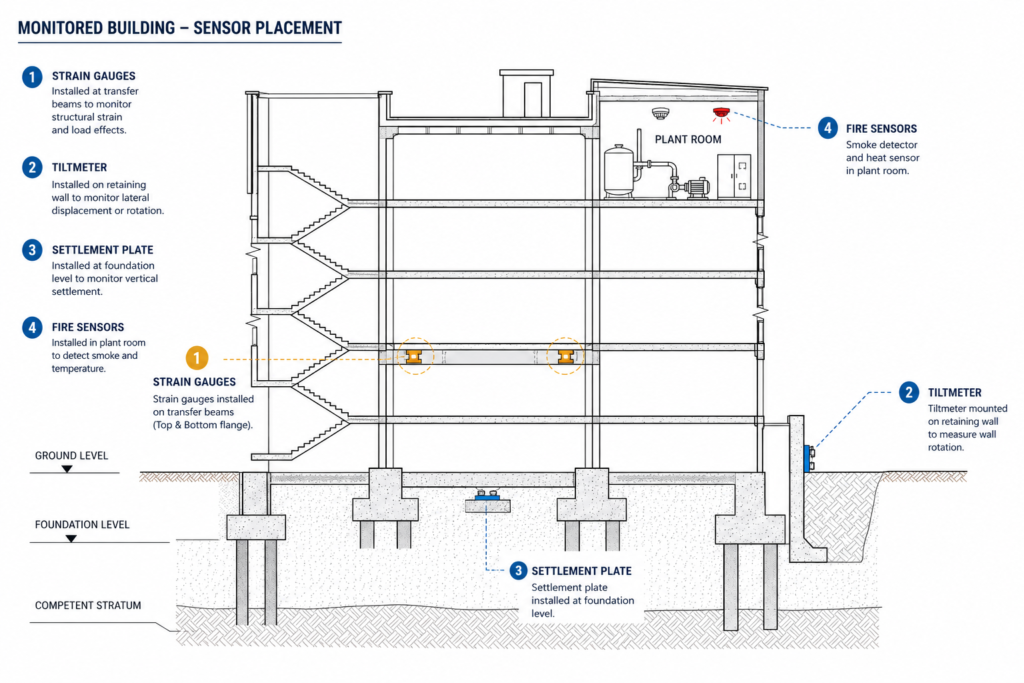
For buildings and bridges, monitoring typically covers four failure modes: excessive deflection, differential settlement, crack propagation, and vibration beyond design tolerance. Instrumentation choices depend on the structure type:
- Vibrating wire strain gauges embedded in reinforced concrete members to track long-term strain and confirm behaviour against the design model.
- Tiltmeters on retaining walls and slopes, particularly relevant on cut-and-fill sites where lateral earth pressure assumptions from the geotechnical report are being tested by real loading.
- Piezometers to monitor pore water pressure in embankments and earth dams, since a rapid rise often precedes slope failure.
- Settlement plates and extensometers on raft and pile foundations bearing on compressible or variable strata, tracking whether actual settlement stays within the limits calculated during soil investigation.
Data from these instruments feeds a threshold-based alert system. A single anomalous reading triggers a low-priority flag for engineer review; a sustained trend crossing a predefined limit — typically set at a fraction of the serviceability limit state used in design — triggers an immediate notification to the responsible engineer and, depending on severity, a recommendation to restrict occupancy.
Flood and Drainage Early Warning
Nigerian cities face a specific and recurring hazard: flash flooding driven by rainfall intensities that outpace drainage design capacity, worsened by unplanned development on natural floodplains. Public safety systems address this through networked water-level sensors placed at drainage channels, culverts, and known flood-prone junctions, feeding data to a control centre that can issue alerts faster than word-of-mouth or delayed radio broadcasts. Agencies such as the Nigerian Hydrological Services Agency (NIHSA) already issue seasonal flood outlooks; the engineering opportunity is connecting hyperlocal sensor data to that broader forecast, giving residents in a specific low-lying district hours of additional lead time rather than a generalised state-level warning.
Fire and Life Safety Systems
In high-occupancy buildings, smart fire detection extends beyond conventional smoke detectors to include thermal imaging cameras at plant rooms and electrical risers, air-quality sensors that flag combustion by-products before visible smoke develops, and automated integration with building management systems to shut down HVAC zones and unlock designated escape routes on alarm activation. This reduces the time between ignition and evacuation initiation — the single largest determinant of fire casualty rates in multi-storey buildings.
Regulatory and Institutional Context in Nigeria
Public safety engineering does not operate in a vacuum — it sits within a regulatory structure that assigns responsibility and sets minimum standards. The Council for the Regulation of Engineering in Nigeria (COREN) requires that structural designs and any subsequent monitoring or remediation works be signed off by a registered engineer, which matters for smart safety systems because sensor data alone does not constitute a compliance decision — a qualified engineer must interpret it against the original design basis. The Nigerian Industrial Standards (NIS) framework, alongside the National Building Code, sets baseline requirements for structural adequacy, fire safety, and means of escape that any monitoring system is designed to verify continued compliance against, not replace.
State-level building control agencies — the Lagos State Building Control Agency (LASBCA) being the most active example — have introduced post-construction inspection regimes partly in response to high-profile building collapses over the past decade. A properly specified public safety monitoring system gives building owners continuous evidence of compliance between statutory inspections, rather than relying solely on a point-in-time audit that may miss developing defects. Internationally, where a British Standards or Eurocode basis is referenced — BS EN 1997 for geotechnical design, BS EN 1991 for actions on structures — the monitoring thresholds used in a smart safety system should trace directly back to the serviceability and ultimate limit states defined in that design basis, not to arbitrary sensor manufacturer defaults.
This regulatory grounding also shapes procurement. A public safety system installed without engineer sign-off on threshold values and alert protocols creates a false sense of security — data is collected, but no one has confirmed the thresholds actually correspond to unsafe conditions for that specific structure. Any credible smart city infrastructure programme should treat instrumentation specification as a structural engineering deliverable, not a purely IT procurement exercise.
Common Challenges and Cost Factors
Three recurring obstacles limit how effectively public safety systems get implemented in practice, and each carries a distinct cost implication worth planning for at project inception rather than retrofitting later.
Data interoperability is the most persistent technical challenge. A site may have structural sensors from one vendor, fire systems from another, and a municipal traffic or utility network running a third proprietary protocol. Without a common data standard, alerts stay siloed in separate dashboards that no single control room operator monitors continuously. Specifying open protocols — such as MQTT for sensor telemetry — at the design stage avoids costly integration work later, when retrofitting interoperability across live systems typically costs 30–50% more than specifying it upfront.
Maintenance and calibration get underfunded once a system is commissioned. Strain gauges drift, water-level sensors silt up, and battery-powered nodes in remote locations fail without anyone noticing until an alert simply stops arriving. A realistic operating budget allocates 8–12% of the initial system cost annually to calibration, battery replacement, and firmware updates — a figure clients frequently underestimate when comparing capital cost quotes.
Environmental durability in Nigeria’s climate — high humidity in the south, dust loading and thermal cycling in the north, and coastal salt exposure in Lagos and the Niger Delta — shortens the service life of unprotected electronics. Specifying IP66 or higher-rated enclosures and corrosion-resistant mounting hardware adds roughly 10–15% to hardware cost but avoids premature sensor failure that would otherwise undermine the entire monitoring case within two to three years of installation.
Best Practices for Implementing Public Safety Systems
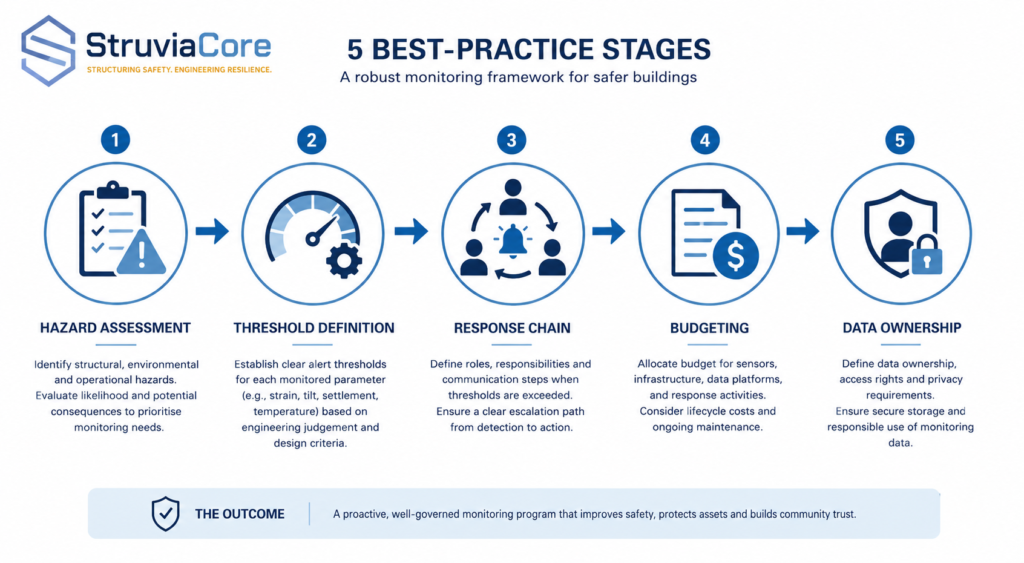
Getting a public safety system right depends less on the sophistication of the sensors and more on the discipline applied before installation begins. The following sequence reflects how a structured project should move from concept to operational system.
- Start with a risk-based hazard assessment specific to the site — geotechnical conditions from soil investigation, flood history, occupancy type, and fire load — rather than applying a generic sensor package across every building in a portfolio.
- Tie monitoring thresholds to the design basis used for the original structural or geotechnical calculations, so an alert corresponds to an actual departure from the assumptions the structure was built to, not an arbitrary sensor limit.
- Define the response chain before installation — name who receives each alert tier, what action they take, and within what timeframe, and test that chain with a simulated alert before relying on it operationally.
- Budget for the full asset life, including calibration, replacement parts, and data platform hosting, not just the initial hardware and installation cost.
- Confirm data ownership and access rights at contract stage, particularly where a municipal authority, building owner, and monitoring contractor all have a stake in the same data stream.
You should also verify that whoever installs the physical sensor network follows the same site safety protocols expected on any active construction or retrofit site — working at height on facades, entering confined plant rooms, and working near live electrical systems all carry their own risk that a monitoring project does not get exempted from. Running the installation itself through a structured risk assessment before mobilisation catches these hazards early rather than during execution.
Frequently Asked Questions About Public Safety
Q: What is public safety in civil engineering?
A: Public safety in civil engineering refers to the design decisions, code compliance measures, and — increasingly — continuous monitoring systems that reduce the risk of harm to people from structural failure, fire, flooding, or other hazards in the built environment. It spans everything from foundation design margins to real-time sensor networks that flag developing problems before they cause injury.
Q: How does structural health monitoring improve public safety benefits?
A: Structural health monitoring uses instruments such as strain gauges, tiltmeters, and settlement plates to track a structure’s behaviour continuously against its original design assumptions. It catches deviations — like unexpected deflection or settlement — weeks or months before they would become visible to a routine visual inspection, giving engineers time to intervene before failure occurs.
Q: How much does a public safety monitoring system cost?
A: Costs vary widely with building size and hazard complexity, but a basic structural monitoring package for a mid-rise commercial building in Nigeria typically starts in the range of ₦3–8 million for installation, with annual maintenance running 8–12% of that initial cost. Flood or fire-specific additions scale separately depending on sensor density required.
Q: What is the difference between structural health monitoring and routine building inspection?
A: Routine inspection is a periodic, point-in-time visual assessment carried out by an engineer, typically annually or after a specific event. Structural health monitoring is continuous and automated, using embedded sensors to detect changes between inspection cycles, catching gradual deterioration that a once-a-year visual check would likely miss.
Q: Who is responsible for setting alert thresholds in a public safety system?
A: A COREN-registered structural or geotechnical engineer should set alert thresholds, tying them directly to the serviceability and ultimate limit states used in the original design calculations. Sensor vendors can supply default thresholds, but these should always be reviewed and confirmed by the engineer of record for the specific structure.
The public safety benefits of smart city engineering come down to one operational shift: moving from periodic, visual assessment of a structure’s condition to continuous, data-backed monitoring that catches problems while they are still cheap and safe to fix. That shift depends on getting the fundamentals right — thresholds tied to actual design calculations, a tested response chain, and a maintenance budget that keeps the sensors themselves reliable over a multi-year service life. Done properly, within a framework that respects COREN registration requirements and the relevant NIS and code provisions, these systems give building owners, municipal authorities, and the people who occupy these spaces daily a measurable reduction in risk. If you are planning a monitoring system for an existing asset or want structural health monitoring built into a new development from the design stage, StruviaCore’s structural and geotechnical team can help you scope a system matched to your site’s actual risk profile.
Leave a Reply