
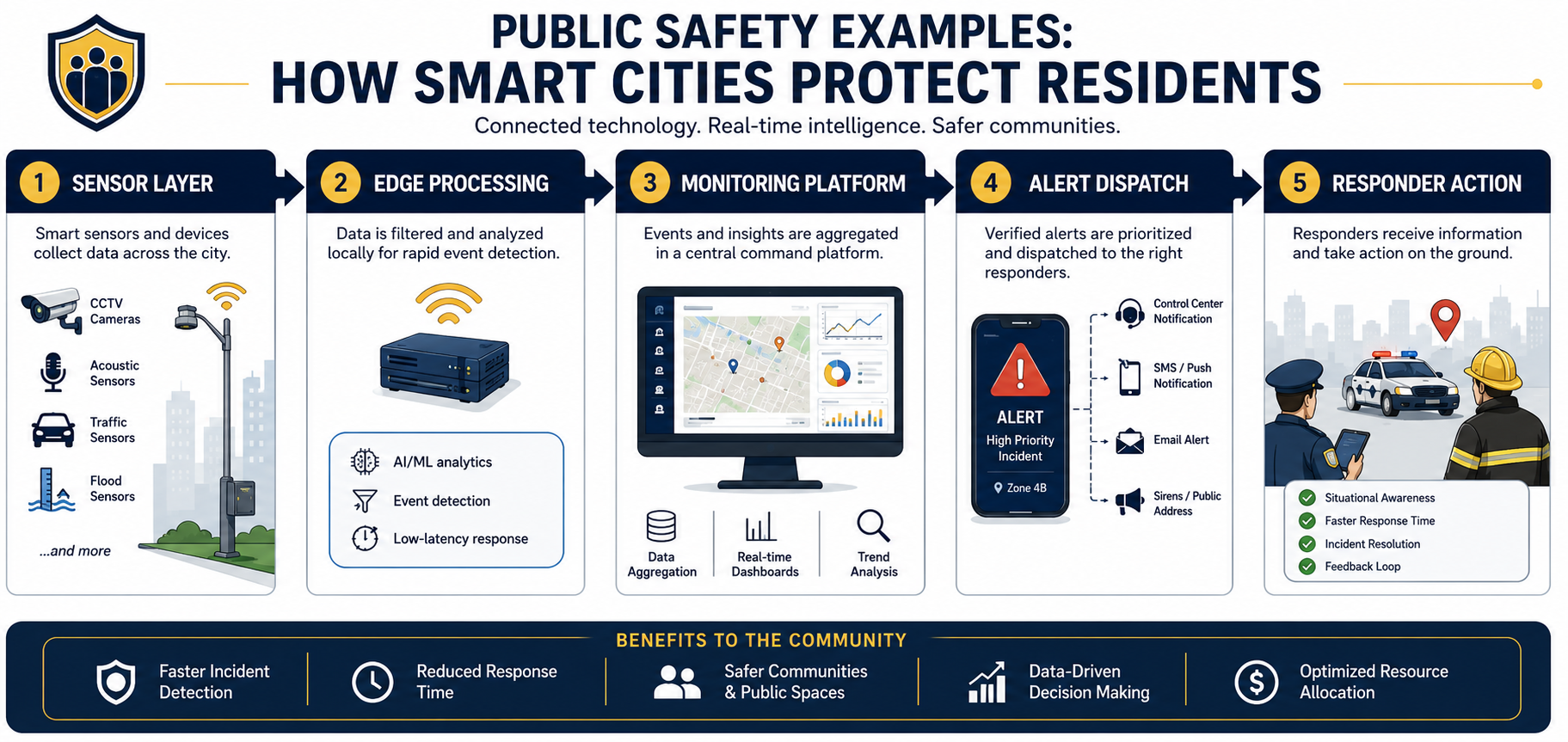
A flood retention basin in Lekki fills faster than its design storm predicted. A pedestrian bridge in Abu Dhabi records a vibration spike outside its normal range at 2 a.m. A tunnel ventilation fan in a Lagos underpass drops below its rated airflow during rush hour. In each case, the difference between a near-miss and a fatality came down to whether the infrastructure was instrumented to report the problem before a person walked into it. That is the practical core of public safety in a smart cities context: engineered systems that detect risk conditions in the built environment and route that information to people who can act on it in time.
This article works through concrete public safety examples drawn from structural, geotechnical, and infrastructure engineering — not generic “smart city” marketing language. You will see how sensor networks, video analytics, structural health monitoring, and emergency response integration function together, what they cost, where they fail, and how to specify them correctly on a project brief.
Public safety, Quick Answer
Public safety in smart city engineering is the use of sensors, cameras, structural monitoring, and connected emergency systems to detect hazards — structural distress, flooding, fire, traffic conflict, crime — and alert responders in real time. Examples include IoT-based bridge monitoring, CCTV analytics for crowd density, gas and flood sensors, and gunshot detection tied to dispatch systems. These systems shorten response time and reduce preventable harm.

What Public Safety Means in Structural and Civil Engineering
Public safety is the discipline of designing infrastructure that fails visibly and early rather than silently and catastrophically. In classical structural design, this shows up as ductile detailing — a reinforced concrete beam that cracks and deflects before it ruptures, giving occupants warning. In a smart cities context, the same logic extends outward: instead of relying only on the material to warn you, you add instrumentation that reports distress conditions directly, often before visible cracking occurs.
The scope covers four overlapping domains. Structural health monitoring tracks strain, tilt, vibration, and settlement in bridges, towers, and stadiums. Environmental hazard monitoring covers flood gauges, gas detection in tunnels and confined spaces, and air quality sensors near construction sites. Video and crowd analytics manage pedestrian density at transport hubs, mosques during Friday prayers, or stadium entrances. Emergency integration ties all of the above into a dispatch system — the Lagos State Emergency Management Agency (LASEMA), Nigeria’s National Emergency Management Agency (NEMA), or Dubai’s Smart City command centre being examples of the receiving end.
Why Engineers, Not Just IT Teams, Own This
A common mistake on Nigerian and Gulf smart city tenders is treating public safety systems as an ICT scope item, procured separately from the structural and geotechnical design. This produces sensor placements that make electrical sense but not structural sense — a strain gauge mounted where the moment diagram shows near-zero stress, or a tilt sensor bonded to a non-structural cladding panel instead of the primary frame. The structural engineer of record should specify sensor locations against the actual load path, calibrated during design development, not bolted on after handover by a systems integrator working from a generic checklist.
Regulatory Grounding
In Nigeria, public safety instrumentation on public infrastructure typically falls under COREN’s professional practice guidelines for structural certification, with SURCON governing the underlying survey control used to baseline monitoring points. There is no dedicated Nigerian code for structural health monitoring yet, so practitioners commonly reference BS ISO 18649 for strain measurement practice and BS 8006 series conventions for geotechnical instrumentation where retaining structures are involved. In the UK, BIM Level 2 mandates on public projects increasingly require a digital twin with embedded sensor tagging as part of the Common Data Environment (CDE) deliverable. Dubai Municipality’s smart city framework requires connected infrastructure reporting for any project inside designated smart district zones.
Public Safety Examples by System Type
Below are the systems seen most often on live projects across Lagos, Abuja, London, and the UAE, with the engineering reasoning behind each.
Structural Health Monitoring on Bridges and High-Rises
A typical installation places fibre-optic or vibrating-wire strain gauges at three to five critical sections of a bridge deck — usually midspan and over supports, where the bending moment envelope peaks. Tiltmeters at pier heads catch differential settlement before it becomes visible in the deck profile. On the Third Mainland Bridge corridor in Lagos, for instance, the engineering case for monitoring is straightforward: the bridge crosses soft lagoon deposits with documented long-term settlement behaviour, and early detection of differential pier movement is cheaper than post-crack retrofitting by an order of magnitude.
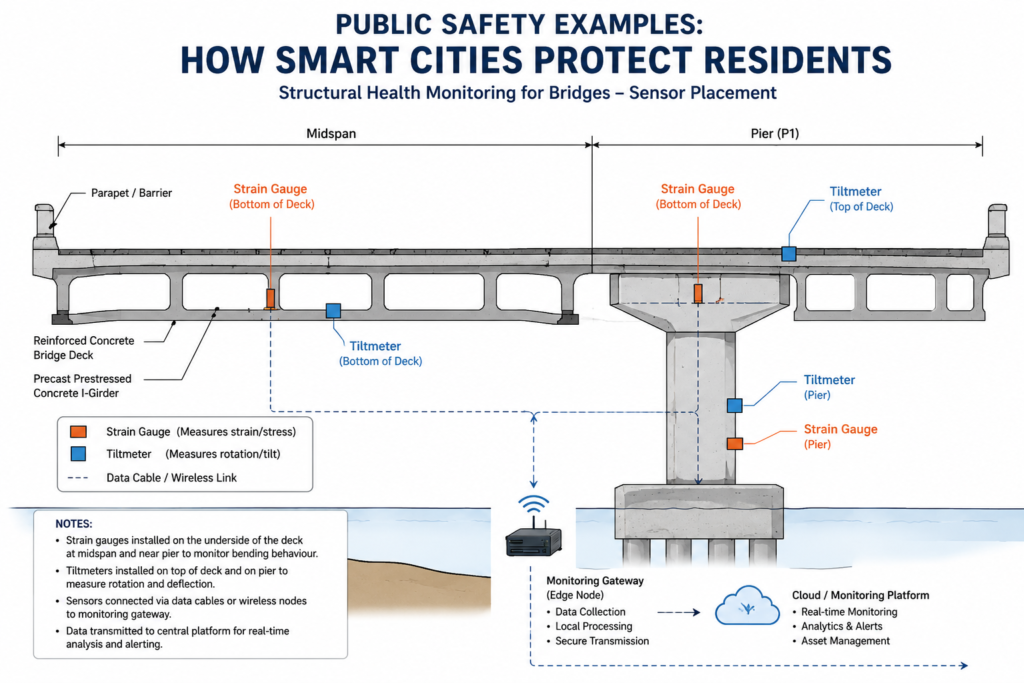
On tall buildings, accelerometers at the top three to four floors track sway amplitude against the design serviceability limit, typically height/500 under wind load per BS EN 1991-1-4 as adopted regionally. Sustained readings above that threshold flag a need for damping system inspection, not evacuation — the distinction matters because false alarms erode trust in the whole system faster than any single missed event.
Flood and Drainage Sensor Networks
Lagos’s flood risk is a drainage capacity problem as much as a rainfall problem. Ultrasonic level sensors placed at key drainage channel nodes — Oshodi, Ikoyi, and low-lying sections of the Lekki-Epe corridor are common examples — measure water level against the channel’s design freeboard. When level exceeds 80% of freeboard, the system triggers an alert to LASEMA and to nearby residents through SMS gateway integration, giving 30 to 90 minutes of lead time depending on catchment size. This lead time is the entire value proposition: it converts a flood from a surprise into a manageable evacuation.
Gas Detection and Confined Space Monitoring
Underground utility tunnels and basement car parks require continuous monitoring for methane, hydrogen sulphide, and carbon monoxide, particularly where the site sits near old refuse dumps or has poor natural ventilation — a known condition in several reclaimed sections of Lagos Island and Victoria Island. Fixed gas detectors wired to a building management system (BMS) that automatically triggers mechanical ventilation and alarm at 10% of the lower explosive limit (LEL) are standard practice; portable detectors carried by maintenance staff are a supplement, never a substitute.
Video Analytics for Crowd and Traffic Safety
CCTV with embedded analytics — as opposed to passive recording — counts crowd density in real time and flags when a zone crosses a per-square-metre threshold, typically 4 people per square metre as the point where crowd crush risk becomes significant per crowd safety guidance used in UK event planning. At transport interchanges in Abuja and at mosque approaches in Abu Dhabi during peak prayer times, this analytics layer feeds directly into gate control and signage rather than only a control room screen watched by a human who may be monitoring 40 other feeds simultaneously.
Cost Factors and Common Challenges
Public safety instrumentation is not free, and clients frequently underestimate the recurring cost, not just the capital cost. A mid-size structural health monitoring installation on a single bridge span — six to ten sensors, a data logger, cellular or fibre backhaul, and a basic dashboard — runs from roughly $15,000 to $45,000 depending on sensor type and access difficulty, with annual calibration and connectivity costs of 10 to 15% of capital cost. Flood sensor networks scale by node count; a ten-node network across a drainage catchment in Lagos typically costs $60,000 to $120,000 installed, driven mainly by civil works to protect sensors from vandalism and debris impact rather than the sensors themselves.
The most common failure mode is not sensor malfunction — it is data going nowhere. A system that logs strain readings to a local server with no integration into an emergency dispatch workflow is a monitoring system, not a public safety system. You need three things working together for the investment to pay off:
- A defined threshold for each sensor, agreed with the structural engineer of record, not a factory default setting
- A named receiving agency with an actual response protocol, not a generic “authorities will be notified” clause in the O&M manual
- A maintenance contract that includes recalibration, since drift in vibrating-wire and MEMS sensors over two to three years can produce false negatives that are worse than no monitoring at all
A second recurring problem is retrofitting monitoring onto existing structures without a settlement or strain baseline. Without at least six months of pre-installation baseline data, you cannot distinguish normal thermal expansion cycling from genuine structural distress, and the system will either cry wolf constantly or miss the real event buried in noise.
Best Practices for Specifying Public Safety Systems
If you are writing the specification for a project — whether a new build or a retrofit — work through this sequence rather than starting from a vendor’s product catalogue.
- Identify the failure mode you are actually trying to catch first: differential settlement, overstress, flooding, gas accumulation, or crowd crush. Each drives a different sensor type and placement logic.
- Locate sensors against the structural analysis model, not against convenient access points. Ask your structural engineer where the moment, shear, or displacement envelope peaks.
- Set thresholds as a percentage of the design capacity or serviceability limit, documented in the O&M manual with the calculation reference, not as an arbitrary round number.
- Confirm the receiving agency and response protocol in writing before commissioning — COREN-registered structural sign-off should include this as a condition of the monitoring system’s acceptance, not an afterthought.
- Budget for a minimum six-month baseline period before treating any reading as an alarm condition.
- Build recalibration into the facilities management contract from day one, with a named responsible party and a fixed interval — annually for most structural sensors, per manufacturer guidance for gas detectors.

Frequently Asked Questions About Public Safety
Q: What is public safety in civil engineering?
A: Public safety in civil engineering refers to instrumented systems — structural sensors, environmental monitors, and video analytics — that detect hazardous conditions in infrastructure and route alerts to emergency responders. It extends traditional passive safety design, such as ductile detailing, into active real-time hazard detection.
Q: How does structural health monitoring work?
A: Sensors such as vibrating-wire strain gauges, tiltmeters, and accelerometers are placed at critical structural sections identified from the design’s moment and displacement envelope. Readings are logged continuously, compared against thresholds set as a percentage of design capacity, and flagged to a monitoring dashboard or emergency system when exceeded.
Q: How much does a public safety monitoring system cost?
A: A single-bridge structural health monitoring installation typically costs $15,000 to $45,000 for six to ten sensors, a data logger, and connectivity, with 10 to 15% of that figure recurring annually for calibration and data services. Flood sensor networks across a drainage catchment commonly run $60,000 to $120,000 for a ten-node installation, driven largely by protective civil works.
Q: What is the difference between passive and active public safety measures?
A: Passive measures are built into the structure itself, such as ductile reinforcement detailing that gives visible warning before failure. Active measures are instrumented systems — sensors, cameras, and connected alerts — that detect a hazard condition and notify people before visible failure occurs, shortening response time.
Q: What are the requirements for public safety systems on public infrastructure?
A: Requirements vary by jurisdiction, but generally include structural sign-off from a COREN-registered engineer in Nigeria, a defined baseline monitoring period before thresholds are treated as active, a named receiving emergency agency with a documented response protocol, and a recalibration schedule built into the facilities management contract.
The public safety examples covered here share one trait: none of them work as isolated products. A strain gauge without a structural baseline is noise. A flood sensor without an agency response protocol is a data logger. The engineering discipline is in the integration — placing instrumentation against the actual load path or hazard model, setting thresholds that mean something, and confirming a named responder will act on the alert before the system goes live. Get that sequence right and the payoff is measured in minutes of warning time that convert a structural or environmental failure from a casualty event into a maintenance ticket. If you are scoping a monitoring system for a bridge, tower, or drainage network, review our best practices guide for public safety system specification or get in touch with StruviaCore’s structural team to work through the sensor placement and threshold calculations for your project.
Leave a Reply