
A rail project in Nigeria that looks straightforward on a feasibility study has a habit of arriving at construction with a budget that looks nothing like the original estimate. The Abuja Light Rail — completed in phases from 2016 — saw cost escalations tied to land resettlement, utility diversion, and the complexity of tunnelling through laterite-rich terrain. The Lagos Blue Line, long delayed before its 2023 partial opening, faced similar pressures: right-of-way acquisition alone ran into complications that extended timelines by years. These are not anomalies. They reflect the structural realities of rail cost factors in Nigeria, where geology, governance, and procurement all exert simultaneous pressure on a project’s bottom line.
This article breaks down each major rail cost factor — from earthworks and track formation to signalling, rolling stock, and the regulatory environment governed by the Nigerian Railway Corporation (NRC) and COREN-registered practitioners. Whether you are a project manager, a client reviewing a contractor’s bill of quantities, or a site engineer trying to understand where contingency gets spent, this is the cost anatomy of a Nigerian rail project.
Rail Cost Factors: Quick Answer
Rail cost factors are the technical, commercial, and regulatory variables that determine the total project expenditure for a railway scheme. In Nigeria, the primary drivers are civil earthworks and formation, track type and gauge, land acquisition and resettlement, signalling and electrification, rolling stock procurement, and construction logistics in regions with poor access roads or unstable ground condition
What Rail Cost Factors Actually Mean in Practice
Rail cost factors are the individual technical and commercial variables that, taken together, determine what a railway scheme costs to design, build, and commission. Unlike a building project — where the scope is relatively contained within a site boundary — a rail project is a linear infrastructure asset. Every kilometre introduces new ground conditions, new utility crossings, new land parcels, and new community interfaces. The cost per kilometre is therefore a running variable, not a fixed rate.
In Nigeria, the NRC Act Cap N130 LFN 2004 governs railway construction and operation, with the Ministry of Transportation overseeing concession agreements and capital projects. COREN-registered civil, structural, and geotechnical engineers carry statutory responsibility for design sign-off. These regulatory layers introduce procurement timelines and compliance costs that standard international comparators — often drawn from European or Asian rail programmes — do not capture.
The standard gauge (1,435mm) and narrow gauge (1,067mm) distinction alone splits the Nigerian rail cost landscape into two categories with meaningfully different track material costs, rolling stock specifications, and civil formation widths. The ongoing expansion of the standard gauge network — Abuja–Kaduna, Lagos–Ibadan, and the proposed Port Harcourt–Maiduguri corridor — operates at cost levels per kilometre that are substantially higher than legacy narrow gauge rehabilitation on the same corridors.
How Cost Per Kilometre Is Calculated
A rail project quantity surveyor or cost engineer will typically disaggregate the total scheme cost into component rates per kilometre of track. A single-track standard gauge corridor in Nigeria — accounting for earthworks, formation, ballast, sleepers, rail, and basic civil structures — might carry a civil works cost of $3 million to $6 million per kilometre depending on terrain. Introduce a viaduct, a river crossing, or a tunnel, and that rate can spike by a factor of three to five for the affected section.
The cost per kilometre figure quoted in project announcements is almost always an average across the alignment. It masks the peaks — the kilometres that run through dense urban fabric in Lagos, or through black cotton soil expanses on the Benue corridor, or across the Niger Delta’s soft, high-compressibility sediments near Port Harcourt. Understanding rail cost factors means understanding that the average conceals the extremes that break budgets.
The Role of Project Classification
Rail schemes in Nigeria typically fall into one of three classifications: new-build greenfield corridors, brownfield rehabilitation of existing track, and urban transit (metro or light rail). Each has a distinct cost profile. Greenfield projects carry the highest land acquisition burden and the largest civil earthworks scope. Rehabilitation projects often surface hidden structural problems — degraded sleepers, corroded fishplates, weakened subgrade — once the old track is removed. Urban transit projects face the most complex stakeholder environments, with utility diversions, business displacement compensation, and elevated structures adding cost layers that corridor rail does not encounter to the same degree.
Understanding which classification your project falls into is the first step toward a realistic cost forecast. For a deeper grounding in how these projects fit within Nigeria’s broader transport network, see our transportation engineering guide.
Civil Works and Formation: The Dominant Cost Driver
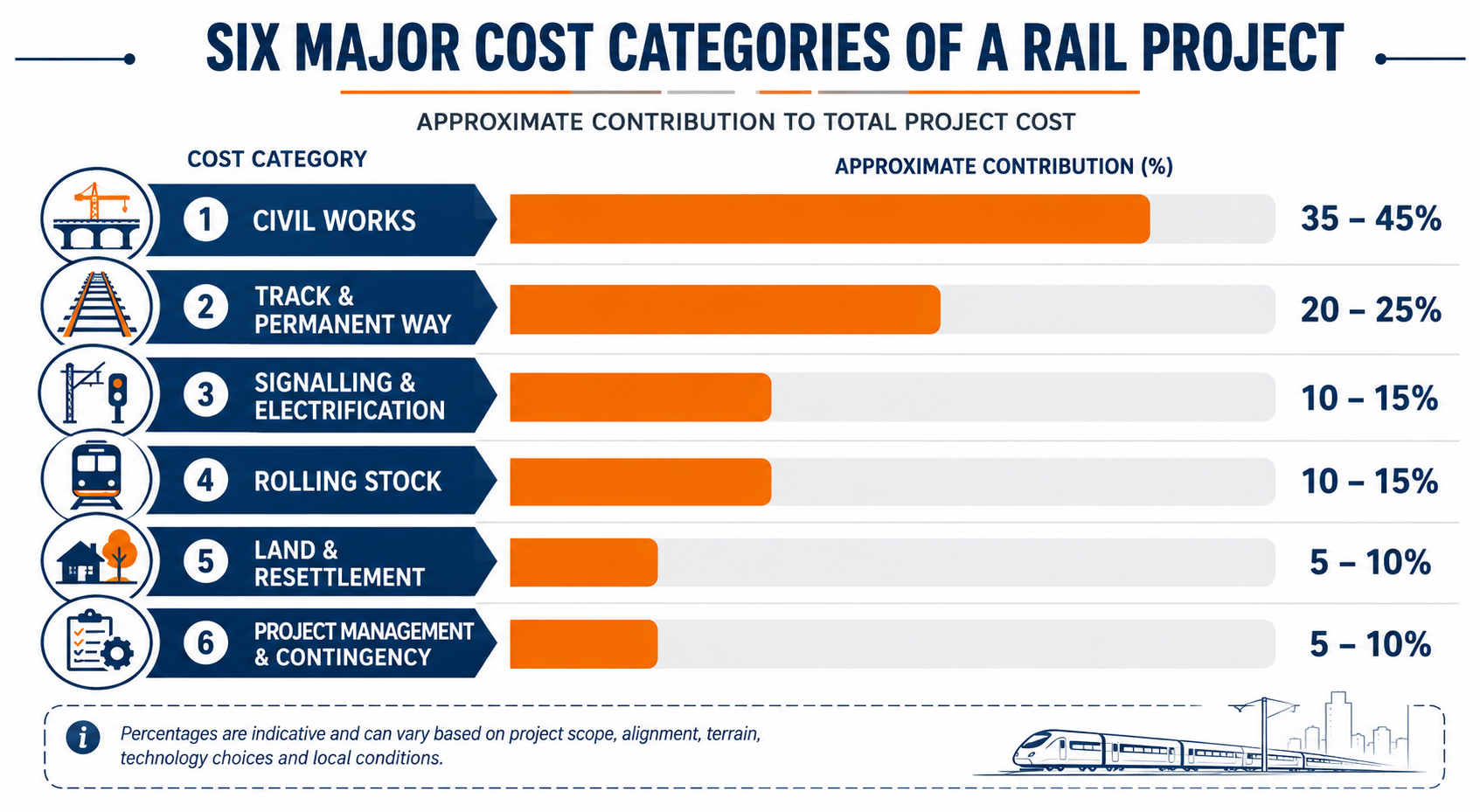
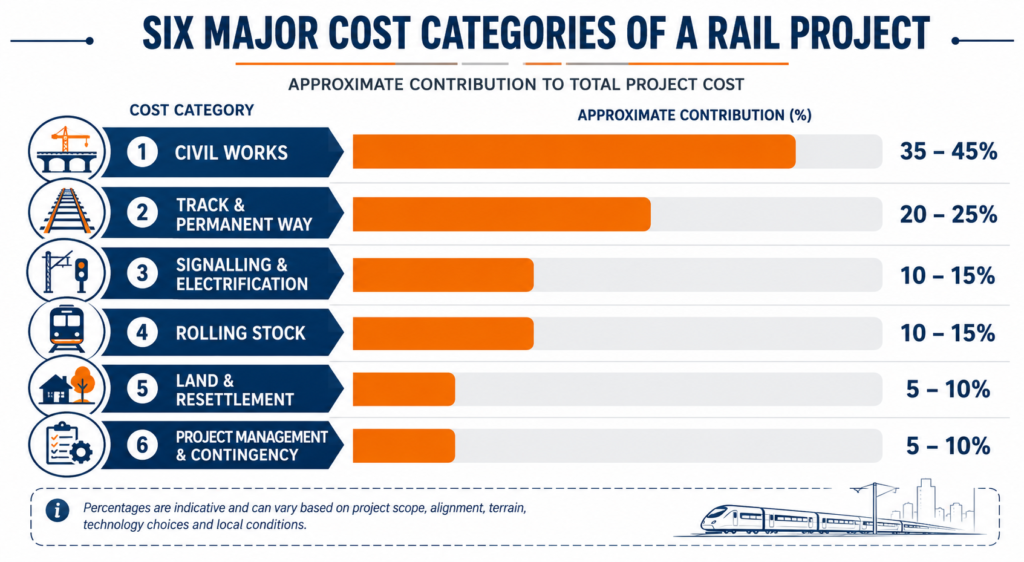
On most Nigerian rail projects, civil earthworks and track formation account for 35 to 45 percent of total project cost. This is the cost that varies most dramatically between corridors and that is most often underestimated in early-stage feasibility work.
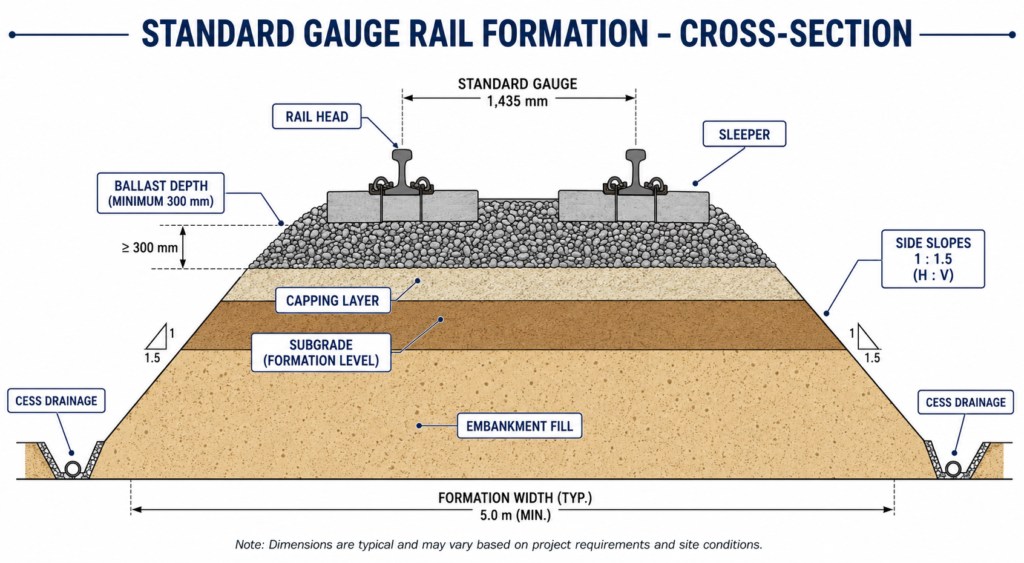
Formation design follows the principles set out in BS 6031 (earthworks) and the NRC’s own engineering standards, which specify minimum formation widths and compaction requirements for different traffic loading scenarios. A standard gauge single-track formation requires a minimum formation width of around 6.5 metres at subgrade level, rising to 8.5 metres or more on embankments where side drainage must be accommodated. Double-track formation can double the earthworks volume on cuttings and embankments.
Terrain and Soil Conditions in Nigeria
Nigeria’s geology divides into three broad zones that each carry distinct cost implications for rail civil works. The southwest — Lagos, Ogun, Oyo — presents a mix of coastal alluvium, mangrove sediments near the lagoon, and Basement Complex rocks further inland. Soft ground near the Lagos coastline requires either deep soil improvement (vibro-compaction, dynamic compaction, or surcharging) or piled embankment solutions, each of which adds $150,000 to $400,000 per kilometre over a simple cut-fill scheme.
The north-central zone — Abuja, Niger State, Kogi — tends to present weathered granite and gneiss with lateritic overburden. Laterite is variable: well-graded lateritic gravel can be a competent fill material and subbase, but highly plastic laterite in the A-7 classification under BS 1377 requires lime stabilisation or replacement, adding treatment costs of $20,000 to $60,000 per kilometre. The geotechnical investigation programme must distinguish between the two before a realistic earthworks tender is produced. Our geotechnical engineering guide covers ground investigation methodologies applicable to these conditions.
The south-south and southeast — Rivers State, Cross River, Anambra — present the most challenging ground conditions for rail. High groundwater tables, soft deltaic deposits with California Bearing Ratio (CBR) values below 3%, and peat lenses in some sub-surface profiles demand ground improvement works that can represent 20 to 30 percent of the total civil cost on affected sections. These are not theoretical risks; they are quantifiable through proper site investigation that a COREN-registered geotechnical engineer must certify before design commences.
Drainage and Flood Risk
Rail formation drainage is a recurring source of underestimated cost in Nigerian projects. A poorly drained subgrade loses bearing capacity rapidly under repeated axle loading, causing differential settlement that translates into track geometry defects and speed restrictions. Side drains, catch drains, and cross-drainage culverts must be sized for the 1-in-100-year storm return period as a minimum — and in low-lying areas of Lagos or the Niger Delta, this means sizeable reinforced concrete box culverts at regular intervals. The culvert and drainage allowance on a well-engineered Nigerian rail scheme typically runs at $80,000 to $200,000 per kilometre, a line item that gets squeezed in value-engineering exercises and later drives maintenance expenditure.
Track and Permanent Way: Where Specification Decisions Compound
Track materials — rail, sleepers, fasteners, and ballast — represent 20 to 25 percent of a typical Nigerian rail project budget. The decisions made at specification stage compound through the entire life of the asset, because cheaper track components carry higher maintenance costs and shorter replacement cycles.
For standard gauge track on a mainline corridor, 60kg/m UIC rail is the appropriate specification for freight-capable infrastructure. Substituting 50kg/m rail saves approximately 15 percent on rail material cost but limits axle loading capacity and accelerates wear under heavy freight traffic. Nigeria’s ambition to run 25-tonne axle loads on the standard gauge network — consistent with modern bulk freight requirements — demands 60kg/m rail as the minimum.
Sleeper type is the second major specification decision. Prestressed concrete monoblock sleepers conforming to BS EN 13230 are the standard for new mainline track. They carry a unit cost of approximately $120 to $180 per sleeper landed in Nigeria (including import duty and port clearance), compared to $40 to $70 for hardwood timber sleepers. Timber sleepers have a service life of 12 to 20 years under moderate traffic; concrete sleepers typically achieve 40 to 50 years. The lifecycle cost case for concrete is unambiguous. The capital cost case, however, is sensitive to the project’s financing structure — and in Nigeria, where project finance often runs on short loan tenors, clients sometimes accept higher lifecycle costs to reduce upfront capital draw.
Ballast supply chain is a Nigeria-specific cost driver that international benchmarks miss. Quality crushed granite ballast meeting the grading requirements of BS EN 13450 (50mm to 63mm nominal size, Los Angeles Abrasion value below 20%) must be sourced from approved quarries. In the southwest and northcentral zones, viable quarry sources exist. In the south-south, marine dredged aggregate does not meet the abrasion resistance specification, meaning ballast must be hauled from distances of 150km or more — adding $8 to $15 per tonne in haulage cost over a base ex-quarry price of $12 to $20 per tonne. A single-track kilometre requires approximately 1,200 to 1,500 tonnes of ballast, so haulage distance is not a minor variable.
For context on how infrastructure material specifications translate to project costs across other sectors, our article on road cost factors covers parallel decisions in pavement engineering.
Signalling, Electrification, and Systems Costs
Signalling and electrification together account for 10 to 15 percent of total rail project cost on non-urban schemes, rising to 20 to 30 percent on metro or light rail projects where traction power infrastructure forms a major scope item.
On the Nigerian standard gauge mainline network, current signalling specifications use a combination of token block working on lower-traffic sections and Automatic Block Signalling (ABS) on higher-density sections. A full ABS implementation with level crossing protection and interlocking at stations costs in the range of $800,000 to $1.5 million per kilometre of single track. European Train Control System (ETCS) Level 2 — which removes lineside signals entirely and transmits movement authorities directly to the cab — costs significantly more but offers higher line capacity and is being specified on newer corridors in African rail programmes.
Electrification for overhead line equipment (OLE) on a 25kV AC system — the standard for inter-city rail electrification — adds $1.5 million to $3 million per kilometre, excluding the traction substations at 40 to 60km intervals. For Nigeria’s current mainline programme, diesel traction remains the operational baseline, deferring this cost category. Urban metro schemes — the Lagos Red and Blue Lines — are electrified, and their systems cost per kilometre reflects this: significantly higher than equivalent non-electrified corridor rail.
Land Acquisition, Resettlement, and Right-of-Way Costs
Land acquisition is the rail cost factor that causes the most project delays and the largest divergence between budgeted and outturn costs in Nigeria. The Land Use Act 1978 vests land ownership in state governors, requiring a Certificate of Occupancy (C of O) for formal title. Compulsory acquisition for public infrastructure invokes the Public Lands Acquisition Act, but the valuation and compensation process under this act is slow, contested, and often inadequately funded in project budgets.
On the Lagos–Ibadan standard gauge corridor, resettlement of structures within the railway reservation required compensation payments and relocation logistics that ran into hundreds of millions of naira over the project period. The railway reservation — typically 30 to 50 metres total width on Nigerian mainline corridors — often contains decades of encroachment: structures, farms, markets, and utility lines that must be cleared before earthworks can commence.
Budget for right-of-way should never be less than 8 to 12 percent of total project cost on urban-adjacent corridors, and should be stress-tested against a 30 to 50 percent cost uplift scenario to reflect the reality of resettlement negotiations. Clients who budget the minimum and assume smooth acquisition typically discover that construction cannot proceed on 15 to 25 percent of the alignment until resettlement disputes are resolved — a delay cost that dwarfs the original land budget shortfall.
Understanding how urban growth patterns interact with infrastructure corridors is covered in our urban infrastructure guide, which addresses the planning and land management context directly relevant to rail right-of-way.
Common Mistakes That Inflate Rail Cost Factors
The cost overruns on Nigerian rail projects rarely come from a single cause. They accumulate from a set of predictable mistakes that experienced practitioners can identify early — but that clients and sometimes consultants fail to flag in the pre-contract phase.
- Inadequate ground investigation: Skimping on borehole density — particularly on longer alignments — means the earthworks design is based on assumed ground conditions rather than actual ones. The NRC’s own standards and BS 5930 (Site Investigation) recommend borehole spacing of no more than 200 metres on rail alignments in complex ground. Projects that stretch this to 500 metres or more almost always encounter uncharted problem zones during construction.
- Optimism bias in land acquisition timelines: Scheduling construction to begin 6 months after project award assumes resettlement will conclude in that window. On contested urban corridors in Lagos or Port Harcourt, 18 to 24 months is a more defensible assumption. Mobilising plant to a site with unresolved resettlement generates idle equipment costs of $50,000 to $200,000 per month on a medium-scale rail contract.
- Underspecified drainage: As noted above, drainage allowances are frequently cut in value engineering. The maintenance cost of a poorly drained subgrade over a 20-year period consistently exceeds the capital cost of proper drainage provision — often by a factor of three to five.
- Rolling stock procurement misalignment: Ordering rolling stock before the civil infrastructure gauge, loading gauge, and platform heights are confirmed creates expensive retrofitting requirements. Platform height on Nigerian standard gauge stations has varied between projects, creating rolling stock compatibility issues that add cost at commissioning.
- No contingency stratification: Applying a flat 10 percent contingency to all rail cost categories treats certain risks (material price fluctuation) the same as uncertain risks (unknown ground conditions). A stratified contingency — 5 percent on well-defined civil works, 20 to 25 percent on signalling and systems with foreign currency exposure — is materially more accurate.
For a structured approach to managing project-level cost risk across all infrastructure categories, our cost control guide provides the framework practitioners need before procurement begins.
Best Practices for Managing Rail Cost Factors on Nigerian Projects
The following practices, applied consistently from pre-feasibility through to contract award, will contain the cost factors that typically break Nigerian rail project budgets. This is not a theoretical list — each item reflects a pattern of failure observed on poorly managed rail contracts in the Nigerian market.
- Commission a phased ground investigation. Phase 1 — desk study and walkover survey — before any design work begins. Phase 2 — intrusive investigation with boreholes and trial pits at BS 5930 spacing — before preliminary design. Phase 3 — targeted supplementary investigation where design reveals critical zones — before detailed design is finalised. Skipping Phase 1 and 2 to “save time” is the single most reliable way to generate expensive design revisions.
- Fix the gauge, loading gauge, and interoperability standards before procurement. Decisions on standard versus narrow gauge, axle loading class, and rolling stock compatibility must be locked in the brief. Changes after contract award are among the most expensive design variations in rail engineering.
- Separate land acquisition from the main works contract. Issue the main works contract only after at least 80 percent of the right-of-way is legally cleared. The remaining 20 percent — typically the most contested parcels — can proceed in parallel, but a contractor should not be handed a programme that assumes 100 percent possession on day one.
- Apply the NRC’s environmental and social safeguard requirements early. The Environmental Impact Assessment (EIA) under the NESREA Act 2007 and the Federal Ministry of Environment’s EIA procedure regulations require formal approval before construction commences. An EIA process that begins late delays the construction programme and, on World Bank or AfDB-financed projects, triggers additional social impact assessment requirements that extend timelines by 6 to 12 months.
- Use Nigerian material sources where specification allows. Locally quarried granite, locally produced concrete products, and locally fabricated civil structures reduce foreign exchange exposure. Track materials — rail, fasteners, and many signalling components — will almost always require importation, but maximising local content in civil works is achievable and reduces the foreign currency contingency requirement significantly.
- Require the quantity surveyor to produce a cost plan at each RIBA/NEC stage equivalent. A cost plan updated at conceptual design, preliminary design, and detailed design stages — with stated assumptions and risk allocations — gives the client meaningful control over the budget trajectory before commitment to construction.
Frequently Asked Questions About Rail
Q: What is the average cost per kilometre of a rail project in Nigeria?
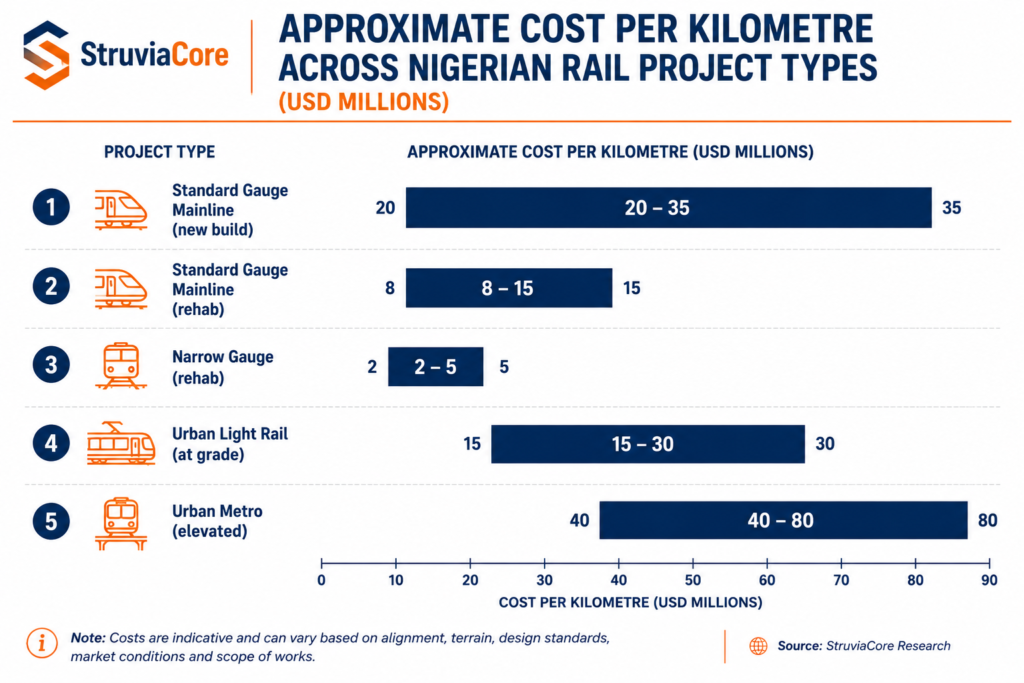
A: Costs vary significantly by project type. Standard gauge mainline new-build on relatively straightforward terrain has run at $8 million to $15 million per kilometre on recent Nigerian projects, consistent with comparable African corridor rail programmes. Urban light rail runs higher — $20 million to $40 million per kilometre at grade, and $60 million or more per kilometre for elevated metro infrastructure, as seen on the Lagos Blue and Red Lines. These figures include civil works, track, and basic systems but exclude rolling stock unless specified.
Q: What are the main rail cost factors specific to Nigeria compared to other countries?
A: Nigeria-specific factors include: foreign exchange exposure on imported track materials and signalling equipment (typically 40 to 60 percent of project cost is USD-denominated); land acquisition complexity under the Land Use Act 1978; port clearance delays and inland haulage costs for heavy materials; the cost premium for ground improvement in soft deltaic soils in Rivers and Delta States; and the absence of a deep domestic rail supply chain, which means most specialist subcontractors and materials come from outside Nigeria.
Q: How does gauge choice affect rail cost factors?
A: Standard gauge (1,435mm) costs more to build than narrow gauge (1,067mm) in almost every cost category. Formation width is wider, sleeper lengths are longer, and rolling stock is heavier and more expensive to procure. However, standard gauge allows interoperability with modern international rolling stock and supports higher axle loads and operating speeds. For freight-primary corridors with long-term volume ambitions, the lifecycle economics of standard gauge are favourable despite the higher capital cost. Narrow gauge rehabilitation remains appropriate for lower-traffic secondary corridors where the existing alignment and structures are already narrow gauge.
Q: What role does the Nigerian Railway Corporation play in rail project costs?
A: The NRC acts as the technical regulator for railway construction standards and the concessionaire or operator on many federal rail assets. NRC approval is required for construction plans, and NRC inspection is mandatory at defined hold points during construction. Engagement with NRC early in the design process — particularly on station design, level crossing treatment, and track geometry standards — avoids costly late-stage design revisions. NRC’s published design standards and clearance requirements must be incorporated into the engineer’s design basis at the outset.
Q: How do signalling costs compare between diesel and electrified rail in Nigeria?
A: On a diesel-traction corridor, signalling accounts for the majority of the systems budget — broadly $800,000 to $1.5 million per single-track kilometre for Automatic Block Signalling with station interlocking. On an electrified urban transit scheme, traction power infrastructure (OLE, substations, power supply agreements with the Distribution Company of Nigeria or an independent power producer) adds $1.5 million to $3 million per kilometre on top of the signalling cost. Electrification decisions therefore roughly double the systems cost per kilometre and introduce a parallel dependency on reliable grid power — a significant operational risk factor in the Nigerian context.
Rail cost factors in Nigeria are predictable once you understand the categories and the Nigeria-specific variables that distort international benchmarks. Civil earthworks and formation dominate the budget. Track specification compounds over the asset lifecycle. Land acquisition delays break construction programmes. Signalling and electrification carry the highest foreign exchange exposure. And across all categories, inadequate ground investigation at the front end creates the most expensive surprises at the back end.
The Nigerian rail expansion programme represents a genuine opportunity for economic transformation — but only on projects where the cost anatomy is understood before commitments are made. A project that enters construction with a realistic, stratified cost plan and a properly sequenced right-of-way programme will consistently outperform one that starts fast and adjusts late.
StruviaCore provides independent cost advisory, civil and structural design, and geotechnical engineering services across rail and transport infrastructure projects in Nigeria. To discuss your project’s cost structure or commission a technical review, explore our rail infrastructure services or contact the StruviaCore team directly.
Leave a Reply