
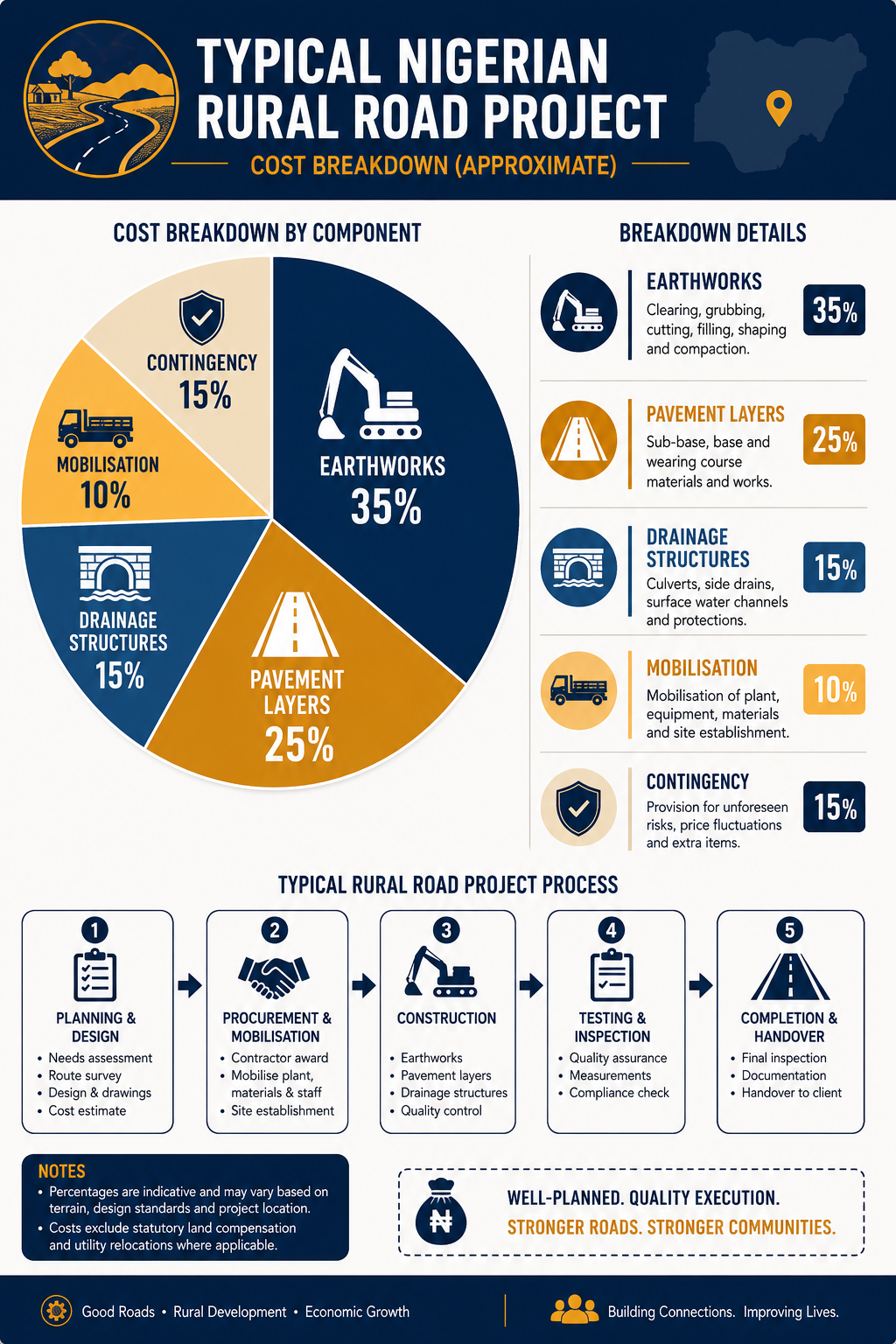
A site engineer reviewing a bill of engineering measurement and evaluation (BEME) for a 12km rural access road in Ogun State recently found that earthworks alone consumed 38% of the contract sum — far above the 20-25% typically budgeted. The cause was not poor estimating. It was a soil profile that shifted from lateritic gravel to expansive black cotton soil halfway along the alignment, forcing a redesign of the pavement structure and an unplanned import of fill material from a borrow pit 14km away. This is the reality of transportation engineering cost factors in Nigeria: the numbers on paper rarely survive contact with the ground.
This article breaks down what actually drives the cost of transportation infrastructure projects — roads, bridges, and associated drainage — from the design table to the final wearing course. It covers the technical components that determine pricing, the Nigerian regulatory and site conditions that shift those numbers, the mistakes that cause budget overruns, and a practical approach to controlling costs from feasibility through construction.
Transportation Engineering Cost Factors: Quick Answer
Transportation engineering cost factors are the technical, material, and site-specific variables that determine a road or bridge project’s budget. The main drivers are earthworks volume, pavement design (subbase, base, and surface course thickness), drainage provisions, haulage distance to material sources, soil conditions along the alignment, and compliance with design standards such as the Federal Ministry of Works Highway Manual.
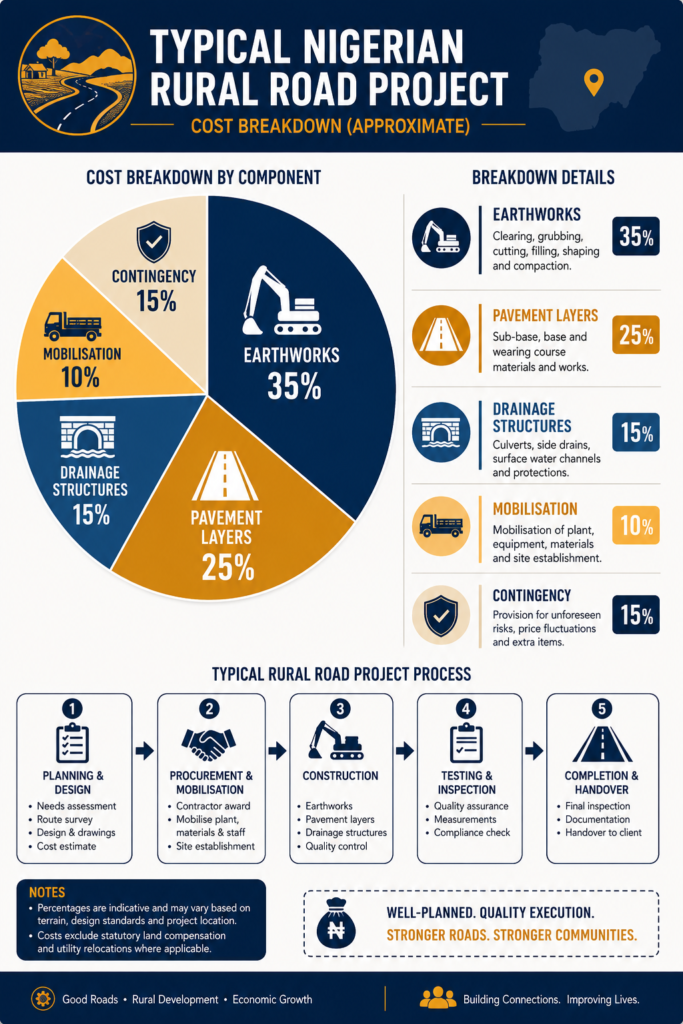
What Determines Transportation Engineering Costs
Transportation engineering is the discipline concerned with the planning, geometric design, structural design, and construction of roads, highways, bridges, railways, and related infrastructure. Within this discipline, cost is not a single line item — it is the sum of decisions made at every stage of the design process, each of which compounds or reduces the final figure.
At the feasibility stage, the route alignment chosen determines how much earth must be cut, filled, or hauled. A straight alignment across flat terrain in parts of Kano or Sokoto State can keep earthworks below 15% of total cost. The same length of road crossing the undulating terrain of the Jos Plateau, or the swampy lowlands around Port Harcourt, can push earthworks past 40% because of the cut-to-fill imbalance and the need for soil replacement in poor-bearing zones.
At the design stage, the pavement structure — the layered system of subbase, base course, and surface course sitting above the subgrade — is sized according to the projected traffic loading, expressed as the design Equivalent Standard Axle Load (ESAL) over the design life, typically 10 to 20 years for Nigerian trunk roads. A road designed for 5 million ESALs requires a thicker, stiffer pavement than one designed for 1 million ESALs, and that difference is measured in tens of millions of naira per kilometre once asphalt, crushed stone, and compaction plant time are factored in.
The Three Cost Layers Engineers Must Account For
It helps to think of transportation project costs in three layers. The first is the fixed geometric layer — the alignment, gradient, and cross-section, which is largely locked in once route selection is approved. The second is the structural layer — pavement design, drainage capacity, and any bridge or culvert structures, which can still be value-engineered during detailed design. The third is the execution layer — haulage distances, plant availability, labour rates, and site access, which fluctuates with location and timing and is often the most volatile of the three.
Why Cost Per Kilometre Varies So Widely
Published figures for road construction in Nigeria often range from ₦150 million to over ₦500 million per kilometre for a standard two-lane carriageway, and this spread is not arbitrary. A project in a region with accessible quarries and lateritic soil suited for subbase material sits at the lower end. A project requiring imported aggregate, soil stabilisation with cement or lime due to poor subgrade CBR (California Bearing Ratio) values below 5%, or extensive box culverts across multiple drainage channels sits at the upper end. Engineers preparing cost estimates without a site-specific soil investigation are, in effect, guessing — and that guess can be off by a factor of two.
Technical Cost Components: Pavement, Earthworks, and Structures
Breaking the budget into its technical components shows where the money actually goes, and where engineering decisions have the greatest leverage on the final figure.
Earthworks typically represent the largest single cost category on rural and semi-urban roads. This includes site clearance, topsoil stripping, cut-to-spoil, fill placement, and compaction. Compaction itself must meet specified densities — commonly 95% of Maximum Dry Density (MDD) for fill material and 100% MDD for the top 300mm of subgrade, tested using the modified AASHTO compaction method as adopted in Nigerian specifications. Achieving these densities in high-moisture-content soils, common during the rainy season in the South-South and South-East zones, often requires moisture conditioning or aeration, both of which add plant hours and cost.
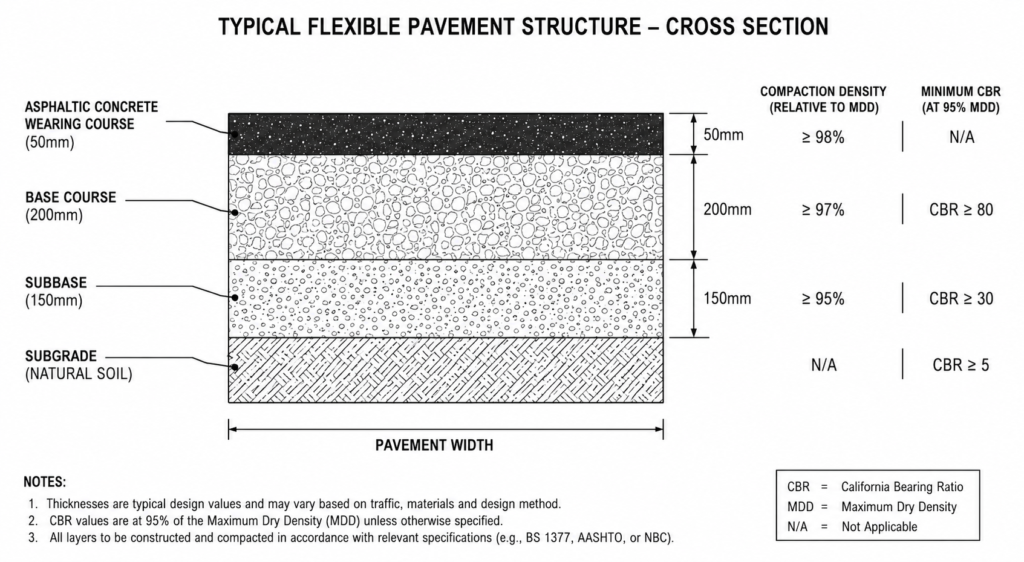
Pavement materials form the second major component. A standard flexible pavement on a Nigerian trunk road might consist of a 150mm subbase of selected granular material (CBR ≥ 30%), a 200mm base course of crushed stone or laterite-cement mix, and a 50mm asphaltic concrete wearing course. Each layer has a unit cost driven by material availability: lateritic material sourced within 10km of the site costs a fraction of crushed granite hauled 80km from a quarry in Ogun or Oyo State. Bitumen prices, which are tied to crude oil derivatives and largely imported, have historically been one of the most volatile inputs in Nigerian road budgets, with price swings of 30% or more within a single construction season not unusual.
Drainage Structures and Their Cost Weight
Drainage is frequently underestimated at the proposal stage but becomes one of the largest variable costs during construction. Side drains, culverts (pipe or box), and cross-drainage structures must be sized using hydrological data appropriate to the catchment — typically a design return period of 10 to 25 years for minor structures and up to 50 years for major bridges, in line with guidance referenced by the Nigerian Institution of Highway and Transportation Engineers (NIHTE). Underdesigned drainage leads to pavement failure within two to three rainy seasons, which then becomes a maintenance cost that dwarfs the original savings.
Bridge and Culvert Structural Costs
Where the alignment crosses a watercourse, the cost jumps significantly. A simple reinforced concrete box culvert spanning 2-3m might add ₦15-25 million to a project, while a reinforced concrete bridge with span lengths over 15m, requiring pile foundations driven to refusal in the soft alluvial soils typical of the Niger Delta, can add hundreds of millions of naira and extend the project timeline by several months due to the need for temporary works and dewatering.
Nigerian Context: Regulatory Requirements and Site Conditions
Cost estimation in Nigeria cannot be separated from the regulatory and physical environment in which projects are delivered. Designs that ignore local conditions almost always cost more in the long run, even if they appear cheaper on the initial tender.
The Federal Ministry of Works Highway Manual remains the primary reference for trunk road design parameters, including geometric standards, pavement design methods, and drainage criteria. For state and local government roads, design standards are often adapted from this manual but with reduced specifications appropriate to lower traffic volumes — a distinction that, if ignored, leads to over-engineered (and therefore overpriced) designs for low-volume rural roads. COREN-registered engineers are required to sign off on structural elements such as bridges and major culverts, and this professional certification step, while not a major direct cost, affects project timelines and therefore financing costs.
Soil conditions vary dramatically across Nigeria’s geological zones, and this variation is the single largest hidden cost driver. The lateritic soils common across much of the Middle Belt and parts of the South-West generally provide good subgrade support, with CBR values often exceeding 10% after compaction. By contrast, the alluvial and deltaic soils of the Niger Delta and parts of Lagos State frequently present CBR values below 3%, requiring either soil stabilisation (lime or cement, typically 3-5% by weight), geotextile separation layers, or full subgrade replacement — each option carrying a different cost profile that should be compared during detailed design, not assumed at concept stage.
Climate and seasonality also shape cost. The rainy season, which runs roughly from April to October across most of southern Nigeria and slightly shorter in the north, restricts earthworks and compaction activities. Contractors who fail to programme around this lose productive months, and the resulting schedule extension translates directly into higher mobilisation, supervision, and financing costs — often 8-12% of the original contract sum for projects that overrun by a full dry season.
Land acquisition and right-of-way issues add another layer of cost variability specific to the Nigerian context. Compensation for structures, crops, and land within the road reserve, governed by the Land Use Act, can introduce delays measured in months where communities dispute valuations — a cost factor that is administrative rather than engineering in nature but no less real on the project balance sheet.
Common Cost Overruns and Mistakes in Nigerian Transportation Projects
Most cost overruns on Nigerian road and bridge projects trace back to a small number of recurring mistakes, and recognising them early is the most effective way to protect a project budget.
The first mistake is conducting design based on desk studies or limited soil investigation. A geotechnical investigation that samples soil at 500m intervals along a 20km alignment, with boreholes to only 1.5m depth, will miss localised weak zones that surface during construction as unplanned soft spot treatments. Each unplanned soft spot — typically requiring excavation to 1-1.5m and replacement with selected fill — can cost ₦2-4 million per occurrence, and on a poorly investigated alignment, dozens of such spots can appear.
The second mistake is specifying pavement layers based on generic standards without verifying local material availability. A design that specifies crushed stone base course for a site where the nearest quarry is 100km away locks the project into high haulage costs from day one. Substituting a laterite-cement stabilised base, where local laterite meets the required plasticity index after stabilisation, can reduce this single cost component by 25-35% without compromising structural performance — but only if this substitution is evaluated during design, not negotiated mid-construction under pressure.
The third mistake is underestimating drainage and erosion protection, particularly on projects in areas with steep cross-slopes or high rainfall intensity. Gully erosion along unprotected side slopes in parts of Anambra and Imo States has, on multiple documented projects, required emergency remedial works costing more than the original drainage allocation for the entire project. Erosion protection — lined drains, check dams, and revegetation — is cheap relative to the cost of repairing a washed-out embankment.
The fourth mistake is poor sequencing of mobilisation against the rainy season calendar. Contractors who mobilise plant and begin earthworks at the start of the rains, rather than the start of the dry season, frequently find that the first two to three months of the contract period are largely unproductive — yet financing costs, site overheads, and security costs continue to accrue regardless.
Best Practices for Managing Transportation Engineering Costs
Controlling costs on a transportation project starts long before the first earthmover arrives on site. The following practices reflect how experienced Nigerian engineering teams keep budgets realistic and defensible.
Begin with a soil investigation programme proportional to the project’s scale and risk. For a major trunk road, this means boreholes at intervals not exceeding 300m, with dynamic cone penetrometer (DCP) testing between borehole locations to map subgrade variability continuously along the alignment. This data lets you select pavement designs that match actual ground conditions rather than worst-case or best-case assumptions.
次に, evaluate material sources before finalising pavement specifications. You should commission a materials survey identifying laterite borrow pits, quarry locations, and their haulage distances from each section of the alignment, then design pavement layers around what is locally available wherever the resulting structural performance is acceptable.
When you prepare the cost estimate, separate it into the three layers discussed earlier — geometric, structural, and execution — and apply different contingency percentages to each. Geometric costs, once the alignment is fixed, carry relatively low risk and might justify a 5% contingency. Structural costs, particularly drainage and any bridge works, carry moderate risk and warrant 10-15%. Execution costs — haulage, labour, and seasonal productivity — are the most volatile and often justify 15-20% contingency on projects in remote or environmentally challenging locations.
Programme the construction sequence around the dry season for earthworks and pavement layer construction, reserving wet-season activities for tasks less sensitive to moisture, such as structural concrete work on bridges and culverts where formwork and curing can be managed under cover.
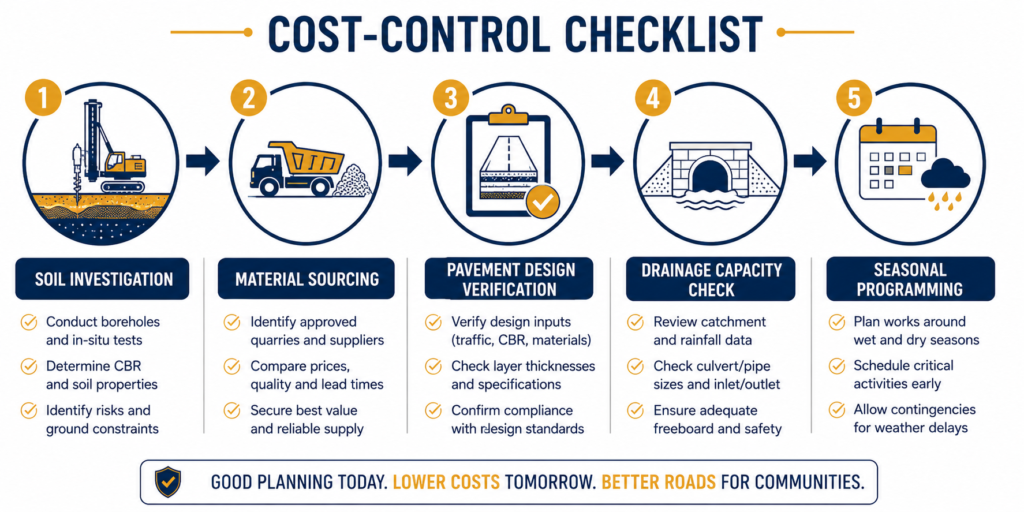
Finally, build a checklist into the design review stage that confirms: soil investigation data covers the full alignment at adequate intervals; pavement design matches the verified subgrade CBR; drainage capacity is checked against catchment hydrology, not just road geometry; material sources and haulage distances are confirmed, not assumed; and the construction programme accounts for seasonal access constraints. A design that passes this checklist is far less likely to generate the cost surprises that derail project budgets.
Frequently Asked Questions About Transportation Engineering
Q: What is transportation engineering in civil engineering?
A: Transportation engineering is the branch of civil engineering responsible for planning, designing, and constructing roads, highways, bridges, railways, and airports. It covers geometric design, pavement design, traffic analysis, and drainage, and in Nigeria it is guided primarily by the Federal Ministry of Works Highway Manual and standards referenced by COREN.
Q: How much does it cost to build a road per kilometre in Nigeria?
A: Costs typically range from around ₦150 million to over ₦500 million per kilometre for a standard two-lane carriageway, depending on terrain, soil conditions, and material haulage distances. Projects requiring soil stabilisation, imported aggregate, or extensive drainage structures fall toward the upper end of this range.
Q: What is the difference between subbase and base course in pavement design?
A: The subbase sits directly above the subgrade and is typically a granular material with a minimum CBR of around 30%, providing a working platform and load distribution. The base course sits above the subbase, is usually stiffer (often crushed stone or stabilised laterite), and bears the majority of structural load before it reaches the wearing course.
Q: Why do road construction costs vary so much between Nigerian states?
A: Cost variation is driven mainly by soil conditions, distance to material sources, and terrain. States with accessible lateritic soil and nearby quarries, such as parts of the Middle Belt, generally see lower per-kilometre costs than the Niger Delta region, where poor subgrade CBR values and long haulage distances increase both material and earthworks costs significantly.
Q: How does soil investigation affect transportation engineering costs?
A: A thorough soil investigation, with boreholes at intervals of 300m or less and DCP testing between them, allows pavement designs to match actual subgrade strength. Without this data, designers often over-specify pavement layers as a precaution, or under-specify them and face costly soft-spot treatments — both of which inflate the final project cost compared to a design based on accurate ground data.
The biggest transportation engineering cost factors on Nigerian projects are rarely the ones listed first in a generic estimate template. They are the soil conditions discovered only through proper investigation, the haulage distances that depend on where the nearest usable material sits, the drainage capacity that local hydrology actually demands, and the seasonal calendar that dictates when work can productively proceed. Engineers who treat these as design inputs from the start — rather than as risks to be absorbed later — produce budgets that survive construction. If you are scoping a road, bridge, or drainage project and want a cost estimate grounded in site-specific data rather than generic assumptions, explore our transportation engineering services or get in touch with the StruviaCore team to discuss your project.
For related reading, see our guides on road infrastructure development, bridge design and construction, pavement engineering fundamentals, and our breakdown of cost control strategies for civil engineering projects.
Leave a Reply