

Drive along the Lagos–Ibadan Expressway after a heavy rainstorm and you will see the difference between a road that was designed and one that was merely surfaced. Potholes don’t appear because asphalt is weak. They appear because someone, somewhere, got the layer beneath it wrong — the subgrade, the drainage, the compaction, or the traffic loading assumption. Roads look simple from the windscreen of a car, but they are one of the most calculation-heavy structures a civil engineer designs, carrying repeated dynamic loads over decades while resisting water, heat, and traffic growth that nobody fully predicts at design stage.
This piece sets out what roads actually are as engineered systems, how they’re designed and built, the codes and institutions that govern them across markets like Nigeria, the UK, and the Gulf, and the mistakes that turn a properly specified road into a five-year liability. If you’re a site engineer, a project manager pricing a contract, or a student trying to connect the textbook to the trench, this is the practical version.
Roads: Quick Answer
A road is an engineered structure built in layers — subgrade, sub-base, base, and a wearing surface — designed to spread vehicle loads across the ground without excessive deformation or water damage. Engineers size each layer using soil strength data (commonly CBR), projected traffic loading, and a recognised design method such as the TRL Road Note 31 or AASHTO 1993 procedure.
What Is a Road, Structurally Speaking?
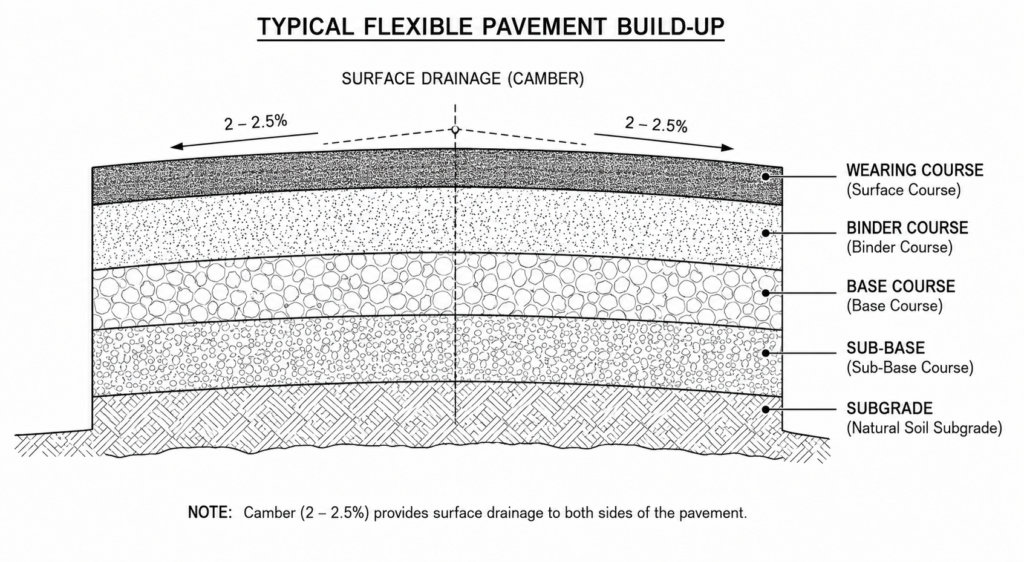
A road is not a slab of asphalt sitting on dirt. It’s a layered structural system, and each layer has a defined job. The wearing course at the top resists abrasion, sheds water, and gives skid resistance. Below it, the base course carries most of the structural load and spreads stress before it reaches the ground. The sub-base works as a transition and drainage layer, and at the bottom, the subgrade — the natural or improved ground — has to carry everything above it without rutting, swelling, or collapsing under repeated wheel loads.
This stacking exists because no single material is strong enough and cheap enough to do the whole job alone. A 50mm asphalt wearing course laid directly on weak Lagos clay would fail within months under trailer traffic. The layers below it exist specifically to reduce the stress reaching the subgrade to a level the soil can tolerate — engineers call this load transfer, and it’s the entire logic behind pavement design.
Flexible vs Rigid Pavements
Most of the projects you’ll work on in Nigeria, the UK, or the wider West African market are flexible pavements — asphalt or bituminous surfacing over granular or stabilised layers, designed to flex slightly under load and recover. Rigid pavements, by contrast, use a continuously reinforced or jointed concrete slab that distributes load through bending strength rather than layer compaction. You’ll see rigid pavements at port approaches, weighbridge aprons, and some urban junctions in Abuja where heavy axle loads and channelised traffic make asphalt rutting a recurring problem.
The choice between the two isn’t aesthetic. Flexible pavements cost less upfront and are faster to repair, but they need periodic resurfacing every 7–15 years depending on traffic. Rigid pavements cost more initially, often 20–35% above an equivalent flexible design, but can serve 30–40 years with minimal maintenance if the subgrade and joints are detailed correctly. A contractor pricing a rural trunk route in Nasarawa State and one pricing a container terminal access route in Port Harcourt are solving fundamentally different engineering problems, even though both sit under the same broad classification.
Subgrade: The Layer Everyone Underestimates
The subgrade is the single biggest variable in road performance, and it’s also the layer most frequently shortchanged on Nigerian sites. In Lagos, you’re often dealing with soft, high-water-table sandy or peaty soils near the lagoon fringe, sometimes with CBR values below 5%. In Abuja and much of the Middle Belt, lateritic soils with moderate plasticity give CBR values of 15–25%, which is far friendlier to design. In Port Harcourt and the wider Niger Delta, organic and swampy deposits can produce CBR values close to zero, forcing engineers into full subgrade replacement or chemical stabilisation before any pavement layer goes down. A soil investigation isn’t a formality — it’s the number that decides whether your pavement is 300mm thick or 600mm thick.
Not every alignment gets a sealed wearing course, and that’s a deliberate engineering choice rather than a shortcut. Across rural Nigeria and much of the developing road network in West Africa, unsealed laterite or gravel surfacing remains common on low-volume access routes where traffic counts don’t justify the capital cost of bitumen. These surfaces still follow layer logic — a compacted lateritic wearing layer over a prepared subgrade — but they trade long-term durability and dust control for a lower upfront cost, and they need more frequent grading and re-gravelling to stay serviceable through the wet season. Specifying gravel over asphalt isn’t a downgrade; it’s a traffic-volume decision that should be revisited as a feeder route matures into a higher-traffic corridor.
How Roads Are Designed: Methods, Calculations, and Standards
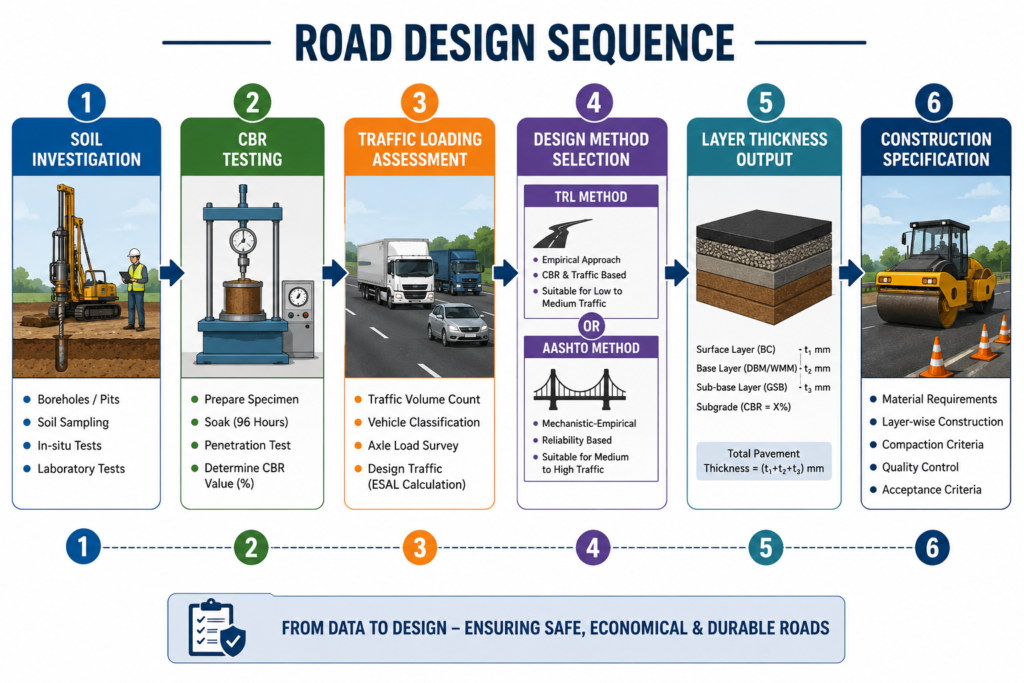
Pavement design starts with two inputs: how strong is the ground, and how much traffic will the road carry over its design life. Everything else follows from those two numbers.
Engineers determine subgrade strength through a geotechnical investigation — typically boreholes or trial pits at intervals along the alignment, combined with California Bearing Ratio (CBR) testing per BS 1377 or its locally adapted equivalents. The CBR value tells you how the soil performs under a standard penetration load relative to crushed stone, and it directly drives layer thickness. A subgrade with a CBR of 3% needs a far thicker pavement build-up than one with a CBR of 20% to carry the same traffic.
Traffic loading is converted into Equivalent Standard Axle Loads (ESALs) or, in the TRL method common across West Africa, cumulative standard axles over the design period — usually 10, 15, or 20 years. This is where many cost overruns originate: traffic counts done over a single dry-season week, extrapolated with a generic growth rate, routinely underestimate actual loading on Nigerian trunk roads, where overloaded trucks are common despite axle load limits set by the Federal Road Safety Corps and state weighbridge regulations.
With CBR and traffic data fixed, engineers use one of several established methods to size each layer:
- TRL Road Note 31 — the most widely applied method for tropical and sub-tropical roads, including across Nigeria, Ghana, and much of East and West Africa, calibrated for lateritic materials and tropical climate behaviour.
- AASHTO 1993 Guide — used where international funding agencies or design consultants apply US-calibrated structural number methods, often cross-checked against TRL outputs on the same project.
- Mechanistic-empirical design — increasingly used on major dual-carriageway and expressway projects, modelling stress and strain through the pavement layers using material properties rather than empirical charts alone.
Each method outputs a structural number or layer thickness schedule, which the design engineer then converts into a buildable specification: sub-base thickness, base course material and compaction requirements, and surfacing type and thickness. For more on how this connects to the wider discipline, see this pavement engineering overview, which covers material testing in more depth than this piece can.
Roads on the Ground: Regulatory Framework and Site Conditions
Design calculations only matter if the construction process and the regulatory framework around it hold up. In Nigeria, road projects on federal trunk roads follow the Federal Ministry of Works General Specification for Roads and Bridges, while state and local roads often follow adapted versions of the same document with regional modifications for material availability. Engineers practising in this space are expected to be registered with the Council for the Regulation of Engineering in Nigeria (COREN), and materials testing — from aggregate grading to asphalt mix design — references Nigerian Industrial Standards (NIS) alongside British Standards still widely adopted across the sector, such as BS 594987 for asphalt surfacing materials.
Site conditions vary enormously across the three cities engineers reference most often in West African practice. Lagos presents high water tables, reclaimed land with variable fill quality, and tidal influence near the lagoon — meaning drainage design and subgrade improvement dominate the cost and risk profile. Abuja’s lateritic terrain is generally more forgiving geotechnically, but rapid urban expansion has pushed road projects into areas with inconsistent compaction history and undocumented utility crossings. Port Harcourt combines the worst of both: soft organic soils, high rainfall intensity, and flooding risk that makes drainage design — not pavement thickness — the determining factor in whether a road survives its first wet season.
International contractors and consultants working across these markets need to reconcile specifications, too. A design built around AASHTO assumptions for material gradation won’t automatically satisfy a Nigerian state ministry’s approval process, and BS-based testing regimes don’t map one-to-one onto ASTM equivalents. Reconciling these standards early in the design phase — not after tender award — avoids the redesign delays that derail project schedules. This is closely tied to wider geotechnical engineering practice, since almost every road problem traces back to a soil assumption made (or skipped) at the start.
Common Challenges, Failure Mechanisms, and Cost Factors
Most road failures fall into a short list of repeat offenders, and recognising them early saves money that’s far harder to recover once asphalt is already laid.
Inadequate drainage causes more pavement failure than any other single factor in Nigerian road construction. Water trapped beneath the surface softens the subgrade, and once the subgrade loses strength, the layers above it crack and deform regardless of how well they were specified. A road built to a correct structural design but missing side drains, cross-falls, or culverts at low points will fail years ahead of its design life.
Overloading compounds the problem. Axle loads above the legal limit don’t just cause proportional extra wear — pavement damage from overloaded axles increases roughly with the fourth power of the load increase, meaning a truck running 20% over its legal axle load can cause more than double the structural damage of a compliant vehicle. This is why weighbridge enforcement matters as much as design quality.
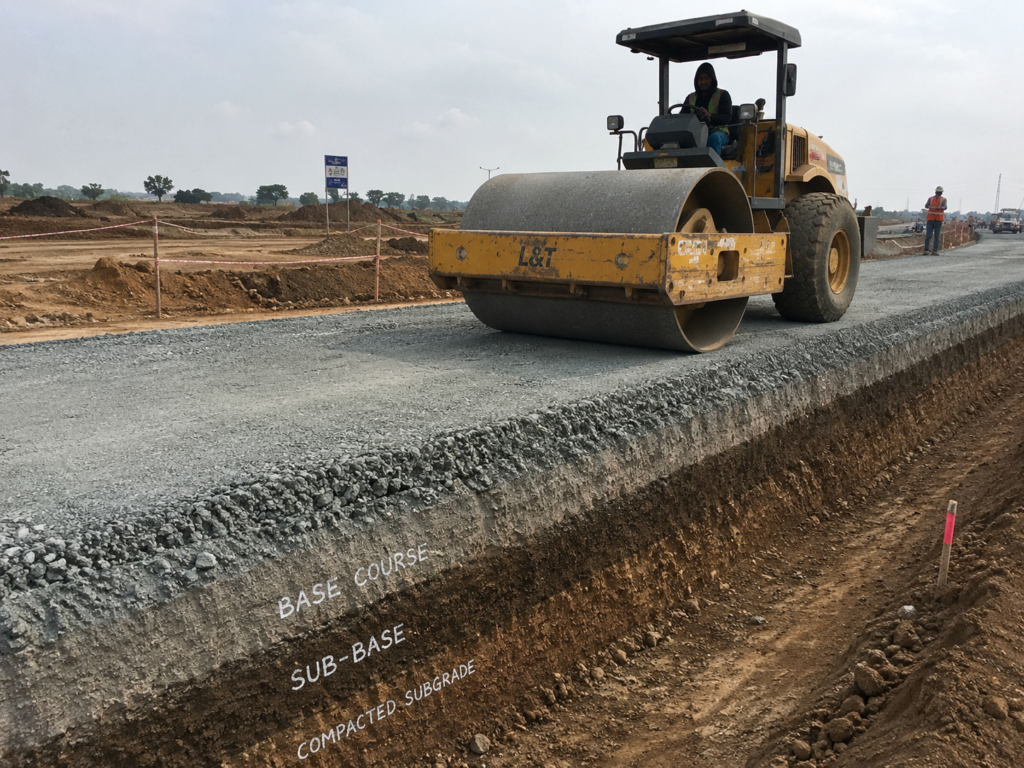
Poor compaction during construction is the failure mode most directly under the contractor’s control and most frequently skipped under schedule pressure. Each layer needs verified compaction — typically 95–98% of maximum dry density per modified AASHTO or BS 1377 compaction tests — confirmed by field density testing, not visual inspection. Skipping this step to save a day on programme routinely costs far more in early-life rutting and patching.
Cost factors on road projects break down into predictable categories: haulage distance to source quarry or borrow pit material, which can dominate budgets on projects far from established quarries; subgrade treatment requirements, which can double pavement cost on poor soils like those near the Lagos lagoon fringe; drainage structures and culverts, often underestimated at tender stage; and bitumen price volatility, since asphalt binder costs are tied to crude oil pricing and currency exchange rates in import-dependent markets. A realistic cost plan treats these as line items, not contingency. You can compare these against general road construction cost factors when building your own estimate.
Best Practices: A Construction-Stage Checklist
Getting a road design right on paper is half the job. Getting it right on site is the other half, and that’s where most of the value — or the loss — actually happens. Use the following as a working checklist on your next project.
- Verify subgrade CBR at multiple points along the alignment, not just at the design borehole locations. Soil conditions change over even short distances, especially across reclaimed or transitional ground.
- Confirm drainage design before pavement construction starts, including side drains, culvert capacity for the local rainfall intensity, and cross-fall gradients — retrofitting drainage after surfacing is far more expensive than building it in sequence.
- Test compaction layer by layer, with field density results recorded against the specified target before the next layer goes down. Don’t let programme pressure compress this into a single test at the end.
- Match material specification to the actual design method used — if your design ran on TRL Road Note 31 assumptions, your material testing should reference the same standard, not a mismatched AASHTO or ASTM equivalent.
- Plan for maintenance from day one, including a resurfacing interval appropriate to traffic loading and a drainage inspection schedule, since reactive pothole repair costs far more per square metre than scheduled resurfacing.
If you’re managing a multi-kilometre alignment with variable ground conditions, treat each homogeneous section as its own mini-design rather than applying one pavement thickness across the whole route. You’ll spend more time on the design phase, but you’ll avoid the common outcome of one section failing at year three while the rest of the road performs as expected for fifteen.
Frequently Asked Questions About Roads
Q: What is a road in civil engineering terms?
A: In civil engineering, a road is a designed, layered ground structure built to carry vehicle and pedestrian traffic loads safely over a defined design life, typically 10–20 years. It consists of a prepared subgrade, sub-base, base course, and wearing surface, each sized using soil strength data and projected traffic loading rather than fixed standard dimensions.
Q: How does road pavement design actually work?
A: Pavement design works by combining two measured inputs — subgrade strength (commonly CBR) and projected traffic loading over the design period — and applying a recognised method such as TRL Road Note 31 or the AASHTO 1993 Guide to calculate the required thickness of each layer. The output is a layer-by-layer construction specification, not a single number.
Q: What is the difference between flexible and rigid pavement?
A: Flexible pavement uses asphalt over granular layers and distributes load through layer compaction, costing less upfront but needing resurfacing every 7–15 years. Rigid pavement uses a concrete slab that distributes load through bending strength, costing 20–35% more initially but lasting 30–40 years with minimal maintenance under heavy or channelised traffic.
Q: How much does road construction cost per kilometre in Nigeria?
A: Costs vary widely based on subgrade condition, drainage requirements, and material haulage distance, but rural single-carriageway flexible pavement projects commonly range from tens of millions to over a hundred million naira per kilometre, while dual-carriageway urban roads with structures and utilities cost significantly more. Soft ground requiring stabilisation, such as sections near the Lagos lagoon fringe, can push costs well above standard estimates.
Q: What causes potholes to form on newly built roads?
A: Potholes typically form when water penetrates the pavement through cracks or inadequate drainage, softening the base course or subgrade beneath the surface. Once the supporting layer loses strength, traffic loading breaks the surface from underneath, and what starts as a small crack becomes a pothole within one or two rainy seasons if left unaddressed.
Q: What standards govern road design in Nigeria?
A: Federal trunk roads in Nigeria are designed and constructed under the Federal Ministry of Works General Specification for Roads and Bridges, with materials testing referencing Nigerian Industrial Standards (NIS) and British Standards such as BS 1377 for soil testing and BS 594987 for asphalt materials. Engineers practising on these projects are typically registered with COREN.
Roads succeed or fail on decisions made before the first truckload of asphalt arrives: the soil investigation, the traffic loading assumption, the drainage layout, and the compaction discipline on site. Treating a road as a single surfacing job rather than a layered structural system is the single most common reason projects underperform their design life. Get the subgrade right, design drainage as a primary system rather than an afterthought, and match your material specification to the design method you actually used.
If you’re scoping a road project — whether a short access route or a multi-kilometre trunk realignment — StruviaCore’s structural and civil engineering team can review your geotechnical data, pavement design, and specification before tender. Get in touch to discuss your site conditions, or explore our related guide on asphalt materials and mix design for the surfacing layer decisions covered only briefly here.
Leave a Reply