
Drive along the Abuja–Kaduna Expressway, cross the Third Mainland Bridge in Lagos, or navigate the growing ring-road network around Port Harcourt, and you are experiencing decades of transportation engineering decisions made visible. Some of those decisions were sound. Others — crumbling asphalt shoulders, under-designed drainage channels, bridges with no pedestrian provision — reveal what happens when the discipline is misunderstood, underfunded, or simply rushed past.
Transportation engineering is the branch of civil engineering concerned with the safe, efficient, and sustainable movement of people and goods across road, rail, air, and waterway networks. It covers everything from the geometric alignment of a single carriageway to the traffic signal timing of an entire metropolitan corridor. Done well, it reduces journey times, lowers accident rates, supports economic growth, and forms the backbone of functional urban infrastructure. Done poorly, it costs lives and money for generations.
This article explains what transportation engineering actually involves — the core disciplines, the technical methods, the regulatory context relevant to practitioners working across Nigeria and the wider global market, the common pitfalls on real projects, and the best practices that separate durable infrastructure from expensive rework.
Transportation Engineering: Quick Answer
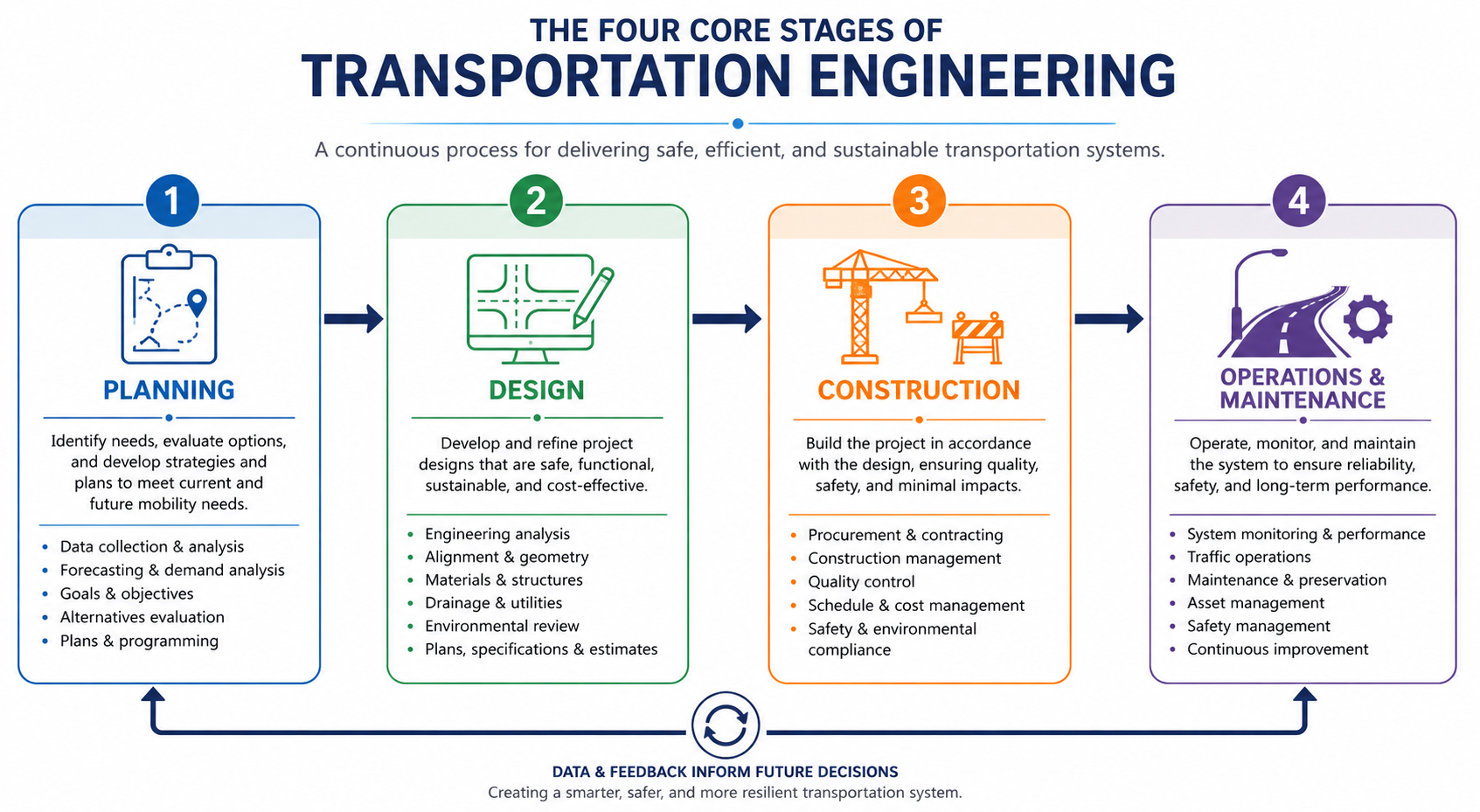
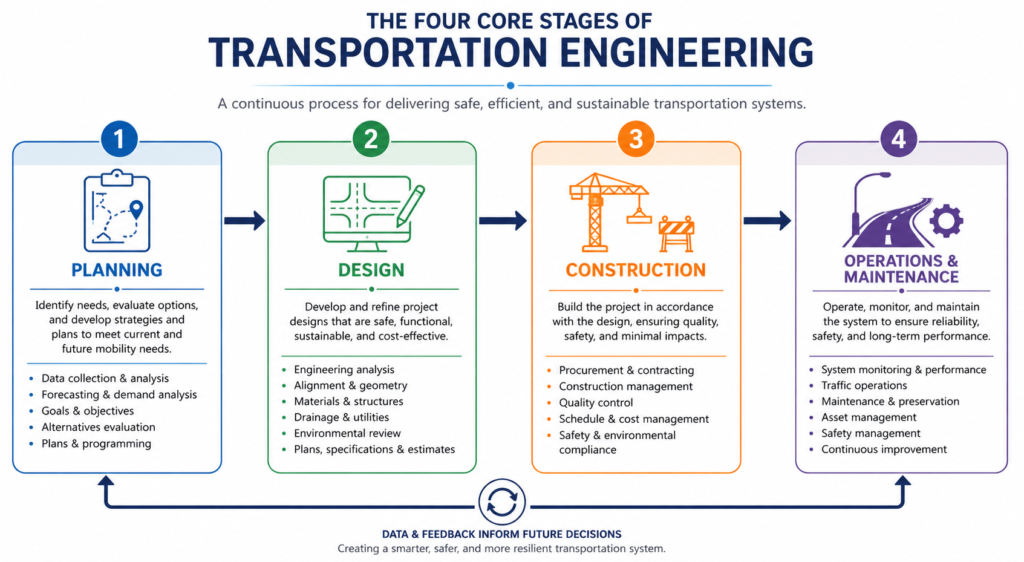
Transportation engineering is the application of engineering principles to the planning, design, construction, operation, and management of transport systems — roads, bridges, railways, airports, and ports. It integrates traffic analysis, geometric road design, pavement engineering, and drainage to move people and goods safely and efficiently. The discipline is governed by codes such as the Nigerian Highway Manual, BS EN standards, and AASHTO geometric design guides where applicable on international projects.
What Transportation Engineering Actually Covers
The term is sometimes used loosely to mean “road design.” That framing misses most of the discipline. Transportation engineering sits at the intersection of several technical fields, and a competent practitioner must move between them depending on the project phase and infrastructure type.
The Core Sub-Disciplines
Traffic engineering deals with the behaviour of vehicles, pedestrians, and cyclists within existing networks. It uses observed volume counts, speed surveys, and origin-destination studies to model how demand moves through a system — and where it will fail under projected growth. A traffic impact assessment for a new commercial development in Lekki, for example, requires intersection capacity analysis using Highway Capacity Manual (HCM) methods, adjusted for the gap-acceptance behaviour and mixed-traffic conditions common to Nigerian urban roads.
Geometric design governs the physical layout of roads — horizontal and vertical alignment, cross-section elements, sight distances, and junction arrangements. Nigerian practice draws primarily from the Nigerian Highway Manual (Federal Ministry of Works) and, on federal projects, the AASHTO Green Book for design speed and stopping sight distance standards. On urban collector roads in Lagos State, the Lagos State Urban Transport Authority (LAMATA) publishes supplementary design standards that practitioners must reference alongside federal guidance.
Pavement engineering sits within the broader transportation remit and addresses the structural design of road surfaces — selecting layer compositions, thicknesses, and materials that can carry the expected Equivalent Standard Axle Load (ESAL) over the design life, typically 15–20 years for a flexible pavement. In laterite-heavy regions of southwest Nigeria, subgrade CBR values can vary from under 3% in waterlogged clay to over 15% in well-drained gravelly soils, making accurate subgrade characterisation non-negotiable before any pavement design proceeds.
Transport planning works at the strategic level — modelling future travel demand, assessing modal options (road, rail, waterway), and producing the master plans that guide infrastructure investment decisions. This is where transportation engineers interact directly with urban planners, economists, and government agencies. COREN-registered engineers working on federal transport projects are required to sign off on technical submissions; non-registered consultants cannot legally do so under the Engineers (Registration, etc.) Act.
The Interplay with Other Engineering Disciplines
A dual carriageway project rarely sits in isolation. It requires structural engineering input for bridges and overpasses, geotechnical investigation to classify the subgrade and any unstable ground, hydraulic design for culverts and drainage, and sometimes environmental engineering where the alignment crosses ecologically sensitive terrain. The transportation engineer coordinates these inputs into a coherent design package — which is why the role demands both technical breadth and project management clarity.
Key Technical Methods in Transportation Engineering
Understanding the vocabulary of transportation engineering helps clients, project managers, and junior engineers engage meaningfully with the technical process rather than treating it as a black box.
Traffic Modelling and Demand Forecasting
Traffic volume is counted using manual classified counts (MCC) or automatic traffic counters (ATC), typically over a minimum seven-day period to capture weekly variation. Peak hour factors (PHF) are calculated to identify the busiest 15-minute interval within the peak hour — a figure that drives junction design. On inter-urban routes, Annual Average Daily Traffic (AADT) figures are used to project 20-year design traffic volumes using growth rates derived from historical counts or economic projections.
Software such as VISSIM, SIDRA Intersection, and VISUM is widely used for micro- and macro-simulation. On simpler junctions, the ARCADY and PICADY tools (originally developed by TRL in the UK and adopted across Commonwealth practice) remain standard for roundabout and priority junction capacity analysis. Nigerian practitioners should verify software applicability against local driving behaviour, particularly at uncontrolled intersections where gap acceptance differs markedly from the calibration data underpinning UK-derived models.
Road Geometric Design
Horizontal alignment uses circular curves, transition spirals, and tangent sections to define the road’s path in plan. The minimum radius for a given design speed is set by the relationship between centripetal acceleration and superelevation — a 100 km/h design speed road requires a minimum horizontal curve radius of approximately 700 m under the Nigerian Highway Manual, rising to 900 m if the full superelevation runoff is to be achieved comfortably. Vertical alignment uses gradients and parabolic curves to manage sight distance and drainage. A maximum gradient of 8% is generally acceptable on rural roads; steeper grades require detailed stopping sight distance checks and, on heavily trafficked freight routes, crawler lane provision.
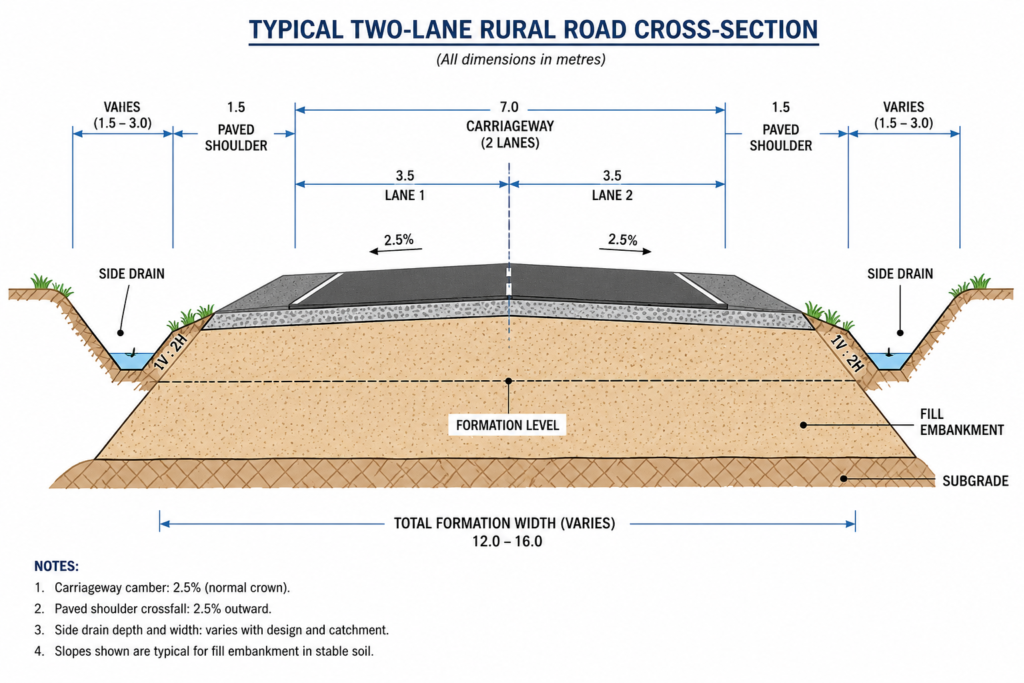
Cross-section design determines lane widths (typically 3.5–3.7 m for rural highways), shoulder widths, median treatment, and side slope gradients. Road drainage is integral to geometric design — a minimum cross-fall of 2.5% on paved surfaces directs surface water toward channels, and longitudinal gradients of at least 0.5% prevent water ponding in flat terrain.
Pavement Structural Design
Flexible pavement design in Nigeria follows the AASHTO 1993 Guide or the Road Note 31 (TRL) methodology, depending on client preference and the availability of local calibration data. The design process begins with a subgrade classification — typically expressed as a California Bearing Ratio (CBR) percentage determined from laboratory testing of remoulded samples at field moisture conditions. Sub-base and base course thicknesses are then derived from the design ESAL count and the structural number (SN) equation. Asphalt surface courses are typically 50 mm of Dense Bitumen Macadam (DBM) or Asphaltic Concrete (AC) on primary roads, with binder course thicknesses increasing on high-volume routes.
On roads subject to heavy goods vehicle (HGV) loading — fuel tanker routes in the Niger Delta, cement distribution roads in Ogun State — a damaging factor (DF) of 2.0–3.0 per overloaded vehicle is realistic, meaning one 20-tonne overloaded axle inflicts the equivalent pavement damage of several hundred standard axle passes. This is why axle load monitoring and enforcement at weigh-in-motion stations are inseparable from pavement life — design and enforcement are two sides of the same problem.
The Regulatory and Institutional Context
Transportation engineering in Nigeria operates within a layered regulatory environment. At the federal level, the Federal Ministry of Works is responsible for federal trunk roads and sets the technical standards that govern their design, construction, and maintenance. The Federal Roads Maintenance Agency (FERMA) manages the maintenance of this network. State ministries of works handle state roads, with Lagos State’s significant transportation investment overseen partly through LAMATA, which coordinates mass transit and road corridor projects under a public-private partnership model.
COREN registration is mandatory for engineers signing off technical designs on public infrastructure projects. This applies to both the design consultant and, on larger contracts, the resident engineer supervising construction. The Nigerian Institute of Civil Engineers (NICE) and the Nigerian Society of Engineers (NSE) provide professional development frameworks that transportation engineers are expected to participate in throughout their careers.
On federal highway projects, the specification for materials and workmanship draws from the General Specifications for Roads and Bridges published by the Federal Ministry of Works — a document that practitioners should treat as a living standard, cross-referencing it against the latest revision before tendering. International projects, or projects funded by multilateral lenders such as the African Development Bank (AfDB) or World Bank, typically require compliance with additional environmental and social safeguard standards that sit above the domestic regulatory minimum.
For projects that include significant bridge or overpass elements, structural engineering principles governed by BS EN 1991-2 (Eurocode: Traffic Loads on Structures) apply to loading assumptions, and the bridge design must account for the passage of abnormal indivisible loads (AIL) where relevant routes serve industrial or oil-and-gas infrastructure.
Common Challenges and Cost Factors on Transportation Projects
Transportation projects across Nigeria and the broader sub-Saharan African market share a set of recurring challenges that consistently inflate costs and extend delivery timelines. Understanding them at project initiation — not after mobilisation — separates projects that are delivered on budget from those that are not.
Right-of-way (RoW) acquisition is the single most common source of cost overrun on Nigerian road projects. Where RoW is not secured before design finalisation, late changes to horizontal alignment can render months of detailed design work worthless. Federal and state RoW acquisition follows the Land Use Act 1978, which vests all land in state governors — but the practical process of compensation and resettlement can extend over years on politically sensitive corridors. Engineers should flag unresolved RoW as a project risk at feasibility stage, not a construction-phase problem.
Subgrade variability is a technical challenge that surprises practitioners who import generic design approaches without adequate site investigation. The Lagos coastal plain, for example, includes areas of soft marine clay with undrained shear strengths as low as 10–20 kPa, requiring ground improvement or lightweight fill — conditions that demand geotechnical engineering input from the earliest design stage. In contrast, the Abuja plateau’s weathered basement complex can produce excellent subgrade conditions but with highly variable depth to rock, affecting culvert design and formation level decisions.
Drainage failure is the primary cause of premature pavement deterioration on Nigerian roads. Many roads designed to a 15-year pavement life deteriorate within five years — not because the pavement structural design was wrong, but because the drainage design was inadequate, allowing water to saturate the subgrade and strip the base course. Designing side drains, culverts, and mitre drains to handle the 1-in-10-year storm event (Q10) is the minimum standard; on primary roads, a 1-in-25-year event (Q25) is more appropriate.
Materials quality control on remote sites is another consistent challenge. Bitumen sourced from local depots can vary in penetration grade (typically 60/70 pen is specified, but 80/100 or lower-grade material sometimes enters the supply chain), and aggregate crushing values may not meet the maximum 30% specified for wearing course materials. A robust mix design programme — with independent laboratory verification — is not an optional add-on; it is the difference between a road that lasts and one that ravels within two rainy seasons.
Understanding the full cost picture also means accounting for lifecycle costs, not just capital expenditure. A road built to a higher pavement standard at ₦50 million per kilometre may cost 20–30% more than a lower specification, but maintenance costs over a 20-year period can be three to four times lower — a calculation that client-side engineers must be able to articulate clearly to procurement decision-makers focused only on initial bid price.
Best Practices for Delivering Transportation Engineering Projects
The following practices apply whether you are a consultant preparing a feasibility study, a contractor executing a road rehabilitation, or a client-side engineer managing delivery on behalf of a government agency.
- Commission a traffic and transport study before fixing the design standard. Design speed, lane configuration, and junction type should follow from forecast traffic volumes — not from assumptions or precedent. A road designed for 2,000 vehicles per day (vpd) has fundamentally different geometry to one designed for 15,000 vpd, and the cost difference between them is not a saving if demand exceeds the lower figure within five years.
- Conduct a minimum of one borehole or trial pit per 500 m of road alignment, plus additional investigation at all bridge foundations, major culvert locations, and areas of known problematic geology. Subgrade investigation is cheap relative to its cost when omitted.
- Design drainage as a primary element, not a secondary consideration. Calculate catchment areas, determine peak flow using the Rational Method or unit hydrograph as appropriate, and size all drainage structures to the specified return period before the pavement design is finalised.
- Integrate road safety audit (RSA) at each design stage. A Stage 1 RSA at scheme design, Stage 2 at detailed design, and Stage 3 before opening to traffic is the standard recommended under the UK’s HD 19/15 guidance, which Nigerian practitioners can adopt as best practice where no equivalent domestic standard exists. RSA has consistently been shown to reduce the number and severity of road accidents — a measurable outcome, not a procedural formality.
- Specify materials testing frequency in the contract. For asphalt works, Marshall stability and flow tests should be conducted for every 500 tonnes of mix produced, with field core density checks every 1,000 m² of laid surface. For base course compaction, nuclear density gauge readings at a frequency of one per 1,000 m² minimum, with sand replacement tests for calibration.
- Require an as-built survey of all drainage and service crossings before issuing the taking-over certificate. Drainage structures that are not as-built surveyed disappear from institutional memory and cannot be maintained or located when they inevitably require repair.

For projects involving bridges or grade-separated junctions, the best-practice checklist extends to include hydraulic analysis of waterway crossings, scour protection design for bridge foundations, and a clear maintenance access strategy built into the structure’s geometry from the start. Bridge engineering is a discipline in its own right, but transportation engineers must be fluent enough in its principles to coordinate effectively with specialist structural designers.
Urban mobility projects — bus rapid transit (BRT) corridors
Leave a Reply