
Walk past any construction site in Lagos, Abuja, or Port Harcourt and you will see reinforced concrete frames, steel roof trusses, retaining walls, foundations, and elevated water tanks taking shape. What most people do not see is the engineering work that determines whether those structures will safely carry loads for decades or develop cracks, excessive settlement, or even collapse. That responsibility falls largely on structural engineers.
Structural engineering sits at the centre of the construction industry. It combines mathematics, mechanics, material science, and practical construction knowledge to create structures that can safely resist loads from occupants, equipment, wind, rainfall, and environmental effects. In Nigeria, structural engineers work closely with architects, civil engineers, geotechnical specialists, quantity surveyors, contractors, and regulatory authorities to deliver safe and economical projects.
The consequences of poor structural design are well known. Several building failures reported across Nigerian cities have highlighted the need for proper design verification, soil investigation, construction supervision, and compliance with recognised standards. This makes structural engineering a discipline that directly affects public safety.
This article explains what structural engineering is, how it works, the major structural systems used in construction, the regulatory framework in Nigeria, common challenges encountered on projects, and the practices that experienced engineers follow to deliver reliable structures.
Related reading: structural engineering guide
Structural Engineering: Quick Answer
Structural engineering is the branch of civil engineering that analyses, designs, and assesses structures so they can safely resist loads and remain stable throughout their service life. Structural engineers design buildings, bridges, towers, foundations, and other infrastructure using recognised engineering principles, material standards, and construction codes.
What Structural Engineering Is and How It Works
Structural engineering is a specialised branch of civil engineering concerned with the behaviour and design of structures under different loading conditions. Every structure experiences forces. These forces may come from the self-weight of the structure, occupants, machinery, wind pressure, water pressure, traffic movement, or environmental effects.
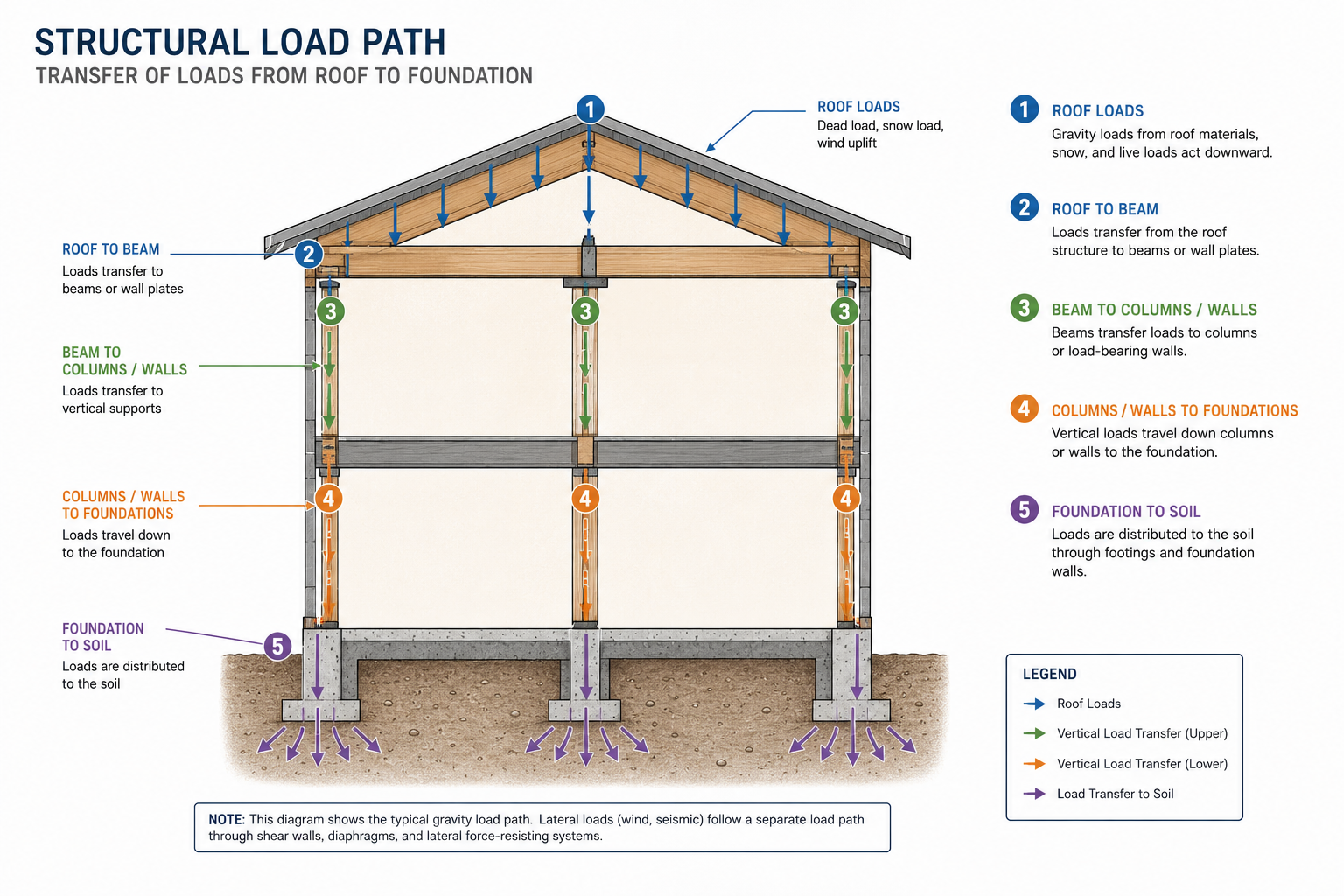
The structural engineer’s role is to determine how those forces travel through a structure and eventually transfer safely into the ground. This process is commonly referred to as the load path.
When a roof slab carries loads, those loads move into beams. The beams transfer them into columns or walls. The columns transfer the loads into foundations, which distribute them into supporting soil layers. If any part of this load path is incorrectly designed, structural distress can occur.
Structural engineering therefore focuses on three fundamental objectives:
- Safety against collapse
- Serviceability during normal use
- Economical use of materials and construction resources
A structure may be strong enough to avoid collapse but still fail serviceability requirements. Excessive deflection, unacceptable cracking, vibration, and water ingress can make a building unsuitable for use even when collapse is not imminent.
Structural engineers analyse these conditions using engineering calculations, computer modelling software, site investigations, and material testing data.
The Relationship Between Structural and Civil Engineering
Many people use the terms civil engineering and structural engineering interchangeably. While structural engineering falls within civil engineering, the two are not identical.
Civil engineering covers transportation systems, highways, drainage networks, water supply systems, hydraulic structures, environmental infrastructure, geotechnical works, and buildings. Structural engineering focuses specifically on the load-bearing components of structures.
For example, on a housing estate project, a civil engineer may design drainage channels, access roads, and utility networks, while a structural engineer designs foundations, columns, beams, slabs, and retaining structures.
For a broader understanding of ground conditions that affect structural performance, see our article on geotechnical engineering principles.
What Structural Engineers Actually Design
Structural engineers work on a wide range of projects across the built environment. Common examples include:
- Residential buildings
- Commercial developments
- Industrial facilities
- Bridges and flyovers
- Water retaining structures
- Telecommunication towers
- Steel warehouses
- Retaining walls
- Marine structures
- Infrastructure support systems
Each project presents unique loading conditions, environmental influences, and construction constraints. A multi-storey residential development in Victoria Island may require deep foundations because of weak coastal soils, while a similar structure in parts of Abuja may be supported by shallower foundation systems due to stronger bearing strata.
Key Principles That Govern Structural Design
Although structural engineering projects vary significantly, the same engineering principles apply throughout the profession.
Equilibrium requires that all forces acting on a structure balance correctly.
Strength requires every structural member to resist applied loads without failure.
Stability prevents overturning, sliding, buckling, and progressive collapse.
Serviceability controls deflection, vibration, cracking, and user comfort.
Durability addresses long-term performance under environmental exposure, corrosion, moisture, and chemical attack.
Modern structural engineering design incorporates all these requirements simultaneously rather than treating them as separate considerations.
Structural Engineering Design Process and Structural Systems
Structural design follows a systematic process. While project complexity varies, experienced engineers generally move through a sequence of investigations, calculations, modelling, detailing, and review activities before construction begins.
Each stage contributes directly to the safety and performance of the completed structure.
Stage 1: Site Investigation and Data Collection
Structural design begins with understanding the project site. Engineers gather information about topography, intended building use, architectural layout, groundwater conditions, and soil properties.
Geotechnical investigation plays a central role during this stage. Borehole data, cone penetration testing, laboratory analysis, and groundwater observations help determine bearing capacity, settlement characteristics, and foundation requirements.
In Lagos, weak compressible soils often necessitate pile foundations for larger developments. In parts of Abuja, engineers may encounter residual soils and weathered rock formations that can support alternative foundation systems.
The quality of structural design depends heavily on the quality of site information available at this stage.
Stage 2: Load Assessment and Structural Analysis
After collecting site information, engineers determine the loads acting on the structure.
Typical load categories include:
- Dead loads from structural self-weight
- Imposed loads from occupants and equipment
- Wind loads
- Rainwater loads
- Hydrostatic pressures
- Construction loads
- Accidental loads where applicable
These loads are evaluated according to recognised design standards and combined using prescribed load combinations.
Engineers then perform structural analysis to determine internal forces, bending moments, shear forces, axial loads, and reactions throughout the structure.
Software packages such as ETABS, SAFE, SAP2000, STAAD.Pro, and Robot Structural Analysis are commonly used. However, software does not replace engineering judgement. Experienced engineers verify outputs through hand calculations and independent checks.
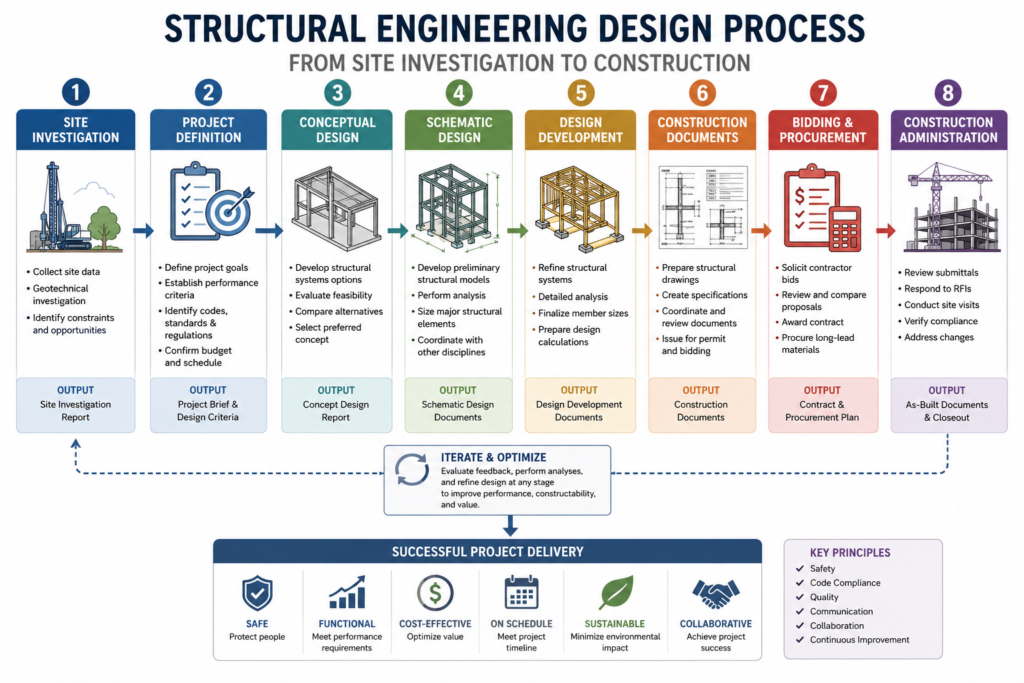
Stage 3: Selection of Structural Systems
The structural system determines how loads travel through a structure. Different systems suit different project requirements.
Reinforced concrete frames remain the most widely used structural system in Nigeria because concrete materials are readily available and contractors are familiar with construction methods.
Structural steel systems offer faster erection speeds and longer spans. They are commonly used for warehouses, factories, event centres, and industrial facilities.
Load-bearing masonry systems may be suitable for low-rise structures where loading requirements remain relatively modest.
Composite systems combine concrete and steel to take advantage of the strengths of both materials.
The selection process considers span requirements, architectural constraints, cost, construction speed, durability, maintenance demands, and local contractor capabilities.
Foundation selection follows a similar evaluation process. Engineers may choose pad foundations, strip foundations, raft foundations, or pile foundations depending on loading conditions and soil characteristics.
Readers interested in foundation selection can also review our foundation design guide.
Stage 4: Structural Detailing and Documentation
Analysis alone does not produce a buildable structure. Engineers must translate calculations into construction drawings and detailed specifications.
Structural detailing defines reinforcement arrangements, member dimensions, connection details, anchorage lengths, cover requirements, and construction notes.
Errors at the detailing stage frequently create site problems, even when the underlying calculations are correct. Clear documentation allows contractors to construct the design accurately while reducing ambiguity during execution.
Before construction begins, reputable engineering firms subject drawings and calculations to internal technical review processes. Independent design checks become particularly valuable for complex projects, high-rise developments, and public infrastructure.
Structural Engineering in the Nigerian Construction Environment
Structural engineering practice in Nigeria operates within a unique combination of environmental conditions, regulatory requirements, material availability, and construction realities. A design approach that works effectively in one region may require significant modification in another because soil conditions, groundwater levels, climate, and construction methods vary considerably across the country.
One of the most significant influences on structural design is geotechnical variability. Lagos presents challenges associated with soft marine deposits, high groundwater tables, and compressible soils. Port Harcourt and other Niger Delta locations often encounter similar conditions, with additional durability concerns arising from aggressive environmental exposure and elevated moisture levels. In contrast, many parts of Abuja and northern Nigeria offer stronger founding strata that can support more economical shallow foundation solutions.
Structural engineers therefore cannot rely solely on architectural drawings when designing a project. Site-specific investigation remains a mandatory part of responsible engineering practice.
Professional regulation also plays a major role. Structural engineering services are typically provided by engineers registered with the Council for the Regulation of Engineering in Nigeria (COREN). Professional practice is guided by recognised engineering standards and quality management procedures intended to protect public safety.
Design work commonly references British Standards and Eurocode-based methodologies that have been adopted across many Nigerian engineering projects. Examples include:
- BS 8110 for reinforced concrete design on legacy projects
- BS 5950 for structural steel design on legacy projects
- BS 8004 for foundation design
- Eurocode 2 for concrete structures
- Eurocode 3 for steel structures
- Eurocode 7 for geotechnical design
- Eurocode 8 where seismic considerations apply
Although Nigeria is not generally considered a high-seismic region, structural engineers still evaluate stability, accidental loading, and robustness requirements to reduce the risk of disproportionate collapse.
Material quality represents another practical consideration. Reinforcement steel, cement, aggregates, and blockwork can vary significantly between suppliers. Engineers therefore specify testing requirements and quality control procedures throughout construction.
Building approval authorities increasingly require detailed structural documentation before granting development approvals. This trend reflects greater awareness of structural safety following multiple building failures reported across major urban centres.
Projects that integrate proper geotechnical investigation, professional design review, and construction supervision generally achieve better long-term performance than projects where these activities are omitted to reduce initial costs.
For a broader overview of the profession, see our benefits of structural engineering article.
Common Structural Engineering Challenges and Cost Factors
Every project faces technical and commercial constraints. Structural engineers must balance safety, functionality, constructability, and budget requirements without compromising performance.
One common challenge is incomplete project information. Architectural layouts may change repeatedly during design development. When column positions, floor layouts, or loading requirements change, structural calculations often require revision. These revisions can affect foundations, framing systems, and construction schedules.
Another challenge involves poor site investigation data. Designing foundations without reliable geotechnical information increases the risk of excessive settlement, differential movement, and costly remedial work. The cost of a soil investigation is usually far lower than the cost of correcting foundation failures after construction.
Material quality also influences project outcomes. Variations in concrete strength, reinforcement properties, and workmanship can significantly affect structural performance. Site supervision and testing therefore remain essential parts of engineering quality control.
Several factors influence structural engineering costs in Nigeria:
- Building size and complexity
- Number of storeys
- Foundation requirements
- Site accessibility
- Soil conditions
- Material specifications
- Structural system selected
- Level of analysis required
- Construction programme constraints
Foundation costs frequently represent a substantial portion of the structural budget. A project requiring deep bored piles or driven piles will generally cost more than an equivalent project supported by pad or raft foundations.
Engineers must also consider durability costs. Structures exposed to marine environments often require enhanced concrete cover, specialised coatings, corrosion protection measures, and stricter quality control procedures.
Design optimisation provides one of the most effective methods of controlling costs. Optimisation does not mean reducing safety margins. Instead, it involves selecting efficient structural layouts, appropriate member sizes, economical reinforcement arrangements, and practical construction methods.
Many project overruns originate from late design changes, poor coordination between disciplines, and inadequate review procedures. Early collaboration between architects, engineers, and contractors often reduces these risks significantly.
Additional insights can be found in our article on structural engineering best practices.
Best Practices for Structural Engineering Projects
Successful structural engineering projects rarely result from calculations alone. They depend on disciplined processes followed consistently from project conception through construction and operation.
If you are involved in planning, designing, reviewing, or managing a construction project, the following practices provide a reliable framework.
- Obtain a geotechnical investigation before foundation design begins.
- Define building loads clearly during the early design stages.
- Select structural systems based on project requirements rather than familiarity alone.
- Verify calculations through independent checking procedures.
- Coordinate continuously with architectural and MEP teams.
- Prepare detailed and unambiguous construction drawings.
- Specify material testing requirements.
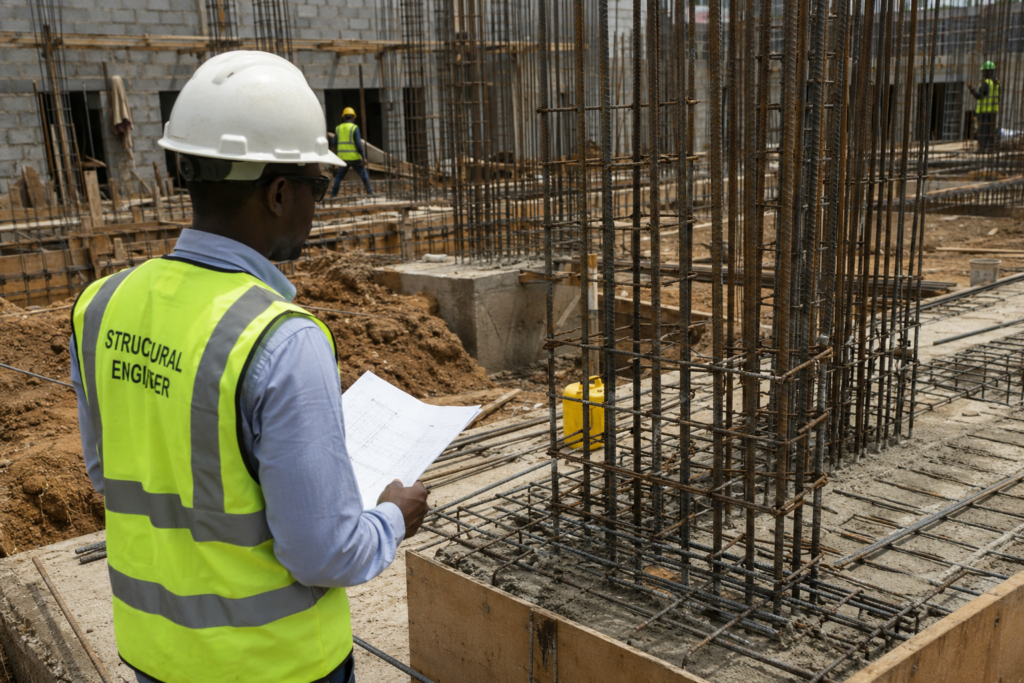
- Inspect reinforcement before concrete placement.
- Monitor concrete quality during batching and placement.
- Maintain accurate site records throughout construction.
- Review construction changes before implementation.
- Conduct final inspections prior to occupancy.
Engineers should also pay close attention to constructability. A theoretically efficient design may become expensive if it requires difficult formwork arrangements, unusual reinforcement configurations, or specialised construction equipment that is not readily available.
Documentation is equally important. Structural calculations, drawings, material certificates, test reports, and inspection records create a technical history that supports future maintenance and renovation activities.
For existing buildings, periodic structural assessment can identify deterioration before significant problems develop. Cracking, corrosion, settlement, and water ingress should be investigated promptly rather than ignored.
The most successful projects integrate engineering judgement with analytical tools, field observations, and rigorous quality control. This combination produces structures that perform reliably throughout their intended service lives.
Frequently Asked Questions About Structural Engineering
Q: What is structural engineering in civil engineering?
A: Structural engineering is the branch of civil engineering responsible for analysing and designing structures that safely resist loads. Structural engineers design buildings, bridges, towers, foundations, retaining walls, and other load-bearing systems using recognised engineering standards and material design principles.
Q: What does a structural engineer do on a building project?
A: A structural engineer determines structural loads, analyses member forces, designs foundations and framing systems, prepares structural drawings, and reviews construction quality. The engineer also verifies that the completed structure satisfies safety, stability, serviceability, and durability requirements.
Q: What standards are used for structural engineering in Nigeria?
A: Many Nigerian projects reference BS 8110, BS 5950, BS 8004, and Eurocode-based design standards. Project requirements, approval authorities, and client specifications often determine the specific standards adopted. Professional practice is generally carried out by engineers registered with COREN.
Q: How much does structural engineering design cost in Nigeria?
A: Costs vary depending on project size, complexity, foundation requirements, location, and scope of services. A residential building design will typically cost significantly less than a multi-storey commercial development requiring advanced analysis, extensive detailing, and specialist foundation solutions.
Q: What is the difference between structural engineering and architecture?
A: Architecture focuses on space planning, functionality, appearance, and user experience. Structural engineering focuses on safety, stability, load resistance, and structural performance. Both disciplines collaborate closely throughout the design and construction process.
Q: Why is soil investigation necessary before structural design?
A: Soil investigation provides information about bearing capacity, groundwater conditions, settlement characteristics, and foundation requirements. Without reliable geotechnical data, engineers cannot accurately design foundations or predict long-term structural behaviour.
Structural engineering is the discipline that transforms architectural concepts into safe, buildable, and durable structures. Every beam, column, slab, foundation, bridge deck, and retaining wall depends on engineering decisions that determine how loads are resisted and transferred safely into the ground.
In Nigeria, successful structural engineering requires more than calculations. Engineers must understand local soil conditions, construction practices, material quality considerations, regulatory requirements, and environmental influences. Projects in Lagos, Abuja, Port Harcourt, and other regions each present distinct challenges that demand informed engineering judgement.
When structural design is supported by proper site investigation, recognised standards, rigorous review procedures, and effective construction supervision, the result is a structure that performs reliably throughout its service life.
If you need professional support for structural design, analysis, assessment, foundation engineering, or construction consultancy services, contact StruviaCore. You can also explore related resources including our structural engineering guide and other engineering insights available across the StruviaCore knowledge centre.
Leave a Reply