

Walk onto a large infrastructure project today and you may see a quadruped robot scanning formwork for dimensional accuracy, a rebar-tying machine working ahead of the concrete pour, or an autonomous tracked vehicle ferrying materials across a congested site. These are not demonstration units — they are production tools on live contracts. Yet for every team deploying robotics in construction effectively, there are two more that have procured equipment, underused it, and written off the investment. The difference is rarely the technology itself. It is almost always how the technology was introduced, integrated, and managed.
This article lays out the technical and operational best practices for robotics in construction engineering. It covers how construction robots work, the types in active field use, the real barriers to adoption, and a structured implementation framework that practitioners — from site engineers to project directors — can apply on their next project.
Best practices for robotics in construction involve matching robot type to task risk and repeatability, integrating robotic systems with BIM-derived data, training a dedicated operator cadre, establishing pre-deployment site readiness checks, and maintaining clear human-machine protocols. Robots deliver measurable value on repetitive, hazardous, or precision-critical tasks — not as general replacements for skilled labour.
What Is Construction Robotics and How Does It Work
Construction robotics is the application of programmable, semi-autonomous, or fully autonomous mechanical systems to perform physical tasks on a construction site or in a fabrication facility. Unlike industrial robots fixed to assembly lines, construction robots must operate in unstructured, variable environments — dealing with uneven terrain, dust, vibration, and dynamic human activity. This is precisely what makes them technically harder to deploy than their factory counterparts, and why field implementation demands more rigour than simply switching the system on.
At the hardware level, construction robots fall into two broad categories: task-specific machines and mobile platforms. Task-specific systems include bricklaying robots (such as those using masonry units fed by a conveyor arm), concrete placing and screeding machines, welding robots for structural steel, and automated rebar-tying systems. Mobile platforms include autonomous ground vehicles (AGVs) for material transport, unmanned aerial vehicles for inspection and surveying, and legged robots such as Boston Dynamics’ Spot, which has been deployed on civil infrastructure projects in Europe and the Gulf for laser scanning and 360° inspection.
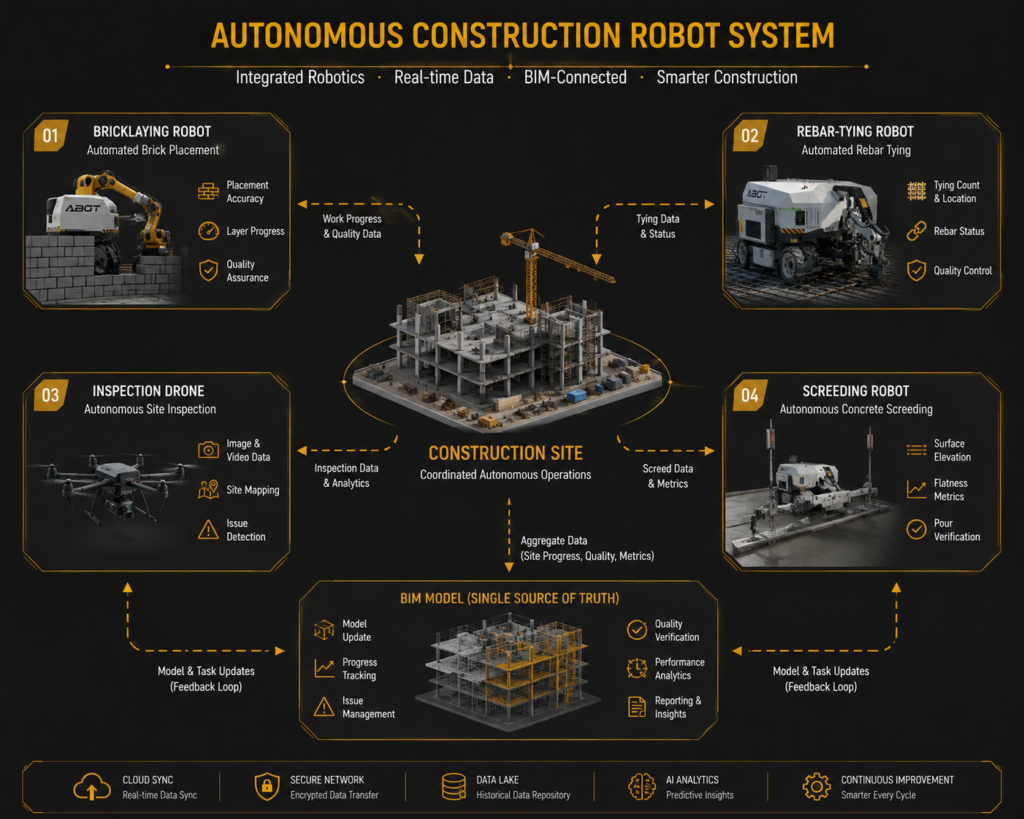
The operational logic of a construction robot typically runs in three phases. First, a digital task definition is loaded — often derived from a Building Information Model or a georeferenced site survey. Second, the robot executes the task using onboard sensors (LiDAR, cameras, ultrasonic proximity detectors) to navigate and adapt to the physical environment. Third, work data — dimensional outputs, task logs, anomaly flags — feeds back into the project’s digital record. That feedback loop is what separates a properly integrated robotic system from a machine that merely completes a task.
Sensor Systems and Spatial Awareness
A construction robot’s effectiveness is governed by its spatial awareness capability. LiDAR (Light Detection and Ranging) is the dominant positioning technology for ground-based systems, providing point-cloud maps accurate to within ±5mm on most commercial units. Photogrammetry-based systems offer a lower-cost alternative, though they perform less reliably in low-light or dusty site conditions. GNSS (Global Navigation Satellite Systems) provides coarse positioning on open sites but loses accuracy inside structures — which is where Ultra-Wideband (UWB) indoor positioning or total station integration becomes necessary. A well-configured system uses sensor fusion: combining two or more input types so that failure of one does not paralyse the machine.
Integration with Digital Project Data
A robot operating in isolation from the project’s digital environment is merely a mechanical workaround. True value comes from linking robotic output to the project’s BIM model and construction programme. When a screeding robot completes a bay, the as-built level data should auto-update the digital twin so structural engineers can verify tolerances without a separate survey visit. When an inspection drone flags a crack in a concrete element, that finding should tag the relevant BIM component and generate a defect record in the quality assurance system. This integration is not automatic — it requires deliberate data architecture decisions at project inception, before any robot arrives on site.
Types of Robots Used in Construction and Their Applications
Matching the right robotic system to the right task is the single most important pre-deployment decision. Deploying a system where it offers no advantage over manual labour wastes capital and demoralises both the workforce and the project team. The following categories represent the systems with the strongest track record in civil and structural construction applications.
Bricklaying and masonry robots — systems like the Hadrian X, which uses a telescoping boom to lay and mortar blocks, achieve laying rates of up to 1,000 blocks per hour under optimal conditions. In practice, rate depends heavily on block type, mortar specification, and the frequency of bond pattern changes. These machines suit large-footprint, repetitive masonry projects more than complex architectural brickwork.
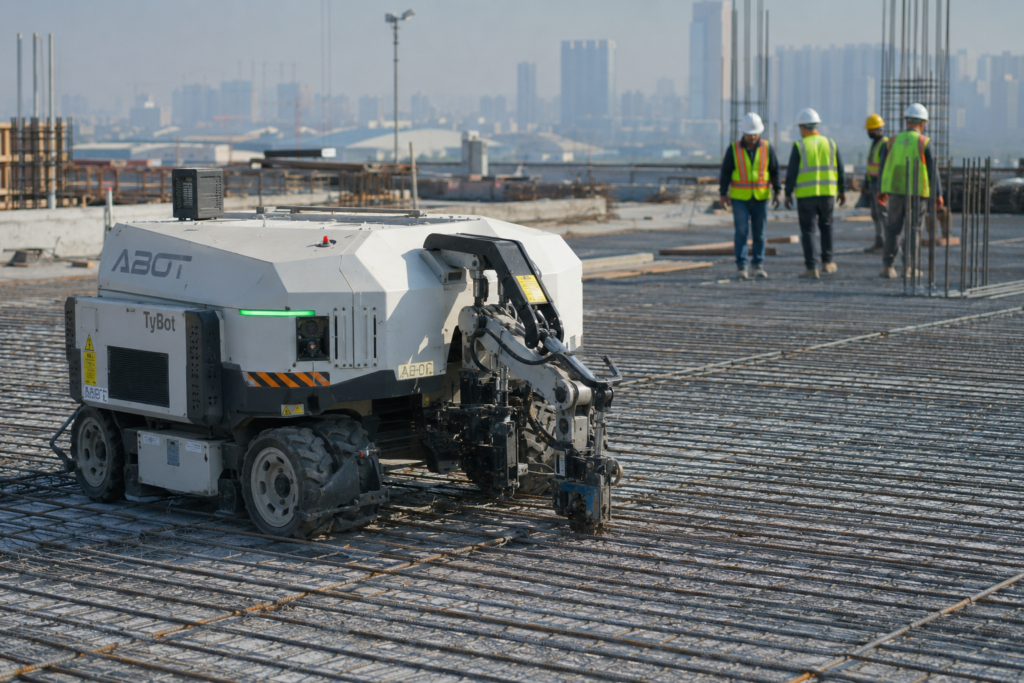
Rebar-tying robots — autonomous systems that move across a laid rebar mat and tie intersections using pre-loaded wire spools. A two-operator rebar-tying robot on a large foundation slab can complete in four hours what twelve workers might need a full day to accomplish, with consistent tie quality regardless of operator fatigue. The BS 8666:2020 standard for scheduling, dimensioning, and cutting reinforcement does not change with robotic tying — the bar schedules still govern; the robot simply executes faster.
Concrete screeding and finishing robots — laser-guided screeding machines produce floor flatness (FF) and floor levelness (FL) values that consistently outperform manual screeding, particularly on large industrial slabs where TR 34 (Concrete Industrial Ground Floors, fourth edition) specifies defined movement (DM) or free movement (FM) surface regularity categories.
Structural steel welding robots — deployed in fabrication shops rather than on open sites, these systems use pre-programmed welding paths based on 3D shop drawings. Weld quality qualifications under BS EN ISO 15614 still apply; the robot operator must be able to interpret weld procedure specifications and conduct visual examinations to BS EN ISO 17637.
Inspection and survey robots — drones performing photogrammetric surveys accurate to ±10–20mm without ground control points (GCPs), and legged platforms carrying LiDAR scanners for confined-space inspection where human access is hazardous. On bridge inspection programmes, drone surveys have reduced scaffolding and access costs by 40–70% on documented projects in the UK and Singapore.
The broader automation ecosystem on a construction project typically includes both robotic hardware and software-driven process automation — and the two must be planned together, not as separate workstreams.
Common Challenges and Cost Factors in Construction Robotics
Understanding why robotic deployments fail is as instructive as knowing best practices. The barriers are consistent across project types and geographies, and most of them are organisational rather than technical.
Site readiness is the most underestimated challenge. Autonomous ground vehicles require surfaces within defined flatness tolerances to navigate reliably. A rebar-tying robot needs clear, organised bar layouts — if bars are out of position by more than the system’s correction threshold (typically ±30mm for current commercial systems), the robot stops and requires manual intervention. On a typical Nigerian or West African reinforced concrete project where bar placement tolerances are informally managed, this is not a theoretical problem. It is a daily operational one.
Connectivity and power infrastructure present practical challenges on sites without reliable grid supply. Most ground-based robots require 415V three-phase power or high-capacity battery systems with reliable charging infrastructure. Inspection drones operating in areas with poor GPS signal — urban canyons in Lagos Island or inside bridge void formwork — need UWB beacons or tethered power and communication solutions.
Workforce integration is handled poorly on most first-time deployments. The instinct to position robots as labour-replacement rather than labour-augmentation creates resistance from site operatives and trades who are often the people best positioned to spot when a robotic system is producing poor output. The projects that extract the most value from robotics are those that designate a small team of existing site workers — typically two to four people per robot system — as robot operators, giving them training, responsibility, and recognition.
Cost structure for robotic systems typically involves: capital purchase or lease cost (ranging from approximately £15,000 for a basic drone survey package to over £1.2 million for a full-scale bricklaying robot), operator training (allow 40–80 hours for complex ground systems), maintenance contracts (budget 8–12% of capital cost per annum), and site preparation works. Return on investment calculations must account for the value of improved quality, reduced rework, and fewer lost-time incidents — not just labour cost displacement. Learn more about how technology procurement fits into project economics in the StruviaCore robotics guide.
Regulatory and liability ambiguity remains unresolved in many jurisdictions. In Nigeria, COREN (Council for the Regulation of Engineering in Nigeria) has not yet issued specific guidelines for autonomous systems on construction sites. Project engineers carrying professional responsibility for works executed partly by robotic systems must document their quality oversight procedures explicitly — the engineer of record cannot delegate professional judgement to an algorithm.
Best Practices for Robotics in Construction: A Structured Framework
The following framework is derived from documented deployment experiences across infrastructure and building projects. Apply it as a pre-deployment checklist and a project-phase guide.
Phase 1: Task Selection and Feasibility (Pre-contract or Early Design)
Start by identifying tasks that meet three criteria: they are repetitive (the same action performed many times), they are measurable (output quality can be verified against a defined standard), and they carry significant cost or risk if done poorly. Rebar tying, slab screeding, structural inspection, and site surveying typically meet all three. Bespoke joinery, complex drainage connections, and in-situ concrete repair typically do not.
For each candidate task, answer four questions: Does the site environment accommodate the robot’s operational requirements? Do we have, or can we train, people to operate and maintain the system? Can the robot’s data output integrate with our project information systems? And does the financial case hold across the likely range of site conditions, not just ideal ones?
Phase 2: Site Preparation and Digital Readiness
Robotic systems perform to specification only when the site meets their operational prerequisites. Before deployment, verify and document the following:
- Surface flatness within the robot’s navigation tolerance — conduct a floor flatness survey per TR 34 or equivalent if deploying ground-based systems indoors.
- Power supply capacity and distribution point locations confirmed against robot power specs.
- Site network coverage mapped — identify GPS-denied zones and plan UWB or beacon augmentation.
- BIM model or CAD data exported in the robot’s native import format (typically IFC, DXF, or RCP point-cloud format) and verified against current drawing revision.
- Safe working zones defined and physically marked — exclusion zones during autonomous operation must be enforced with the same rigour as any other site exclusion zone under the Construction (Design and Management) Regulations equivalent applicable to your jurisdiction.
Phase 3: Operator Training and Role Definition
Every robotic system deployed on site requires at least one trained primary operator and one trained secondary operator per shift. Training must cover: system start-up and shut-down procedures; fault identification and safe stop protocols; data upload and download processes; and daily maintenance tasks including cleaning, sensor calibration checks, and battery management. Operators should also understand the quality standard the robot is working to — a rebar-tying robot operator who does not know the tie spacing requirements of the bar schedule cannot judge whether the machine’s output is acceptable.
Phase 4: Phased Deployment and Performance Monitoring
Do not deploy a robotic system at full production scale on day one. Run a commissioning period of at least three to five working days in which the robot operates at reduced pace while operators confirm that output meets specification, data is flowing correctly to project systems, and the maintenance routine is embedded. Define Key Performance Indicators before deployment: output rate (e.g., ties per hour, m² screeded per shift), rework rate (percentage of robotic output requiring manual correction), and uptime percentage. Review these weekly. A well-deployed rebar robot should achieve uptime above 85% after the commissioning period.
Phase 5: Human-Machine Protocol and Quality Assurance
The engineer of record retains professional responsibility for the quality of all works, whether executed by human or robot. This requires a defined inspection regime for robotic output. For rebar-tying robots, inspect a minimum 10% sample of ties per pour by a qualified site engineer. For screeding robots, conduct floor level surveys at intervals no greater than every 200m² using a calibrated digital level or laser scanning. For inspection drones, have all photogrammetric outputs reviewed by a structural engineer before defect reports are closed. Quality assurance in construction cannot be outsourced to the machine — it must be owned by the person.
Phase 6: Data Management and Lessons Learned
Every robotic system generates data. That data has value beyond the immediate task — it feeds into digital twin models, informs future tender estimates for robotics-enabled scopes, and provides documented evidence of quality for the project record. Assign a data manager — this can be the BIM coordinator on larger projects — to maintain the robotic data archive and confirm that as-built records derived from robotic output are issued under the same document control procedures as any other quality record.

Frequently Asked Questions About Robotics
Q: What types of robots are currently used in civil engineering and construction?
A: The main categories in active construction use are bricklaying robots, rebar-tying robots, concrete screeding machines, structural inspection drones, and autonomous ground vehicles for material transport. Legged platforms such as quadruped robots have been deployed for confined-space inspection on bridges, tunnels, and industrial facilities. Each type suits a specific task profile — repetitive, measurable, and either physically demanding or hazardous for human workers.
Q: How much does a construction robot cost to deploy?
A: Costs vary significantly by system type and procurement model. A commercial inspection drone with photogrammetry software starts at approximately £12,000–£25,000 for equipment plus operator training. A rebar-tying robot system ranges from £80,000 to £250,000 depending on capacity. A full-scale bricklaying robot exceeds £1 million. Lease and pay-per-use models are available from some vendors, which reduces upfront capital exposure. Budget an additional 8–12% of capital cost per annum for maintenance contracts and allow 40–80 hours of operator training time per system.
Q: Do construction robots replace human workers on site?
A: In practice, no — at least not on a one-to-one basis at current levels of adoption. Robots replace specific repetitive tasks, not roles. A rebar-tying robot requires two operators to function and still relies on human workers to lay and position bars. The net effect is typically a redeployment of labour rather than a reduction in headcount, with the workers freed from the most physically demanding or injury-prone tasks. Projects that frame robotics as task-specific tools — not labour elimination programmes — achieve smoother deployment and better operational results.
Q: What are the main risks of using robots on construction sites?
A: The primary risks are collision between autonomous systems and site personnel, electrical and mechanical failure causing property damage, data integration failures leading to quality defects, and cybersecurity vulnerabilities in networked robotic systems. Mitigating these requires formal risk assessment before deployment, defined exclusion zones with physical barriers, safe stop protocols that halt the machine when a person enters a defined proximity zone, and regular system integrity checks. Professional liability for defects in robotic output remains with the engineer of record — the machine cannot hold a COREN registration.
Q: What is the difference between automation and robotics in construction?
A: Automation refers to the use of software or mechanical systems to execute tasks with reduced or no human input — this includes automated scheduling software, sensor-triggered concrete curing systems, and automated formwork. Robotics is a subset of automation specifically involving programmable physical machines that interact with the built environment. All robotics involves automation, but not all automation involves robots. The two are often planned together as part of a wider construction automation strategy, and they share similar implementation requirements around data integration and workforce training.
Getting Robotics Right on Your Next Project
The engineering profession has a long record of absorbing new tools — from the total station to the GPS machine control system to BIM — and each time the practitioners who read the technology critically, matched it to genuine site problems, and built the organisational capability to use it properly, came out ahead. Best practices for robotics in construction follow the same logic: select by task fit, prepare the site, train your people, monitor performance against quantified benchmarks, and keep the engineer’s professional judgement in the loop.
Robotics will not solve a poorly managed project. But on a well-run site with clear quality standards and a team willing to operate new systems methodically, the productivity, safety, and quality gains are real and repeatable. The question is not whether to use construction robots — it is whether your team is set up to use them well.
StruviaCore provides technical advisory services for construction technology integration, including robotics feasibility assessments, BIM-to-robot data workflow design, and quality assurance framework development. Contact the team to discuss your project requirements.
Leave a Reply