

Drive along almost any federal highway in Nigeria during the rainy season and you’ll see the same story repeating itself: potholes forming along wheel paths within two or three years of resurfacing, edge failures creeping in from poorly drained shoulders, and patched sections that fail again within months. For most site engineers and project managers, this is not a mystery of bad luck — it’s a predictable outcome of skipped steps in pavement engineering. This article walks through what pavement engineering actually involves, the design methods and materials that determine how long a road lasts, and the best practices that separate a road that survives ten wet seasons from one that doesn’t survive two.
Pavement Engineering: Quick Answer
Pavement engineering is the discipline of designing, constructing, and maintaining the layered structure that carries traffic loads on roads, airports, and parking areas. It combines soil mechanics, materials science, and traffic analysis to determine layer thicknesses, material specifications, and drainage requirements that prevent premature cracking, rutting, and potholing under expected loading and climate conditions.
What Pavement Engineering Involves
At its core, pavement engineering is about transferring wheel loads from vehicles down through a series of structural layers until the stress reaching the natural ground — the subgrade — is low enough that it won’t deform or fail over the design life of the road. Every layer in the system has a specific job. The subgrade, typically the existing soil compacted to a specified density, provides the foundation. Above it sits the sub-base, often a granular material or weak cement-stabilised layer that spreads load and improves drainage. The base course, usually crushed stone or lateritic gravel compacted to a high density, carries most of the structural load. On top sits the surfacing — either an asphalt concrete wearing course for flexible pavements or a concrete slab for rigid pavements.
Flexible vs Rigid Pavements
Flexible pavements, built with asphalt layers over granular bases, distribute load gradually through the layers and flex slightly under traffic. They’re cheaper to construct initially, faster to repair, and dominate Nigerian road networks — used on the majority of federal and state roads. Rigid pavements, built with reinforced or unreinforced concrete slabs, distribute load over a wider area through slab action rather than layer-by-layer dispersion. They cost more upfront but last longer with less maintenance, which is why you’ll find them increasingly specified for ports, container terminals, and heavy-duty truck routes such as the Apapa-Oshodi corridor.
Why Drainage Is Structural, Not Cosmetic
Many engineers treat drainage as an afterthought — something to sort out once the pavement layers are in place. This is backwards. Water trapped within or beneath a pavement structure is the single biggest cause of premature failure in Nigeria’s tropical climate. When the subgrade saturates, its bearing capacity drops sharply, sometimes by 50% or more compared to its dry-season value. A pavement designed on dry-season CBR (California Bearing Ratio) values without accounting for saturated conditions is a pavement designed to fail in its first rainy season. Side drains, cross-drains, and a crown profile of at least 2.5% are not optional extras — they are part of the structural design.
Pavement Design Methods and Materials
Design methods for flexible pavements generally fall into two families: empirical methods, which rely on accumulated performance data correlated to soil strength and traffic, and mechanistic-empirical methods, which calculate stresses and strains within the pavement structure using material properties and then check these against allowable limits derived from performance data. In Nigeria, the most widely used reference remains adapted versions of the British Road Note 29 and Road Note 31 methods, which were specifically developed for tropical and sub-tropical road conditions and remain embedded in Federal Ministry of Works specifications.
The Role of CBR and Traffic Analysis
The CBR test, carried out either in the laboratory on remoulded samples or in-situ using a dynamic cone penetrometer, gives the foundation strength value that everything else builds on. A subgrade with a soaked CBR below 5% is classed as weak and typically requires either a capping layer of selected fill or full replacement to an adequate depth — often 300mm to 450mm — before construction proceeds. Traffic analysis converts the projected vehicle stream into Equivalent Standard Axles (ESA), usually expressed as a cumulative figure over the design period, commonly 10, 15, or 20 years depending on the road category. A federal trunk road carrying heavy articulated trucks might be designed for cumulative traffic exceeding 10 million ESA, while a low-volume rural access road might be designed for under 0.5 million ESA — and these two scenarios produce dramatically different layer thicknesses.
Material Selection for Tropical Conditions
Material choice in Nigeria has to account for what’s locally available and how it performs when wet. Lateritic gravel remains the dominant base and sub-base material across most of the country because of its widespread availability, but its quality varies enormously between sources — some lateritic deposits have plasticity indices well above the 6% maximum typically specified for base course material, making them unsuitable without stabilisation. Where good-quality crushed stone or quarry products are too far away to be economical, cement or lime stabilisation of marginal laterite is often the more cost-effective solution, typically using 3% to 6% cement content by dry weight depending on the soil’s plasticity and the required strength gain.
Asphalt mix design follows Marshall mix design procedures in most Nigerian practice, targeting stability values, flow, and air void content within specified ranges for the climate and traffic category. Bitumen content typically falls between 4.5% and 6% by weight of the total mix for a standard dense bitumen macadam wearing course, though this varies with aggregate gradation and the penetration grade of bitumen used — commonly 60/70 penetration grade for Nigerian conditions given the high ambient temperatures.
Pavement Engineering in the Nigerian Context
Pavement engineering in Nigeria operates under a layered regulatory and institutional framework. The Federal Ministry of Works sets specifications and standards for federal roads, including its General Specifications for Roads and Bridges, which most state agencies and consultants reference even on state-funded projects. The Council for the Regulation of Engineering in Nigeria (COREN) regulates who can sign off on design documents and certify construction supervision, and any pavement design submitted for approval on a public project should bear the seal of a COREN-registered engineer.
Climate is the variable that most distinguishes Nigerian pavement design from temperate-climate practice. The country’s rainfall pattern — heavy seasonal rains in the south, more concentrated but still significant rains in the north — means that moisture ingress into pavement layers is a near-certainty over the design life, not an exception. This is why Nigerian specifications place heavy emphasis on soaked CBR testing rather than as-moulded values, and why side drain capacity is often specified based on rainfall intensity data from the Nigerian Meteorological Agency (NiMet) for the specific project location.
Geology also varies sharply across regions in ways that affect material availability and subgrade behaviour. In the Niger Delta and coastal areas around Lagos and Port Harcourt, engineers regularly encounter soft, compressible clays and high water tables that require ground improvement — sand filling, geotextile separation layers, or surcharge preloading — before any pavement layers can be placed. In the north, expansive black cotton soils found in parts of Borno and Adamawa states present a different challenge: these soils shrink and swell with moisture changes, causing pavement heave and cracking unless the subgrade is treated with lime stabilisation or replaced with non-expansive fill to a sufficient depth, typically 600mm to 1,000mm depending on the severity of the soil’s plasticity index.
Common Pavement Failures and Cost Factors
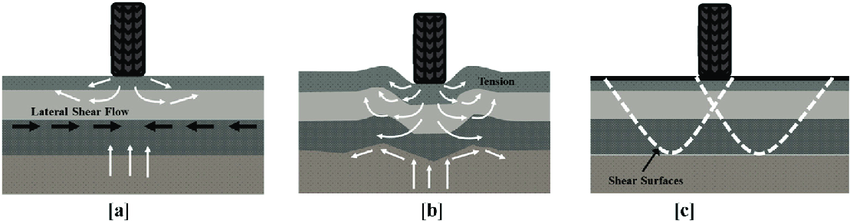
Potholes are the failure everyone notices, but they’re almost always the visible end-point of a problem that started underneath. Alligator cracking — a network of interconnected cracks resembling reptile skin — typically signals fatigue failure from repeated loading exceeding the structural capacity of the pavement, often because the design traffic was underestimated or the base layer was under-compacted. Rutting, the formation of depressions along wheel paths, points to either insufficient compaction of the asphalt layer during construction or an unstable mix with too much bitumen relative to the aggregate gradation. Edge failures, where the pavement breaks away along the road’s edges, almost always trace back to inadequate shoulder support or drainage that allows water to undermine the pavement structure from the side.
Cost factors in Nigerian pavement projects extend well beyond the bill of quantities for materials. Haulage distance to suitable borrow pits or quarries can dominate the cost structure on projects in areas without local lateritic deposits or crushed stone sources — in some cases, transport accounts for more than 40% of the cost of a cubic metre of base course material delivered to site. Bitumen price volatility, tied to global crude oil prices and import costs since Nigeria’s domestic bitumen refining capacity remains limited, can shift asphalt costs significantly between the design stage and construction tender, which is why many contracts include price adjustment clauses tied to published bitumen indices.
Maintenance deferred is maintenance compounded. A road that receives timely crack sealing and pothole patching within the first two to three years of cracks appearing can often have its functional life extended by 50% or more for a fraction of the cost of a full overlay. Once cracking allows water into the base and subgrade, the deterioration curve steepens sharply — a road that might cost ₦5 million per kilometre to maintain at the right time can require ₦25 million or more per kilometre to fully reconstruct once structural failure sets in.
Best Practices for Pavement Engineering
Getting pavement design and construction right consistently comes down to a handful of disciplines applied without shortcuts. If you’re managing or supervising a pavement project, these are the checkpoints worth treating as non-negotiable.
- Conduct soil investigation at adequate spacing. Boreholes or test pits should be spaced no more than 100m to 150m apart on uniform ground, with closer spacing where subsoil conditions are known to be variable, and CBR testing should always include soaked values.
- Design drainage before finalising pavement thickness. Side drain gradients, culvert spacing, and cross-fall should be set based on catchment area and rainfall intensity data, not retrofitted after the pavement geometry is fixed.
- Verify material sources before tender close. Confirm that proposed borrow pits and quarries can actually supply material meeting plasticity index, gradation, and CBR specifications in the required quantities — discovering a source fails specification mid-construction causes costly delays and redesign.
- Enforce compaction testing at every layer. Field density tests using sand replacement or nuclear density gauges should confirm at least 95% of maximum dry density (MDD) for sub-base and base layers before the next layer is placed — a layer that fails this test and gets covered becomes a hidden defect.
- Control asphalt laying temperature and rolling sequence. Asphalt mix temperature at laying should typically not fall below 120°C, and rolling should follow breakdown, intermediate, and finish rolling stages without gaps that allow the mix to cool before adequate density is achieved.
- Build in a maintenance schedule from day one. Routine inspection at six-month intervals, with crack sealing triggered as soon as cracks exceed 3mm width, prevents minor defects from becoming structural failures.
Frequently Asked Questions About Pavement Engineering
Q: What is pavement engineering in civil engineering?
A: Pavement engineering is the branch of civil engineering concerned with designing and constructing the layered structure — subgrade, sub-base, base, and surfacing — that supports traffic loads on roads and similar surfaces. It draws on geotechnical engineering for subgrade assessment, materials science for asphalt and concrete mix design, and traffic engineering to determine the loading the pavement must withstand over its design life, typically 10 to 20 years.
Q: How does the pavement design process work?
A: The process starts with soil investigation and CBR testing to establish subgrade strength, followed by traffic analysis to estimate cumulative Equivalent Standard Axle loads over the design period. These two inputs are used in a design method, commonly an adapted Road Note 29 or 31 approach in Nigeria, to determine the thickness of each pavement layer. Material specifications and drainage design are finalised alongside the layer thicknesses before construction documentation is issued.
Q: What are the pavement design requirements in Nigeria?
A: Nigerian pavement designs must follow the Federal Ministry of Works General Specifications for Roads and Bridges, with subgrade CBR testing carried out on soaked samples to reflect rainy-season conditions. Base course materials typically require a plasticity index below 6% and a minimum CBR of 80% after compaction, while drainage design should be based on rainfall intensity data from the Nigerian Meteorological Agency. Designs for public projects require certification by a COREN-registered engineer.
Q: What is the difference between flexible and rigid pavements?
A: Flexible pavements use asphalt surfacing over granular layers and distribute load progressively through each layer, flexing slightly under traffic — they’re cheaper to build and easier to repair in sections. Rigid pavements use concrete slabs that distribute load through slab bending action over a wider area, costing more initially but offering a longer service life with lower maintenance frequency, which is why they’re often chosen for ports and heavy-duty industrial yards.
The roads that hold up across Nigerian wet seasons aren’t the ones built with exotic materials — they’re the ones where soil investigation, drainage design, material verification, and compaction control were treated as structural decisions rather than procedural boxes to tick. Pavement engineering succeeds or fails layer by layer, and the cheapest time to fix a problem is always before that layer gets covered. If you’re planning a road project and need a pavement design reviewed or a failing section assessed, explore StruviaCore’s pavement engineering services for guidance tailored to your site conditions.
For readers building broader context, our related guides on what pavement engineering involves, road infrastructure planning, asphalt materials and mix design, and geotechnical engineering best practices cover the supporting disciplines discussed throughout this article in more depth.
Leave a Reply