
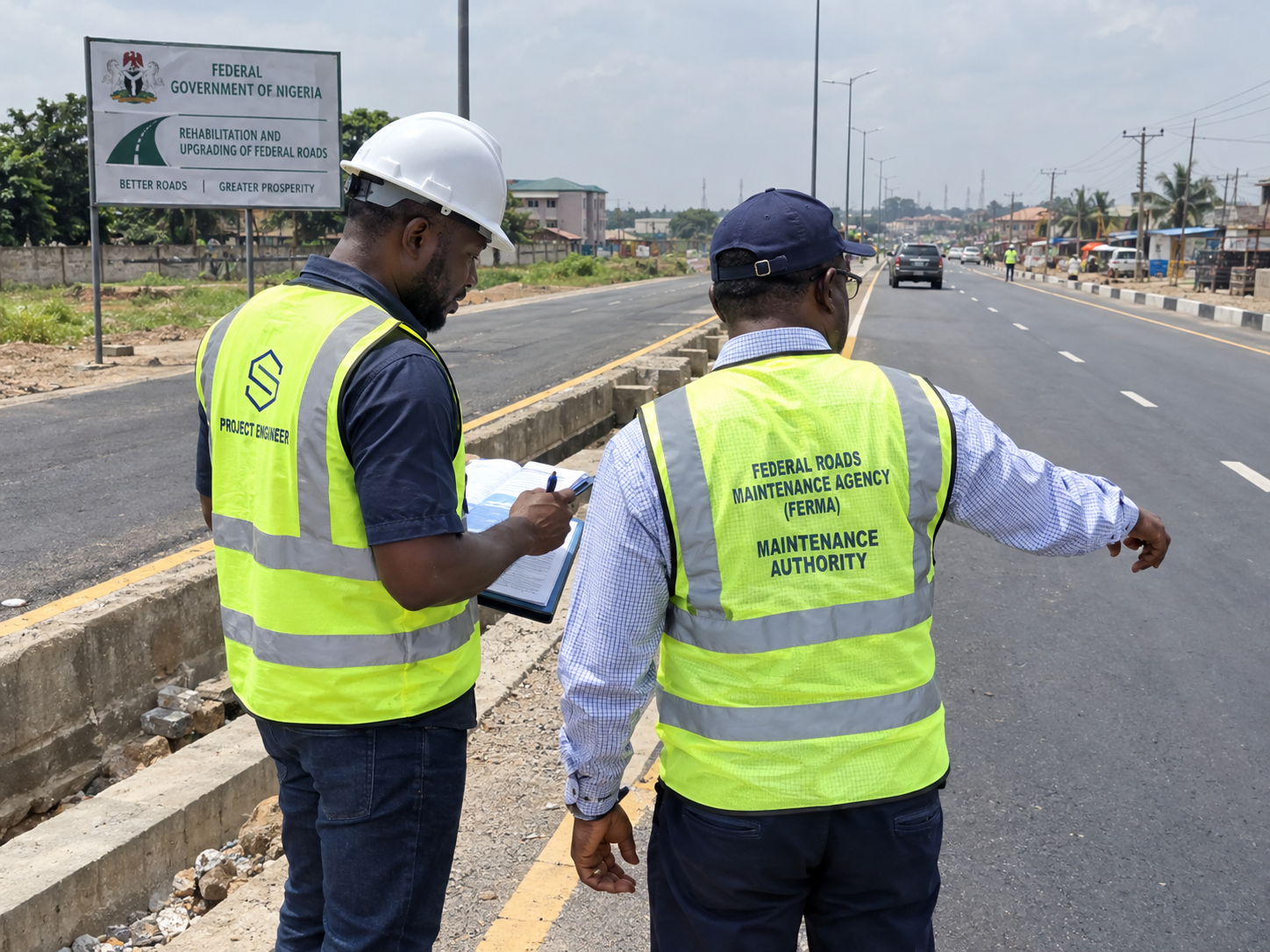
A pavement can be designed correctly, with sound CBR data, the right Road Note 31 layer thicknesses, and a materials specification that accounts for Nigeria’s rainy season, and still fail within its first two years for reasons that have nothing to do with the design itself. A contractor selected on lowest bid without capacity verification runs out of working capital mid-project. A supervision consultant signs off compaction tests without independent verification. A completed road gets handed over with no documented maintenance plan, and by year three it is deteriorating for want of the routine crack sealing that would have cost a fraction of a full reconstruction. This pavement engineering guide covers the delivery side of the process: procurement, contract structure, supervision, and handover, the decisions that determine whether a well-designed pavement actually performs as designed.
Pavement Engineering Guide: Quick Answer
Delivering a pavement engineering project successfully requires more than correct design. It requires a procurement process that selects a genuinely capable contractor, a contract structure that allocates risk sensibly, independent quality supervision through construction, and a documented handover with a funded maintenance plan, since most Nigerian pavement failures trace back to a delivery-stage gap rather than a design error.
Procuring a Pavement Project in Nigeria
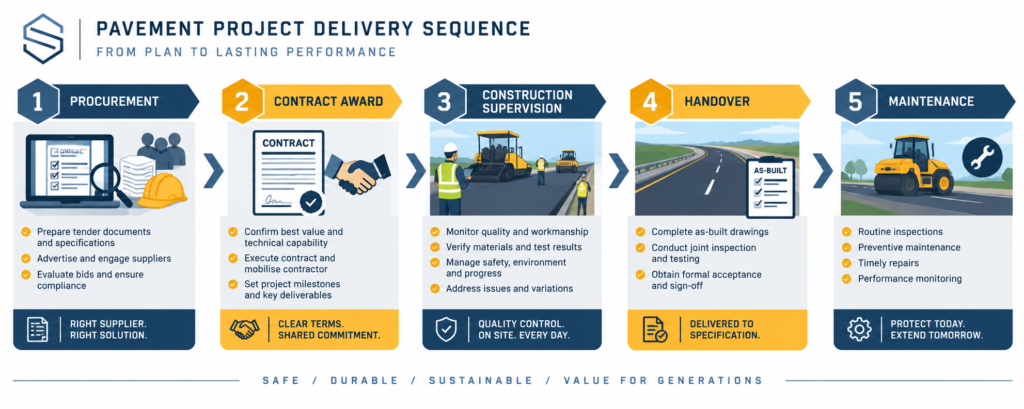
Procurement decisions made before a contractor ever mobilises to site shape a project’s outcome more than most clients realise. A tender process that evaluates only price, without verifying a bidder’s plant holding, technical staff, and track record on comparable pavement work, routinely selects contractors who cannot actually deliver the specification they priced against. This is a different set of risks from the material and design questions covered in pavement engineering best practices; a technically sound specification still depends on a contractor capable of executing it.
Public Procurement Act Requirements for Government Roads
Federal and most state government road projects fall under the Public Procurement Act 2007, administered through the Bureau of Public Procurement (BPP) at federal level and equivalent state procurement agencies. The Act sets out competitive bidding requirements, prequalification criteria, and approval thresholds that determine how a contract is advertised and awarded. For pavement work specifically, prequalification should verify a contractor’s asphalt plant capacity or access to one, laboratory testing capability, and completed projects of comparable scale, not just general civil works experience. A contractor who has built drainage structures but never run an asphalt-laying crew presents a real delivery risk that price alone will not reveal.
Prequalification documentation should be checked against actual site visits to plant and yard locations where practical, rather than accepted purely on paper. A bidder’s stated asphalt plant capacity means little if the plant is shared across several concurrent projects or is not actually operational at the time of tender. Clients delivering their first pavement project sometimes skip this verification step to save time during evaluation, and it is consistently the step whose absence correlates most closely with later contractor performance problems.
Contract Types: Unit Rate vs Lump Sum
Most Nigerian road contracts use unit rate, or admeasurement, contracts, where the contractor is paid against measured quantities of work actually completed, with rates fixed at tender for each item, cubic metre of sub-base, square metre of asphalt surfacing, and so on. This structure suits pavement work well because quantities like haulage distance to borrow pits or the extent of subgrade treatment needed often only become fully clear once earthworks begin, and a unit rate contract absorbs that variability without constant renegotiation. Lump sum contracts, where a fixed total price covers defined scope regardless of measured quantity, shift more risk onto the contractor and are more common on smaller, well-defined projects such as short access road resurfacing where ground conditions are already well understood.
Mobilisation advance, typically a percentage of contract value released once the contract is signed to help the contractor fund initial plant mobilisation and materials procurement, is standard on Nigerian pavement contracts but needs its own safeguard: a mobilisation advance guarantee, usually a bank guarantee, that protects the client if the contractor fails to deliver against the advance received. Retention money, a percentage withheld from each interim payment certificate and released after the defects liability period expires, provides a further layer of protection specifically against defects that surface after completion. Both mechanisms are standard practice, but clients delivering a first pavement project sometimes omit one or negotiate it away under contractor pressure, which removes a meaningful layer of financial protection for a relatively small negotiating concession.
Quality Assurance During Delivery
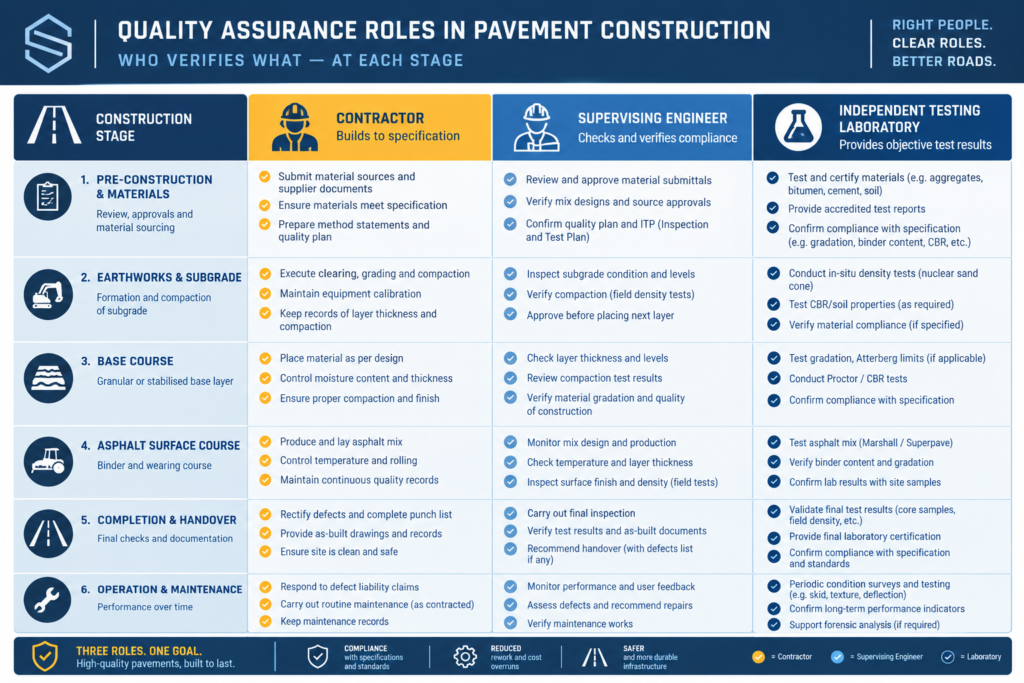
Design specifications only translate into pavement performance if construction-phase quality control actually verifies compliance at each stage, not just at final inspection. A full pavement engineering checklist sets out the layer-by-layer verification sequence in detail; the point worth establishing here is who is responsible for applying it and how independently that responsibility actually operates in practice.
Documentation discipline separates quality assurance that actually catches problems from quality assurance that exists only on paper. Every test result, whether a passing or failing compaction reading, needs a dated record tied to a specific chainage and layer, not a summary sheet compiled at the end of the month from memory. Projects that maintain this level of record-keeping consistently catch specification deviations early enough to correct them cheaply; projects that reconstruct records after the fact routinely discover the deviation only once it has already been covered by the next layer.
The Role of the Supervising Engineer
The supervising engineer, typically a consultant engaged separately from the contractor, is responsible for confirming that materials, compaction, and layer thicknesses meet specification before payment certificates are issued. This role only functions as a genuine check if the supervising consultant has real independence from delivery pressure, financial or otherwise, to approve work that has not actually met specification. Contracts that make the supervising consultant’s fee contingent on project completion timelines, rather than a fixed independent fee, create a structural incentive to wave through marginal work, and clients should be alert to this when structuring supervision contracts.
Independent Testing and Verification
Beyond the supervising engineer’s own checks, an independent testing laboratory, separate from both contractor and consultant, provides a further layer of verification for critical acceptance tests such as compaction density and asphalt core extraction. This is standard practice on larger federal projects but is frequently omitted on smaller state and private developments to save cost, which is precisely where it tends to matter most, since smaller projects often have less experienced supervision staff on site full-time.
Federal vs State Road Delivery: Institutional Differences
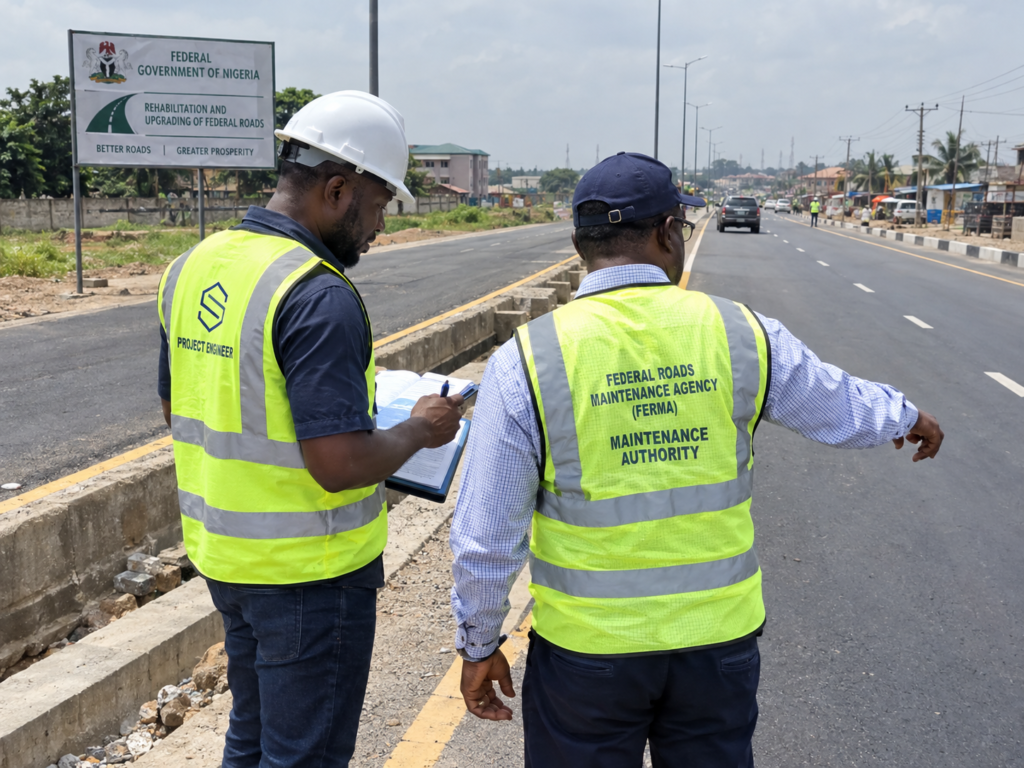
Which government body delivers and later maintains a Nigerian road changes significantly depending on its classification. Federal trunk roads fall under the Federal Ministry of Works for construction and the Federal Roads Maintenance Agency (FERMA) for ongoing maintenance once complete, with a formal handover process meant to transfer maintenance responsibility and documentation between the two. State roads follow an equivalent structure through State Ministries of Works, though the maturity of maintenance planning and funding varies considerably between states. Local government and estate-internal roads often have the least formal delivery and maintenance structure of all, which is one reason pavement failures tend to appear earliest and most visibly on this tier of the network. Pavement sits within the broader discipline of transportation engineering, and the institutional split described here mirrors similar classification differences that apply across the wider road network, not just pavement specifically.
This institutional split matters at the procurement stage because it determines which specification and approval body governs the project, and it matters again at handover because the receiving maintenance authority needs the design and as-built documentation to plan future work. A contractor experienced with federal road delivery through FERMA’s processes will not automatically know a specific state’s equivalent requirements, and assuming otherwise is a common source of approval delay on state-funded projects.
Common Delivery-Stage Problems and Their Cost
Contractor default or under-capacity is the delivery-stage problem with the most severe cost consequences, since remobilising a replacement contractor mid-project carries both direct cost and significant delay, on top of whatever defective work the original contractor leaves behind. This risk traces directly back to the procurement stage: a prequalification process that genuinely verified plant, staff, and track record would have screened out many contractors who later default. The construction sequence itself, from subgrade preparation through sub-base, base course, and surfacing, follows the same general logic across most Nigerian road types; understanding how road construction works as a sequence helps a client recognise which stage a struggling contractor is actually behind on, rather than relying solely on the contractor’s own progress reporting.
Variation orders, formal changes to scope or specification during construction, are a normal part of pavement delivery given how often actual ground conditions differ from what a desk-based design assumed. The cost problem is not variations themselves but variations that are agreed verbally on site and only formalised, if at all, well after the work is complete, by which point the rate negotiation happens from a weak position for whichever party did not initiate the change. A project team that has already priced foundation design cost factors for the same site understands how ground-condition variability drives cost adjustment in comparable ways, and applying the same discipline, documenting and agreeing variations before work proceeds, protects both client and contractor on pavement projects specifically.
Handover and Long-Term Maintenance Responsibility
The gap between construction handover and effective long-term maintenance is where a large share of Nigeria’s pavement network loses condition faster than its design life would predict. A completed road handed over with as-built drawings but no funded maintenance plan is, in practical terms, a road with a countdown already running on its useful life, since routine maintenance, crack sealing, pothole patching, drainage clearing, typically depends on a maintenance authority actually having budget allocated and released on schedule.
For federal roads, FERMA’s handover process should include the as-built pavement design, material test records, and a condition baseline against which future deterioration can be measured. Confirm this documentation is actually transferred and acknowledged at handover, not simply filed by the delivering ministry, since a maintenance authority working from an incomplete handover package cannot plan interventions accurately. Where a defects liability period applies, typically twelve months on most Nigerian road contracts, use that window actively: inspect the pavement at defined intervals rather than waiting for the period to expire, since defects that surface in month eleven are still the contractor’s responsibility to rectify if identified before the period closes.
Beyond the formal handover package, brief the receiving maintenance team directly on anything site-specific that would not otherwise survive in the drawings: a section that required unusual subgrade treatment, a drainage detail sensitive to blockage, or a materials substitution agreed mid-project that differs from the original specification. This same principle applies across infrastructure types generally, not just pavement; a facilities team inheriting any asset without this kind of practical context is set up to make avoidable maintenance decisions simply because nobody told them what to watch for.
Frequently Asked Questions About Pavement Engineering
Q: What should a pavement engineering guide cover beyond design?
A: A complete guide should cover procurement and contractor selection, contract structure, construction-phase quality assurance, and handover with a documented maintenance plan, since delivery-stage decisions determine whether a correctly designed pavement actually performs as intended over its design life.
Q: What procurement process applies to Nigerian government road projects?
A: Federal and most state road projects fall under the Public Procurement Act 2007, administered through the Bureau of Public Procurement at federal level and equivalent state agencies, which set competitive bidding, prequalification, and approval requirements for how contracts are advertised and awarded.
Q: What is the difference between unit rate and lump sum pavement contracts?
A: Unit rate contracts pay against measured quantities at rates fixed at tender, which suits pavement work where quantities like haulage distance or subgrade treatment extent are hard to fix precisely in advance. Lump sum contracts fix a total price for defined scope, shifting more risk to the contractor, and are more common on smaller, well-defined projects.
Q: Who is responsible for pavement quality assurance during construction?
A: Primary responsibility sits with the supervising engineer, typically an independent consultant engaged separately from the contractor, supported where possible by an independent testing laboratory for critical acceptance tests. Genuine independence in both roles, rather than compromised or contractor-linked arrangements, is what makes the quality assurance function effective.
Q: What happens to a Nigerian road after construction handover?
A: Responsibility transfers to the relevant maintenance authority, FERMA for federal roads or the equivalent state ministry for state roads, which should receive full as-built documentation and a condition baseline at handover. Ongoing pavement condition then depends heavily on whether routine maintenance is actually funded and delivered on schedule.
Q: How long is the defects liability period on a Nigerian road contract?
A: Twelve months is typical on most Nigerian road contracts, though the specific period is set by the contract itself. Active inspection during this period, rather than passive waiting, is what allows defects to be identified and remain the contractor’s responsibility before the liability period closes.
A pavement engineering guide focused only on layer thicknesses and material specifications addresses half of what determines whether a Nigerian road actually performs over its design life. Procurement that genuinely verifies contractor capability, a contract structure suited to the project’s risk profile, independently applied quality assurance, and a documented, funded handover to the maintenance authority are what carry a correct design through to a road that survives its intended service life. Treat delivery as seriously as design, and the pavement failures that show up two or three years after opening become far less common. If your project needs support structuring procurement, supervision, or handover for a Nigerian road project, StruviaCore’s engineering team can work through that process with you.
Leave a Reply