
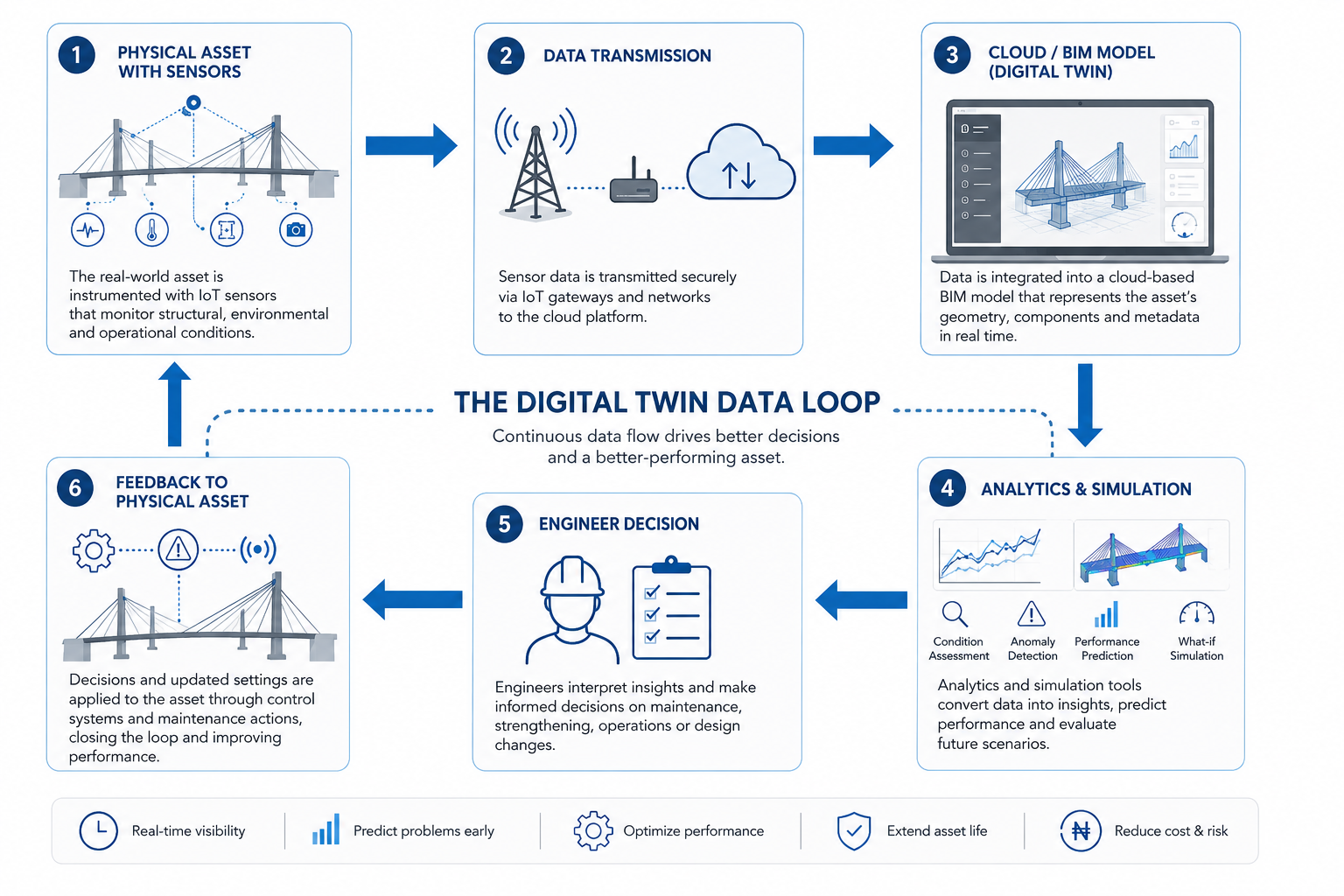
A site engineer in Lagos watches a dashboard update in real time as a bridge deck sensor reports a 2mm deflection under peak traffic load. Two thousand kilometres away, a facilities manager in Dubai reviews a 3D model that shows exactly which chiller unit in a 40-storey tower is drawing more power than its design baseline. Neither engineer is guessing. Both are reading a digital twin — a live, data-fed replica of a physical asset. The concept has moved well past the marketing slide deck stage; on live infrastructure across the UK, UAE, and Nigeria, it now sits behind real maintenance decisions and real budget approvals. This article walks through real digital twins examples from structural monitoring, water infrastructure, transportation, and building operations, and explains what makes each one work, what it costs to set up, and where the approach still runs into trouble on site. By the end, you should be able to judge whether your own asset portfolio is a good candidate for a twin, and what to specify if it is.
Digital twins examples: Quick Answer
Digital twins examples in construction include bridge structural health monitoring twins, water network pressure-management twins, airport terminal operations twins, and building energy-management twins. Each pairs a 3D or BIM model with live sensor data so engineers can simulate performance, predict failure, and adjust operations before a physical fault occurs.
What a Digital Twin Actually Is on a Construction Project
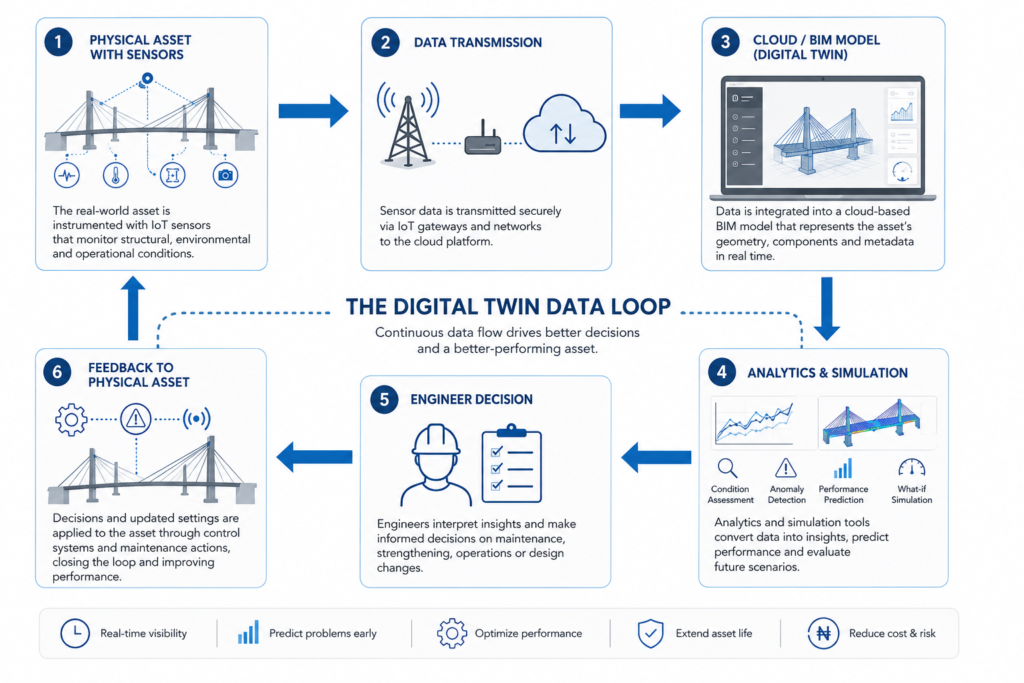
A digital twin is a live, data-connected digital replica of a physical asset, updated continuously so that the model reflects the real condition of the structure rather than its condition on the day it was handed over. That distinction matters. A static BIM model captures design intent at completion. A digital twin keeps updating after handover, drawing on sensor feeds, inspection data, and operational records to mirror what the asset is doing right now.
The concept sits on three layers: the physical asset itself, the data layer that captures its behaviour, and the virtual model that mirrors it. ISO 30173 defines the terminology for this relationship, and ISO 19650 governs the information management framework that most UK and Gulf digital twin projects build on, since it already structures how BIM data is exchanged and maintained. In Nigeria, projects working toward COREN-recognised design practice increasingly treat the twin as an extension of the as-built BIM deliverable rather than a separate system.
Among the clearest digital twins examples is structural health monitoring on long-span bridges, where strain gauges, accelerometers, and tiltmeters feed a model that recalculates load distribution every few seconds. A second common example sits in water utilities, where pressure sensors and flow meters across a distribution network feed a hydraulic twin that predicts pipe bursts before they happen. A third example, increasingly common across Dubai and Abu Dhabi developments, is the building operations twin — a live model of HVAC, lighting, and occupancy that flags energy waste in near real time.
Digital Twin vs BIM Model
A BIM model is a coordinated, information-rich 3D representation built during design and construction. A digital twin uses that model as its geometric foundation but adds a live data connection that a standard BIM file does not have. Once handover happens, most BIM models freeze; a digital twin keeps ingesting data from the physical asset for the rest of its service life. Firms already running a BIM workflow are closer to twin-readiness than firms starting from paper drawings, because the geometric and metadata foundation already exists.
Digital Twin vs SCADA
Supervisory Control and Data Acquisition (SCADA) systems have monitored infrastructure — water treatment plants, power substations — for decades, and engineers sometimes assume a digital twin is just a rebranded SCADA dashboard. It isn’t. SCADA reports raw values: pressure at 4.2 bar, flow at 180 l/s. A digital twin takes that same feed and runs it against a physics-based or data-driven model of the asset, so it can forecast what happens if pressure climbs another 0.5 bar rather than just reporting the current reading.
Five Digital Twins Examples From Live Infrastructure Projects
The theory is straightforward; the execution varies a lot by asset type. Below are five categories of digital twins examples engineers are actually running, with the sensor stack and modelling approach behind each one.
Bridge Digital Twins Examples: Structural Health Monitoring
Long-span and cable-stayed bridges are the most mature digital twin application in structural engineering, because the failure consequences are severe and the sensor retrofit is comparatively simple. A typical setup places strain gauges at critical sections, accelerometers near expansion joints, and tiltmeters on piers, all feeding a structural analysis model that recalculates stress distribution continuously. When measured strain deviates from the model’s predicted range by more than a set threshold — commonly 10–15% on flagship monitoring programmes — the system raises an inspection alert instead of waiting for the next scheduled visual survey. This shifts maintenance from a fixed calendar interval to condition-based intervention, which typically cuts unnecessary inspection visits by a third on instrumented structures.
Water Network and Utility Twins
Non-revenue water loss from leakage and burst pipes runs above 40% in several Nigerian urban networks, which makes water infrastructure one of the strongest business cases for a twin. A hydraulic digital twin combines a calibrated network model with live pressure and flow readings from district metering areas, allowing operators to spot pressure anomalies that indicate a developing leak days before it surfaces at street level. Lagos Water Corporation-style distribution improvement programmes and DEWA’s smart grid initiatives in Dubai both apply this pattern, though DEWA’s rollout benefits from a denser IoT sensor network and near-universal smart metering that most Nigerian utilities have not yet reached.
Airport and Transport Terminal Twins
Passenger terminals generate huge volumes of operational data — footfall, baggage handling throughput, HVAC load — that a twin can correlate to spot bottlenecks before they cause delays. Dubai International and Abu Dhabi’s Zayed International have both piloted terminal-level twins that model passenger flow against real-time occupancy sensors, letting operations teams reroute queuing or adjust gate assignments dynamically rather than reactively.
High-Rise Building Energy Twins
In commercial towers across the UAE, energy twins pull data from building management systems (BMS) — chiller loads, lift usage, lighting zones — and compare it against the design-stage energy model. Deviations flag equipment running outside its efficiency band, which on a 40-storey commercial tower can represent measurable annual energy cost savings once faults like a stuck damper or miscalibrated thermostat are identified and corrected.
Rail and Transit Asset Twins
Rail operators use twins to track rail wear, signalling equipment condition, and overhead line integrity. Sensors mounted on maintenance vehicles or fixed trackside points feed a model that predicts component fatigue, supporting a shift from time-based to condition-based rail replacement — a pattern increasingly referenced in UK Network Rail asset management strategy documents.
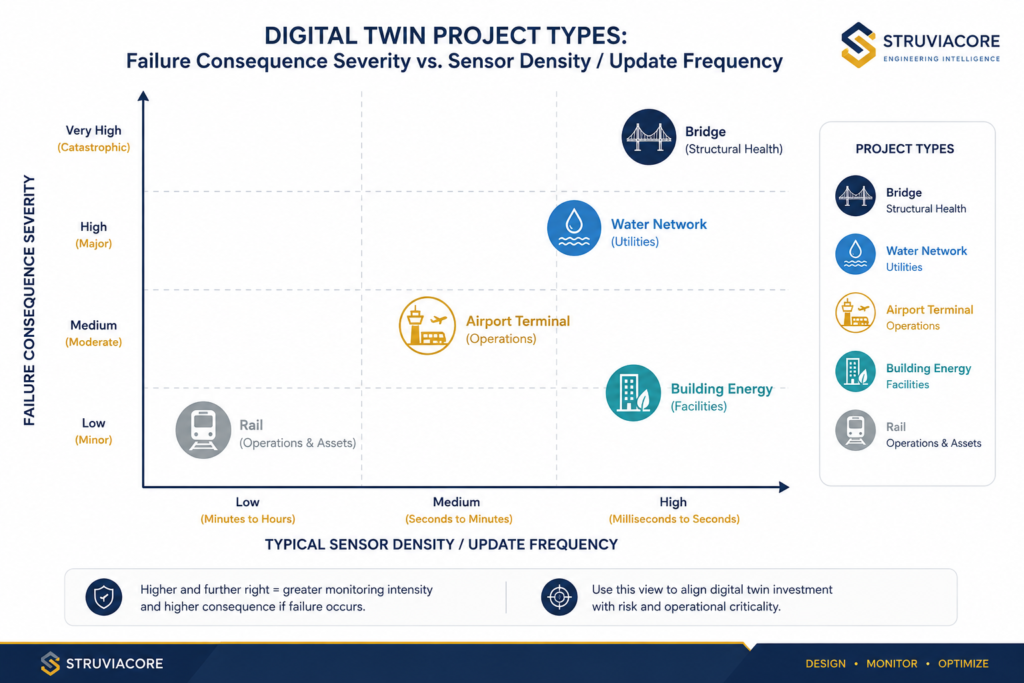
Set side by side, these five digital twins examples show a consistent trade-off: the more severe the failure consequence, the denser and more expensive the sensor network tends to be. A bridge twin justifies continuous, high-frequency structural sensing because a missed anomaly can mean collapse. A building energy twin tolerates a slower update cycle because a missed anomaly means higher utility bills, not structural risk. Scoping a twin correctly starts with naming which end of that spectrum your asset sits on, before a single sensor gets specified.
Why UK, UAE, and Nigerian Projects Adopt Digital Twins Differently
Regulatory maturity and sensor infrastructure vary sharply across StruviaCore’s core markets, and that gap shapes how twins get specified and delivered.
In the UK, digital twin adoption is pushed largely by the National Digital Twin Programme and BS 8536 asset management guidance, both of which assume a client already runs a mature ISO 19650 information management process. Public infrastructure clients, particularly in transport and utilities, now specify twin-readiness as a contract requirement rather than an optional add-on, which means design teams build the data structure for a future twin into the BIM execution plan from RIBA Stage 2 onward.
In the UAE and wider Gulf, adoption is driven top-down through smart city mandates — Dubai’s Digital Twin Strategy and Abu Dhabi’s DMT-led smart infrastructure programmes both fund twin deployment directly, and utilities like DEWA treat the twin as core operational infrastructure rather than a pilot project. This gives Gulf projects faster sensor deployment budgets but less flexibility to scale down scope, since the twin is often written into the asset’s operating license from day one.
In Nigeria, twin adoption is earlier-stage and concentrated in flagship private developments and select utility pilots rather than mandated across public infrastructure. COREN’s design practice guidance does not yet reference digital twins directly, so most Nigerian projects that deploy a twin do it through client demand — typically international investors or lenders requiring ongoing performance monitoring as a condition of financing — rather than regulatory push. That means the business case has to stand on its own: reduced maintenance cost, avoided downtime, and lender reporting, without a code mandate behind it. Firms exploring IoT-based monitoring as a first step often find it a lower-cost entry point than a full twin deployment.
The practical implication for anyone scoping a cross-border project: a twin specification that works in Dubai won’t automatically transfer to Lagos or Manchester without adjusting for local connectivity, contract structure, and regulatory expectation. A UK-style contract clause requiring twin-readiness at Stage 2 design assumes a client team fluent in ISO 19650; the same clause dropped into a Nigerian private development brief usually needs translating into plain deliverables and milestones the design team can actually price.
Common Challenges and Cost Factors in Digital Twin Projects
Digital twin projects fail for predictable reasons, and most of them show up before the sensors are even installed.
- Data quality gaps. A twin is only as accurate as its sensor calibration and the as-built model behind it. Projects that skip a proper geotechnical and structural survey before instrumentation end up modelling a building that doesn’t match the physical one.
- Sensor network cost. Instrumenting a single long-span bridge with a full structural health monitoring array — strain gauges, accelerometers, data loggers, and telemetry — commonly runs into six figures in US dollar terms for flagship structures, before ongoing data management costs are factored in.
- Connectivity reliability. Rural and peri-urban sites across Nigeria and parts of the Gulf hinterland face intermittent cellular or satellite connectivity, which forces engineers to build in local data buffering rather than assuming continuous cloud upload.
- Skills gaps. Reading a digital twin dashboard usefully requires structural or geotechnical judgement, not just IT competence. Teams that hand twin monitoring entirely to a facilities or IT department without engineering sign-off tend to miss anomalies that a trained eye would flag immediately.
- Cybersecurity exposure. A live data connection to a physical structure is an attack surface. Water utilities and airport operators in particular need segmented networks between the twin’s data layer and any system with physical control authority.
- Unclear maintenance ownership. A twin generates alerts, but someone has to own the response. On several early pilots, structural anomaly alerts sat unread in a shared inbox for weeks because no single role was assigned to triage them, which defeats the purpose of moving to condition-based monitoring in the first place.
Cost scales with asset complexity and sensor density far more than with software licensing. A single-building energy twin using existing BMS data can run at a fraction of the cost of a bridge structural health monitoring system, because it reuses sensors already installed for building management rather than deploying a bespoke structural array. Ongoing costs matter as much as setup costs: data storage, sensor calibration drift, and telemetry connectivity fees accumulate over the asset’s service life, and a twin scoped without a maintenance budget attached tends to degrade in accuracy within two or three years as unreplaced sensors drift out of calibration.
Best Practices for Specifying a Digital Twin on Your Project
If you’re scoping a twin for a client or your own asset portfolio, work through these steps in order rather than jumping straight to sensor selection.
- Define the decision the twin needs to support. A predictive maintenance twin needs different sensors and update frequency than an energy-optimisation twin. Specify the operational question first — “when should we schedule the next bridge inspection” is a different brief from “where is this building losing energy.”
- Audit your existing BIM and asset data. If your as-built model is incomplete or your asset register is out of date, fix that before adding live sensor feeds — a twin built on inaccurate geometry compounds the error rather than correcting it.
- Match sensor density to failure consequence. Critical structural elements justify continuous monitoring; secondary elements can often run on periodic inspection supplemented by spot sensors.
- Confirm data ownership and access terms. Clarify contractually who owns the sensor data, who can access the model post-handover, and how long records are retained — this gets contentious on design-build-operate contracts if it isn’t settled early.
- Plan for connectivity failure. Specify local data logging with buffered upload rather than assuming permanent connectivity, particularly on sites outside dense urban cores.
- Build in engineering review, not just IT monitoring. Route structural or hydraulic anomaly alerts to a qualified engineer, not just a facilities dashboard, so that threshold breaches get professional judgement rather than automated dismissal.

Frequently Asked Questions About Digital Twins
Q: What is a digital twin in civil engineering?
A: A digital twin in civil engineering is a live digital replica of a physical structure or network, connected to real-time sensor data so it mirrors the asset’s actual condition rather than only its design-stage model. It differs from a static BIM model because it keeps updating throughout the asset’s service life, supporting condition-based maintenance and operational decisions.
Q: How does a digital twin work on a bridge?
A: Sensors such as strain gauges, accelerometers, and tiltmeters are installed at critical structural sections and feed continuous readings into a structural analysis model. The model compares live readings against expected performance thresholds, flagging deviations of roughly 10–15% for engineering review before a visual inspection would otherwise catch the issue.
Q: What is the difference between a digital twin and BIM?
A: BIM is a coordinated 3D model built primarily during design and construction, typically frozen at handover. A digital twin uses that BIM geometry as a foundation but adds a continuous live data connection to the physical asset, so it keeps reflecting real-world condition long after handover, through the operational phase of the asset’s life.
Q: How much does a digital twin cost to set up?
A: Cost depends heavily on sensor density and asset complexity. A building energy twin that reuses an existing building management system can cost a fraction of a bespoke structural health monitoring array on a long-span bridge, where instrumentation, telemetry, and data infrastructure for a flagship structure can run into six figures in US dollar terms.
Q: Do digital twins require IoT sensors?
A: Most digital twins rely on IoT sensors — strain gauges, flow meters, occupancy sensors, or environmental monitors — to supply the live data layer, though some twins also incorporate periodic manual inspection data or drone survey data alongside continuous sensor feeds. Firms building a construction automation strategy often introduce IoT sensing as an early step before full twin deployment.
The digital twins examples covered here — bridge monitoring, water network management, terminal operations, building energy systems, and rail assets — share one pattern: a live data connection turns a static model into a decision-support tool. The technology works best when engineers define the operational question first, build on accurate BIM and asset data, and route anomaly alerts through qualified professional review rather than automated dashboards alone. Whether you’re scoping a first pilot on a single asset or planning a portfolio-wide rollout across a connected infrastructure programme, get the data foundation right before you specify a single sensor. StruviaCore’s structural and digital infrastructure teams can help you scope a twin that matches your asset’s actual risk profile — contact us to discuss your next project.
Leave a Reply