

A road rehabilitation project in Lagos Island gets halfway through construction and runs 40% over budget. The drainage redesign alone — prompted by poor pre-contract ground investigation — costs more than the original earthworks package. This is not an unusual scenario. Across urban infrastructure projects worldwide, cost overruns trace back to a predictable set of root causes that are often known before a single sod is turned, yet rarely quantified early enough to inform budget setting.
Urban infrastructure cost factors are the technical, logistical, environmental, and contractual variables that collectively determine what it costs to deliver roads, drainage systems, bridges, utilities, and public realm works in a city environment. Understanding them is not optional for anyone involved in public or private urban development — it is the difference between a realistic budget and an expensive surprise. This article breaks down those factors systematically: what drives costs, how they interact, and what practitioners can do to control them from project inception through delivery.
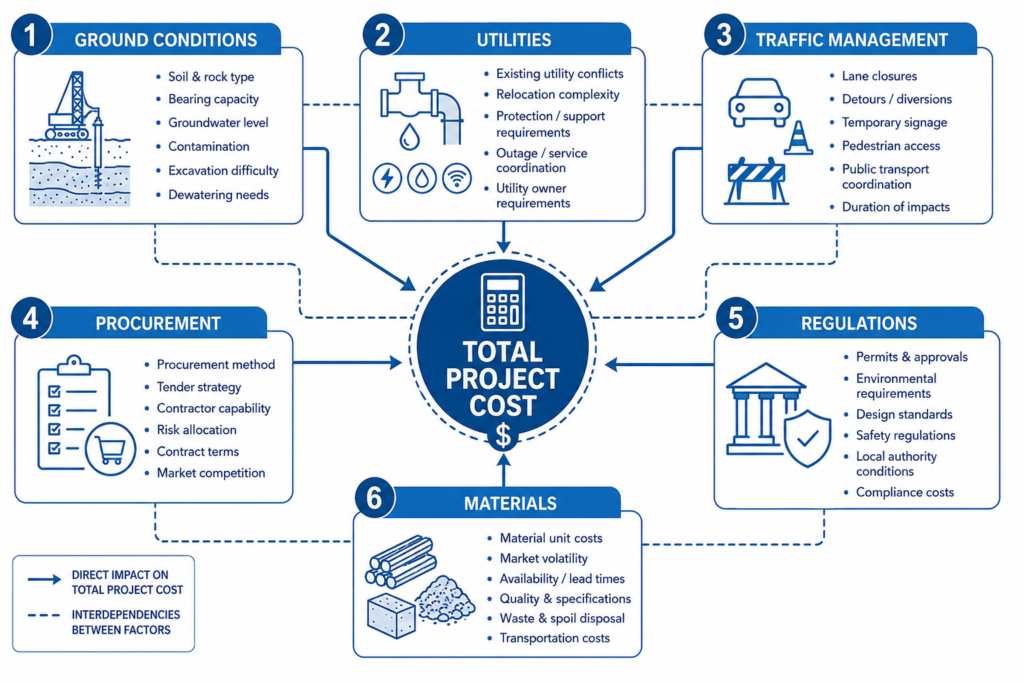
Urban infrastructure cost factors are the variables that determine the total expenditure of city-level civil works. Key drivers include ground conditions, utility conflicts, traffic management, material supply chains, regulatory requirements, procurement method, and site access constraints. In dense urban environments, these factors interact and compound, often adding 25–60% to baseline construction costs compared to greenfield projects.
What Urban Infrastructure Cost Factors Actually Mean
Urban infrastructure is the network of physical systems that enables a city to function — roads, bridges, drainage, water supply, wastewater, power distribution, telecoms, and public transit. For a fuller breakdown of these components and how they interact, see what urban infrastructure is and why it matters. Each system carries its own cost profile, but all share a common reality: delivering them in an already-built urban environment costs significantly more than building on vacant land.
The term “cost factors” refers specifically to the inputs and conditions that shift the price of a project from its theoretical minimum to its actual outturn. These are not merely line items in a bill of quantities. They are structural conditions — some fixed before design begins, others arising during construction — that a project team must identify, price, and manage. Failure to capture them at the outset is the single most common cause of cost overruns in urban civil works.
The Difference Between Cost Drivers and Cost Risks
A useful distinction for any project engineer or quantity surveyor is between cost drivers and cost risks. A cost driver is a known, quantifiable input: the volume of excavation required, the length of road to be resurfaced, the diameter and depth of a new sewer. These appear directly in the estimate. A cost risk is a potential condition that will increase cost if it materialises: contamination discovered below a previously clean site, a utilities record that proves inaccurate, or rainfall that disrupts programme.
Both must be accounted for. The standard approach under NEC4 or FIDIC contracts is to carry cost drivers in the priced schedule and cost risks in the risk register, with contingency allowances sized to the probability and consequence of each risk event. In practice, under-resourced pre-contract phases routinely conflate the two — quantified items are priced accurately, but risk contingencies are either omitted or set at an arbitrary percentage of contract value with no supporting analysis.
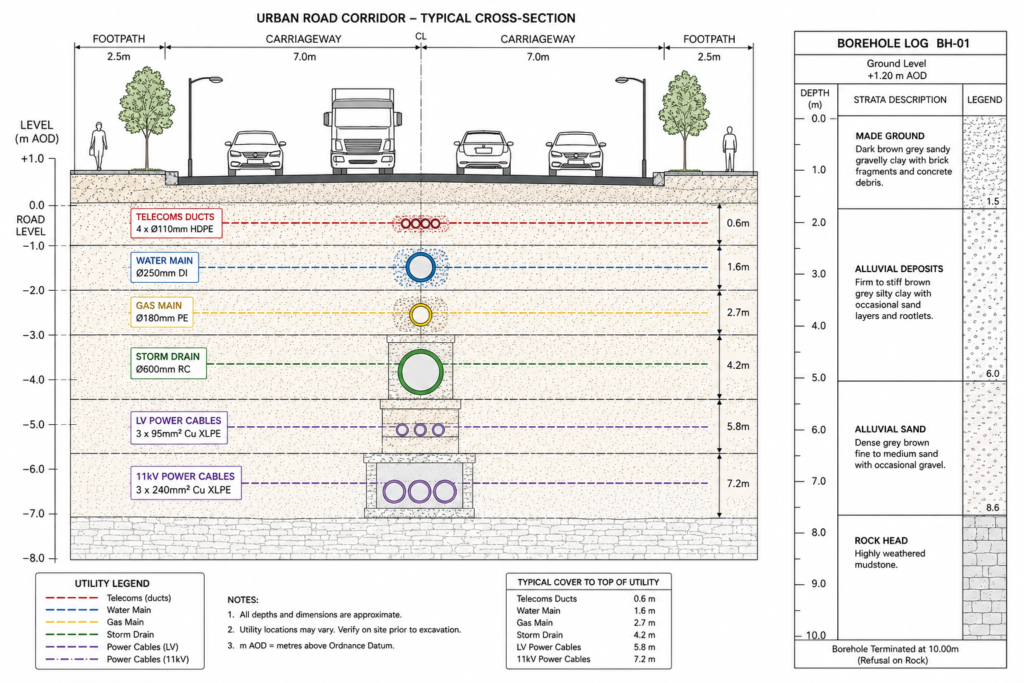
For urban projects specifically, risk registers should be live documents reviewed at every design gateway. A risk that sits at low probability in the concept design phase can escalate to near-certain once ground investigation results are available. The moment a borehole log confirms made ground at 4 metres depth across a road corridor, what was a contingency becomes a cost driver and must be repriced accordingly.
Baseline Cost Benchmarks
Before examining individual factors, a sense of scale is useful. Published benchmarks from the UK’s HM Treasury Infrastructure and Projects Authority and comparable data from the Nigerian Infrastructure Advisory Facility (NIAF) suggest that urban road rehabilitation in a medium-density city typically costs 1.5 to 2.5 times the equivalent rural scheme, on a per-kilometre basis. New urban drainage at 450mm diameter in a trafficked carriageway typically runs at £300–£600 per linear metre in the UK; comparable projects in Lagos or Abuja attract significant local multipliers driven by material import costs, generator fuel dependency, and access constraints.
These figures are not targets — they are starting points. The job of pre-contract cost planning is to adjust from the benchmark to the specific conditions of the project in front of you.
Ground Conditions and Subsurface Uncertainty
No urban infrastructure cost factor carries more potential for budget disruption than the ground. Every urban area sits on a geological and anthropogenic history that pre-contract investigation may only partially reveal. In Lagos, for instance, the coastal alluvial soils underlying much of Lagos Island and Victoria Island are characterised by low bearing capacity, high compressibility, and shallow groundwater. A carriageway reconstruction that appears straightforward from surface inspection may require full-depth pavement reconstruction, geotextile reinforcement, and a raised formation level to achieve adequate long-term performance — none of which appears in a price based on surface condition survey alone.
In Abuja, the lateritic profiles common across the Federal Capital Territory present differently: adequate bearing capacity in the dry season but susceptibility to moisture-induced swelling and settlement during the rains. Road schemes that do not account for subgrade moisture protection through adequate sub-base thickness and edge drainage can expect significant maintenance cost within five years of completion — effectively converting capital expenditure into recurring revenue spend.
The international standard for subsurface utility investigation, BS PAS 128:2022, provides a four-level quality designation for utility records, from desktop study (Quality Level D) through to physical verification (Quality Level A). Applying Quality Level A investigation — which involves physical exposure of utilities — before finalising the design of underground works in urban environments typically adds 2–4% to pre-construction costs but can prevent utility strike events that routinely cost £50,000–£250,000 per incident, excluding delay claims.
Geotechnical investigation programmes for urban infrastructure should follow the phased approach set out in BS EN 1997-2 (Eurocode 7 Part 2) and its UK National Annex. A preliminary investigation phase establishes the broad ground model; a detailed phase targets specific design decisions; and a supplementary phase resolves anomalies encountered during construction. Compressing these phases into a single mobilisation — common when procurement programmes are tight — is a false economy that transfers cost risk to the construction contract.
For a deeper treatment of how ground conditions affect civil engineering design decisions at the project level, the geotechnical engineering guide on this site covers investigation methods, ground models, and the relationship between subsurface data quality and design confidence.
Utility Conflicts and Coordination Costs
In any established urban area, the ground below a carriageway or footway is occupied. Water mains, gas distribution pipes, electrical cables, telecoms ducts, district heating pipes, and foul and surface water sewers share a corridor that was never designed to accommodate all of them simultaneously. Over decades of piecemeal installation, accurate records become increasingly unreliable. The result is that utility conflict — the discovery that a planned excavation intersects an existing service — is not a risk on urban infrastructure projects. It is a certainty. The only variable is severity.
Utility diversion and protection costs are among the most consistently underestimated items in urban infrastructure budgets. Several structural reasons explain this. First, utility records are held by individual asset owners whose data quality varies widely; no single source gives a complete picture. Second, utility owners have statutory rights to protect their assets under the New Roads and Street Works Act 1991 (NRSWA) in the UK, or equivalent national frameworks, which means a diversion request can be declined or significantly delayed if it does not meet the asset owner’s design standards. Third, diversion design is carried out by the utility owner’s own engineering team, whose resource availability is outside the project manager’s control.
Costs for individual utility diversions vary enormously. A simple telecoms duct diversion in a carriageway might be completed for £8,000–£15,000. A high-pressure gas main diversion requiring specialist shutdown, purging, and reinstatement to IGEM standards can run to £500,000 or more on a single run. An electricity distribution network diversion in a congested urban core — particularly where 33kV or 132kV infrastructure is involved — may require National Grid involvement and carry lead times of 18–36 months regardless of project programme.
The practical implication for cost planning is that utilities budgets on urban schemes should be developed from a detailed conflict register, not from a percentage uplift. Each identified conflict should carry a diversion estimate based on the asset type, depth, diameter, and the operational constraints on the owning utility. Where a conflict cannot be priced from available data, a risk allowance sized by reference to comparable projects should be carried in the risk register.
Traffic Management, Access, and Logistics
Urban construction cannot operate in isolation from the city around it. Every excavation in a trafficked road, every crane lift adjacent to a live carriageway, every concrete pour in a pedestrianised zone carries a traffic management cost that does not exist on a greenfield site. For urban infrastructure projects, traffic management regularly accounts for 8–18% of total construction cost — a figure that surprises many clients who have seen only rural or out-of-town project cost plans.
The reasons are structural. Urban roads carry high traffic volumes, often with no alternative route available for diversion. A temporary road closure that would be trivial in a rural context may require a traffic management scheme involving advance signing over 2 kilometres, signal-controlled single-lane working, banksmen during peak hours, and noise-restricted working hours under local authority permit. Each of these elements costs money directly; collectively they also extend programme, which compounds preliminaries costs and delay risk.
Material delivery logistics add another layer. Concrete, aggregates, prefabricated elements, and plant must reach a site that is often accessible from a single direction, with restricted delivery windows, and no room for laydown. In dense city centres, this drives up plant-and-material costs through less efficient loading cycles, longer vehicle waiting times, and the need for smaller plant that can access confined worksites. A 20-tonne excavator that would comfortably handle an open-air excavation may not physically fit through the access constraints of a tight urban site, requiring a smaller machine with lower productivity.
Night and weekend working — often required to minimise disruption to businesses and residents — carries a wage premium of 25–50% above standard day rates, together with additional supervision costs, lighting, and enhanced site security. These costs must be built into the programme resource plan, not treated as provisional sums. Road infrastructure planning and delivery is directly shaped by these logistical constraints, particularly in city centre corridors where day-rate access windows may be limited to four to six hours.
Regulatory Requirements, Approvals, and Compliance Costs
Urban infrastructure sits at the intersection of planning law, highway regulation, environmental legislation, and health and safety frameworks. Each of these regimes imposes requirements that carry cost — some predictable, some contingent on decisions made by regulatory bodies whose timelines are outside project control.
In Nigeria, the regulatory landscape for urban infrastructure intersects COREN registration requirements for design signatories, State Urban Development Authority approvals, Environmental Impact Assessment (EIA) obligations under the Environmental Impact Assessment Act Cap E12 LFN 2004 for projects above certain thresholds, and Local Government Authority road opening permits. Each approval gate carries fees, preparation costs, and — most significantly — time. A statutory EIA for a major urban road scheme in Nigeria can take 12–18 months; the cost of carrying project overheads across that period is a real cost that belongs in the project budget, not the risk register.
Health and safety compliance under Nigeria’s Factories Act and the broader framework of CDM principles (now adopted in spirit if not statute across much of Sub-Saharan Africa) also drives cost through mandatory requirements for method statements, risk assessments, welfare facilities, and competent supervision. The temptation to treat these as administrative overheads rather than genuine cost items leads to under-resourced project teams and a disproportionate share of accidents on urban construction sites — a cost that manifests in delays, investigations, and reputational damage that far exceeds the cost of adequate compliance from the outset.
Environmental protection requirements during construction — sediment control on drainage works, dust suppression on earthworks, noise monitoring adjacent to sensitive receptors — add a further layer of compliance cost. These should be scoped during the Environmental Management Plan preparation stage and priced as discrete site preliminaries items, not absorbed into a contingency line.
Cost Control Best Practices for Urban Infrastructure Projects
Cost overruns on urban infrastructure are not inevitable. They are the predictable result of specific, identifiable failures in pre-contract preparation, risk allocation, and project governance. The following practices, applied consistently from project inception, give a project team the best chance of delivering within budget.
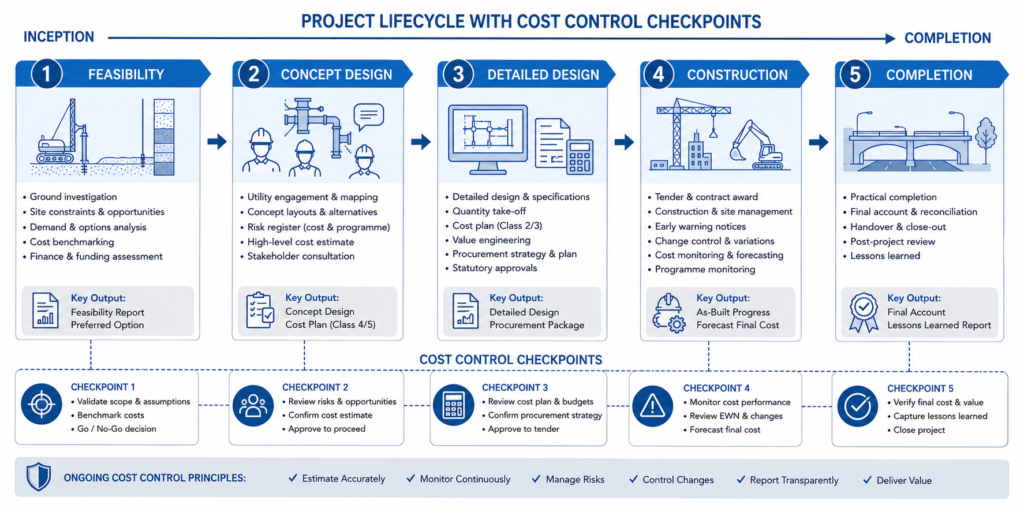
Invest in pre-contract investigation. Ground investigation, utility verification to BS PAS 128:2022 Quality Level B or above, topographic survey, and traffic data collection are not costs to defer. They are insurance against significantly larger costs during construction. A pre-contract investigation programme that spends 2–3% of estimated construction value on resolving uncertainty will typically return that investment multiple times over in avoided variation orders.
Build the cost plan from first principles. Benchmark rates have a role in early-stage feasibility, but a cost plan submitted for funding approval should be built from a measured bill of quantities, priced against current market rates obtained from recent comparable projects. Urban infrastructure rates move with material prices, fuel costs, and labour market conditions; a benchmark from three years ago may be 20–35% below current market.
Separate cost drivers from cost risks. Your budget should show what the project costs under base assumptions, and your risk register should show what it could cost if identified risks materialise. Blending the two — carrying risk contingency within unit rates rather than as a separately identified allowance — obscures the true cost profile and makes it impossible to manage risk proactively.
Engage utility asset owners early. Notification to utility owners of planned works should happen at concept design stage, not at detailed design. Early engagement gives asset owners time to plan diversions within their own capital programmes, may allow coordination with existing planned works (reducing costs for both parties), and establishes the project’s programme obligations before they become critical path items.
Price traffic management specifically. Use Traffic Management Regulations and the local authority’s standard conditions to identify exactly what will be required. Price each element — advance signing, signal heads, banksmen, lane closures, night-working — as a discrete item. Lump-sum traffic management packages with no breakdown are a reliable indicator of an undercooked estimate.
Use NEC4 or equivalent contracts with active early warning mechanisms. The Early Warning Notice mechanism in NEC4 requires both parties to notify the other of any event that may affect cost, programme, or quality. This mechanism, when used actively, creates a contemporaneous record of cost events and forces the project team to consider mitigation options before a situation escalates into a formal compensation event claim. For urban infrastructure projects, where complexity is high and surprises are frequent, active contract management is as important as good design.
A structured approach to cost planning and project delivery is examined in detail in the cost control guide for civil engineering projects, which covers estimation methodology, contingency sizing, and change management processes applicable to urban infrastructure schemes of all sizes.
Frequently Asked Questions About Urban Infrastructure
Q: What is urban infrastructure cost in civil engineering?
A: Urban infrastructure cost refers to the total expenditure required to design, construct, and commission city-level civil works such as roads, drainage, bridges, and utilities. It encompasses direct construction costs, pre-contract investigation, traffic management, utility diversions, regulatory compliance, and professional fees. In urban environments, this figure is consistently higher than equivalent rural works due to site constraints, subsurface complexity, and the need to maintain city function during construction. Benchmarks from the UK Infrastructure and Projects Authority suggest urban premiums of 50–100% over greenfield equivalents are typical.
Q: Why do urban infrastructure projects go over budget?
A: The most common causes are inadequate pre-contract ground investigation, underestimated utility diversion costs, unrealistic traffic management allowances, and insufficient risk contingency. In many cases, cost plans are prepared at early design stages with limited site data and are not updated as investigation results introduce new information. A cost plan that was accurate at 15% design can be significantly wrong by the time the scheme reaches tender if it has not been progressively refined as uncertainty resolves.
Q: How does urban planning affect infrastructure costs?
A: Urban planning decisions directly shape infrastructure cost in several ways. Mixed-use zoning increases utility load density, requiring larger-diameter mains and higher-capacity drainage. Density-led masterplanning in existing urban areas often requires retrograde utility upgrades to serve new development — costs that fall on either the developer or the infrastructure authority depending on the adopted infrastructure delivery model. Poor coordination between planning approvals and infrastructure delivery programmes is a structural cause of cost inefficiency in many cities. For more context on how planning frameworks interface with infrastructure delivery, see the urban planning guide.
Q: What procurement route reduces urban infrastructure cost risk?
A: No procurement route eliminates cost risk, but some allocate it more appropriately. NEC4 Engineering and Construction Contract (ECC) with an Activity Schedule (Option A) or Bill of Quantities (Option B) provides clear price certainty for defined scope and transparent change management for unforeseen conditions. Design-and-build procurement can reduce design-cost interface risk but may transfer ground risk to a contractor who prices conservatively, inflating tender prices rather than reducing them. The most cost-effective approach is to invest in pre-contract investigation to reduce scope uncertainty, then procure on a lump-sum or admeasurement basis with a well-structured risk register and adequate client-retained contingency.
Q: How much contingency should an urban infrastructure project carry?
A: Contingency levels should be risk-based, not percentage-based. However, as a practical guide, HM Treasury’s Green Book supplementary guidance recommends Optimism Bias uplifts of 15–66% for civil infrastructure projects, depending on project type and stage of development. For urban infrastructure at concept design stage, a combined risk and optimism bias allowance of 25–35% of base estimate is common. This reduces as design progresses and uncertainty resolves. By the time a scheme reaches tender, residual contingency held by the client should reflect only genuinely unresolvable uncertainty — typically 10–15% for a well-investigated urban project.
Managing Urban Infrastructure Costs: The Practitioner’s Summary
Urban infrastructure cost factors do not operate in isolation. Ground conditions affect foundation design, which affects programme, which affects traffic management costs, which affects the community relations position that may influence regulatory approvals. The interplay between these factors is what makes urban infrastructure cost management genuinely difficult — and why projects that treat each factor as an independent line item, rather than as part of an interconnected cost model, consistently disappoint.
The consistent thread across well-delivered urban infrastructure projects is early investment in information. Spend on ground investigation, utility verification, and traffic surveys before design freezes. Build cost plans from measured quantities priced at current market rates. Maintain a live risk register that distinguishes cost drivers from cost risks. Engage utility asset owners and regulatory bodies before their involvement becomes programme-critical. And use contracts that require active management of emerging events, not passive administration of completed ones.
For a broader understanding of what urban infrastructure systems comprise and how they are planned at the city scale, the urban infrastructure guide provides a structured overview of the sector and its design considerations.
StruviaCore advises clients on urban infrastructure cost planning, risk management, and project delivery across Nigeria and internationally. If you are preparing a budget for an urban civil works scheme and need independent cost assurance or technical due diligence, contact the StruviaCore team to discuss how we can support your project from the earliest stages.
Leave a Reply