

A municipal engineer in Lagos and a network planner in Manchester are asking the same question this year: why does a “smart” utility upgrade cost three to five times more than the conventional retrofit it replaces? The answer sits in a mix of hardware, integration labour, data infrastructure, and long-term maintenance obligations that rarely appear in the headline capex figure. Understanding smart utilities cost factors matters because procurement teams that miss them end up with stalled projects, blown budgets, or systems that work in year one and fail by year three.
This article breaks down where the money actually goes in a smart utility deployment — water, power, and waste networks fitted with sensors, telemetry, and automated controls — and how structural and civil teams should plan around it. We cover the core cost components, the technical drivers behind them, regional regulatory pressure in Nigeria, the UK, and the UAE, the mistakes that inflate budgets, and a practical checklist for cost control.
Smart Utilities Cost Factors: Quick Answer
Smart utilities cost factors include sensor and metering hardware, communications infrastructure (LoRaWAN, NB-IoT, or fibre backhaul), SCADA and data platform licensing, civil works for equipment housing, cybersecurity provisioning, and ongoing calibration and maintenance. Typical smart water or grid retrofits run 25–60% above conventional equivalents, driven mainly by integration labour and data infrastructure rather than the sensors themselves.
What Drives Smart Utilities Cost Factors
A smart utility system layers digital monitoring and control over physical infrastructure that, in most cases, already exists. That layering is exactly why smart utilities cost factors differ so sharply from a straightforward pipe replacement or transformer swap. You are not just paying for a device; you are paying for a device, the network that carries its data, the platform that interprets that data, and the civil works needed to protect all three from weather, vandalism, and power interruption. This sits inside the broader shift toward connected infrastructure across urban networks, where every asset class is expected to report its own condition in real time.
Hardware and Sensor Costs
Smart water meters with ultrasonic flow sensing typically cost $80–$150 per unit installed, compared to $15–$25 for a mechanical meter. Pressure transducers for leak detection networks add $200–$600 per monitoring point depending on pipe diameter and access conditions. On the power side, smart transformers with embedded monitoring cost 30–45% more than standard units of equivalent kVA rating. None of these figures include the civil works — trenching, chamber construction, or pole-mounted enclosures — needed to house them safely.
Communications and Data Infrastructure
This is where budgets most often go wrong. A LoRaWAN gateway covers roughly 2–5 km in dense urban terrain and 10–15 km in open ground, meaning a mid-sized city network needs multiple gateways, each requiring power, a mounting structure, and often a rooftop lease agreement. NB-IoT connections avoid the gateway cost but carry recurring SIM data charges across potentially thousands of endpoints. Fibre backhaul for SCADA control rooms costs more upfront but eliminates the ongoing per-device data fees that erode budgets over a 10-year asset life.
Technical Cost Categories in Detail
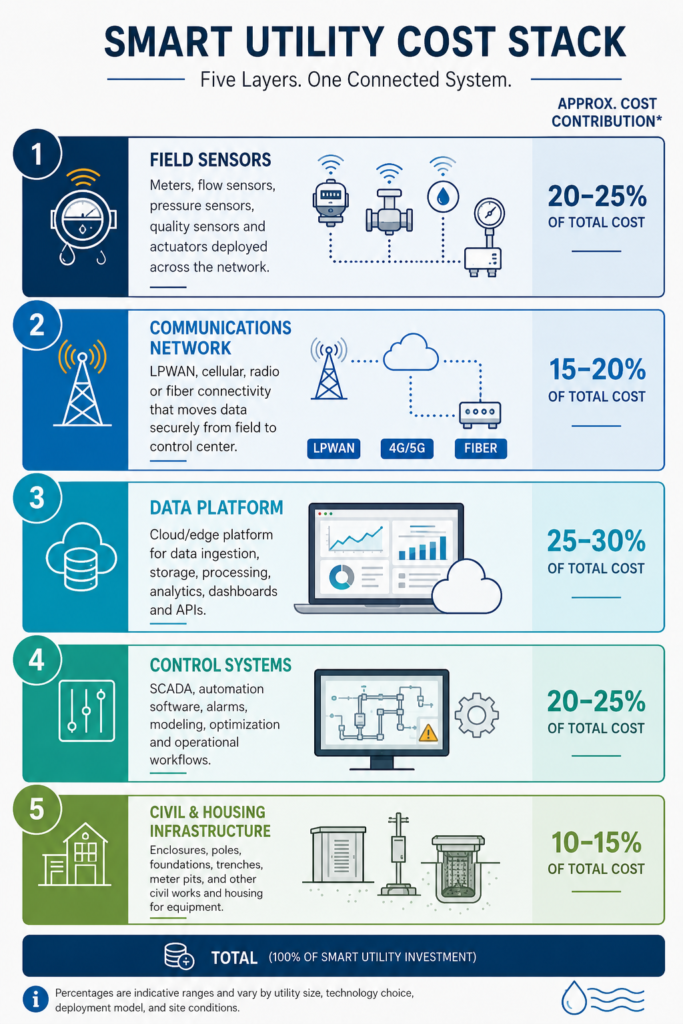
Break a smart utility budget into five categories and the picture becomes manageable: field devices, network infrastructure, data platform and software licensing, civil and structural works, and cybersecurity provisioning. Each category behaves differently over the asset lifecycle, and treating them as one lump “smart technology” line item is the single biggest planning error we see on client projects. Many of these principles carry over directly from conventional network planning — see our utilities guide for the baseline cost structure before the digital layer is added.
Civil and Structural Works
Every sensor node, gateway, or control cabinet needs a foundation, enclosure, or mounting bracket rated for local conditions. In Lagos and Port Harcourt, equipment housings need corrosion-resistant specification and elevated plinths above the 1-in-50-year flood level, adding 15–20% to civil costs compared to a temperate climate installation. In the UAE, ambient temperatures above 45°C require forced-air or passive cooling enclosures for control cabinets, which is a cost line absent from most vendor quotations built around European reference designs.
Data Platform and Licensing
SCADA and utility management platforms are usually licensed per tag or per connected device, meaning costs scale directly with network size rather than tapering off after initial deployment. A network of 10,000 smart meters can carry annual licensing fees of $2–$5 per meter, which on a 15-year asset horizon exceeds the original hardware cost. Procurement teams should model this recurring cost against capex, not alongside it as an afterthought.
Regional and Regulatory Context
Cost factors do not sit in a vacuum; they respond directly to the regulatory and market conditions a project sits inside. In Nigeria, smart utility rollouts intersect with NERC’s metering regulations and the eligibility criteria for the Meter Asset Provider scheme, which shapes procurement routes and financing structures for smart electricity meters. Projects also need COREN-certified engineering sign-off on any structural works tied to substation upgrades or elevated equipment housings, which adds a design review cycle that international vendors frequently underestimate in their timelines.
In the UK, Distribution Network Operators (DNOs) require compliance with BS EN 61439 for low-voltage switchgear assemblies used in smart grid control cabinets, and any structural civil works fall under the relevant Building Regulations Part A for structural safety. Ofgem’s price control framework (RIIO-ED2) also directly influences how much capital DNOs can allocate to smart grid pilots, which is worth understanding before proposing a scope that exceeds a client’s regulatory allowance.
In the UAE, Dubai Electricity and Water Authority’s smart grid strategy mandates specific communication protocol compliance for any device connecting to its network, and Dubai Municipality requires structural approval for ground-mounted enclosures above a defined footprint. Skipping this approval step is the most common cause of delayed smart utility handovers we encounter on Gulf projects. This regulatory layering is one reason smart utility rollouts are increasingly planned alongside wider urban planning frameworks rather than as standalone utility upgrades.
Common Mistakes That Inflate Smart Utilities Cost Factors
Most budget overruns trace back to a handful of repeated errors rather than genuinely unpredictable circumstances. Recognising these patterns early lets a project team correct course before costs compound.
- Underestimating civil works scope. Vendor quotations for sensors and gateways rarely include chamber construction, trenching, or enclosure foundations, leaving these costs to surface mid-project.
- Ignoring recurring data and licensing fees. A capex-only business case looks attractive until the 10-year opex on platform licensing and SIM connectivity is added, at which point the total cost of ownership can double.
- Specifying hardware without local environmental derating. Equipment rated for 25°C ambient fails prematurely in Gulf or coastal West African conditions, driving replacement costs that were never budgeted.
- Skipping cybersecurity provisioning. Retrofitting network segmentation and encrypted communications after a breach costs significantly more than designing it in from the outset.
- Treating regulatory approval as a formality. Structural sign-off from COREN, Building Control, or Dubai Municipality can add 6–12 weeks to a schedule if not planned for, and schedule slippage carries its own direct cost.
Each of these mistakes shares a root cause: treating the digital layer and the physical infrastructure as separate projects with separate budgets, when they need a single, integrated cost model from day one. The same discipline that governs a wider smart cities rollout applies just as much to a single utility upgrade — scope the digital and physical layers together, or expect the budget to move.
Best Practices for Managing Smart Utilities Cost Factors
You can control most of the cost volatility in a smart utility project by building the right assumptions into your business case early. The following approach reflects how we structure cost planning for clients across Nigeria, the UK, and the UAE.
Build a Five-Layer Cost Model
Model field devices, network infrastructure, data platform licensing, civil works, and cybersecurity as five distinct budget lines, each with its own capex and opex profile. This structure exposes the recurring costs that a single “technology” line item hides, and it gives you a defensible basis when a client questions why the smart option costs more than a like-for-like conventional replacement.
Specify for Local Conditions From the Start
Request environmental derating data for every device against your actual site conditions — flood level, ambient temperature, humidity, and corrosion exposure — before finalising a vendor shortlist. Retrofitting environmental protection after installation costs far more than specifying it correctly the first time.
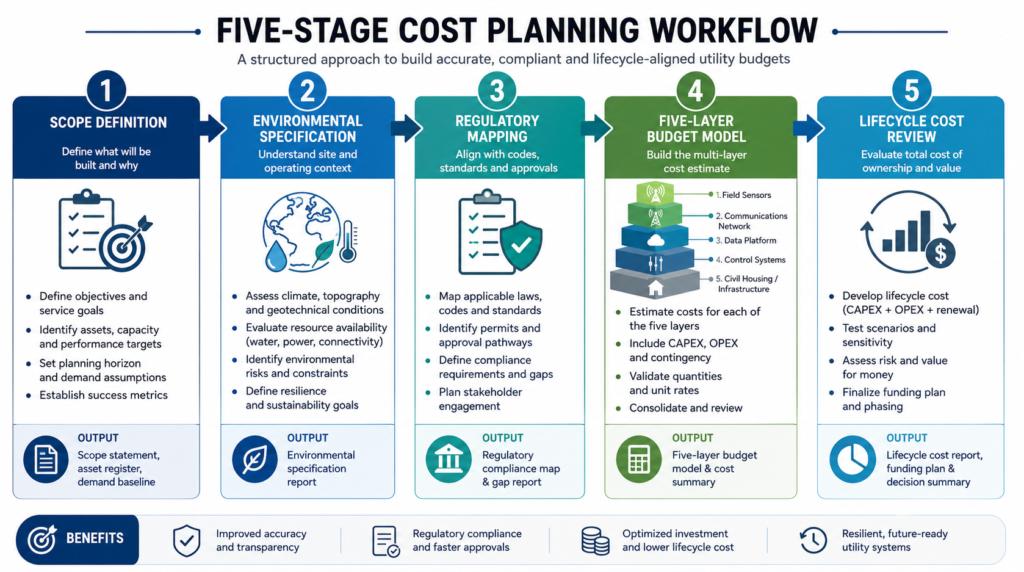
Map every applicable regulatory approval — NERC, COREN, DNO connection agreements, BS EN certification, or Dubai Municipality sign-off — against your project timeline before construction starts, not after a delay forces the review. Build a lifecycle cost review into year three and year seven of the asset’s life, since sensor calibration drift and platform license renegotiation both tend to surface at those intervals and catch unprepared operators off guard.
Frequently Asked Questions About Smart Utilities
Q: What is smart utilities cost planning in civil engineering?
A: Smart utilities cost planning is the process of budgeting for both the physical infrastructure and the digital layer — sensors, networks, and software — that make a water, power, or waste system remotely monitored and controlled. It requires separate capex and opex modelling for hardware, connectivity, platform licensing, civil works, and cybersecurity.
Q: How much does a smart water metering rollout cost per connection?
A: Installed cost typically runs $80–$150 per connection for the meter itself, plus $30–$60 per connection for network and platform allocation, and additional civil works costs depending on chamber condition. A city-wide rollout of 50,000 connections commonly totals $6–$10 million once network and platform costs are included.
Q: What is the difference between smart utilities and conventional utilities in terms of cost?
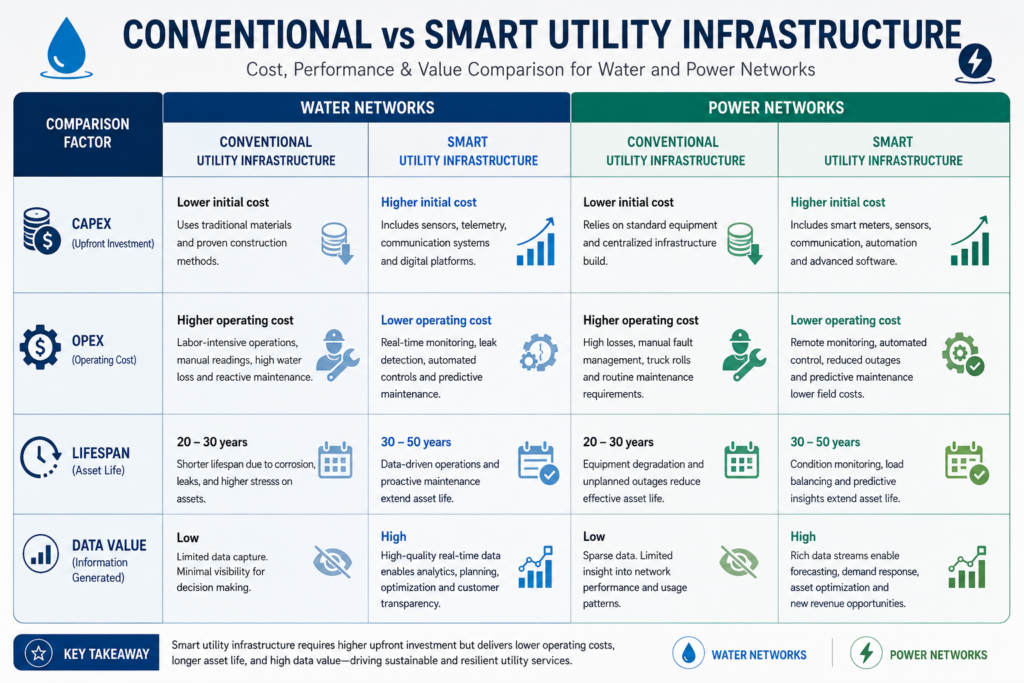
A: Conventional utilities carry lower upfront capex but no ongoing data or licensing costs beyond routine maintenance. Smart utilities carry 25–60% higher initial capex but generate recurring opex through data platform licensing, connectivity fees, and cybersecurity provisioning across the asset’s life.
Q: What regulatory approvals affect smart utilities cost factors in Nigeria?
A: NERC’s Meter Asset Provider regulations govern procurement and financing routes for smart electricity meters, while COREN certification is required for structural sign-off on any civil works tied to substations or elevated equipment enclosures. Both add review time and documentation cost that should be scoped into the project timeline.
Q: How do you reduce smart utilities cost factors without cutting essential functionality?
A: Standardise on a single communications protocol across the network to avoid paying for multiple gateway types, negotiate platform licensing on a tiered per-tag basis rather than a flat per-device rate, and specify environmental derating correctly the first time to avoid premature replacement. These three actions typically recover 15–20% of total lifecycle cost without reducing monitoring coverage.
Smart utilities cost factors reward the teams that model them properly and punish the ones that treat digital infrastructure as an add-on to conventional civil works. The real cost lives in the layers most vendor quotations leave out: civil housing rated for local conditions, recurring data and licensing fees, and the regulatory approval cycles specific to Nigeria, the UK, or the UAE. Build your budget around five distinct cost layers rather than one lump figure, and you avoid the mid-project surprises that derail most smart utility rollouts. If you are scoping a smart water, power, or waste project and need a defensible cost model before you go to procurement, talk to StruviaCore’s smart infrastructure team about a site-specific cost assessment.
Leave a Reply