

A field technician in a Lagos distribution company still climbs several flights of stairs each month to read an analogue meter by torchlight, while three streets away a burst water main has been leaking since Tuesday and nobody at the utility company knows it yet. Both problems share the same root cause: the network cannot report on itself. Smart utilities change that equation. They turn power, water, gas, and waste networks into systems that measure, transmit, and respond to their own condition in near real time, replacing manual reads and complaint-driven repairs with continuous data. Utility operators, project managers, and civil and electrical engineers now have to specify, procure, and maintain these systems on projects ranging from single estates to national metering rollouts. This guide sets out what smart utilities are, how the sensor, communication, and data layers work together, what Nigerian and international regulation requires, where the costs and failure points sit, and how to plan a deployment that survives an unreliable power grid and an import-dependent supply chain.
Smart Utilities: Quick Answer
Smart utilities are power, water, gas, and waste networks that use sensors, smart meters, and data platforms to report consumption and system condition in real time. Instead of periodic manual readings, operators receive continuous data on flow, load, and faults, which shortens response times and cuts revenue losses from leaks, theft, and estimated billing.
What Smart Utilities Means in Civil Engineering Practice
Smart utilities are utility networks — electricity, water, gas, or waste — instrumented with sensors and communication technology so the network reports its own status instead of waiting for a technician or a customer complaint to reveal a fault. A conventional utility network is largely blind between scheduled inspections: a transformer overheats, a pipe leaks, or a meter under-reads, and nobody finds out until a bill dispute or an outage forces the issue. A smart utility network closes that gap by pairing physical infrastructure with a data layer that runs continuously rather than on an inspection cycle. This is why smart utilities sit inside the broader smart cities agenda: a city cannot run adaptive traffic signals or demand-responsive street lighting without the underlying power and water networks already reporting usable data.
Core Components of a Smart Utility System
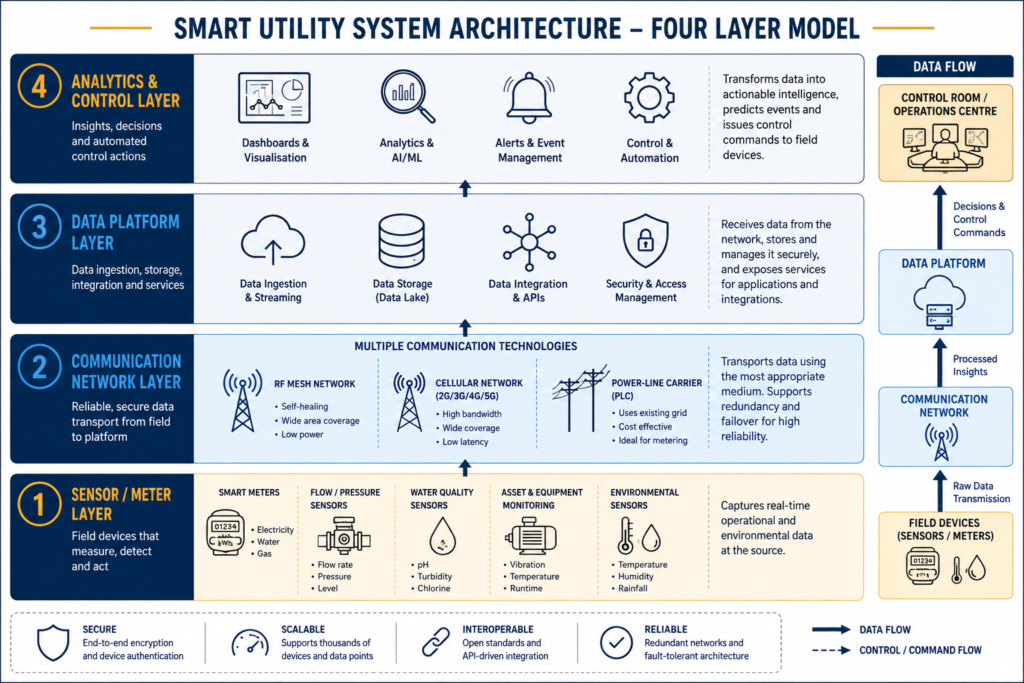
Four layers make up almost every smart utility deployment, and skipping one is the most common reason a pilot project stalls before it reaches full scale:
- Sensor and meter layer: smart electricity meters, water flow and pressure sensors, gas leak detectors, or waste bin fill-level sensors that generate the raw readings.
- Communication layer: the network that carries readings back to a head-end system, built on Internet of Things (IoT) radio protocols such as NB-IoT, LTE-M, or LoRaWAN, on power-line carrier signalling for electricity meters, or on RF mesh networks in dense urban areas.
- Data platform layer: the head-end system and meter data management software that stores, validates, and structures incoming readings before anyone acts on them.
- Analytics and control layer: SCADA systems, geographic information system (GIS) overlays, and billing engines that turn raw data into alerts, dashboards, and — in more mature deployments — automated control actions.
How Data Moves from the Field to the Control Room
A single meter reading illustrates the full chain. A smart electricity meter records a consumption value, timestamps it, and packages it according to IEC 62056, the international DLMS/COSEM standard that governs how electricity, gas, and water meters structure and exchange data regardless of manufacturer. The meter pushes that packet over its communication channel to a data concentrator, which forwards it to the utility’s head-end system. Meter data management software then validates the reading against expected ranges, flags anomalies such as tamper events or reverse flow, and feeds clean data into billing and analytics systems. The full cycle, from meter to dashboard, typically completes in minutes rather than the weeks a manual meter-reading cycle takes — which is the practical difference a project team is really paying for when it specifies a smart utility system over a conventional one.
Smart Utilities in Practice: Systems and Technology Types
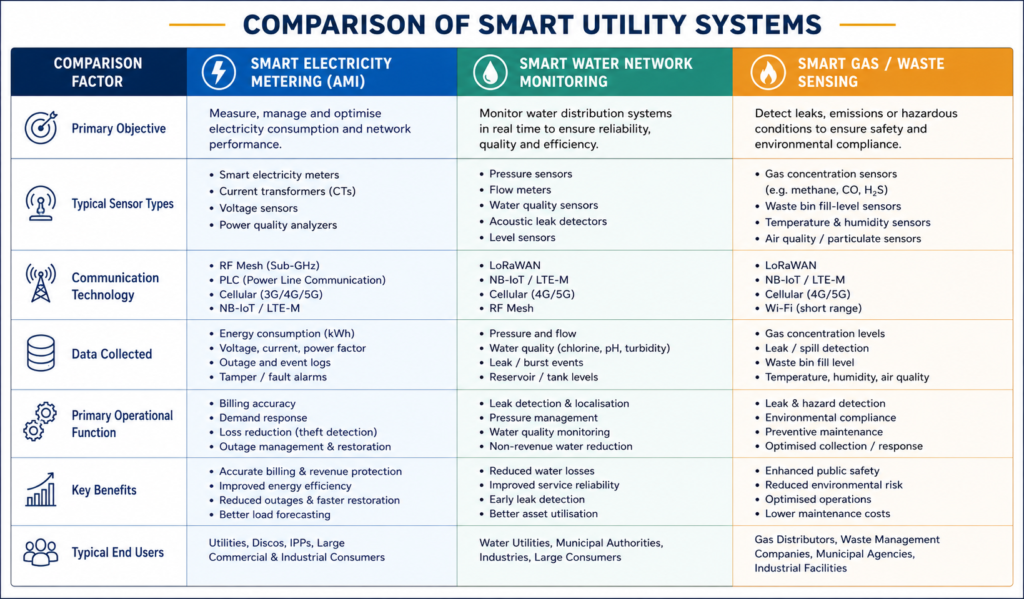
Smart utilities is an umbrella term that covers four distinct engineering problems, each with its own sensor technology, failure mode, and business case. Electricity, water, gas, and waste networks are rarely digitised on the same timeline or by the same team, and a specification written for one rarely transfers cleanly to another. Operators increasingly pair the raw sensor data from each network with a digital twin model of the physical system, which lets engineers simulate a pipe burst, a feeder overload, or a demand spike before it happens rather than reacting after the fact.
Smart Electricity Grids and Advanced Metering Infrastructure
Advanced metering infrastructure (AMI) is the electricity-sector term for a smart meter network with two-way communication: the utility can read consumption remotely and, in a prepaid market like Nigeria’s, can also disconnect, reconnect, or adjust a customer’s credit balance without a site visit. Nigerian prepaid meters typically implement the Standard Transfer Specification (STS) token system, which lets a customer load credit through a 20-digit token generated at a vending point. Beyond metering, distribution automation adds reclosers and remotely operated switches to the feeder network, so a fault on one section isolates itself instead of tripping an entire feeder. This is where the operational payoff shows up most clearly: fewer truck rolls, faster fault isolation, and shorter outage durations, which we break down in more detail in our guide to automation benefits.
Smart Water Networks and Leak Detection
Water utilities face a different problem: pressure and flow data, not consumption alone, reveal most faults. Acoustic sensors clamped to a pipe network pick up the distinct sound signature of a leak long before it surfaces, and pressure-zone monitoring flags the sudden drop that signals a burst main. The stakes are large: the International Water Association estimates that utilities worldwide lose roughly 126 billion cubic metres of treated water a year to what the sector calls non-revenue water — water produced but never billed — worth an estimated $39 billion annually, with rates exceeding 45–50% in some water-stressed regions. Utilities that deploy IoT-based leak detection and pressure management typically cut non-revenue water by 15 to 25 percentage points within 18 to 36 months, a meaningful figure for any Nigerian water authority weighing sensor costs against continuing losses from an ageing distribution network.
Nigerian Regulation and Real-World Deployment
The Nigerian Electricity Regulatory Commission (NERC) is the reference point for any smart utilities project that touches electricity in Nigeria. Its Meter Asset Provider (MAP) Regulation, NERC/R/112, took effect on April 3, 2018, and lets licensed MAPs install meters on behalf of a distribution company (DisCo), with the customer repaying the cost over a period of up to ten years. The Federal Government layered the National Mass Metering Programme (NMMP) on top of MAP in 2020, backed by an initial ₦200 billion in seed capital aimed at closing the metering gap and eliminating estimated billing. In April 2024, NERC deregulated MAP meter pricing under Order NERC/2024/040, a change that also formally opened the scheme to smart meters and IoT-enabled meters rather than restricting it to basic electromechanical units. The World Bank-backed Distribution Sector Recovery Programme (DISREP), a $500 million facility, targets 3.2 million additional smart meters on top of that.
The gap these programmes are chasing remains wide. NERC reported 12,386,848 active electricity customers as of March 31, 2026, of whom only 7,324,079 carried a meter — a national metering rate of 59.13%, leaving roughly 5.06 million customers on estimated billing. Every meter installed still has to clear the Nigerian Electricity Management Services Agency (NEMSA), which enforces the Grid Metering Code and Distribution Metering Code in line with IEC standards through four National Meter Test Stations — Lagos, Kaduna, Port Harcourt, and Enugu — with two more under construction. A meter without a valid NEMSA crimp seal and test certificate cannot legally go into service, which matters as much to a project’s commissioning schedule as the sensor specification does.
Nigeria’s rollout is also starting to intersect with wider connected infrastructure planning, as urban authorities look at utility data alongside traffic and public-safety systems rather than in isolation — the same pattern already visible in more mature markets such as the UK, where regulator-mandated smart meter rollouts pushed electricity AMI penetration well past the levels Nigeria’s DisCos report today. Because smart meters generate granular, timestamped consumption data tied to an individual customer, any Nigerian deployment also has to treat that data as personal data under the Nigeria Data Protection Act (NDPA) 2023, not simply as billing input.
Common Challenges and Cost Factors in Smart Utilities Projects
Three constraints shape most smart utilities projects in Nigeria before the technology choice even comes up. First, sensor and communication nodes need continuous power, which is a difficult requirement on a grid where the assets being monitored are themselves part of an unreliable supply — most rural and peri-urban deployments budget for solar panels and battery backup at every remote node rather than assuming mains power will hold. Second, cable and meter theft remains a persistent operating cost: exposed communication cabling and externally mounted meters are frequent vandalism targets, which pushes many specifications toward tamper-evident enclosures and armoured cable runs that a lower-risk market would not need. Third, rural and peri-urban areas often sit outside reliable cellular or LoRaWAN coverage, forcing a choice between extending communication infrastructure or accepting a store-and-forward data model with longer reporting delays.
Capital cost is dominated by imported hardware, which links project budgets directly to the naira-dollar exchange rate. Before NERC deregulated pricing in 2024, the Commission’s last regulated review had set single-phase MAP meter costs at roughly ₦81,795 and three-phase units at roughly ₦143,836, inclusive of installation and warranty; since deregulation, prices are set through competitive bidding among approved Meter Asset Providers and vary by vendor and specification. A full smart water network — sensors, communication gateways, and a data platform for a single treatment zone — typically costs several times a comparable metering-only rollout once SCADA integration and civil works for sensor chambers enter the budget, so a project team should price the platform and integration separately from the per-unit sensor cost a vendor quotes.
The long-term cost that specifications most often miss is maintenance capacity. A sensor network is only as reliable as the technicians who calibrate, repair, and replace it, and Nigeria’s technician pipeline has historically lagged the pace of rollout — part of why the Presidential Metering Initiative now trains 5,000 young Nigerians as meter installers and technicians alongside the hardware procurement. A project that budgets for sensors but not for a local maintenance contract and spare-parts stock typically sees its data quality degrade within the first eighteen months of operation.
Best Practices for Planning a Smart Utility Project
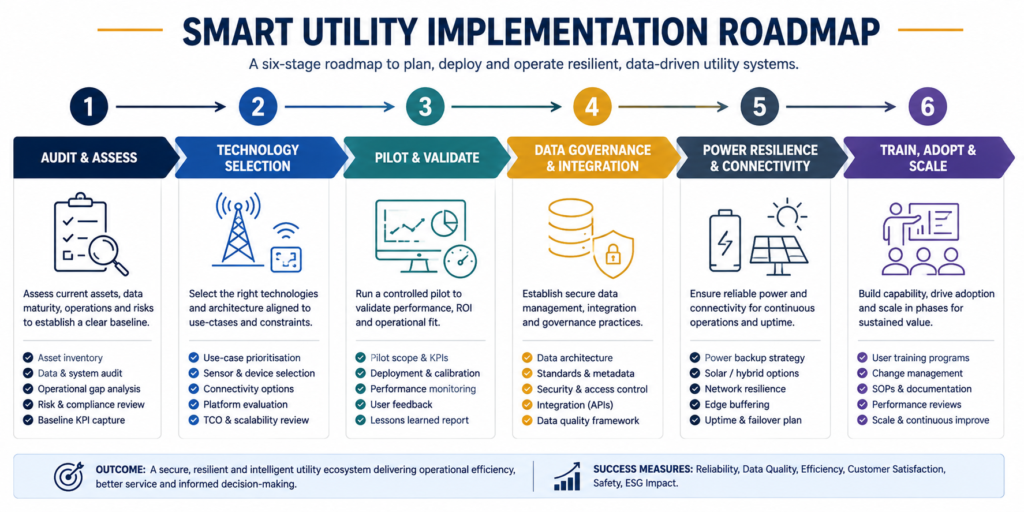
You reduce the risk of a stalled smart utilities rollout by sequencing the work the way experienced utility teams do, rather than procuring hardware first and figuring out the data platform afterward. Six steps cover most of what a project needs before the first sensor goes into the ground:
- Audit before you specify. Map your existing meter and asset baseline, including what is already metered, what communication coverage exists, and where your worst-performing feeders or pipe sections sit, before writing a technical specification.
- Match the communication technology to the terrain. Power-line carrier and RF mesh suit dense urban feeders; NB-IoT or LTE-M suit areas with existing cellular coverage; LoRaWAN suits low-power, long-range rural deployments where cellular signal is weak.
- Pilot on one feeder, estate, or treatment zone first. A 90- to 180-day pilot exposes integration problems — head-end software that will not talk to your chosen meter brand, for instance — while the financial exposure is still small.
- Build data governance in before go-live, not after. Define who can access customer consumption data, how long you retain it, and how you meet NDPA 2023 obligations, before the first meter starts reporting.
- Budget power resilience at every remote node. Specify solar-plus-battery backup for sensors and gateways sited away from a reliable grid connection, and size the battery for at least 72 hours of autonomy.
- Fund training alongside hardware. Contract local technician training and a spare-parts holding as a line item in the project budget, not as an afterthought once the warranty period ends.
None of these steps requires exotic technology. What separates a smart utilities rollout that survives its first rainy season from one that does not is almost always sequencing and maintenance planning, not the sensor hardware itself.
Frequently Asked Questions About Smart Utilities
What is smart utilities in civil engineering?
In civil and electrical engineering practice, smart utilities refers to power, water, gas, or waste infrastructure fitted with sensors, smart meters, and communication technology so the network reports consumption and condition data continuously rather than through periodic manual inspection. Engineers specify these systems to shorten fault response times, reduce revenue loss, and support predictive rather than reactive maintenance schedules.
How does smart metering work?
A smart meter records consumption at set intervals, timestamps and structures the reading according to a data-exchange standard such as IEC 62056 (DLMS/COSEM), and transmits it over a communication network — cellular, RF mesh, or power-line carrier — to the utility’s head-end system. Software there validates the data, flags anomalies such as tampering, and feeds it into billing and analytics platforms, usually within minutes of the original reading.
What are the requirements for a smart water network?
A functioning smart water network needs pressure and flow sensors at key points in the distribution system, a SCADA platform at the treatment works, a communication backbone capable of reaching remote sensor locations, and a data platform that can flag pressure drops or flow anomalies as potential leaks. Nigeria does not yet have a dedicated smart-water regulation comparable to NERC’s electricity framework, so most utilities design to general SCADA and water-utility good practice rather than a single mandated standard.
How much does smart utility implementation cost?
Costs vary widely by scope, but Nigeria’s last NERC-regulated meter prices, before the 2024 deregulation, set single-phase units at roughly ₦81,795 and three-phase units at roughly ₦143,836 including installation — a useful anchor for the metering component alone. A full network deployment with SCADA integration, communication infrastructure, and civil works for sensor chambers costs substantially more, and because most hardware is imported, budgets stay sensitive to naira-dollar exchange rate movements.
What is the difference between smart utilities and a smart grid?
A smart grid is the electricity-specific version of a smart utility system — sensors, automation, and two-way communication applied to power generation, transmission, and distribution. Smart utilities is the broader term, covering that same approach applied to water, gas, and waste networks as well as electricity, each with its own sensor types and regulatory bodies.
The Practical Takeaway on Smart Utilities
Smart utilities are not a single product a vendor sells; they are a shift in how a network reports on itself, built from sensors, a communication layer, a data platform, and the maintenance capacity to keep all three running. In Nigeria, that shift is already underway through NERC’s metering programmes, NEMSA’s certification regime, and a growing base of DisCo and water utility pilots, but the gap between procured hardware and working data remains the main project risk, not the sensor technology itself. A specification that plans for power resilience, communication coverage, data governance, and local technician training from the outset stands a materially better chance of still reporting clean data two years after commissioning. If your team is scoping a metering upgrade, a SCADA retrofit, or a new development’s utility backbone, StruviaCore can help you turn this into a specification you can procure, install, and maintain.
Leave a Reply