
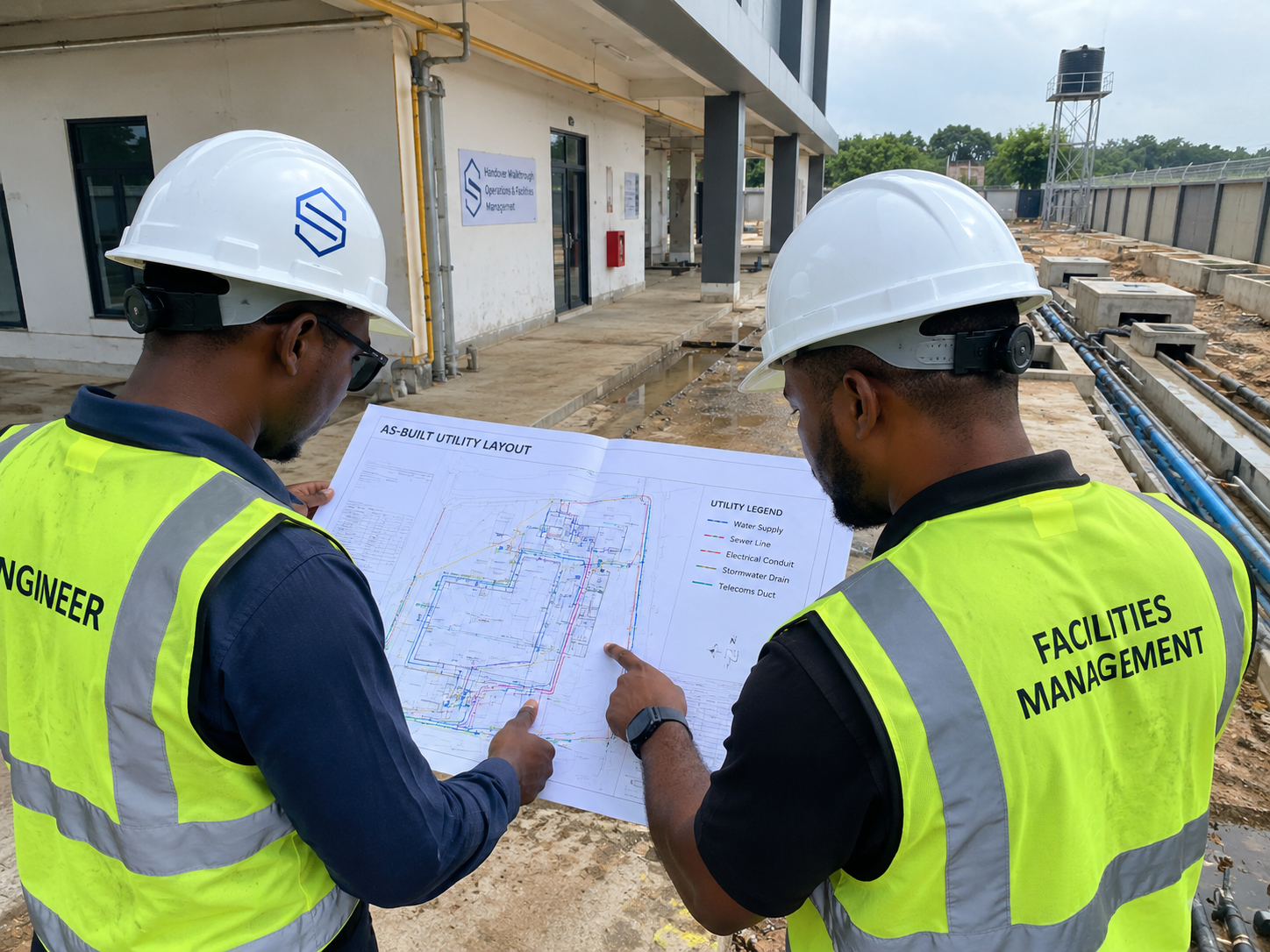
A backhoe operator in Port Harcourt cuts into an unmapped 415V cable while excavating for a culvert. Power to three streets goes down, the site closes for a Discos investigation, and the contractor spends two weeks negotiating a reconnection fee before work resumes. Most utility guidance a project team encounters covers one phase and stops. A detection survey brief explains how to find buried services. A permit checklist explains how to apply for a wayleave. Almost nothing explains what happens to that information after construction finishes, which is exactly when a facilities manager six months into operating the building discovers that nobody kept an updated record of where the diverted water main actually ended up. This utility infrastructure guide follows the whole sequence: planning and feasibility, procurement and permits, construction-phase protection, and the handover step most projects treat as an afterthought.
Utility Infrastructure Guide: Quick Answer
A utility infrastructure guide sets out how a construction project should identify, coordinate, protect, and document every water, power, telecom, and gas service connected to or crossing a site, across the full project lifecycle from feasibility through to operational handover. It links planning decisions, permit applications, construction-phase protection, and as-built documentation into one continuous process rather than treating each as a separate task.
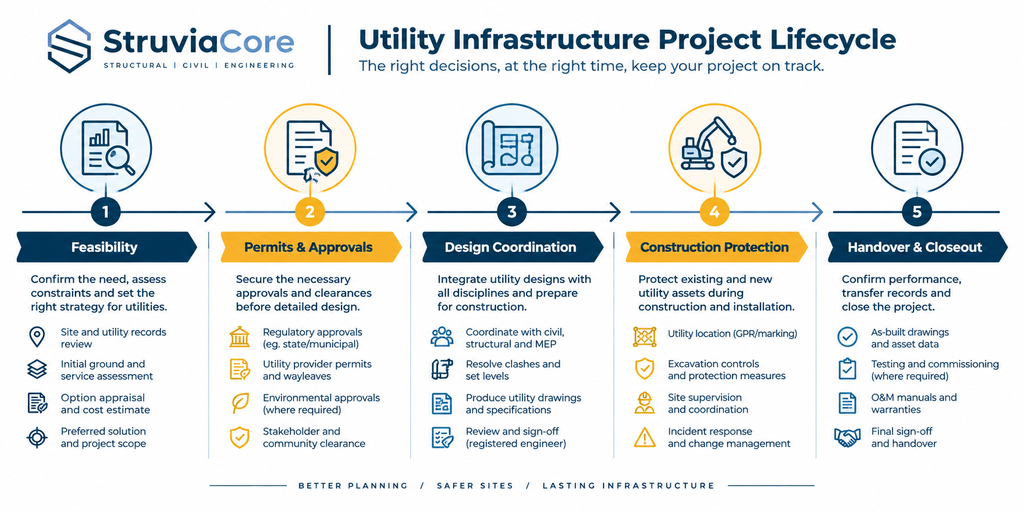
The Utility Infrastructure Lifecycle on a Nigerian Project
Treating utility infrastructure as five connected phases, rather than a single “utilities” task, is what keeps information from getting lost between the people who plan it, the people who build around it, and the people who eventually operate the finished project. Each phase produces information the next phase depends on, and a break anywhere in that chain is where problems surface later.
Planning and Feasibility
Feasibility-stage utility work is about constraints, not detail. A preliminary records request to each statutory utility owner, covering the site boundary and immediate surroundings, tells you whether a major transmission line rules out part of your layout, or whether the site sits far enough from the water network that a private borehole solution needs pricing into the concept design from day one. This stage does not need the confidence-graded detail a detection survey provides; it needs to surface the constraints that change what the project can be before the design team commits to a layout.
Budget for this stage realistically. A records request to a Water Corporation or Discos office rarely returns same-week, and a feasibility programme that assumes a two-day turnaround will either proceed without the information or slip its own deadline waiting for it. Build a four-to-six-week window into the feasibility programme for first-round utility correspondence, and treat anything faster as a bonus rather than the baseline you plan around.
Design and Coordination
Once layout is fixed, design-stage utility work splits into two parallel tracks: designing around existing services the project must avoid or divert, and designing new connections the finished project will need. Both tracks need input from the utility owners directly, not just from drawings. A Discos capacity confirmation, a water corporation connection point, and a telecom operator’s preferred duct entry location all shape the services design in ways a desk-based assumption cannot replace.
Keep both tracks visible to the whole design team, not siloed within the services engineer’s own workstream. A structural engineer who does not know a water main diversion is still unresolved may finalise a foundation layout that makes the eventual diversion route more expensive or physically difficult than it needed to be. Weekly design coordination meetings that specifically include utility status, rather than folding it into a general “services” line item, catch these conflicts while they are still cheap to resolve.
Procurement, Permits, and Wayleave Applications
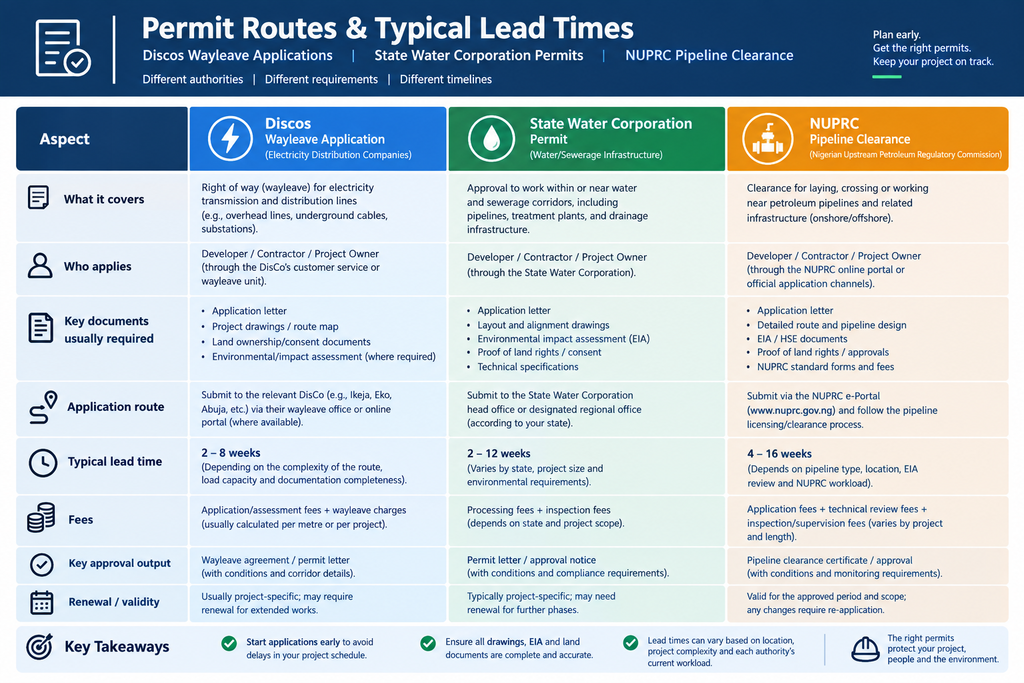
Utility permits do not follow a single national process, and a utility infrastructure guide that promises one universal procedure is oversimplifying what practitioners actually face. Each statutory utility owner runs its own application route, on its own timeline, and the project team’s job is to run them in parallel rather than in sequence wherever possible.
Statutory Utility Applications
Discos wayleave and capacity applications, State Water Corporation connection and diversion permits, and, where a pipeline right-of-way is involved, NUPRC clearance in Niger Delta corridors, each need a separate application with its own supporting documents. Building approval itself, whether through LASBCA in Lagos State or the equivalent agency elsewhere, increasingly expects these utility approvals to be referenced or attached within the main building permit submission rather than handled as an entirely separate process. Starting all of these applications the moment the site layout is confirmed, rather than waiting for detailed design to finish, is the single biggest lever a project team has over utility-related programme delay.
Contractual Risk Allocation
Decide, in writing, who commissions each permit application and who carries the cost if a utility owner’s response is slower than programmed. Ambiguity here is where utility delay claims get contentious later, because both client and contractor can reasonably argue the other party should have chased a non-responsive utility owner sooner. A utility infrastructure guide is only as useful as the contract that sits behind it; documenting responsibility clearly at the start removes most of that argument before it starts.
Corridor projects add a further layer to this risk allocation question. StruviaCore’s own review of utility coordination within rail corridors found that crossing agreements, negotiated between the utility owner and the corridor authority rather than the project directly, introduce a third party into what is normally a two-party negotiation. Contracts on corridor-adjacent projects should name who is responsible for chasing the corridor authority specifically, separately from who chases the utility owner, since the two approvals rarely move at the same pace.
Protecting Utilities Through the Construction Phase
Once permits and diversion designs are approved, construction-phase work shifts to physical protection and verified excavation limits. This is deliberately the shortest section of this guide, because a full utilities checklist already covers the detection, confidence-grading, and site-marking process in the depth it needs. The point worth restating here is that construction-phase protection only works if the planning and permit stages before it were done properly; a detection survey cannot recover a diversion that was never designed, and a checklist cannot substitute for a wayleave that was never applied for.
Where protection in place is sufficient, rather than full diversion, confirm the protection method, whether concrete surround, sleeving, or a marked exclusion zone, is acceptable to the utility owner before construction proceeds, not after. Some utility owners require their own inspector to sign off protection measures before backfill; missing this step can mean re-excavating a section that was already completed correctly, purely for a signature.
Plant operators need the same information supervisors have, restated for their specific task rather than assumed from a general site induction months earlier. A brief before each excavation task, covering exactly which assets are near that specific work area and what the confirmed safe offset distance is, takes a few minutes and catches the gap between what a drawing shows and what an operator sitting in a cab actually knows before the bucket goes down.
Utility Handover and As-Built Records
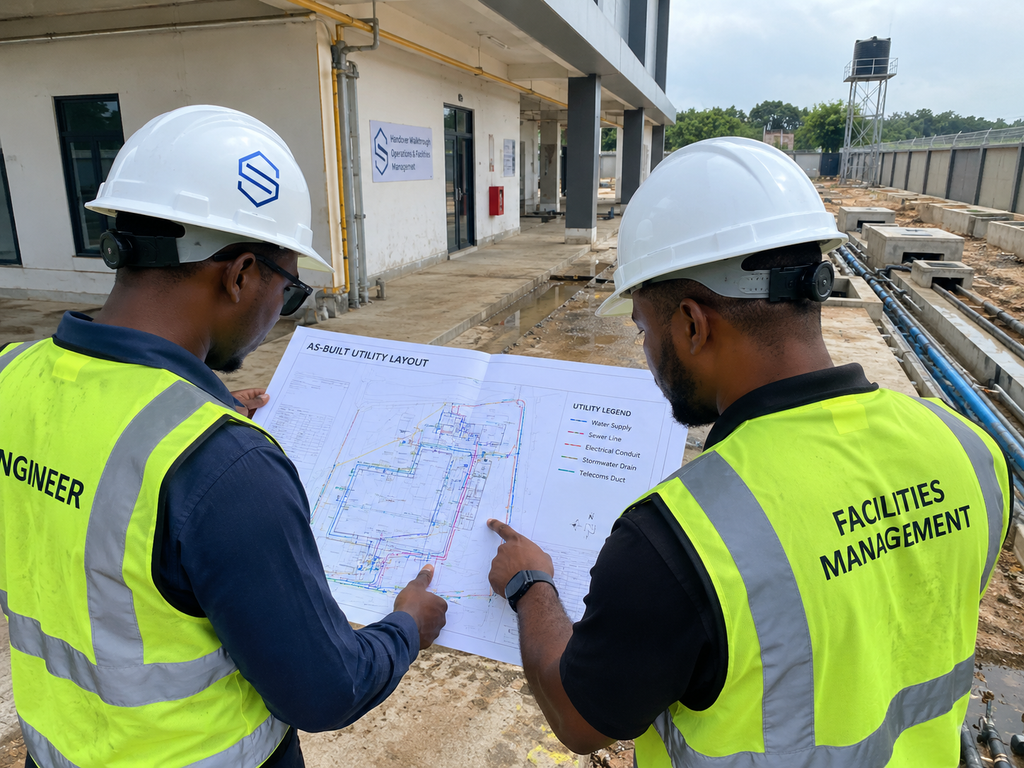
This is the phase most utility infrastructure guides skip entirely, and it is where a surprising amount of avoidable operational cost gets created. Every diversion, every new connection, and every protected asset needs an accurate as-built record before the project hands over, not a copy of the original design drawing with the diversion sketched on afterward from memory.
Commission as-built survey of every utility asset that moved or was newly installed, cross-referenced against your original utility infrastructure records so the facilities team inherits a single, reconciled picture rather than two conflicting document sets. Where a diversion design was signed by a COREN-registered engineer, the as-built confirmation should carry the same level of sign-off, since it becomes the reference document for any future works on or near the site, including the client’s own future maintenance excavation.
Include utility asset locations, ownership contacts, and any outstanding maintenance obligations in the operations and maintenance manual handed to the client, not as an appendix nobody reads but as a section the facilities team is specifically briefed on at handover. A defects liability period covers workmanship issues on your own installed connections; it does not cover a utility strike caused by a facilities team working from an inaccurate or missing as-built record two years after handover, and that gap in protection is easier to explain before handover than to argue about afterward.
Schedule the handover briefing itself as a specific meeting, not an email attachment. Walk the facilities team, or the client’s own maintenance contractor, through the as-built drawings on site if practical, pointing out anything non-obvious: a diversion that runs deeper than standard depth of cover in one section, a protection sleeve that should not be disturbed without utility-owner notification, or a private connection whose ownership will transfer to a residents’ association rather than staying with the original developer. None of this detail survives in a drawing set alone, and a facilities team inheriting a building without this context is set up to repeat the same detection process a construction team already paid for once.
Common Mistakes Across the Utility Infrastructure Lifecycle
The most expensive mistakes rarely happen within a single phase; they happen in the gaps between phases, where one team’s output was never properly handed to the next. A feasibility study that flagged a transmission line constraint but never made it into the design brief. A diversion permit that was approved but whose as-built position was never surveyed after construction. A protection method the utility owner accepted verbally on site but that was never confirmed in writing, and disputed months later once the original site inspector was no longer available.
These handoff failures share a common cause: each phase treats utility infrastructure as complete once its own deliverable is signed off, without confirming the next phase actually received and understood it. A permit approval filed away rather than distributed to the design team achieves nothing. A construction-phase protection record kept only in a site diary rather than transferred into the as-built package achieves nothing once the diary is archived. Naming a single utility infrastructure owner who tracks the whole lifecycle, not just their own phase, is the most effective single fix for this pattern, even on projects too small to justify a dedicated utilities coordinator role.
Cost tracking suffers from the same fragmentation. Utility costs that get folded into a general services allowance rather than tracked against the specific permit, diversion, and connection items that generated them make it difficult to learn from one project to the next. A team that has already reviewed foundation design cost factors for comparable Nigerian sites understands how useful project-specific cost data becomes for pricing the next one accurately; utility infrastructure deserves the same discipline, and rarely gets it. Rail and highway corridor projects show this pattern clearly: rail cost factors analysis consistently finds utility coordination as one of the least predictable line items precisely because so few projects retain structured cost data from previous utility diversions to price the next one against.
A simple fix available to any project regardless of size is a single running utility log, started at feasibility stage and carried through to handover, recording every records request, permit application, detection result, protection or diversion decision, and as-built confirmation in one place with dates and named owners. It costs nothing beyond the discipline of maintaining it, and it is the single artifact most likely to prevent the phase-to-phase information loss that causes most of the mistakes described above.
Frequently Asked Questions About Utilities
Q: What should a utility infrastructure guide cover?
A: A complete guide should cover the full project lifecycle: feasibility-stage constraint identification, permit and wayleave applications, construction-phase protection or diversion, and post-construction handover with accurate as-built records. Guidance that only covers one of these phases leaves a project exposed at the others.
Q: How long does utility permit approval take in Nigeria?
A: Timelines vary significantly by utility type and by state. A straightforward Discos wayleave for a shallow cable diversion can sometimes be arranged within a few weeks, while a water main diversion crossing multiple ownership boundaries, or any NUPRC-regulated pipeline clearance, commonly takes several weeks to a few months. Running applications in parallel from the earliest possible stage is the main way to manage this uncertainty.
Q: What are as-built records and why do they matter for utilities?
A: As-built records document the actual final position of utility assets after construction, including any diversions, which frequently differ from the original design drawing. They matter because they become the reference document for all future maintenance, extension, or excavation work on the site, and an inaccurate or missing as-built record recreates the same strike risk the original detection survey was meant to eliminate.
Q: Who is responsible for utility handover documentation?
A: This should be assigned explicitly in the contract, but in practice the contractor typically commissions the as-built survey while the client’s consultant or facilities team confirms it against the operations and maintenance manual before formal handover. Leaving this responsibility unassigned is a common reason handover documentation ends up incomplete.
Q: How does utility infrastructure planning differ between a rail corridor and a standard building site?
A: Corridor projects add a layer of coordination between the utility owner and the corridor authority itself, since crossing agreements typically need both parties to align before either signs off, which usually takes longer than a standard site’s direct utility-to-project coordination. Budget corridor projects extra float for this two-party approval structure.
Q: What happens if a utility issue is discovered after project handover?
A: Responsibility depends on the contract and the defects liability period terms, but generally covers workmanship defects in the contractor’s own installed connections, not damage caused by third-party works relying on inaccurate as-built records. This is why accurate, well-communicated as-built documentation at handover matters as much as the construction-phase protection work itself.
A utility infrastructure guide that stops at the construction phase has only done half the job. Planning and feasibility set the constraints, permits and design coordination turn those constraints into an approved plan, construction-phase protection keeps existing services safe while the plan is built, and accurate handover documentation is what lets the finished project operate safely for years afterward without repeating the same detection work the original project team already paid for. Treat all five phases as one continuous responsibility, assign clear ownership at each handoff point, and the utility risk that derails so many Nigerian projects becomes a managed, budgeted part of the programme rather than a recurring surprise. If your project needs a structured utility infrastructure plan spanning feasibility through handover, StruviaCore’s engineering team can build that plan with you from the earliest stage.
Leave a Reply