
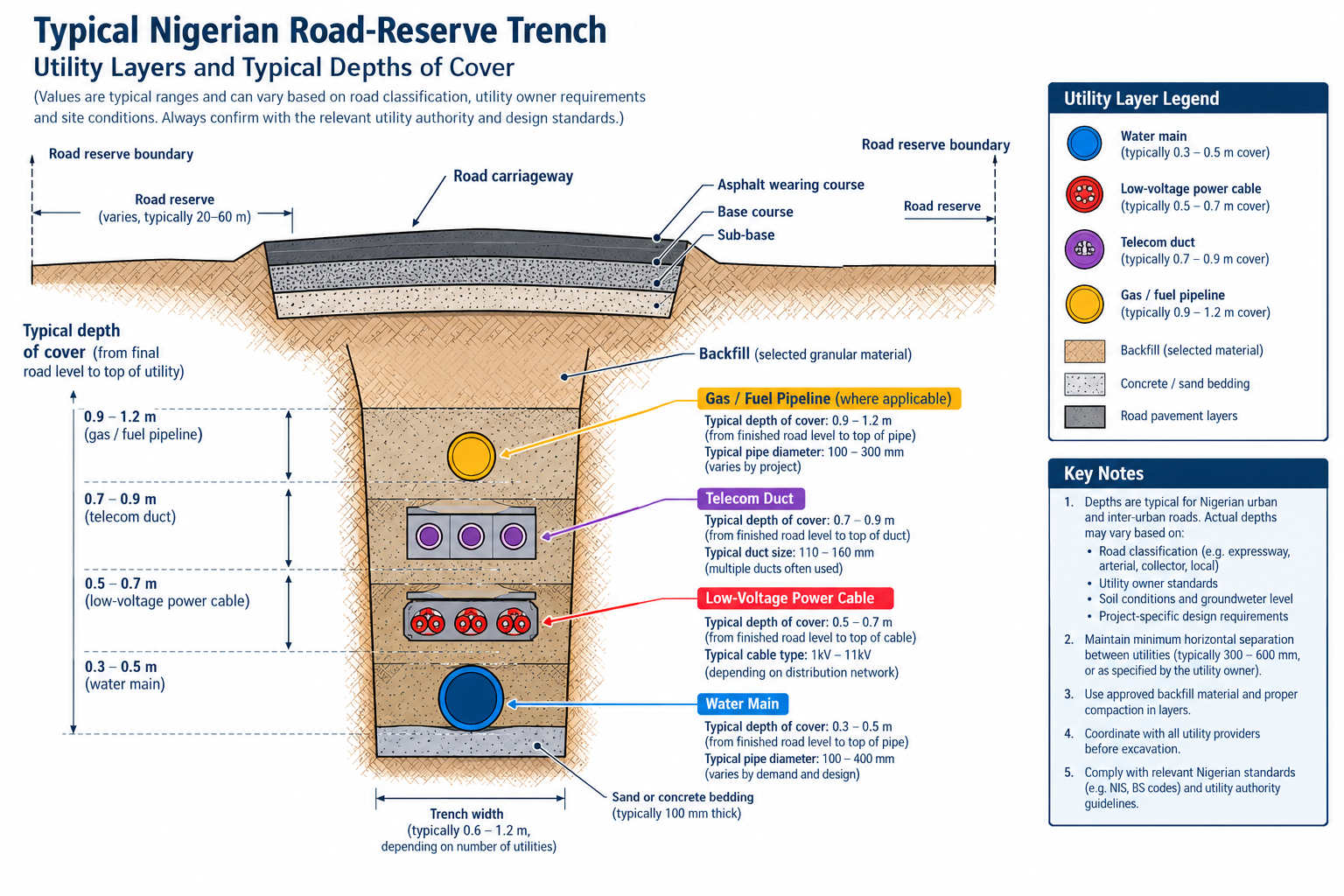
A backhoe operator in Port Harcourt cuts into an unmapped 415V cable while excavating for a culvert. Power to three streets goes down, the site closes for a Discos investigation, and the contractor spends two weeks negotiating a reconnection fee before work resumes. None of this happens because anyone was careless. It happens because nobody on site had a utilities checklist that told them what was buried where before the first bucket went into the ground. A utilities checklist is the structured record of every existing water, power, telecom, and gas service that crosses a site, paired with the verification steps needed before excavation, piling, or trenching begins near any of them. This piece sets out how to build one for a Nigerian site, what regulatory coordination it needs to survive, and where the cost of skipping it actually lands.
Utilities Checklist: Quick Answer
A utilities checklist is a documented inventory of existing underground and overhead services on a construction site, built from utility-owner records, physical detection surveys, and site verification. It confirms depth, alignment, and ownership of each asset before excavation starts, and it assigns responsibility for permits, protection measures, and diversion where a service conflicts with the new works.
What a Utilities Checklist Actually Covers
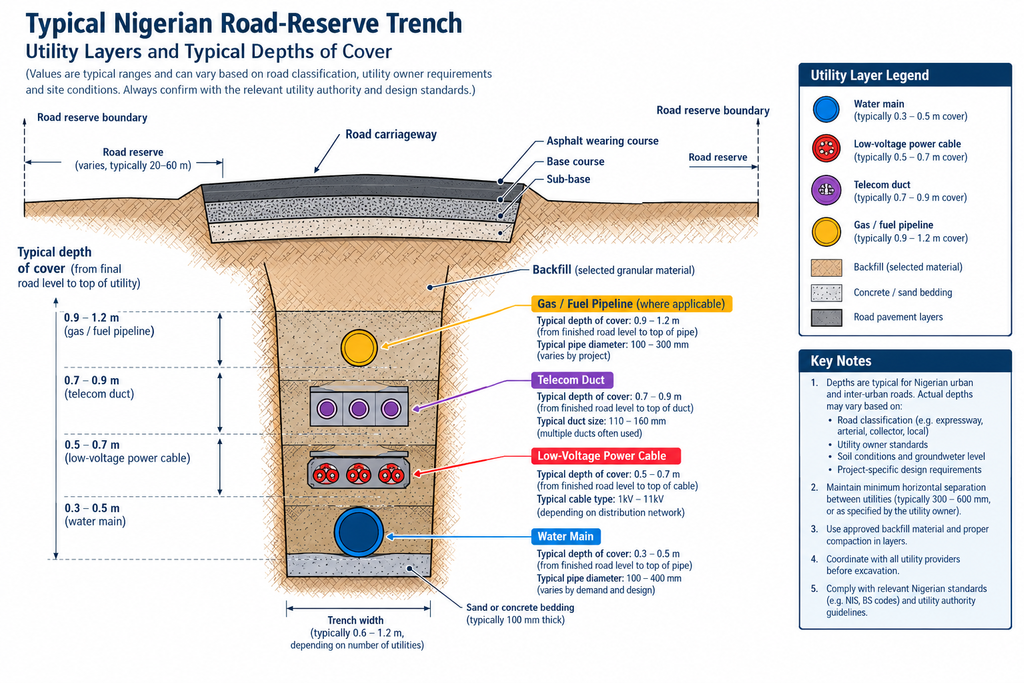
A working utilities checklist is not a generic list of “water, power, telecom.” It names every individual asset crossing or bordering the site, records who owns it, states its approximate depth and alignment, and flags whether it needs protection, diversion, or a formal wayleave before works begin near it. On a typical urban infill site in Lagos or Abuja, that can mean six to twelve distinct assets from four or five different owners, each with its own notification process and timeline.
Contractors who skip this step usually assume that because a service is marked on a drawing from the client or a previous survey, its position is reliable. Drawings drift. Utility owners in Nigeria frequently do not update as-built records after emergency repairs, and informal connections made by residents or previous contractors rarely appear on any register at all. A checklist that is only as good as the desk records behind it will miss exactly the assets most likely to cause a strike.
Statutory vs. Private Utility Owners
Split your checklist by ownership category early, because each category has a different notification process. Statutory utilities include the Distribution Company (Discos) serving the state, the relevant State Water Corporation, and, in pipeline corridors across the Niger Delta and southwest, NNPC or NUPRC-regulated oil and gas infrastructure. Private or quasi-private utilities include fibre and duct networks run by MTN, Globacom, Airtel, and smaller ISPs, plus any private borehole or generator-fed distribution network serving an adjacent estate. Statutory utilities generally require a formal permit-to-work or wayleave application; private operators sometimes accept a direct site meeting and written notice, but confirm this in writing rather than assuming it.
Underground vs. Overhead Assets
Overhead lines get less attention on a utilities checklist than buried ones, which is a mistake. Crane and long-reach excavator strikes on overhead 11kV and 33kV lines cause a disproportionate share of Nigerian construction site fatalities relative to how often they appear in project risk registers. Record every overhead line crossing the site boundary, its voltage where known, and its minimum safe approach distance, alongside the buried assets. A checklist that only covers what is underground has covered half the risk.
How to Build a Site-Specific Utilities Checklist
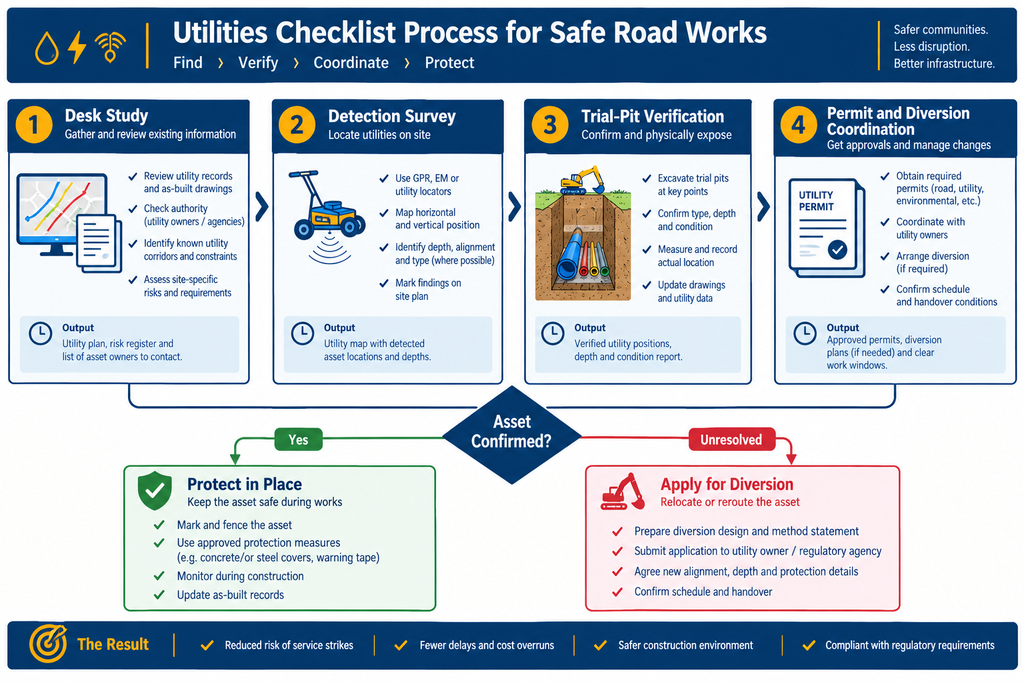
Building the checklist itself follows a sequence, and skipping steps to save time is where most of the risk gets reintroduced. Start with records, move to detection, and only then move to physical trial holes. This is the same discipline StruviaCore applied on a recent rail corridor project, where utility coordination on rail corridor projects required sequencing five separate utility owners before any earthworks could start.
Desk Study and Records Request
Write to every statutory and known private utility owner with the site boundary coordinates and ask for existing asset records in the area. In practice, response times from Discos and State Water Corporations in Nigeria vary widely by state and by how the request is framed; a request routed through a named engineering or estates contact tends to move faster than a general correspondence address. Where a formal response does not arrive within a reasonable window, document the request and proceed to physical detection rather than delaying the whole programme, but flag the gap in the checklist as unverified by records.
Utility Detection and Survey
Detection survey categorises what has actually been found against how confident the surveyor is in its position, a system set out in BS PAS 128:2022, the UK specification for underground utility detection, verification, and location. Nigeria has no indigenous equivalent standard, so BS PAS 128’s four-tier confidence system (from desktop-only records through to physically verified trial-pit data) is the reference most Nigerian consulting engineers apply in practice, and it gives your checklist a defensible, gradeable confidence level for every asset rather than a flat “confirmed / not confirmed” entry. Ground-penetrating radar and electromagnetic locators handle most detection; in the high-water-table alluvial soils common across the Niger Delta, radar performance drops noticeably and physical trial pits become the more reliable method even though they cost more time.
Soil type changes the detection strategy more than most checklists account for. The lateritic soils common across much of northern Nigeria hold radar signal well and generally give clean detection results at typical utility depths. Lagos’s reclaimed and sandy coastal soils sit between the two extremes: detection works reasonably well in dry season but degrades after heavy rain saturates the upper soil profile. Where your project sits in one of these three broad soil environments should directly change how much of your detection budget goes to radar survey versus trial pits, and a foundation design guide prepared for the same site will usually already contain the geotechnical data needed to make that call before survey work starts.
Coordinating Utilities Within Nigeria’s Regulatory Framework
Utility diversion and protection work sits inside the same regulatory structure as the rest of your project, and treating it as a side task separate from your main permit process is a common source of delay. Under the National Building Code, a project’s approving authority, whether LASBCA in Lagos State or the equivalent building control agency elsewhere, expects service coordination to be documented as part of the approved site plan, not resolved informally after excavation starts. Any engineer signing off a utility diversion design, including temporary support or protection details for an exposed main, needs to hold current COREN registration in the relevant discipline; unsigned or informally approved diversion drawings create liability exposure for the contractor if a failure occurs later.
Coordination with statutory utility owners has no single national process. Lagos State has moved further than most states toward requiring utility clearance as a documented condition of building permit approval, while several other states still handle it purely through direct contractor-to-utility correspondence with no formal cross-check by the permitting authority. Where a pipeline right-of-way is involved in the Niger Delta, clearance runs through NUPRC and the pipeline operator directly, on a timeline measured in weeks rather than days, and should be built into the programme from the earliest planning stage rather than treated as a late-stage formality.
One structural gap worth planning around directly: Nigeria has no centralized, nationwide “call before you dig” utility-locate service of the kind that exists in the UK or US. Each utility owner must be contacted individually, and there is no single authority that guarantees a complete answer about what is buried in a given road reserve. Build extra float into your programme for this fragmentation rather than assuming one round of correspondence will surface every asset.
Practically, this means your utilities checklist doubles as your evidence file if a dispute arises later over who knew what and when. Keep dated copies of every records request, every response (or non-response), and every survey report in a single project folder, because a Discos or water corporation dispute over responsibility for a strike is far easier to resolve with a documented request trail than with a verbal account of what someone remembers asking for.
Common Utility-Related Mistakes and Their Cost
Utility strikes and undocumented diversions are expensive in ways that rarely show up as a single line item, which is part of why they get underweighted in early cost estimates. A Discos reconnection and repair invoice for a damaged low-voltage cable in urban Lagos commonly runs into the mid six figures in naira, before counting the contractor’s own delay costs or any client liquidated-damages exposure for the lost days. On projects where urban infrastructure cost factors are already tight, an unplanned utility strike can consume a contingency allowance meant to cover the whole remainder of the programme.
Three mistakes account for most of the damage seen on Nigerian sites. First, relying on a single desk-study record without physical verification, particularly in areas with a history of informal or unrecorded connections. Second, excavating within the minimum safe clearance of a live line because the checklist recorded an asset’s existence but not a verified depth, so plant operators had no real basis for a safe dig line. Third, treating utility diversion as the utility owner’s problem alone and failing to formally record who approved a temporary protection measure, which becomes a serious liability question if that protection fails during later works. Every one of these failure modes traces back to a checklist that existed on paper but was not built to the confidence level the site actually needed.
Water main strikes carry their own specific cost pattern worth planning for separately, since they tend to escalate faster than power strikes because of downstream pressure loss to other consumers. A project team that has already worked through a water resources checklist for the site’s own water supply and drainage design is better positioned to recognise an existing main during excavation, because they already understand the network context rather than encountering it as an unexpected obstruction.
Utilities Checklist: Best Practices Before You Excavate
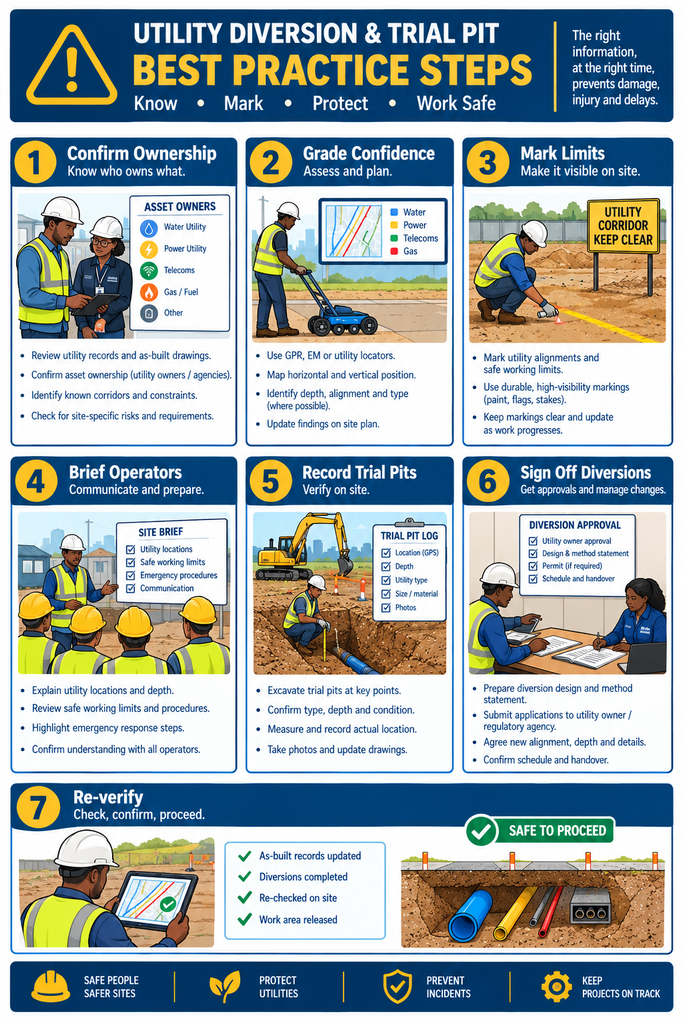
Once your desk study and detection survey are complete, use the following sequence to move from checklist to safe excavation. Treat each step as a gate: do not authorise excavation in a given area until it has been cleared.
- Confirm ownership in writing for every asset before you request a permit or wayleave. Verbal confirmation from a site contact is not sufficient documentation if a dispute arises later.
- Grade every asset by confidence level using a BS PAS 128-style tier, and treat anything below trial-pit-verified confidence as live until proven otherwise.
- Mark safe excavation limits physically on site, not just on the drawing. Paint or pegs at the verified offset distance prevent a plant operator from misreading a scaled drawing under time pressure.
- Brief plant operators directly on which assets are near their specific work area before each excavation task starts, not once at project induction three months earlier.
- Record every trial pit result, including negative results where no asset was found, since a negative result at a specific point is itself useful evidence for adjacent excavation.
- Route diversion designs through a COREN-registered engineer and keep the signed drawing on site, not filed at head office.
- Re-verify after any gap in the programme longer than a few weeks; unrelated third-party works nearby can alter buried conditions without your project being notified.
You will find that the projects with the fewest utility incidents are not the ones with the most paperwork, but the ones where the checklist is a live site document that plant operators and supervisors actually consult before digging, similar in spirit to how a well-run team treats an airports checklist as an operational tool rather than a filing exercise.
Frequently Asked Questions About Utilities
Q: What is a utilities checklist in civil engineering?
A: A utilities checklist is a documented record of every existing underground and overhead service crossing or bordering a construction site, including its owner, approximate position, and verified confidence level. It is used to plan excavation safely, apply for the correct permits or wayleaves, and assign responsibility for protecting or diverting any asset that conflicts with the new works.
Q: How does utility detection work on a Nigerian construction site?
A: Detection typically combines a desk study of records from Discos, State Water Corporations, and telecom operators with a physical survey using ground-penetrating radar or electromagnetic cable locators. Where ground conditions or record quality make detection unreliable, particularly in high-water-table areas of the Niger Delta, trial pits provide direct visual confirmation of depth and alignment.
Q: What are the utilities checklist requirements for a building permit?
A: Requirements vary by state. Lagos State increasingly expects documented utility clearance as part of the LASBCA approval process, while several other states handle utility coordination through direct contractor correspondence with no formal permit cross-check. Confirm the specific requirement with your state’s building control agency before finalising your programme.
Q: How much does utility diversion cost on a typical project?
A: Cost depends heavily on the asset type, depth, and how far it must move. A shallow low-voltage cable diversion of a few metres can often be arranged directly with the local Discos for a modest fee, while a water main diversion crossing multiple property boundaries, or any pipeline-related relocation regulated by NUPRC, can add weeks to a programme and a proportionally larger cost. Building diversion risk into contingency early is more reliable than pricing it after a strike forces the issue.
Q: What is the difference between utility protection and utility diversion?
A: Protection leaves an existing asset in place and adds physical safeguards, such as concrete surround, sleeving, or a marked exclusion zone, so nearby works can proceed without disturbing it. Diversion physically relocates the asset out of conflict with the new structure or excavation. Protection is generally faster and cheaper where the design allows it; diversion becomes necessary when the new works occupy the same space the asset currently holds.
Q: Who is responsible for utilities checklist accuracy on a construction project?
A: Responsibility is typically shared but should be assigned explicitly in the contract. The client or their consultant usually commissions the initial desk study and detection survey, while the contractor is responsible for physical verification immediately before excavation and for briefing plant operators on the confirmed safe limits. Any diversion design should be signed by a COREN-registered engineer regardless of which party commissioned it.
Conclusion
A utilities checklist only earns its place on a project if it changes what happens on site, not just what appears in the pre-start paperwork. The desk study, the detection survey, and the written ownership confirmations exist to answer one practical question before every excavation task: is it safe to dig here, and who needs to sign off if it is not. Treat the checklist as a live document that plant operators consult daily, grade every asset honestly by confidence level rather than assuming a drawing is correct, and route diversion designs through a COREN-registered engineer so responsibility is documented rather than assumed. If your project is approaching excavation near existing services and you want a second set of eyes on the utility risk before it becomes a site incident, StruviaCore’s engineering team can review your utilities checklist and detection survey scope before work starts.
Leave a Reply