

Walk onto any major airport construction site in the UAE — Al Maktoum International, the ongoing expansions at Abu Dhabi, or one of the regional airstrips serving the Northern Emirates — and the scale of coordination involved becomes immediately apparent. You have aircraft pavement carrying loads that dwarf anything a highway engineer typically encounters. You have instrument landing systems with precision tolerances measured in metres. You have storm drainage networks that must evacuate the entire airfield surface within minutes of a Gulf downpour, and fire safety infrastructure that operates on response times shorter than most engineers have ever designed to. Getting any one of these wrong does not just cause a programme delay — it compromises operational safety and, in a regulated environment, can void airworthiness certification.
This airports checklist breaks down the engineering verification sequence that any structural or civil consultancy should work through on an airport development project. It covers site assessment, pavement design, airside drainage, navigational aids integration, and the regulatory sign-off process relevant to UAE aviation infrastructure. Whether you are a project manager scoping a new general aviation facility or a site engineer reviewing design packages for an international terminal expansion, this guide gives you the technical reference points that matter.
Airports Checklist: Quick Answer
An airports checklist is a structured engineering verification tool used to confirm that all civil, structural, geotechnical, drainage, and systems elements of an airport development meet ICAO standards, UAE GCAA requirements, and project-specific performance criteria before construction proceeds or operations commence.

What an Airports Checklist Actually Covers
An airport engineering checklist is not a single document — it is a family of verification schedules that map onto distinct project phases. Most practitioners familiar with infrastructure delivery will recognise the concept from other project types, but airports introduce layers of complexity that have no real parallel in road or building work. The checklist must account for airworthiness, not just structural adequacy.
In the UAE context, the governing framework combines ICAO Annex 14 (Aerodromes), the UAE General Civil Aviation Authority (GCAA) Air Navigation Orders, and where adopted, BS EN standards for structural and drainage elements. For any airport development touching international operations, ICAO Annex 14 Volume I is the foundational reference — it sets out physical characteristics, obstacle limitation surfaces, visual aids, and electrical systems requirements that feed directly into engineering design parameters.
At the broadest level, a complete airports checklist will span the following domains:
- Site feasibility and master planning — land area, airspace constraints, obstacle limitation surfaces (OLS), prevailing wind analysis for runway orientation
- Geotechnical and ground investigation — subgrade CBR values, settlement risk, groundwater depth, and sabkha identification in coastal UAE locations
- Airside pavement design — flexible and rigid pavement thickness for the Aircraft Classification Number (ACN) / Pavement Classification Number (PCN) system
- Drainage and stormwater management — surface gradients, inlet sizing, detention, and outfall design
- Navigational aids and electrical infrastructure — ILS, PAPI, airfield ground lighting (AGL), and power supply redundancy
- Structural works — terminal buildings, control towers, maintenance hangars, and fuelling facilities
- Safety and regulatory compliance — GCAA design acceptance, fire and rescue provisions, and bird hazard management
Each domain has its own verification criteria, and the checklist structure should reflect the project’s design stage — concept, detailed design, pre-construction, and pre-operation are four distinct check points with different levels of design resolution required at each.
The Role of ICAO Standards in UAE Airport Engineering
ICAO categorises airports by Aerodrome Reference Code — a two-part designation combining a number (1 to 4, based on the reference field length of the critical aircraft) and a letter (A to F, based on wingspan). Dubai International, handling A380 traffic, operates at Code 4F. A business aviation facility in Fujairah might be designed to Code 2B or 3C. The code determines everything from runway width to runway strip dimensions, taxiway separation distances, and the geometry of aprons.
Every checklist item that touches physical layout must be validated against the correct aerodrome reference code. A common error on smaller regional projects is applying Code 4 separation standards where Code 3 would suffice, resulting in unnecessary land take and cost — or conversely, designing to Code 3 on a facility that will ultimately receive Code 4 traffic, requiring expensive redesign after the master plan is approved.
Site Assessment and Geotechnical Investigation Checklist
No airports checklist can proceed meaningfully without a properly scoped ground investigation. In the UAE, ground conditions vary sharply between emirate jurisdictions. Coastal Abu Dhabi and parts of Dubai sit on sabkha — gypseous, saline soils with low bearing capacity and a propensity for severe sulphate attack on concrete. Inland sites in Al Ain or the Northern Emirates present calcareous sedimentary profiles with potentially significant gypsum dissolution risk. Neither condition can be assumed away.
The geotechnical investigation for an airport site should be specified to a density appropriate to the complexity of the ground model. ICAO does not prescribe investigation density directly, but BS 5930 (Code of Practice for Ground Investigations) and the associated Eurocode 7 framework — both referenced in UAE practice — set out minimum requirements. For a runway strip of 3,000m, trial pits and boreholes at 50m centres along the centreline with 100m grid coverage on the strip width is a starting minimum. Plate load tests and California Bearing Ratio (CBR) testing at multiple depths are non-negotiable inputs for pavement design.
Geotechnical Checklist Items
The following items should be verified at completion of the ground investigation phase, before pavement design commences:
- Borehole and trial pit locations mapped against the aerodrome layout — confirm coverage of runway, taxiways, aprons, and all building footprints
- In-situ CBR values at formation level (top of subgrade) across the full runway length — minimum three test locations per 100m
- Groundwater depth confirmed by standpipe piezometers — design groundwater level to be taken as the highest recorded level plus a 0.5m allowance per UAE practice guidance
- Sulphate content of soil and groundwater quantified — classify exposure condition per BS 8500-1 to determine concrete specification (DC-class designation)
- Sabkha identification — if present within 1.5m of formation level, stabilisation or replacement strategy required before pavement design is finalised
- Settlement analysis completed for compressible layers — total and differential settlement predictions to confirm acceptability against ICAO Annex 14 gradient tolerances
- Geotechnical interpretive report (GIR) issued and reviewed — design parameters formally adopted by the structural and pavement engineer of record
For further context on how ground investigation outputs feed into foundation selection and structural design, the geotechnical engineering guide on this site covers investigation methodology and interpretation in detail.

Airside Pavement Design and the ACN/PCN Checklist
Airfield pavement engineering is one of the most technically demanding elements of any airports checklist. The design loads are fundamentally different from highway pavements. A Boeing 777-300ER, for example, exerts a maximum ramp weight of approximately 352 tonnes, distributed across a main gear assembly of six wheels in a dual-tandem-tandem configuration. The pavement must carry repeated applications of this load over a design life of typically 20 years without exceeding allowable cumulative plastic deformation or fatigue damage.
The ACN/PCN system, mandated by ICAO, is the mechanism by which aircraft load is matched to pavement strength. The Aircraft Classification Number (ACN) is a function of the aircraft’s weight and gear geometry, calculated against a standard subgrade category. The Pavement Classification Number (PCN) is the published load-carrying capacity of the pavement, expressed in the same index. The operating rule is straightforward: ACN must not exceed PCN for routine unrestricted operations. Where ACN exceeds PCN by up to 10%, operations may continue subject to engineering assessment and defined conditions — but this is not a design target, it is a controlled exception.
Flexible Pavement Checklist Items
Flexible pavement design for airports in the UAE typically follows FAA Advisory Circular AC 150/5370-10 methodology or, where specified by the authority, the UK Defence Infrastructure Organisation (DIO) pavement design standards — both of which apply the CBR-based layer thickness design approach. The checklist for flexible pavement should confirm:
- Design aircraft selected and gross weight, gear configuration, and tyre pressure documented — these are the critical design inputs
- Design subgrade CBR adopted — use the 90th percentile value from in-situ testing, not the mean
- Total pavement thickness calculated and verified against design charts for the annual departure count of the design aircraft
- Sub-base material specification confirmed — crushed aggregate or stabilised material meeting gradation requirements, minimum CBR of 30% after compaction
- Asphalt mix design reviewed — for UAE climatic conditions, high-temperature performance grading (PG 76-10 or PG 82-10) is standard given ambient surface temperatures exceeding 60°C in summer
- Construction tolerances specified — surface regularity measured by 3m straight-edge; maximum deviation of 10mm for runways per ICAO Annex 14
- PCN declared value calculated post-construction and verified against design prediction
Rigid Pavement Checklist Items
Concrete pavement is common on aprons and high-stress areas near jet blast zones. The checklist for rigid (concrete) pavement should additionally confirm:
- Slab thickness design — typically using the Portland Cement Association (PCA) method or equivalent; minimum 350mm for Code 4 apron pavement under heavy wide-body traffic
- Concrete grade — C32/40 minimum compressive strength per BS EN 206 is standard UAE airport practice; sulphate-resisting cement (SRPC) or CEM III blends required where sulphate exposure class DC-3 or above applies
- Joint design — transverse contraction joints at maximum 5m spacing; dowel bars of 32mm diameter at 300mm centres for load transfer
- Curing regime specified and enforced — UAE heat makes inadequate curing a genuine cracking risk within hours of placing
- Surface texture — grooving or tining pattern specified to meet skid resistance requirements; average texture depth minimum 0.5mm per ICAO Annex 14
The broader principles governing pavement layer design and material specification also apply to the road network serving the airport landside area. The pavement engineering guide provides a useful reference for those elements of the project.
Drainage, Navigational Aids, and Structural Works
Drainage on an airport site has to function within tighter tolerances than almost any other infrastructure type. The ICAO Annex 14 requirements on surface gradients are not advisory — they are certification criteria. Runway longitudinal gradients must not exceed 1.25% for Code 3 and 4 aerodromes, and transverse gradients must fall between 1.0% and 1.5% to drain without ponding. Any deviation from these limits requires formal safety case assessment and GCAA agreement.
The drainage checklist should verify that the stormwater design matches the rainfall intensity at the site — for Abu Dhabi and Dubai, the design storm intensity for a 1-in-10-year event is approximately 30–40mm/hour, but the 1-in-50-year event relevant to major infrastructure design can reach 60–70mm/hour. The 2022 and 2024 rainfall events across the UAE demonstrated clearly that many older drainage networks were significantly undersized for extreme events — an airport pavement that floods operationally is a critical safety failure.
Navigational aids integration is the point at which civil and electrical engineering converge on the checklist. Instrument Landing System (ILS) installation requires civil works — concrete equipment housings, cable ducts, precision graded cleared areas, and critical area delineation. The ILS localiser must be positioned on the runway centreline extended, and the glideslope antenna sited to give the correct descent profile geometry. These are not positions that can be adjusted on site to suit convenience — they are defined by the instrument procedure design and must be verified by survey before systems commissioning.
Structural works — terminals, control towers, and hangars — require their own dedicated checklist running in parallel. Terminal buildings at UAE airports are subject to Abu Dhabi International Building Code (ADIBC) or Dubai Building Code requirements depending on jurisdiction, alongside GCAA requirements for secure areas, sterile zones, and passenger processing. Control tower structural design must account for blast and progressive collapse resistance given the security classification of the facility. Hangar portal frames require detailed assessment of wind loading in accordance with BS EN 1991-1-4 — the UAE National Annex to the Eurocode suite sets out the design wind speed maps relevant to each emirate.
For projects where the terminal building or airside infrastructure involves complex steel or concrete structural systems, the methodology described in the structural engineering guide is directly applicable to load path analysis and connection design.
Common Checklist Failures and Cost Drivers on Airport Projects
Airport projects in the UAE and the wider region share a set of recurring failure modes that an experienced airports checklist is specifically designed to prevent. Understanding these failure modes helps justify the time invested in thorough pre-construction verification.
Inadequate ground investigation scope is the single most common root cause of programme delay on airport projects. Discovering sabkha or gypsum dissolution zones during subgrade preparation — after earthworks has commenced — triggers a redesign cycle that typically costs three to six months of programme and significant remediation expenditure. A geotechnical investigation budget of 0.5–1.0% of total project value is not excessive for an airport site; it is a risk mitigation investment.
ACN/PCN mismatch at operational stage occurs when the as-built pavement condition does not match the declared PCN. This happens when subgrade CBR at construction differs from design assumptions, compaction standards are not achieved uniformly, or material substitutions are made without formal design review. Post-construction testing — including Falling Weight Deflectometer (FWD) testing across the runway at 25m intervals — is not a luxury. It is the verification step that protects the PCN declaration.
ILS critical area infringement during construction is a less obvious risk. During construction, temporary haul roads, plant parking areas, and stockpiles placed within the ILS critical area will corrupt the signal geometry. If the airport remains partially operational during phased construction — common at major UAE airports — this creates a direct flight safety risk. The checklist must include a phasing diagram showing ILS critical areas and confirming that no construction activity encroaches without a temporary instrument procedure amendment agreed with GCAA.
Drainage underdesign for extreme rainfall — as noted above — is an area where UAE practice has historically relied on rainfall return periods that recent events have shown to be inadequate for critical infrastructure. Upgrading to a 1-in-100-year design storm standard for airport drainage is now standard advice on new projects.
Cost factors on airport projects are largely driven by programme risk rather than material costs. Concrete and asphalt unit rates in the UAE are broadly comparable to regional norms, but mobilisation of specialist airfield contractors, procurement of airfield ground lighting systems, and the lead times on navigational aid equipment can each add 12–20 weeks to a programme if not identified early. The checklist must trigger procurement actions at the right design stage, not just verify technical content. The risk management guide covers the framework for systematically identifying and mitigating these programme risks.
Best Practices: The Pre-Construction Airports Checklist Step by Step
What follows is a stage-by-stage pre-construction airports checklist sequence. Use this as a minimum baseline — project-specific requirements from the GCAA, the airport operator, and the relevant emirate municipality will add items depending on the scope.
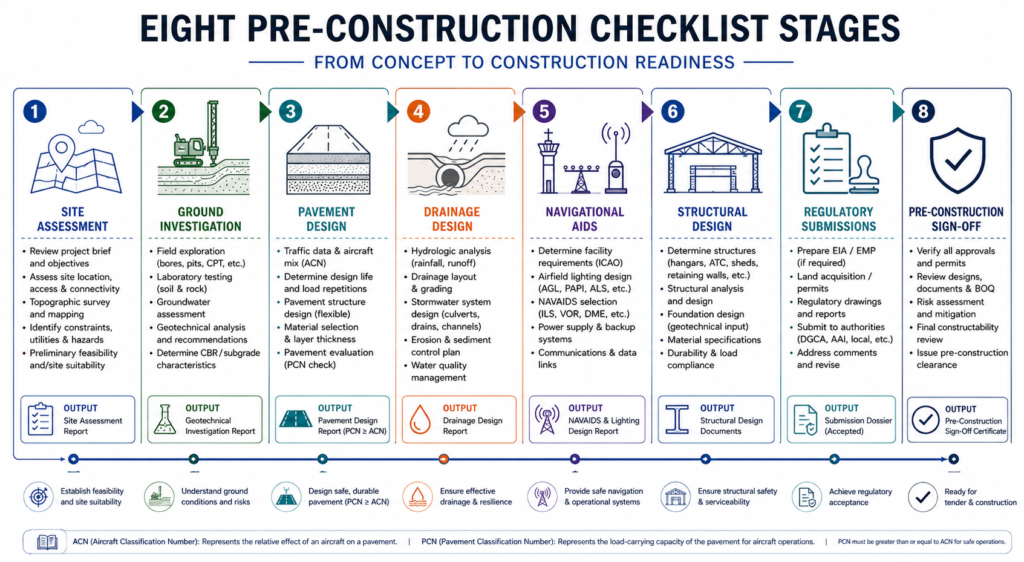
Stage 1 — Master Plan and Airspace Assessment
- Aerodrome reference code confirmed against the critical aircraft for the planning horizon (not just day-one operations)
- Obstacle Limitation Surfaces (OLS) modelled — confirm no existing structures or proposed developments penetrate Take-Off Climb Surface, Approach Surface, or Transitional Surfaces
- Runway orientation confirmed against wind rose analysis — wind coverage for crosswind component not exceeding 13 knots (Code 3/4) must be at least 95%
- Bird Hazard Management Plan scoped — site proximity to wetlands, landfill, or agriculture to be assessed
Stage 2 — Ground Investigation and Geotechnical Design
- Investigation scope signed off against BS 5930 requirements — borehole density, sampling frequency, and laboratory testing suite confirmed
- Sabkha, gypsum, or soft layer identification completed and mitigation strategy agreed before earthworks design is finalised
- Formation level CBR confirmed — minimum design CBR of 6% for flexible pavement subgrade (lower values require capping layer or stabilisation)
- Groundwater assessment completed — dewatering strategy confirmed if groundwater is within 1.0m of formation during construction
Stage 3 — Pavement Design
- Design aircraft and annual departures documented and signed off by airport operator
- Pavement thickness design completed and peer-reviewed — flexible or rigid as appropriate to site conditions
- Material specifications issued — asphalt performance grade, aggregate quality, concrete grade and cement type all confirmed
- PCN design target established — confirm ACN of critical aircraft does not exceed target PCN
- Quality assurance plan for pavement construction drafted — compaction standards, testing frequency, and acceptance criteria defined
Stage 4 — Drainage Design
- Design rainfall intensity confirmed — use UAE Rainfall Atlas data; apply 1-in-50-year minimum for runways, 1-in-100-year for underpasses and below-grade infrastructure
- Runway surface gradients verified against ICAO Annex 14 limits — longitudinal max 1.25%, transverse 1.0–1.5%
- Inlet sizing and pipe network hydraulic analysis completed — confirm self-cleansing velocity in all pipes (minimum 0.75m/s at half-full flow)
- Outfall location agreed with relevant authority — confirm no conflict with existing drainage networks or environmental constraints
Stage 5 — Navigational Aids and Electrical
- ILS category confirmed (Cat I, II, or III) and equipment locations set out by instrument procedure design — civil works must match these positions precisely
- Airfield Ground Lighting (AGL) design completed — confirm cable duct routing, constant current regulator (CCR) sizing, and secondary power supply
- PAPI siting coordinates surveyed and confirmed — glideslope angle verified against instrument approach procedure
- Standby power provision confirmed — ICAO Annex 14 requires essential services to switch to standby within 15 seconds of primary supply failure for Cat II/III operations
Stage 6 — Structural Works
- All structural design packages peer-reviewed — terminal, control tower, hangars, and service buildings
- Concrete specification confirmed against sulphate and chloride exposure conditions — UAE coastal environments frequently require DC-4 class concrete with 0.40 maximum water/cement ratio
- Progressive collapse and blast assessment completed for control tower and security-critical structures
- Fire engineer’s report reviewed — fire compartmentation, sprinkler design, and egress routes confirmed against UAE Fire and Life Safety Code
Stage 7 — Regulatory Submissions
- GCAA Aerodrome Design Acceptance obtained — no construction to commence on airside elements without this
- Emirate municipality building permits obtained for all landside structures
- Environmental Impact Assessment (EIA) approval confirmed — required for any new airport or significant expansion under UAE Federal Law No. 24 of 1999
- Aviation Safety Study submitted and accepted — for projects affecting existing instrument procedures
Stage 8 — Pre-Construction Sign-Off
- Construction method statements reviewed for all airside works — particularly any activity near operational runways or taxiways
- Phasing plan confirmed — ILS critical areas identified on all construction phase drawings
- Site safety plan approved — FOD (Foreign Object Debris) prevention programme documented
- Pre-construction survey completed — existing ground levels, utilities, and structures recorded to serve as baseline
The airports guide on this site expands on the operational and planning context within which this checklist sits, and is worth reviewing alongside this technical verification sequence.
Frequently Asked Questions About Airports
Q: What is an airports checklist in civil engineering?
A: An airports checklist is a structured engineering verification document used to confirm that every civil, structural, geotechnical, drainage, and systems element of an airport project meets applicable regulatory standards — primarily ICAO Annex 14 and, in the UAE, GCAA Air Navigation Orders — before construction or operations begin. It is organised by project phase and discipline, with sign-off authority assigned to the relevant engineer of record at each stage.
Q: What are the ICAO Annex 14 requirements for runway pavement design?
A: ICAO Annex 14 does not prescribe pavement thickness directly — it mandates the use of the ACN/PCN system for declaring and controlling pavement loading. The design must confirm that the Aircraft Classification Number (ACN) of the critical aircraft does not exceed the declared Pavement Classification Number (PCN) for routine unrestricted operations. Physical requirements such as surface regularity (maximum 10mm deviation under a 3m straight-edge), friction characteristics, and surface texture depth (minimum 0.5mm average) are specified in Annex 14 Volume I, Chapter 3.
Q: How does the UAE’s climate affect airport construction and design?
A: The UAE’s climate introduces three significant design constraints. First, extreme heat — ambient surface temperatures exceeding 60°C in summer — requires high-temperature performance-graded asphalt binders (PG 76-10 or PG 82-10) to prevent rutting and demands rigorous concrete curing regimes to prevent plastic shrinkage cracking. Second, coastal sabkha soils in Abu Dhabi and Dubai require ground improvement or replacement strategies before pavement construction. Third, while annual rainfall is low, high-intensity short-duration storms — as demonstrated by the April 2022 and 2024 events — require drainage systems designed to a much higher return period than historically applied.
Q: What is the difference between ACN and PCN in airport pavement engineering?
A: ACN (Aircraft Classification Number) quantifies the relative effect of a specific aircraft on a pavement structure for a given subgrade strength category. PCN (Pavement Classification Number) quantifies the load-carrying capacity of a pavement as constructed. Both are expressed in the same index, allowing direct comparison. The operational rule is ACN ≤ PCN for unrestricted operations. The PCN must be declared by the airport operator to ICAO and published in the Aeronautical Information Publication (AIP).
Q: How much does airport infrastructure design typically cost in the UAE?
A: Engineering consultancy fees for airport design in the UAE typically range from 3% to 6% of construction value, depending on project complexity, regulatory requirements, and the scope of specialist subconsultants (pavement engineers, navigational aids specialists, airport planners). Construction costs vary widely — a general aviation airstrip can be delivered for AED 50–100 million, while a full international terminal with runway and apron infrastructure runs from AED 2 billion upward. Ground conditions and drainage complexity are the most significant cost variables on UAE sites.
A Checklist Is Only as Good as the Engineer Behind It
The airports checklist outlined in this guide reflects the minimum technical verification a well-run airport project requires. It is not a substitute for engineering judgement — it is the framework that makes engineering judgement systematic and auditable. Every item on the checklist represents a failure mode that has occurred on real projects, often with significant consequences for programme, cost, and occasionally safety.
In the UAE, where airport infrastructure is a strategic national priority and where the regulatory environment demands formal design acceptance before airside construction proceeds, the value of a disciplined checklist approach is amplified. The GCAA does not issue Aerodrome Design Acceptance on the basis of intention — it reviews completed design packages against defined criteria. That review process goes faster, and produces fewer revision cycles, when the design team has already applied a rigorous self-verification sequence.
StruviaCore provides structural and civil engineering consultancy across the full airport project lifecycle — from site feasibility and geotechnical investigation through detailed design, construction monitoring, and post-construction verification. If you are working on an airport development in the UAE or wider region and need engineering support aligned with ICAO, GCAA, and international best practice, explore our airports engineering services or contact the team directly to discuss your project requirements.
Leave a Reply