
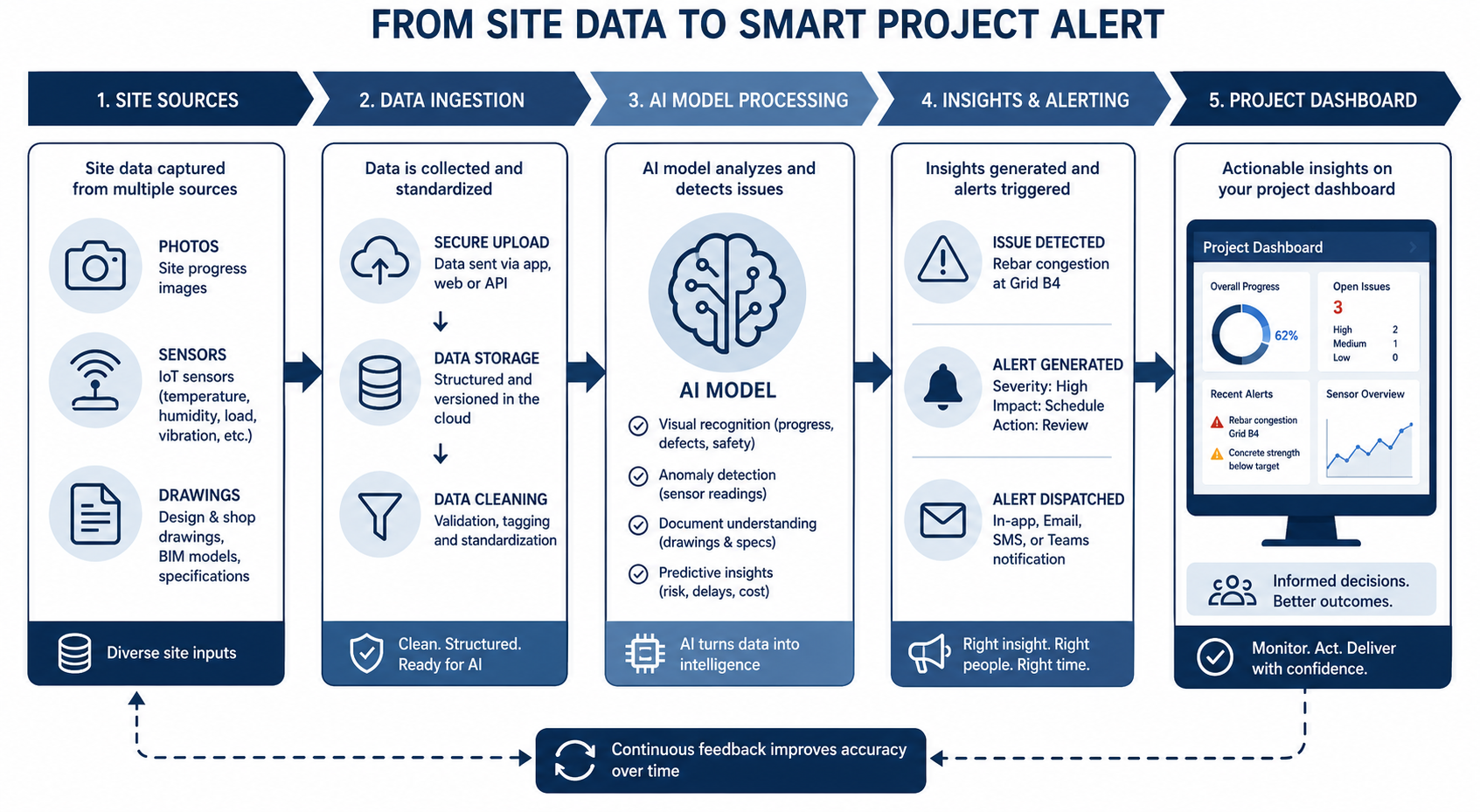
On a mid-rise residential site along the Lekki-Epe corridor, a site engineer spends Monday morning walking the slab formwork with a tape measure and a paper checklist, cross-referencing what he sees against a drawing set that has already been revised three times this month. By the time his report reaches the project manager on Wednesday, two more pours have gone ahead — one of them on a rebar layout that was flagged for change the previous week. This is the gap AI is starting to close on construction sites in Lagos, London, and everywhere in between: the lag between what is actually happening on site and what the project team knows about it. AI benefits construction firms most directly by shrinking that lag, turning photographs, sensor readings, and schedule data into decisions an engineer can act on the same day rather than the following week. This article sets out where AI benefits are strongest in building and infrastructure delivery, what capturing them costs, and how a COREN-registered practice can adopt the technology without gambling the project budget on unproven software.
AI Benefits: Quick Answer
AI benefits construction projects by improving schedule accuracy, reducing rework, and catching safety hazards earlier than manual inspection allows. Machine learning models trained on site photographs, sensor data, and historical project records flag deviations — a mislaid rebar cage, a slipping pour date — days before a routine site walk would, cutting defect rates and protecting float on the critical path.
What Is AI in Construction, and Where Do the Benefits Come From?
Artificial intelligence in construction is software that learns patterns from data — photographs, sensor feeds, cost records, schedules — and uses those patterns to predict, classify, or flag something a human would otherwise find only through manual review. That is narrower than the popular definition. Most of what gets marketed as “AI” on a construction site is machine learning applied to one bounded task: recognising rebar spacing in a photograph, predicting how many days an activity will slip, or matching an invoice line to a purchase order. None of it reasons about a project the way a project manager does. It performs the same lookup and pattern-matching work a human would do, at a scale no manual review team can sustain across a multi-phase development.
For a fuller breakdown of how these systems are classified, and what separates rule-based automation from genuine machine learning, see our guide on how AI is defined and applied across construction workflows. That distinction matters when a vendor pitches “AI-powered” software: ask what the model was trained on, and what happens when site conditions fall outside that training data.
Where AI Sits Next to BIM
AI does not replace BIM — it reads it. A model built to ISO 19650 gives an AI system the geometry and metadata it needs to compare “as-designed” against “as-built” without a human tracing dimensions by eye. On a project using a federated model, an AI clash-detection pass can screen thousands of MEP-versus-structure conflicts overnight, leaving the engineer to adjudicate the twenty or so that matter rather than scroll through the model manually. This is also where digital twin platforms earn their keep: a live, sensor-fed twin gives the AI layer continuously updated data instead of a static snapshot, so the model is comparing today’s site condition against design intent rather than a survey taken three weeks ago. Without that live feed, an AI clash or progress check is only ever as current as the last manual model update — which, on a fast-moving site, can already be out of date by the time the report is issued.
Computer Vision on the Physical Site
Camera-based progress tracking is the most visible form of construction AI today. A 360-degree camera or a hard-hat-mounted device walks the site on a set schedule; the images are matched against the BIM model to produce a percentage-complete figure per zone, per trade. Platforms such as OpenSpace and Buildots built their businesses on exactly this workflow, and Doxel applies a similar approach to quantity verification. The output a Nigerian site team actually uses is simpler than the underlying model: a colour-coded floor plan showing which zones are behind programme, refreshed weekly instead of guessed at in a Monday meeting.
The Core AI Benefits Construction Teams Are Realising
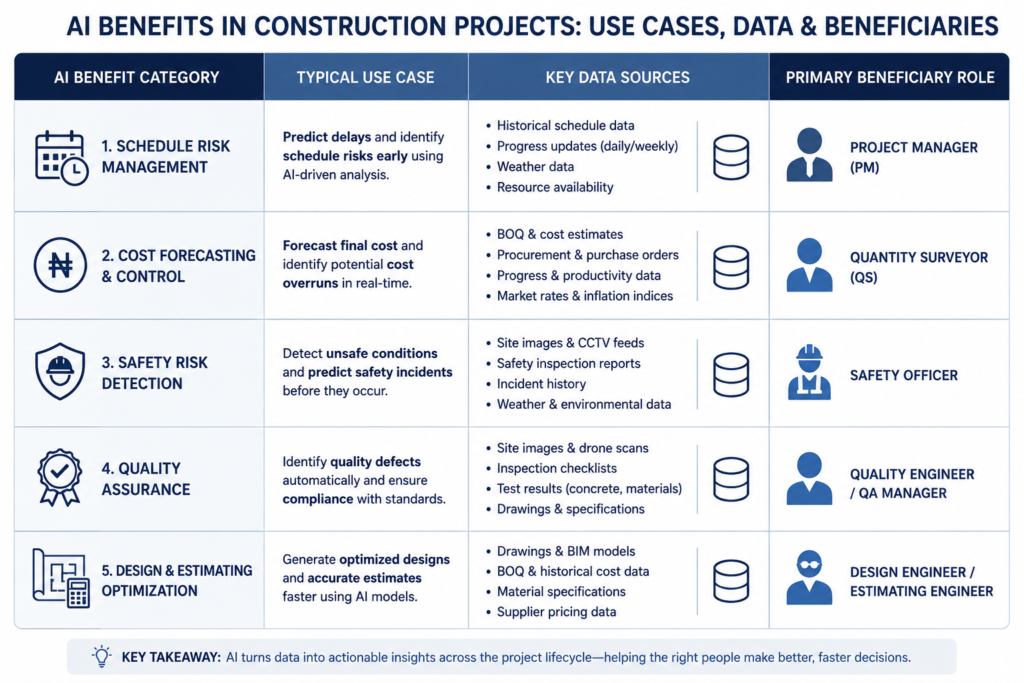
The benefits of AI on a construction project cluster into five areas, and they compound: a schedule prediction model is only as useful as the progress data feeding it, and progress data is only trustworthy if the computer vision model behind it has been trained on local site conditions — Lagos dust and glare read differently to a camera than a UK site in October.
Schedule risk prediction is the clearest financial case. Tools such as nPlan and ALICE Technologies ingest historical schedule data across hundreds of past projects and flag which activities on the current programme carry the highest probability of slipping, before the first day of delay actually shows up on site. For a contractor running a fixed-price contract with liquidated damages clauses, catching a foundation-pour risk four weeks out rather than four days out is the difference between a recoverable resequencing and a claim. Cost forecasting follows a similar logic: models trained on historical bill-of-quantities data catch pricing anomalies in a subcontractor tender — a unit rate for formwork that is 40% below the local market range, for instance — that a quantity surveyor reviewing hundreds of line items under deadline pressure can plausibly miss.
Safety and Quality Gains
Computer vision applied to CCTV or drone footage detects missing PPE, unguarded edges, and unsafe scaffold conditions in near real time, which matters on sites where a safety officer cannot physically be in every zone at once. Quality gains follow the same pattern: an AI model comparing daily photographs against the structural drawing set catches a slab thickness or rebar cover deviation while the pour is still curable, rather than after formwork strike, when the fix means breaking out concrete.
Design and Estimating Support
On the design side, generative design tools now run structural optioneering automatically — testing hundreds of column grid and beam depth combinations against a target load case and cost envelope faster than a design team could iterate manually. Automated takeoff software applies the same pattern-recognition approach to 2D drawings, extracting quantities in a fraction of the time a manual takeoff requires. Our detailed look at automation on Nigerian job sites covers how these estimating gains compound with automated equipment and prefabrication scheduling.
AI Benefits in Context: Regulation and Local Site Conditions
None of this technology operates outside the regulatory framework a COREN-registered engineer already answers to. AI-generated structural optioneering does not remove the requirement for a qualified engineer to check and sign design output against the National Building Code and relevant BS codes as adopted in Nigerian practice; it changes what that engineer spends their review time on. A firm using generative design tools still carries full professional liability for the final scheme, and COREN’s code of conduct treats an AI-assisted design exactly as it treats a manually produced one — the seal is the engineer’s, not the software’s.
Data protection is the second regulatory layer that AI adoption touches directly. Any platform processing site photographs, worker attendance data, or subcontractor records on a Nigerian project falls within the scope of the Nigeria Data Protection Act 2023, which governs where that data is stored and who can access it. UK-based contractors evaluating the same tools answer to UK GDPR instead, and firms working across both markets — increasingly common on StruviaCore’s UK-facing client base — need to confirm a vendor’s data residency terms before rollout, not after a data-sharing dispute arises.
Site conditions shape which AI tools actually perform as advertised. A computer vision model trained on European or North American site imagery frequently underperforms on Nigerian sites until it has been retrained on local conditions: harmattan dust reducing camera contrast, mixed formal and informal labour patterns that confuse worker-counting algorithms, and rebar and formwork practices that differ from what a Western training dataset assumes. NBRRI’s ongoing work on locally appropriate construction technology is a useful reference point here — the same caution it applies to imported building materials applies equally to imported AI models. Ask a vendor directly whether their model has been validated on West African site imagery, or whether your project will be the training data.
Procurement is the third layer worth checking before a contract is signed. Public infrastructure projects tendered under Nigeria’s Public Procurement Act, and NESREA’s environmental compliance requirements for larger developments, both generate the kind of structured document trail an AI-based document review tool can genuinely accelerate — matching submitted method statements against permit conditions, for instance. But a procurement process that specifies a particular AI platform by name, rather than a performance outcome, risks narrowing the bidder pool in a way that invites challenge. Frame the requirement around the outcome — verified progress reporting at a stated frequency, for example — and let contractors propose the tool that meets it.
Common Challenges and Cost Factors in AI Adoption
The single biggest reason AI pilots stall on Nigerian sites is not the software cost — it is data readiness. A schedule risk model needs several completed projects’ worth of historical programme data to train against; a firm still running its records on scattered spreadsheets and paper daily diaries has nothing for the model to learn from. Before evaluating vendors, audit whether your last three projects have consistent, digitised cost and schedule records. If they do not, the first AI investment worth making is a proper project management information system, not a machine learning platform sitting on top of incomplete data.
Cost structures vary widely by tool category. Computer vision progress-tracking platforms typically price per square metre monitored or per project, often landing in the low tens of thousands of dollars annually for a mid-sized commercial project — a figure that needs converting into Naira at the prevailing rate and stress-tested against currency volatility before it goes into a project budget. Schedule risk and cost forecasting software tends to price per seat or per portfolio, making it a harder case to justify on a single project and a much easier one across a developer’s or contractor’s full pipeline. Connectivity is the quieter cost factor: cloud-dependent AI platforms need consistent site internet, which on remote infrastructure sites in parts of Nigeria means budgeting for a dedicated VSAT or 4G/5G link as a project cost, not an assumption. Factor in the hidden cost of retraining or recalibrating a model against local conditions too — a vendor’s headline price rarely includes the weeks of site-specific validation a camera-based system needs before its progress percentages can be trusted over a manual site walk.
Integration cost is the item most first-time buyers underestimate. An AI platform that cannot pull data directly from your existing scheduling software, cost system, or BIM environment forces someone on the team to re-key information manually — which quietly erases the time savings the tool was bought to deliver. Before signing, ask the vendor to demonstrate a live integration with the specific software your practice already runs, not a generic case study from a different tech stack.
Workforce resistance is a real, underdiscussed barrier. A site foreman who has run progress tracking by memory and paper for twenty years has legitimate reasons to distrust a colour-coded dashboard generated by a system he cannot interrogate. Adoption succeeds where the AI output is introduced as a second opinion the site team can challenge and correct, not as a replacement judgement imposed from the project office.
Best Practices for Capturing AI Benefits on Your Projects
Start narrow. The firms that get real value from AI pick one workflow — progress tracking, tender price-checking, safety monitoring — run it on a single project for one full phase, and only then decide whether to scale it. Trying to deploy AI across scheduling, cost, safety, and design simultaneously on a first attempt is how a pilot budget gets spent with nothing conclusive to show for it. You will get a clearer read on real accuracy and real time savings from one well-run pilot than from three half-supervised ones running in parallel.
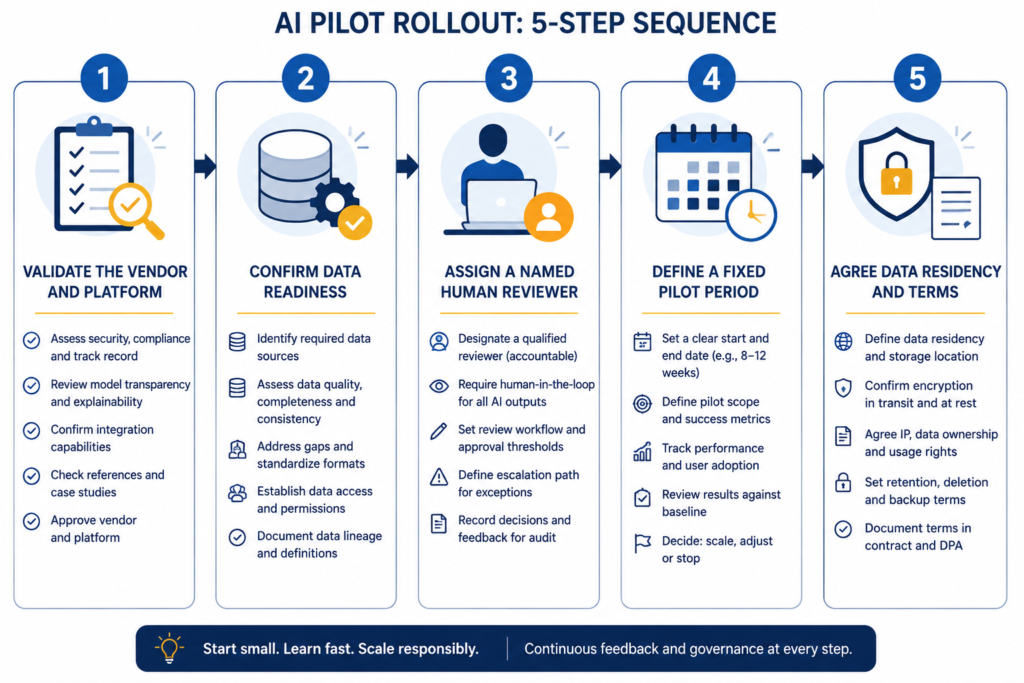
Follow this sequence when you evaluate and roll out a tool:
- Confirm the vendor can show validated performance on sites with conditions comparable to yours — climate, labour structure, and typical construction method — before signing anything.
- Digitise and centralise the historical data the model will train on; a schedule risk tool fed six months of clean data outperforms one fed three years of inconsistent records.
- Assign one named engineer as the model’s human reviewer, with explicit authority to override its output — never let a flagged risk or a defect alert route into a queue with no accountable owner.
- Set a fixed pilot period, typically one construction phase or 90 days, with predefined success metrics agreed before rollout, not after results start arriving.
- Confirm data residency and access terms in writing, particularly for projects spanning Nigerian and UK regulatory jurisdictions.
Our roundup of real-world AI applications across construction works through several of these pilots in more detail, and our full AI adoption checklist expands each of the steps above into a project-ready procedure your team can follow phase by phase.
Frequently Asked Questions About AI
Q: What is AI in civil engineering, in plain terms?
A: It is software trained to recognise patterns in construction data — photographs, sensor readings, cost and schedule records — and to flag, predict, or classify things a human reviewer would otherwise have to find manually. It does not design or manage a project independently; it narrows down what an engineer needs to check.
Q: How does AI improve construction scheduling specifically?
A: AI schedule risk tools compare a current programme against patterns from hundreds of historical projects to flag which activities carry the highest probability of slipping, often weeks before the delay would otherwise become visible. This gives a project manager time to resequence or add resources before float on the critical path is consumed.
Q: What is the difference between AI and BIM in construction?
A: BIM is the structured 3D model and data set describing a building; AI is a set of tools that reads that data to find patterns. AI needs BIM’s structured geometry and metadata to compare as-built conditions against design intent — the two are complementary layers, not competing technologies.
Q: What does AI construction software typically cost for a Nigerian contractor?
A: Pricing varies by category. Computer vision progress-tracking platforms are usually priced per square metre monitored or per project, often in the low tens of thousands of dollars annually for a mid-sized commercial job, while schedule and cost forecasting tools tend to price per seat or portfolio-wide. Convert any quoted figure to Naira at the prevailing rate and build in a currency volatility buffer before it goes into the project budget.
Q: Do I still need a COREN-registered engineer to check AI-generated designs?
A: Yes. AI-assisted generative design and automated takeoff tools do not carry professional liability; the registered engineer reviewing and sealing the output does. Treat AI design tools as a faster first draft, not a substitute for the qualified sign-off the National Building Code and COREN’s code of conduct require.
AI benefits construction projects where the underlying data is clean enough to learn from and where a named engineer stays accountable for the output — not as a replacement for professional judgement, but as a way of surfacing the deviations that judgement would otherwise catch too late. The firms getting real value are not the ones running the most AI tools; they are the ones that picked one workflow, validated the tool against Nigerian or UK site conditions rather than a vendor’s marketing claims, and built a review process around it before scaling further. If your practice is weighing where to start, StruviaCore’s engineering team can walk through your project data and flag which of these five benefit categories would move the needle first on your next build.
Leave a Reply