
A site engineer in Lagos flags a crack pattern on a retaining wall photo and gets a probable cause within seconds. A structural team in Dubai runs a clash-detection pass on a 40-storey BIM model overnight instead of over three days. A rail contractor in the UK feeds sensor data from track-side accelerometers into a model that predicts ballast degradation before it becomes a maintenance emergency. These are not pilot demos. They are AI examples already running on live projects, and understanding how they work matters more than repeating the word “AI” in a proposal document. This article walks through where artificial intelligence is genuinely earning its place in civil and structural engineering workflows, how each application functions technically, and where the current limitations sit.
AI: Quick Answer
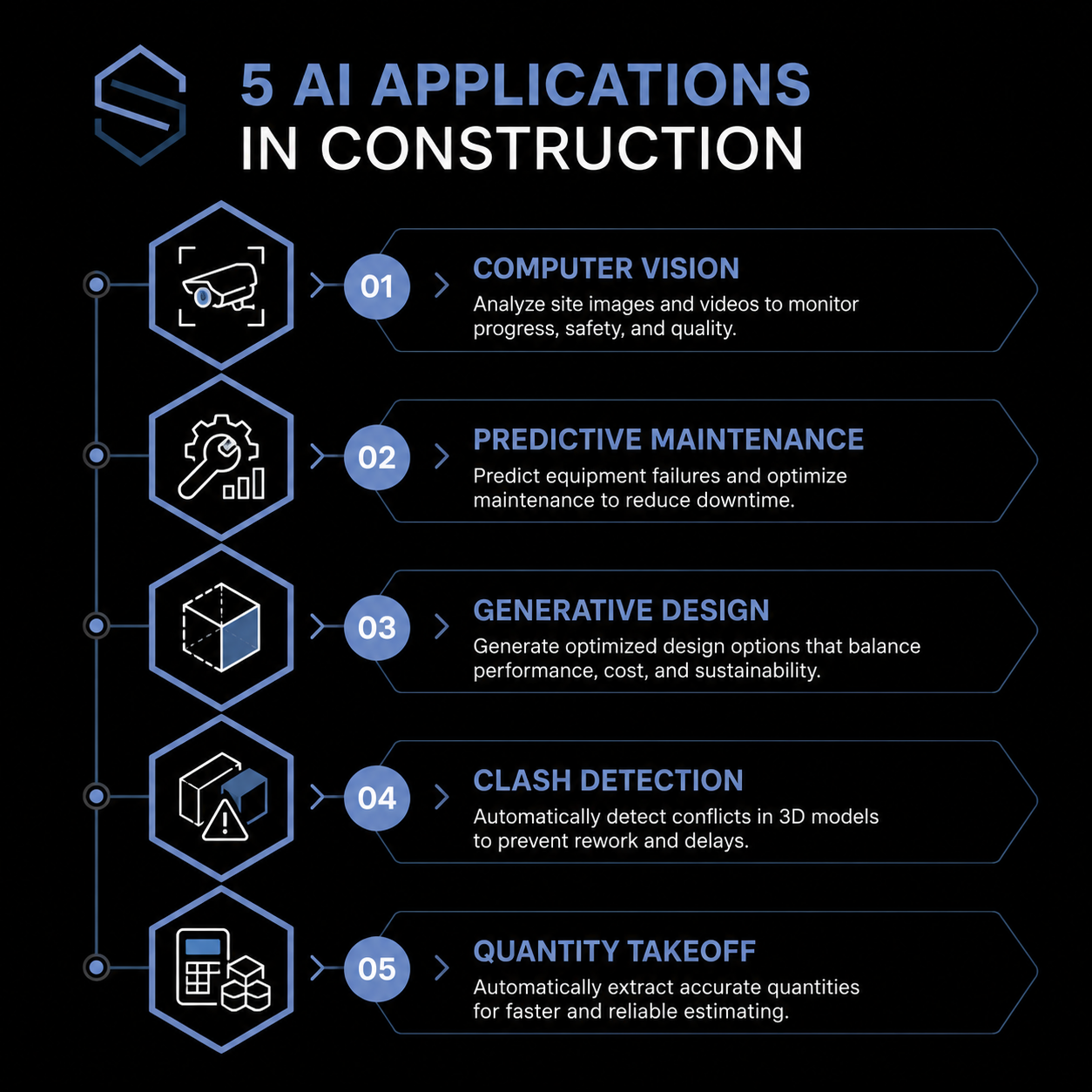
AI examples in construction and structural engineering include computer-vision defect detection, BIM clash automation, predictive maintenance for infrastructure assets, generative design for structural optimisation, and AI-assisted quantity takeoff. Each application uses machine learning models trained on project data — images, sensor readings, or design geometry — to flag risks, cut rework, and speed up decisions that once required manual review.
What AI Actually Does on a Construction Project
AI in construction is a set of software tools that use trained models to recognise patterns in project data and produce a recommendation, prediction, or flagged exception — not a replacement for engineering judgement. The distinction matters because a lot of marketing material implies autonomous decision-making that doesn’t reflect how these tools are deployed. In practice, every AI example discussed in this article sits inside a workflow where a qualified engineer reviews the output before it affects a design, schedule, or safety call.
The underlying mechanics fall into three families. Computer vision models are trained on labelled image datasets — thousands of photos of cracks, spalling, corrosion, or rebar exposure — and learn to classify new images against those categories. Predictive models work on time-series or sensor data, learning the relationship between input variables (load, temperature, vibration, moisture) and an output like remaining service life. Generative and optimisation models explore a defined design space — say, beam depth, column spacing, and material grade — and return options that meet code constraints while minimising a target variable such as steel tonnage or embodied carbon.
What separates a genuinely useful AI application from an expensive novelty is whether it’s solving a problem with a clear, measurable output. “Detect cracking above 0.3mm width” is a well-posed problem a model can be trained and scored against. “Improve project efficiency” is not — it gives a vendor nothing concrete to optimise for and gives you nothing concrete to test acceptance against before signing a contract. Every application covered in this article works because someone defined the specific decision the model needed to support before selecting or training it.
Where the Data Comes From
Model quality depends entirely on training data quality. A defect-detection model trained on inspection photos from temperate climates will misclassify staining and efflorescence patterns common in humid coastal environments like Lagos or Port Harcourt unless it has been retrained on regionally representative images. Firms running AI tools across multiple markets — UK, UAE, Nigeria — need to verify the training dataset composition before trusting output on a new site, because a model’s confidence score does not tell you whether it has seen your specific failure mode before.
Where Engineering Judgement Stays in Control
None of the applications below remove the requirement for a chartered engineer to sign off on structural adequacy. AI output functions as triage: it tells a team where to look first, not what the final answer is. A model flagging a beam-column connection as “high risk” based on visual crack width still requires a site inspection against BS EN 1992 crack-width limits or the applicable National Annex before any remedial decision is made.
Computer Vision Examples: Defect Detection and Progress Monitoring
Computer vision is the most mature AI application on construction sites today, and it splits into two distinct use cases with different technical requirements.
Structural Defect Detection
Drone-mounted or handheld cameras capture high-resolution images of concrete surfaces, steel connections, or masonry, and a convolutional neural network scores each image for defect probability — cracking, spalling, honeycombing, corrosion staining, or delamination. Systems in commercial use today report detection accuracy in the 85–95% range for surface-level defects under good lighting conditions, though accuracy drops meaningfully on wet surfaces, low-light interiors, or heavily textured finishes. On a bridge inspection in the UK, this replaces a portion of the manual visual survey required under Network Rail’s asset inspection framework, though the model output still feeds into an engineer’s assessment rather than substituting for it.
Construction Progress Monitoring
A second computer-vision application compares scheduled 4D BIM progress against photographic or laser-scan capture of actual site conditions, flagging variance automatically. On a multi-tower development in Abu Dhabi, this kind of system can identify that formwork for a given floor slab is seven days behind programme without a planner manually walking the site and comparing notes against the schedule. The output feeds directly into project reporting and can trigger early conversations with subcontractors before delay compounds.
Both applications depend on consistent image capture — same angles, similar lighting, comparable resolution — because the model compares each new image against a learned baseline. Inconsistent capture is the single most common reason these systems underperform in the field.
Predictive Maintenance and Structural Health Monitoring
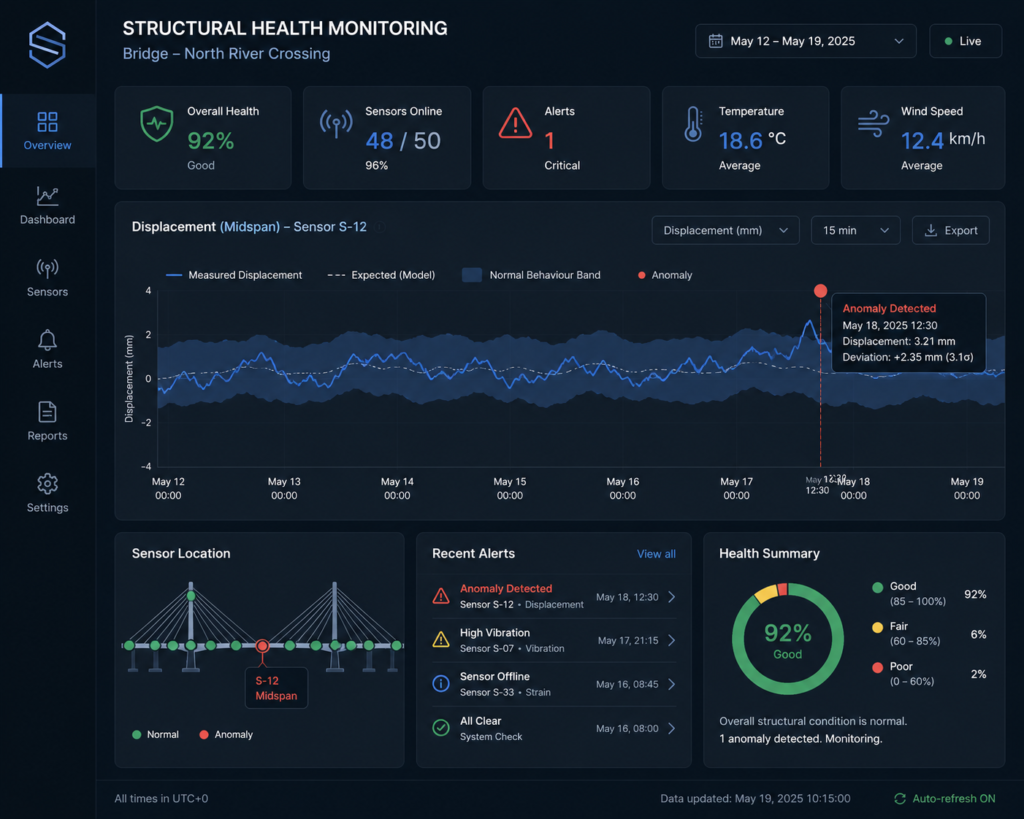
This category applies AI to sensor data collected from an existing asset — a bridge, a water treatment structure, a rail line — to predict deterioration before it reaches a critical threshold.
A typical structural health monitoring setup places strain gauges, accelerometers, and tilt sensors at key locations on a structure, streaming readings continuously. The AI model is trained to recognise the statistical signature of normal behaviour under varying load and temperature conditions, then flags deviations that fall outside that learned envelope. On a cable-stayed bridge, this can detect a stay cable losing tension weeks before the change would be visible on a scheduled inspection cycle, giving the asset owner time to plan intervention rather than react to an emergency closure.
For water and utilities infrastructure, similar models process pressure and flow data across a distribution network to predict pipe failure probability, prioritising which sections of an ageing network need replacement first. This has direct relevance for utilities upgrade programmes across West Africa, where capital budgets are constrained and prioritisation accuracy has a measurable financial impact. You can read more on how these systems interact with distribution networks in our utilities infrastructure guide.
Rail assets follow a similar logic. Track-side accelerometers and axle-box sensors on passing trains generate continuous vibration data, and a trained model learns the vibration signature associated with healthy ballast versus ballast requiring tamping. Rather than running fixed-interval track geometry surveys regardless of actual condition, an asset owner can prioritise inspection resources toward sections the model flags as deteriorating fastest — a shift from calendar-based to condition-based maintenance that most UK rail infrastructure managers are actively moving toward under current asset management frameworks. The same principle extends to airport pavement monitoring, where embedded sensors track load-induced strain across runway sections to schedule resurfacing before surface distress becomes a foreign-object-debris risk.
Generative Design, BIM Automation, and Regulatory Context
Generative design tools explore thousands of structural configurations against a defined objective — minimum steel tonnage, minimum embodied carbon, or minimum deflection — within constraints set by the engineer, such as span limits, load cases, and applicable code provisions. Rather than the engineer manually iterating beam sizes and column grids, the software returns a ranked set of options that already satisfy the constraint set, and the engineer selects and verifies the preferred option against the governing code — BS EN 1993 for steel design in UK and many Commonwealth-influenced markets, or the UAE National Annexes for Gulf projects.
BIM clash detection is the AI application with the fastest and most measurable payback. A trained model reviewing a coordinated Revit or Navisworks model can identify hard clashes — a structural beam intersecting a mechanical duct run — and soft clashes, such as insufficient maintenance clearance around a pump, far faster than manual review. On a hospital project with mechanical, electrical, structural, and architectural models combined, automated clash review compresses a process that used to take a coordination team the better part of a week into an overnight run, with the engineering team spending their time resolving flagged conflicts rather than searching for them. Our BIM implementation guide covers how this fits into a broader coordination workflow.
A related and increasingly common example is AI-assisted quantity takeoff, where a model reads 2D drawings or a 3D BIM model and extracts material quantities — concrete volume, rebar tonnage, formwork area — automatically instead of an estimator measuring each element manually. On a large infrastructure package with dozens of drawing revisions, this cuts the re-measurement cycle every time a design changes, since the model recalculates quantities against the updated geometry rather than requiring a full manual re-take. Accuracy on well-structured BIM models with consistent object naming typically runs close to manual takeoff, though quantity extraction from scanned or poorly labelled 2D drawings remains noticeably less reliable and still needs a quantity surveyor’s spot-check before it feeds into a tender or cost plan.
Regulatory acceptance of AI-assisted design output varies by jurisdiction and remains conservative. COREN in Nigeria, the relevant UK institutions, and Dubai Municipality all require a registered engineer’s stamp on final structural calculations regardless of what tool generated the preliminary option set. No regulatory body currently accepts an AI model’s output as a substitute for code-compliance verification performed by a qualified engineer — treat every generative design output as a starting point for verification, not a finished calculation.
Common Mistakes and Cost Factors in AI Adoption
Firms adopting AI examples into their workflow tend to run into the same handful of problems, and most of them are organisational rather than technical.
- Treating pilot accuracy as production accuracy. A model validated on 200 curated training images often performs worse on unfiltered site photos with variable lighting, dust, and occlusion — budget for a validation phase against your actual site conditions before rolling a tool out fleet-wide.
- Underestimating data preparation cost. Labelling defect images, cleaning sensor data, or structuring historical project records for model training frequently costs more in engineering hours than the software licence itself.
- Skipping the human review step under schedule pressure. The single largest liability risk in AI-assisted engineering is a team accepting model output without independent verification because a deadline is close.
- Ignoring integration cost with existing BIM and document management systems. A defect-detection tool that doesn’t feed directly into your existing snag list or asset register creates duplicate administrative work rather than saving time.
On cost, expect wide variance depending on scope. A single-project computer-vision inspection service might run as a per-survey fee in the low thousands of dollars, while an enterprise structural health monitoring installation with continuous sensor networks and dedicated model training can represent a capital cost in the tens to low hundreds of thousands of dollars depending on asset size and sensor density. Firms in Nigeria and other cost-sensitive markets are increasingly evaluating AI tools against a clear payback period — typically measured against reduced inspection labour hours or avoided emergency repair costs — rather than adopting technology for its own sake. Our construction automation guide covers cost-benefit frameworks that apply equally to AI tool procurement.
Best Practices for Implementing AI Examples on Your Projects
If you’re evaluating AI tools for an upcoming project, work through this sequence rather than starting with a vendor demo.
- Define the specific decision the tool needs to support — defect triage, clash resolution, or maintenance prioritisation are each different problems requiring different model types. A vague goal like “improve efficiency” won’t get you a usable procurement brief.
- Audit your existing data. If you’re targeting predictive maintenance, confirm you actually have historical sensor or inspection data of sufficient volume and quality to train or validate a model against — many firms discover this gap only after signing a contract.
- Run a bounded pilot against a known outcome. Test the tool against a structure or dataset where you already know the answer — a bridge with a documented defect history, for example — so you can measure the model’s real accuracy rather than trust a vendor’s stated benchmark.
- Confirm the regulatory sign-off chain. Establish upfront which outputs require a registered engineer’s independent verification under your governing code framework, and build that review step into the workflow rather than treating it as optional.
- Plan for retraining, not just deployment. Models degrade as site conditions, materials, or camera hardware change — budget for periodic retraining rather than assuming a one-time setup is sufficient for the asset’s full life.
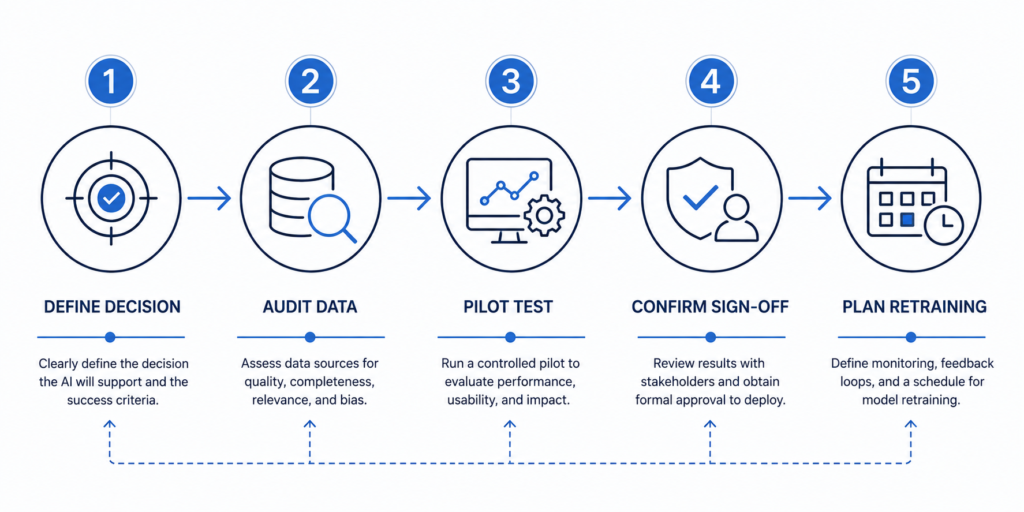
Teams that follow this sequence consistently report faster adoption and fewer disputes over tool reliability than teams that select software first and define the use case afterward. If your organisation is also exploring related digital tools, our digital twins guide and IoT in construction guide cover adjacent technologies that often integrate with AI monitoring systems.
Frequently Asked Questions About AI
Q: What is AI in civil engineering?
A: AI in civil engineering refers to machine learning models applied to construction and infrastructure data — images, sensor readings, or design parameters — to automate pattern recognition tasks such as defect detection, clash checking, or failure prediction. It supports engineering decisions rather than replacing the engineer’s sign-off responsibility.
Q: How does AI-based defect detection work on site?
A: A camera or drone captures images of a structural element, and a trained computer-vision model compares visual patterns against a labelled dataset of known defects like cracking or corrosion. The model returns a probability score for each defect type, which an engineer then verifies against relevant code limits, such as crack-width provisions in BS EN 1992.
Q: What are the main AI examples used in construction today?
A: The most established examples are computer-vision defect detection, BIM clash detection automation, predictive maintenance using structural sensor networks, generative structural design, and AI-assisted quantity takeoff from drawings or point-cloud data. Clash detection and defect monitoring currently have the widest production deployment.
Q: How much does AI implementation cost for a construction firm?
A: Costs vary widely by scope: a single-project computer-vision inspection service can cost a few thousand dollars per survey, while a permanent structural health monitoring installation with sensor networks and model training can run into the tens of thousands of dollars or more depending on asset size. Firms should evaluate cost against a defined payback period tied to labour savings or avoided repair costs.
Q: What is the difference between AI and BIM automation?
A: BIM automation covers rule-based tasks within building information modelling software, such as automated quantity extraction or scheduling links, that follow fixed logic. AI applies trained models that learn patterns from data and improve or adapt with more input — such as a clash-detection model that improves at distinguishing genuine clashes from tolerable near-misses as it processes more coordinated models.
The AI examples covered here — defect detection, structural health monitoring, generative design, and BIM clash automation — share a common thread: each one narrows down where a qualified engineer needs to spend attention, rather than removing the need for that attention. Firms getting real value from these tools treat them as triage and verification aids sitting inside an existing quality and code-compliance process, not as a shortcut around it. If you’re assessing where AI fits into your project workflow, StruviaCore’s engineering team can review your specific asset data, site conditions, and regulatory framework to identify which applications will actually move your schedule or maintenance costs — get in touch to discuss a scoped pilot for your next project.
Leave a Reply