
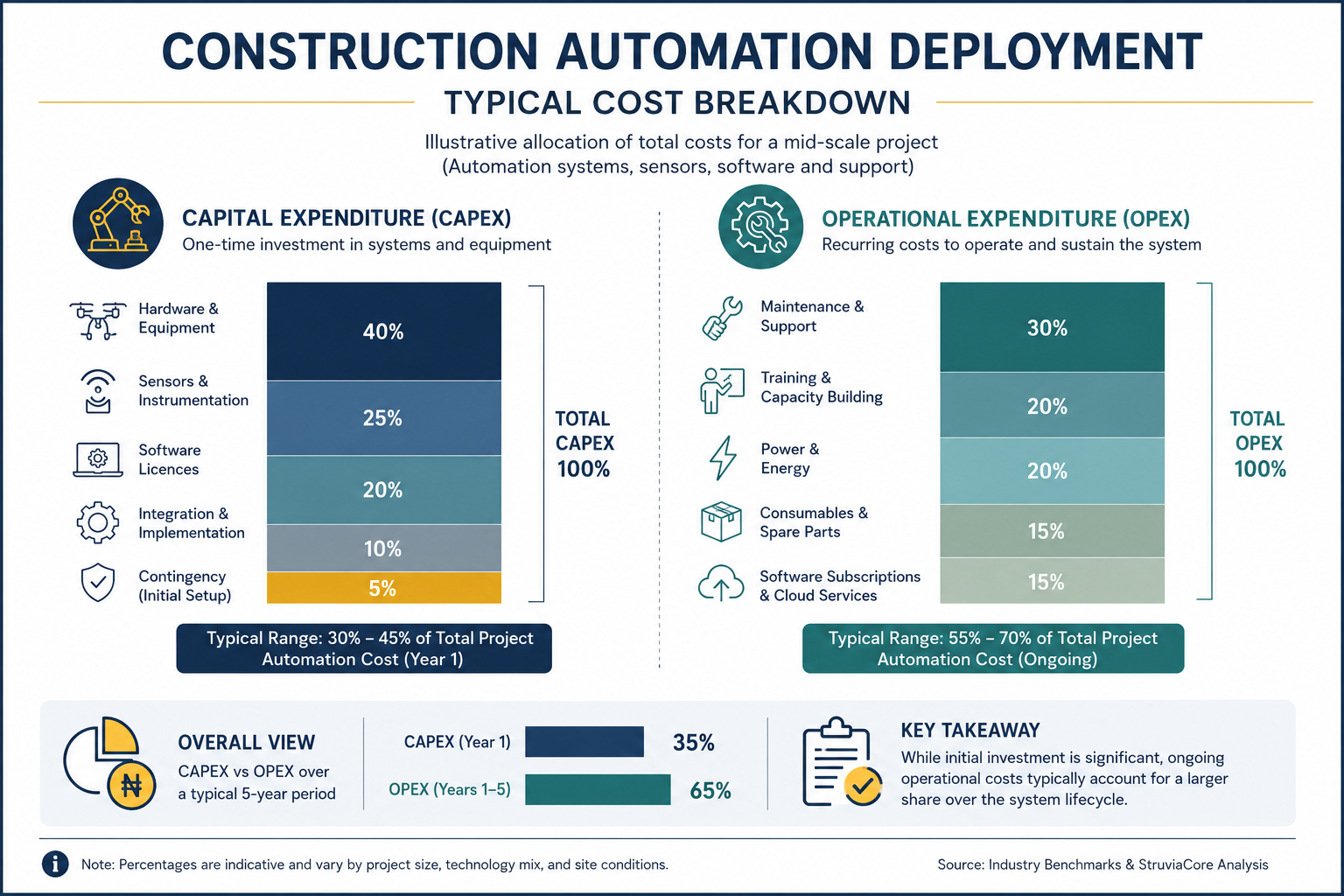
A site engineer in Lagos gets two numbers on the same afternoon: a quote for a robotic rebar-tying unit and the monthly wage bill for the four labourers it would replace. The machine costs more than the crew earns in a year. On paper, that looks like an easy decision — until the maintenance contract, the training days, and the backup generator required to keep the unit running through load-shedding get added to the sheet. Understanding automation cost factors means separating the sticker price of a machine from the full cost of putting it to work on a real site, in a real regulatory environment, with real power and labour constraints. This article works through those cost factors — capital and operational, technical and regulatory — for contractors and consultants operating across Nigeria, the UK, and the Gulf.
Automation Cost Factors: Quick Answer
Automation cost factors in construction include equipment capital cost, software licensing, integration with existing BIM or ERP systems, workforce retraining, ongoing maintenance contracts, and site-specific conditions such as power reliability and skilled labour availability. Payback periods typically run from 18 months to 5 years, depending on utilisation rate, project scale, and whether the automation replaces labour or augments it.

What Drives Automation Cost Factors on a Construction Site
Automation is the use of programmable machinery, sensors, or software to carry out a task — on site or in design production — that a person previously performed manually. That covers a wide range of equipment: automated concrete batching plants, robotic total stations, self-propelled screeding rigs, and design automation tools that generate reinforcement schedules directly from a structural model. Each of these carries a different cost profile, but the underlying cost factors repeat across all of them.
The first factor is hardware and software procurement — the number most people mean when they ask “how much does automation cost.” The second, less visible factor is integration: getting the new system to talk to the site’s existing survey control, project schedule, or design files. A robotic total station that cannot exchange coordinate data with the site’s CAD package loses most of its speed advantage, because someone still re-keys the numbers by hand. The third factor is workforce readiness — operators, supervisors, and maintenance technicians all need training before the equipment earns its keep, and that training has a cost measured in both money and lost productive days.
A fourth factor gets overlooked more often than the first three combined: vendor lock-in. Many automated systems run on proprietary firmware, and spare parts or software updates come from a single supplier with pricing power once the equipment is installed. A batching plant controller that costs ₦2 million to install can carry an annual software support fee that, over a ten-year service life, exceeds the original hardware cost. Ask any vendor for a five-year support-fee schedule in writing before signing the purchase order — a supplier unwilling to commit to that schedule is telling you something about future costs.
Capital Expenditure Versus Operational Expenditure
Capital expenditure (CapEx) covers the purchase or lease of the equipment itself, initial software licences, and any structural or electrical work needed to install it — a hardstanding pad for a batching plant, for instance, or a dedicated power feed. Operational expenditure (OpEx) covers everything that keeps the system running: preventive maintenance, spare parts, consumables, software subscription renewals, and electricity or fuel. Contractors who budget only for CapEx routinely underrun their automation projects by 20–35% once OpEx is added in over the first two years of operation.
Where Automation Cost Factors Differ From Standard Plant Costs
Conventional plant — excavators, cranes, mixers — has a well-understood depreciation curve and a mature secondhand market. Automated systems depreciate faster in practice, because software-dependent equipment becomes obsolete when the vendor stops supporting the control firmware, not when the physical hardware wears out. A five-year-old automated batching controller running unsupported software is a liability even if the mechanical components are sound. Budget for a shorter effective service life than the manufacturer’s mechanical warranty implies — three to four years for control software, against ten to fifteen years for the mechanical frame.
Calculating the Total Cost of Automating a Process
Total cost of ownership (TCO) is the only honest basis for comparing automated and manual approaches to the same task. TCO adds the purchase price to financing costs, installation, training, five years of maintenance, expected downtime losses, and residual value at disposal, then compares that figure against the equivalent labour cost over the same period, adjusted for productivity difference. A robotic rebar-tying system that costs ₦18 million and replaces two tying labourers earning a combined ₦3.6 million a year has a simple payback of five years on labour substitution alone — before accounting for the 3–4x speed increase that shortens the overall programme and reduces preliminaries.
Payback Period and ROI Calculation
Payback period = Net investment cost ÷ Annual net savings. Net investment cost includes CapEx plus first-year OpEx minus any resale or grant value. Annual net savings equals displaced labour cost plus productivity gains, minus ongoing OpEx. A batching plant automation retrofit costing ₦45 million against annual savings of ₦12 million pays back in 3.75 years — reasonable for a contractor running a five-year pipeline of similar-sized projects, questionable for a firm bidding one-off jobs.
Labour Substitution Versus Augmentation
Not every automation investment removes a role; some augment it. A drone-based topographic survey does not eliminate the survey team — it compresses a three-day manual survey into a half-day flight plus office processing, freeing the same surveyors for setting-out work elsewhere on the programme. Cost models for augmentation should track productivity redeployment rather than headcount reduction, because the savings show up as programme compression and reduced site overhead, not as a smaller wage bill.
Sensitivity to Utilisation Rate
Automation economics are unforgiving of idle equipment. A robotic total station used four hours a day instead of eight effectively doubles its per-unit cost of survey data. Contractors moving equipment between multiple small sites — common in the Nigerian residential market — see far worse payback than contractors running one large programme where the equipment stays productive continuously. Before committing capital, model utilisation at realistic (not optimistic) hours, and stress-test the payback calculation against a 30% utilisation shortfall.

Regulatory and Regional Cost Drivers Across Nigeria, the UK, and the Gulf
Regulatory context changes automation cost factors as much as engineering does. In Nigeria, imported automated plant and robotics typically attract import duty and VAT that can add 20–35% to landed cost, and equipment certification against Nigerian Industrial Standards (NIS) or clearance through the Standards Organisation of Nigeria (SON) adds lead time before commissioning. COREN registration requirements for the engineer signing off on an automated system’s structural or electrical interface also shape who can commission the equipment, which affects staffing cost. Power reliability is a direct line item too — sites without stable grid supply need diesel or hybrid backup sized to the automated system’s continuous draw, and that generator capacity, fuel, and maintenance belongs in the OpEx column, not treated as a general site cost.
In the UK, automated machinery on a construction site falls under the Provision and Use of Work Equipment Regulations 1998 (PUWER) and the Construction (Design and Management) Regulations 2015 (CDM 2015), both enforced by the Health and Safety Executive. Machinery safety compliance to BS EN ISO 12100 and, where relevant, BS EN ISO 13849 for control system safety, is not optional and should be priced into procurement rather than treated as a retrofit. UK labour costs are higher than Nigeria’s, which shortens payback periods for labour-substituting automation, but stricter safety case documentation for autonomous or semi-autonomous equipment adds administrative cost that a Nigerian or Gulf deployment of the same machine would not carry.
Gulf markets add a different layer. Dubai Municipality and Trakhees (for Dubai’s free zones) both require permitting review for automated plant with structural or utility connections, and DEWA governs any automated system drawing from the municipal power or water network. Abu Dhabi’s Estidama Pearl rating system rewards automated building management and monitoring systems with sustainability credits, which can offset part of the automation cost through faster planning approval or marketing value on Estidama-rated developments. Skilled labour costs in the Gulf sit between Nigerian and UK levels, but the region’s reliance on expatriate technical staff means training and work-permit costs for automation specialists should be modelled explicitly rather than folded into a general training line.
Set side by side, the three markets invert the usual cost logic. Nigerian projects face the highest import and financing burden but the fastest labour-cost payback once equipment clears customs. UK projects carry the lowest import friction but the highest compliance documentation cost, and Gulf projects sit in between on both counts while offering sustainability-linked incentives that Nigeria and the UK do not match at the same scale. A firm operating across more than one of these markets should build separate cost models per jurisdiction rather than applying one blended assumption — the regulatory line items differ enough to change which automation investments clear payback thresholds in each location.
Common Mistakes That Inflate Automation Cost Factors
Three mistakes account for most automation budget overruns on the projects StruviaCore reviews. The first is quoting the equipment price and stopping there — treating the automation cost factors conversation as a procurement exercise rather than a total-cost-of-ownership exercise. Integration with an existing BIM environment or project management system frequently costs as much as the hardware itself when the two systems were never designed to interoperate, and that integration line is the one most commonly missing from initial budgets.
The second mistake is underfunding training. A four-day operator course looks affordable against a multimillion-naira machine purchase, but skipping refresher training after the first three months — when early confidence meets real site variability — produces avoidable downtime and, in the worst cases, damage claims that dwarf the training saved. Budget training as a recurring OpEx line, not a one-time CapEx add-on.
The third mistake is scope creep during commissioning. Automated systems expose gaps in upstream data quality — a robotic setting-out system flags survey control errors that manual methods tolerated silently — and fixing those upstream problems gets absorbed into the automation project’s budget rather than tracked separately. Ring-fence a contingency of 10–15% specifically for data-quality remediation discovered during commissioning, and track it apart from the core cost control baseline so the automation business case is not blamed for pre-existing data problems.
The fourth mistake is treating insurance and warranty as unchanged by the automation investment. Plant insurers price autonomous or semi-autonomous equipment differently from conventional plant, and a policy written for a manual crane operation does not automatically extend the same liability cover to a robotic system operating near workers. Warranty terms deserve equal scrutiny: many manufacturers void mechanical warranty cover if a third party performs software updates or if the machine operates outside a specified environmental range — a real constraint on sites with high dust loading or inconsistent power quality. Confirm both positions with your insurer and vendor before commissioning, not after an incident forces the question.
Best Practices for Budgeting an Automation Rollout
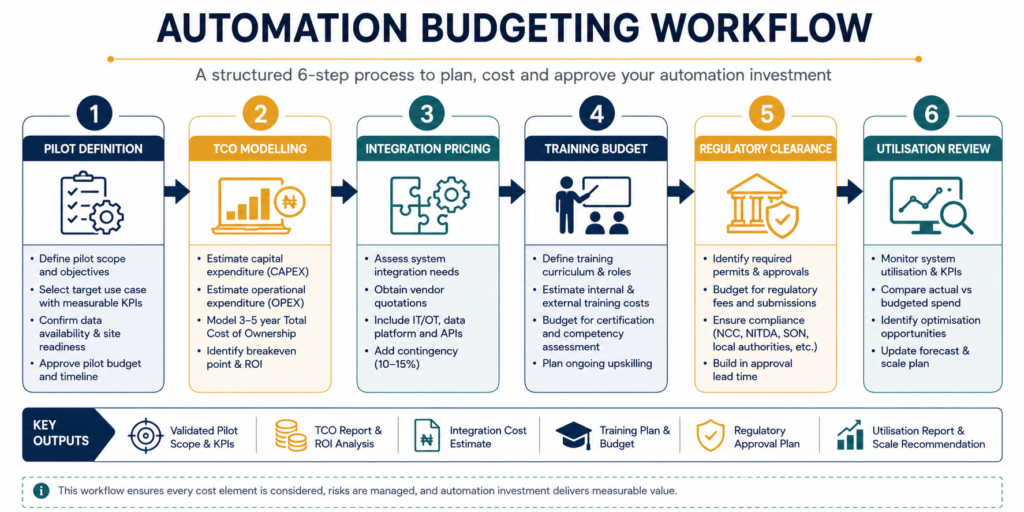
Getting an automation budget right the first time saves you the credibility cost of a revised business case six months into a project. The discipline is the same one you would apply to any major line item — structural engineering cost estimates hold up for the same reason: every component of cost gets named and priced separately instead of folded into a single contingency figure. Work through these steps in order rather than jumping straight to a vendor quote.
- Run a pilot on one work package before committing to fleet-wide rollout, and measure actual utilisation hours against the assumption in your business case.
- Build a five-year TCO model, not a purchase-price comparison — include financing, training, maintenance, power, software renewal, and disposal value.
- Price integration work separately and get a firm quote from whoever manages your BIM or ERP environment before signing the equipment order.
- Budget training as a recurring line: initial certification plus refresher sessions at three, six, and twelve months.
- Confirm import duty, certification, and permitting costs with your regulatory contact before the equipment ships, not after it arrives at port.
- Set a utilisation floor — the minimum productive hours per week the system must hit to stay on payback schedule — and review it monthly against actuals.
If you run a mixed fleet of automated and conventional equipment, track their cost-per-unit-output separately rather than blending them into one plant cost line. Blended figures hide underperforming automation investments until the annual review, by which point the underutilisation has already cost you a year of poor returns.
Frequently Asked Questions About Automation
Q: What is automation in civil engineering?
A: Automation in civil engineering refers to programmable machinery, sensors, or software that perform tasks such as concrete batching, setting-out, or reinforcement scheduling without step-by-step manual operation. It ranges from single-function tools, like an automated batching controller, to integrated systems linking design software directly to site equipment.
Q: How does construction automation cost compare to manual labour?
A: Automated systems usually carry a higher upfront cost than the labour they replace, often two to five times the annual wage of the equivalent crew. Whether automation costs less overall depends on utilisation rate and project duration — payback periods of 18 months to 5 years are typical, and equipment used below 60% of planned capacity rarely reaches breakeven within its effective service life.
Q: What are the automation cost factors for a small contractor in Nigeria?
A: Small contractors face import duty and VAT of roughly 20–35% on imported automated plant, SON certification lead times, and generator backup costs where grid power is unreliable. Because small contractors often move equipment between several smaller sites, utilisation rates tend to be lower than on a single large programme, which lengthens payback and should be modelled explicitly before purchase.
Q: What is the difference between automation and robotics in construction?
A: Automation is the broader category — any programmable system that performs a task without manual step-by-step control, including software that generates reinforcement schedules automatically. Robotics specifically refers to physical machines, such as a robotic total station or a rebar-tying unit, that combine automation with mechanical movement to interact directly with the physical site.
Q: How much does construction automation cost per project?
A: There is no fixed figure, because cost scales with the task automated, the equipment brand, and site conditions — a single robotic total station can cost from ₦8–20 million depending on specification, while a fully automated batching plant retrofit runs into the tens of millions of naira once installation and integration are included. A total-cost-of-ownership model specific to your equipment list and utilisation plan gives a far more reliable figure than a general industry average.
Q: Does automation reduce construction project timelines as well as cost?
A: Yes, in most cases — automated batching, robotic setting-out, and drone survey typically compress the specific task duration by 40–70%, which shortens the overall programme and reduces time-related preliminaries such as site supervision and equipment hire. Timeline savings should be modelled as a separate benefit alongside labour cost savings, since a shorter programme can improve project cash flow even when direct labour substitution is modest.
Automation cost factors extend well beyond the purchase order: integration with existing design and management systems, training that continues past initial certification, regulatory clearance and import duty, power reliability, and — above all — realistic utilisation planning determine whether an investment pays back in eighteen months or never pays back at all. Treat every automation decision as a total-cost-of-ownership exercise, price integration and training as separately as you price the hardware, and stress-test payback against utilisation shortfall before committing capital. StruviaCore works with contractors and developers across Nigeria, the UK, and the Gulf to model automation business cases against real site conditions and regulatory requirements — get in touch if you’re weighing an automation investment on an upcoming project.
Leave a Reply