
Walk onto a major infrastructure site in Lagos, Singapore, or Dubai today, and you will find something that would have seemed unusual a decade ago: machines carrying out tasks that previously required a crew of ten. Automated rebar tying machines work through the night without fatigue. Sensors embedded in fresh concrete transmit strength readings to a site engineer’s phone before she has even left the office. Drones log daily progress against a BIM model and flag deviations over 20mm — automatically.
Automation examples in civil and structural engineering are no longer pilot programmes or academic curiosities. They are live, deployed systems delivering measurable results on the kind of projects that COREN-registered engineers sign off on every day. This article breaks down what those systems actually are, how they work in practice, where they are being applied, and what the adoption challenges look like for engineering firms operating in the Nigerian and broader global construction market.
If you want a clear picture of what automation looks like on a real construction site — not theory, not buzzwords — this is the reference you need.
Automation Examples: Quick Answer
Automation examples in construction include robotic bricklaying systems capable of laying 3,000 bricks per day, autonomous total stations for continuous structural monitoring, AI-driven concrete cure sensors, drone-based site surveys accurate to ±10mm, and BIM-integrated scheduling software that auto-updates programmes based on daily progress inputs. These systems reduce rework, cut labour costs, and improve safety outcomes on civil engineering projects.
What Automation Means in Civil and Structural Engineering
Construction automation is the application of technology — mechanical, electronic, or software-based — to carry out construction tasks with reduced or zero human intervention at the point of execution. That definition covers a wide spectrum, from a simple vibration sensor embedded in a retaining wall to a fully autonomous bricklaying robot navigating a 50-metre wall section.
The distinction between automation and mechanisation matters here. A concrete mixer is mechanised — it reduces human effort but still requires direct human control for every operation. An automated batching plant, by contrast, receives a mix design specification, draws the correct volumes of cement, aggregate, and water, and outputs a calibrated batch without a technician adjusting anything. The human sets the parameters; the system executes.
In the context of structural engineering, automation typically sits at one of three levels. Process automation handles repetitive back-office and design tasks — automated quantity takeoffs from BIM models, for instance, or rule-based checking of structural drawings against BS 8110 or Eurocode requirements. Field automation deploys physical systems on site — robotic equipment, sensor arrays, autonomous vehicles. Data automation collects, processes, and acts on site information faster than any manual reporting system could, feeding project managers with real-time outputs rather than weekly summaries.
Understanding this layered structure matters because the entry points for different firms differ significantly. A small consultancy in Abuja may start with automated design checking software. A large contractor managing a highway project across Kogi and Kwara states may invest in drone-based surveying first, because the cost savings on topographic surveys alone justify the hardware within six months.
The Difference Between Automation and Artificial Intelligence in Construction
Automation and AI are related but not interchangeable. A programmed robotic arm that welds rebar cages to a fixed pattern is automated — it follows a fixed sequence. An AI-driven monitoring system that detects anomalous crack propagation patterns and distinguishes structural distress from temperature-induced movement is intelligent — it makes judgements based on data. Many modern construction automation systems combine both: automated data collection feeding AI-driven analysis. For the purposes of this article, the focus is on deployed automation examples, some of which incorporate AI as an analytical layer on top of the mechanical or sensor-based automation itself.
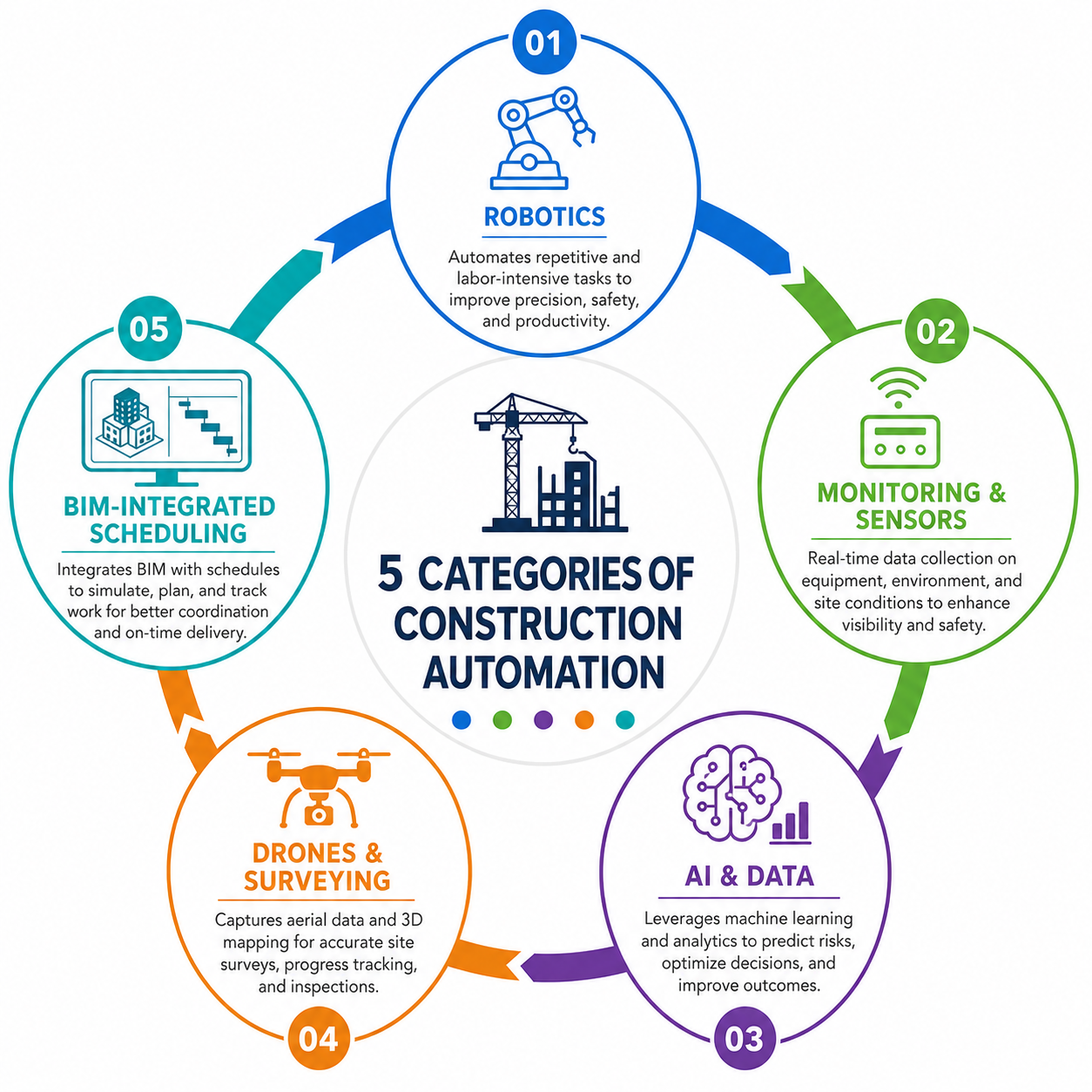
Automation Examples: Six Categories Active on Construction Sites
The most useful way to catalogue automation examples in construction is by functional category — what job the system is actually doing. Six categories currently account for the majority of deployed automation on civil engineering projects globally, and each has clear application potential for the Nigerian and West African market.
1. Robotic Construction Equipment
Robotic systems are the most visible automation examples on a construction site. SAM100 (Semi-Automated Mason), developed by Construction Robotics, can lay up to 3,000 standard bricks per day — roughly six to eight times the output of a skilled mason, with consistent mortar joint thickness. Hadrian X, the Australian robotic bricklaying system developed by FBR Ltd, works from a 3D CAD file and can complete the external brick envelope of a house in under three days.
In the structural sector, automated rebar tying robots — including systems from TyBOT, deployed on bridge deck construction in North America and the Middle East — tie reinforcement intersections at a rate of approximately 1,000 ties per hour, replacing a task that is repetitive, physically demanding, and prone to inconsistency. In environments where rebar placement must conform to BS 4449 tolerances, consistency is not a minor gain — it directly affects structural integrity at the connection points.
Concrete placing robots are now used in tunnel construction and precast manufacturing. Putzmeister’s automated concrete distribution systems, for example, can operate in confined space environments where manual placing would require extended shift rotations under hazardous conditions. This has direct relevance for underground civil works, including drainage tunnels and cable conduit systems being developed in Nigerian cities.
For firms exploring this area further, the guide to robotics in construction engineering covers the full range of deployed robotic systems and their cost-benefit profiles in more detail.
2. Autonomous Surveying and Drone Systems
Unmanned aerial vehicles (UAVs) equipped with LiDAR or photogrammetric cameras represent one of the most mature automation examples in the industry. A drone survey covering 50 hectares of difficult terrain — the kind of site that might take a traditional survey crew two weeks — can be completed in a single day to an accuracy of ±10 to 30mm depending on the ground control point network deployed.
On road construction projects, automated drone surveys generate point clouds that feed directly into design software, comparing actual earthwork volumes against design grades without manual measurement. This eliminates one of the most common sources of dispute on civil contracts: disagreements over excavated volumes and payment quantities.
Autonomous total stations, such as Trimble’s SPS series, track prism targets automatically and log displacement data continuously, without a surveyor at the instrument. On dam construction, retaining wall monitoring, or high-rise foundation work in areas with compressible soils — a frequent challenge in Lagos Island, for instance — continuous automated monitoring catches settlement events that weekly manual surveys would miss entirely.
3. Building Information Modelling Integrated with Automated Scheduling
BIM-linked project management platforms represent a category of automation that operates largely in the project management layer rather than on the physical site. Systems like Autodesk Construction Cloud and Procore can auto-generate updated programmes based on daily progress inputs, flagging critical path delays before they compound into cost overruns.
When a BIM model is linked to a construction programme, automated clash detection identifies conflicts between structural, mechanical, and electrical elements before they reach site — a process that previously required a coordination meeting, manual overlay drawings, and multiple revision cycles. Automated clash detection on a complex building project can identify thousands of clashes in minutes, each one representing potential rework if it reached construction stage.
The BIM guide for civil and structural engineering projects explains how these workflows operate from procurement through to handover, including the data standards and model management protocols that make automated coordination reliable.
4. Concrete and Materials Monitoring Automation
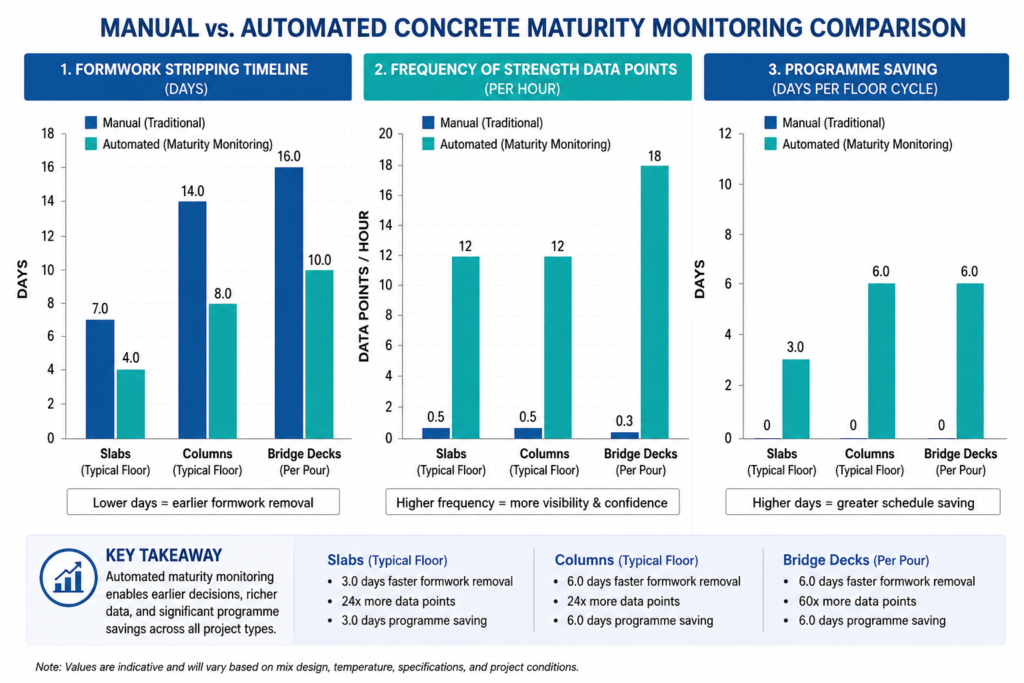
Embedded sensor technology for concrete monitoring is an automation example that is often underestimated. SmartRock sensors (Maturix), Giatec’s COMMAND Centre, and similar systems embed wireless maturity sensors in fresh concrete pours. These sensors transmit temperature and strength gain data in real time, allowing engineers to make formwork stripping decisions based on actual in-situ strength rather than conservative waiting periods derived from cube test schedules.
On a large infrastructure project, the difference between stripping formwork at 72 hours (based on a maturity sensor reading confirming the required 75% of characteristic strength) versus waiting the standard 7-day cube result can shorten a floor cycle by two to three days. On a multi-storey structure with 20 or 30 floor cycles, the programme saving is material. This is automation directly reducing project duration and financing cost — quantifiable benefits that project owners and lenders can price.
Automated batching plants take this further at the production end. A computer-controlled batching plant maintains aggregate moisture compensation automatically — adjusting water additions to account for changes in aggregate surface moisture — producing concrete to tighter water-cement ratio tolerances than manually supervised batching. This matters particularly for structural concrete mixes where durability requirements are linked to w/c ratio limits specified under BS 8500.
5. Digital Twins and Real-Time Site Intelligence
A digital twin is a continuously updated virtual replica of a physical asset or site, fed by sensor data, drone surveys, and IoT-connected equipment. In the context of construction automation examples, digital twins represent the highest level of integration — a system where data from multiple automated sources is unified into a single operational picture.
On infrastructure projects, a digital twin of a bridge under construction might integrate: automated settlement monitoring from total stations, concrete strength data from embedded sensors, daily drone-derived progress updates, and weather station data — all referenced against the design BIM model. Project managers review a single dashboard rather than coordinating data from five separate systems.
The practical value is not in the technology itself but in the decisions it enables. Automated alerts trigger when monitoring data exceeds pre-set thresholds — say, a pier settlement exceeding 5mm per week — without requiring an engineer to review raw survey data manually. The guide to digital twins in construction examines how these systems are being deployed on infrastructure projects and what the implementation requirements look like for a consultancy or contractor entering this space.
6. Prefabrication and Off-Site Manufacturing Automation
Automated precast manufacturing is one of the most economically compelling automation examples in the structural engineering sector. Precast concrete factories using carousel production systems — where formwork circulates through automated concrete casting, vibration, curing, and demoulding stations — achieve dimensional tolerances of ±2mm on structural components, against the ±5mm typically achieved in careful site casting.
Automated CNC fabrication of structural steelwork — drilling, cutting, and fitting preparation — is standard practice in modern steel fabrication shops. A CNC plasma cutter working from an IFC file produced by a structural engineer can fabricate complex connection plates to sub-millimetre accuracy in a fraction of the time required for manual marking and cutting.
Modular construction, which depends on prefabricated volumetric units assembled on site, relies heavily on factory automation to achieve the dimensional consistency that makes assembly viable. This is directly relevant to Nigeria’s housing deficit challenge — factory-produced modular units could be assembled faster and with less skilled site labour than conventional construction, provided the supply chain infrastructure exists to support delivery and lifting operations.
Where Automation Examples Are Being Applied: Real Projects
Theory is straightforward. What does deployment actually look like?
The Crossrail project in London — now the Elizabeth line — used a digital monitoring system integrating over 5,000 sensors across the tunnel network, providing automated displacement and vibration alerts during tunnelling works adjacent to existing foundations. Settlement thresholds were set, and exceedances triggered automatic notifications to the geotechnical team without manual data review. This is structural monitoring automation at infrastructure scale.
In the Middle East, Bechtel’s construction operations on major infrastructure programmes in Saudi Arabia have incorporated drone surveying as standard practice, with daily photogrammetric flights generating progress reports automatically compared against the baseline schedule. Quantity variances exceeding 5% trigger review flags without a quantity surveyor manually processing measurement data.
In Nigeria, adoption is earlier-stage but accelerating. Large contractors on federal road contracts under the Federal Ministry of Works have begun using GPS-guided grader and compactor systems that maintain design levels without a grader operator manually chasing pegs — a direct application of machine control automation that reduces rework on earthworks to near zero when properly implemented. The economic case is strong: rework on earthwork grading can represent 15–20% of plant costs on a project without machine control.
Understanding the broader principles of automation in civil engineering provides essential context for evaluating which systems are appropriate for a given project type and budget.
Common Challenges When Implementing Automation on Construction Projects
Knowing the automation examples is the easy part. Getting them onto a project and delivering the expected return is harder. Several challenges appear consistently across construction automation implementations, and understanding them is the difference between a successful deployment and an expensive trial that gets shelved after six months.
Data integration failure is the most frequent cause of poor automation outcomes. Many construction sites run multiple automated systems — a drone surveying platform from one vendor, a concrete monitoring system from another, a BIM coordination platform from a third — that do not communicate with each other. The result is islands of data that engineers still have to manually reconcile, defeating much of the time-saving purpose. Before procuring any automation system, verify its open API compatibility and data export format against the project’s master data environment.
Operator capability gaps present a significant constraint in the Nigerian construction market. An automated total station sitting on a monitoring pillar is only useful if someone understands how to configure the alert thresholds, interpret the displacement vectors it is reporting, and distinguish sensor drift from real structural movement. Automation does not remove the need for engineering judgment — it relocates where that judgment is applied. Training investment must accompany technology investment, or the system will be switched off within weeks.
Cost versus contract structure misalignment is a structural problem in infrastructure procurement. Nigerian public sector contracts frequently price construction work on bill of quantities bases with tight margins, leaving no room for a contractor to invest in automation that saves time but requires capital expenditure not priced into the bill. Design-and-build or outcome-based contracts create better incentives for automation adoption because the contractor captures the efficiency savings.
Power and connectivity reliability affects field automation specifically. IoT-connected sensor systems, drone charging stations, and cloud-based BIM platforms all depend on consistent power and data connectivity. On remote highway projects or sites outside urban fibre networks, these dependencies require satellite connectivity solutions or local server infrastructure — adding cost and complexity that must be planned at the project setup stage.
Regulatory acceptance is an emerging issue. COREN and the relevant standards bodies have not yet published specific guidance on the acceptance of automated monitoring data as the primary evidence base for structural decisions — in the way that, for example, BS EN 13670 governs concrete conformity. Engineers using automated systems need to document their methodology carefully so that monitoring outputs are legally defensible if a structural dispute arises.
Best Practices for Adopting Automation in Your Engineering Projects
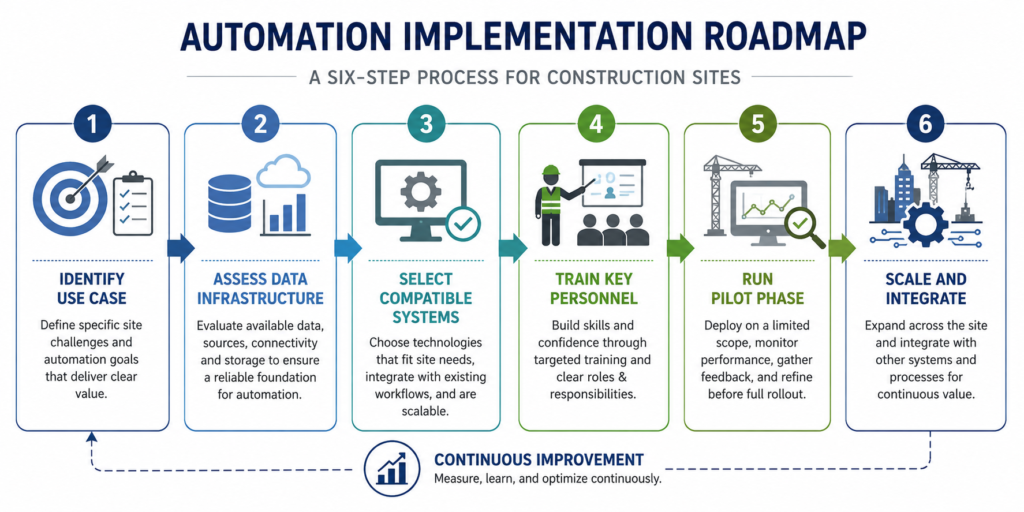
Getting automation right on a construction project is less about picking the most advanced technology and more about matching the right system to the right problem with the right preparation. The following practices reflect what successful implementations share in common.
Start with one use case and prove it. Firms that attempt to automate five processes simultaneously typically succeed at none of them. Identify the single highest-impact pain point on your projects — unreliable earthwork volumes, inconsistent concrete quality, or late progress reporting — and deploy one automation system to address it specifically. Measure the outcome. Then expand.
Define your data outputs before buying hardware. What report, dashboard, or decision does this automation system need to produce? Work backwards from that output to specify the system. A drone survey platform that cannot export to the survey software your project team uses creates more work, not less.
Require open data standards in contracts. When procuring automation technology — or writing subcontracts that involve it — specify that all data outputs must conform to open standards: IFC for BIM data, LandXML for survey and earthworks, CSV or JSON for sensor outputs. Proprietary lock-in is the enemy of integration.
Assign a named data manager on every project. Automation systems generate information continuously. Without someone responsible for reviewing, quality-checking, and acting on that information, it accumulates unread. A data manager does not need to be a senior engineer — a technically capable graduate with defined responsibilities and clear escalation protocols can fill this role effectively.
Build automation costs into preliminary estimates. If your project team is pricing a contract where automation would be beneficial, quantify the cost — hardware, software licences, training, connectivity — and include it in the project budget from the outset. Automation costs added retrospectively almost always get cut.
Establish threshold-based alert protocols in writing. For monitoring automation specifically, document in the project’s monitoring plan what alert levels are set, who receives notifications, and what action each alert level triggers. This is not just good practice — it is the paper trail that demonstrates professional due diligence if a structural event occurs.
For a broader framework on how these systems fit within project delivery, the construction automation implementation guide provides a full workflow from project assessment through to post-construction review.
Frequently Asked Questions About Automation
Q: What are the best examples of automation in civil engineering?
A: The most impactful automation examples in civil engineering include GPS machine control for earthworks grading (reducing rework by up to 20%), embedded concrete maturity sensors that allow formwork stripping decisions based on actual in-situ strength, drone-based topographic surveys accurate to ±10–30mm, automated total stations for continuous structural monitoring, and BIM-integrated scheduling platforms that auto-update construction programmes based on daily progress data. Each addresses a specific inefficiency that recurs across most large civil projects.
Q: How does automation work on a construction site?
A: Construction site automation works at three levels. At the field level, physical systems — robotic equipment, sensors, drones — collect data or perform tasks without direct human control at the moment of execution. At the data level, automated systems process and transmit that information to project management platforms or engineering analysis tools. At the decision-support level, algorithms flag anomalies, generate alerts, or update schedules based on the incoming data. The engineer still makes final decisions, but the information reaching them is faster, more frequent, and more reliable than manual collection would produce.
Q: What is the difference between automation and robotics in construction?
A: Robotics is a subset of automation. All construction robots are automated systems, but not all automation involves robots. A robotic bricklaying system is both automated and robotic — it uses a physical machine with articulated movement. An automated concrete batching plant is automated but not robotic — it uses controlled valves, conveyors, and weighing systems rather than articulated mechanical arms. Automation covers any system that reduces human intervention; robotics specifically involves programmable mechanical systems that carry out physical tasks.
Q: How much does construction automation cost to implement?
A: Costs vary significantly by system type. A commercial drone survey platform with photogrammetry software costs between $15,000 and $40,000 for hardware and annual licences. A concrete maturity sensor system for a single project costs $2,000–$8,000 depending on sensor count. GPS machine control for a grader or compactor typically runs $20,000–$50,000 per machine. Full robotic systems like automated bricklaying are substantially higher — $500,000 and above — and are typically cost-effective only on very large or highly repetitive projects. For most civil engineering firms, the entry point is survey automation or monitoring sensors, both of which offer short payback periods against the labour and rework costs they replace.
Q: Is automation being used in Nigerian construction projects?
A: Adoption is growing, particularly on federal infrastructure projects and commercial real estate developments in Lagos and Abuja. GPS machine control is in active use by several leading earthworks contractors on highway projects. Drone surveying has been adopted by consultancies handling large-scale mapping and infrastructure inspection contracts. BIM-integrated project management platforms are standard on projects with international contractors or development finance institution funding, where reporting requirements mandate digital workflows. The constraint in Nigeria is less technological — the tools are available — and more about procurement structures, connectivity infrastructure, and investment in staff capability.
Applying Automation Examples to Your Projects
The automation examples covered in this article — robotic equipment, drone surveying, BIM-integrated scheduling, concrete maturity monitoring, digital twins, and precast manufacturing automation — represent systems that are deployed, tested, and delivering measurable outcomes on live projects. None of them require a construction firm to fundamentally change how it works. Each can be introduced as a targeted intervention in the area where the return is clearest.
The practical starting point is an honest assessment of where your current projects lose time, money, or quality through manual processes that automation could improve. Earthwork volumes disputed at final account? Machine control pays for itself quickly. Formwork cycles constrained by conservative cube test programmes? Concrete maturity sensors offer an immediate programme gain. Progress reporting dependent on a weekly site visit? Drone photogrammetry changes that dynamic entirely.
Automation in construction is not a single technology decision — it is a series of specific, targeted choices that compound over time into a measurably more efficient delivery capability. StruviaCore works with engineering firms and project owners to identify and implement the automation solutions that fit their project types, budget realities, and team capabilities. Learn more about what automation means for civil engineering practice or contact the StruviaCore team directly to discuss your project requirements.
Leave a Reply