

A bridge built in 2026 looks very different from one designed a decade ago — not just aesthetically, but structurally, materially, and operationally. Across Africa, Asia, Europe, and the Americas, the profession is navigating a confluence of pressures: ageing stock that needs replacement or rehabilitation, climate events stressing structures beyond their original design parameters, tightening carbon budgets, and a generation of engineers who grew up with BIM as standard practice. The result is a measurable shift in how bridge projects are conceived, delivered, and managed over their entire service life.
This article covers the dominant bridge trends in 2026 — from structural system choices and materials to digital monitoring, sustainability targets, and the regulatory context shaping procurement decisions globally. Whether you are a graduate engineer trying to understand where the profession is heading or a project director evaluating options for a new crossing, what follows gives you a clear-eyed account of the forces driving change.
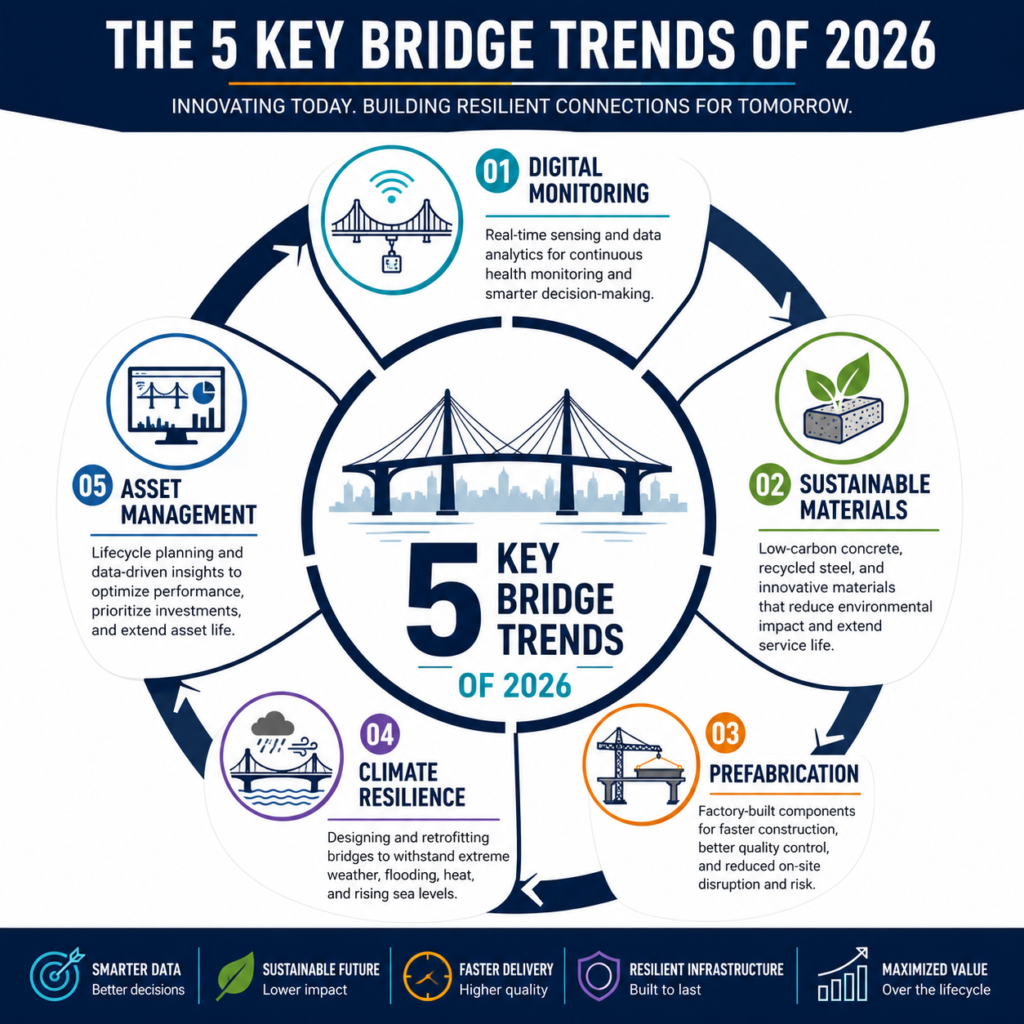
Bridges Trends 2026: Quick Answer
Bridge trends in 2026 are defined by five converging shifts: accelerated adoption of digital twin monitoring, widespread use of ultra-high-performance concrete and low-carbon steel, modular and prefabricated superstructure systems, climate resilience requirements embedded in design standards, and expanded use of structural health monitoring under asset management frameworks. These changes affect new construction and the rehabilitation of existing stock equally.
The Structural Systems Driving Modern Bridge Design
Bridge design in 2026 continues to be shaped by the tension between span efficiency, constructability, and whole-life cost. Certain structural systems are gaining ground precisely because they address all three simultaneously.
Cable-stayed bridges remain the preferred solution for medium-to-long spans in the 200m–600m range, not because the typology is new, but because advances in stay-cable systems — particularly parallel wire strands encased in high-density polyethylene (HDPE) sheathing with corrosion-inhibiting grease — have extended anticipated service lives to 100 years with manageable replacement strategies. The iconic Lekki-Epe Expressway bridges in Lagos are representative of this confidence in cable-stayed systems in high-humidity coastal environments, where corrosion management is a principal design driver.
For shorter spans, integral abutment bridges have seen a steady increase in adoption globally. By eliminating expansion joints and bearings — historically the most maintenance-intensive components of a bridge — integral construction reduces whole-life maintenance costs by 20–35% compared to conventional jointed decks, based on data from UK Highways England whole-life cost studies. The trade-off is more demanding geotechnical design at the abutments, since thermal movements are transferred directly into the soil.
The Rise of Post-Tensioned Concrete Box Girders
Post-tensioned concrete box girders continue to dominate medium-span highway bridges in the 40m–120m range across Africa, the Middle East, and Southeast Asia. The structural efficiency of the closed box section — with high torsional stiffness and favourable shear flow characteristics — makes it well-suited to curved alignments and unequal spans typical of interchange structures. In Nigeria, projects procured under the Federal Ministry of Works have increasingly specified balanced cantilever construction for box girder bridges over active waterways, avoiding false work in tidal zones.
Designers are now routinely analysing these structures using creep and shrinkage models consistent with Eurocode 2 (EN 1992-2) as the basis for time-dependent deflection calculations, with BS EN 1337 specifying bearing requirements. The growing body of instrumented long-term monitoring data on in-service box girders is refining our understanding of real-world creep coefficients compared to code predictions — an area where research is actively updating design guidance.
Hybrid Steel-Concrete Systems
Composite deck bridges — steel girders acting compositely with a reinforced concrete slab — remain standard in UK and European highway practice, and are being increasingly adopted in West and East Africa as fabrication capacity improves. The 2026 refinement is the more sophisticated treatment of shear connection design, particularly at points of contraflexure, where EN 1994-2 guidance has been updated to reflect test evidence on partial interaction under fatigue loading. For a 60m composite bridge, the optimised shear connector arrangement can reduce deck slab cracking risk by a material margin, extending maintenance intervals from 10 to 25 years in moderate exposure environments.
For a deeper grounding in how these structural choices sit within the broader discipline, the structural engineering guide on StruviaCore provides the relevant technical context.
Digital Twins and Structural Health Monitoring
If one development defines bridge engineering in 2026 more than any other, it is the operationalisation of structural health monitoring (SHM) as a routine asset management tool rather than a research activity. Ten years ago, a permanently instrumented bridge was notable. Today, on major infrastructure programmes across the UK, UAE, and increasingly Nigeria, a bridge without a sensor network is the exception worth noting.
SHM systems typically integrate strain gauges, accelerometers, displacement transducers, and corrosion potential probes linked to edge computing nodes that filter raw data before transmission to cloud-based platforms. The real value is not the raw sensor data — it is the integration of that data with a calibrated finite element model to create a digital twin that reflects the structure’s actual condition, not its designed condition. When a digital twin flags that measured natural frequencies have dropped by more than 5% from baseline, that triggers an inspection rather than waiting for a scheduled 2-yearly walkover.
The UK’s PAS 55 Asset Management standard and its successor, ISO 55000, have embedded this shift institutionally. Network Rail’s bridge management procedures now mandate digital twin development for structures above 30m span on the managed estate. In the Nigerian context, COREN-registered practitioners working on federally funded crossings are increasingly required to produce asset management plans that include monitoring provisions, reflecting international alignment in procurement documents.
Cost has come down substantially. A basic SHM installation for a single-span highway bridge — covering strain, temperature, and dynamic response — can be delivered for under £45,000 including sensors, data acquisition hardware, and first-year cloud hosting. That compares favourably with the cost of a single principal inspection, estimated at £12,000–£25,000 per inspection cycle, which the sensor data can either replace or better target.
The StruviaCore guide to digital twins in engineering explores the underlying technology and its applications across infrastructure sectors.

Materials Innovation: UHPC, Low-Carbon Steel, and FRP
The materials palette available to bridge engineers in 2026 is meaningfully wider than a decade ago, and the profession is beginning to move beyond pilot projects into mainstream procurement.
Ultra-High-Performance Concrete (UHPC) — with compressive strengths of 150–250 MPa, tensile capacities exceeding 8 MPa, and fibre reinforcement that eliminates conventional bar reinforcement in some applications — has moved from research curiosity to specified solution on bridge deck panels, connection joints, and overlay rehabilitation systems. Its extremely low permeability (chloride diffusion coefficients typically below 0.02 × 10⁻¹² m²/s compared to 3–5 × 10⁻¹² m²/s for conventional C40 concrete) makes it the preferred material for marine and coastal bridge substructures in chloride-rich environments such as Lagos Island crossings and coastal port approaches.
Low-carbon and recycled-content structural steel is another significant shift. The embodied carbon of a conventional bridge steel section sits at approximately 1.46 kgCO₂e per kg. By specifying steel produced via electric arc furnace (EAF) routes using recycled scrap, engineers can reduce that figure to 0.4–0.7 kgCO₂e per kg — a reduction of 50–70% in steel-related embodied carbon. On a 100m composite bridge with 400 tonnes of structural steel, that difference amounts to approximately 300–400 tonnes of CO₂e avoided. With clients facing mandatory scope 3 carbon reporting under evolving ESG frameworks, specifiers are under real commercial pressure to make this switch where the supply chain supports it.
Fibre-Reinforced Polymer (FRP) composites — glass, carbon, and basalt fibre variants — are increasingly used for bridge deck panels, parapet systems, and vehicle restraint systems where corrosion elimination is the primary driver. The maintenance-free service record of FRP decks on several UK canal and footbridge crossings over 15+ years is influencing procurement decisions on highway structures, despite the higher initial material cost. Per-metre costs for FRP deck panels range from £450–£900/m² installed, compared to £120–£200/m² for conventional reinforced concrete decking, but the whole-life arithmetic shifts when maintenance costs over a 60-year period are modelled.
For further context on how material selection integrates with structural performance, see the sustainable materials guide covering low-carbon construction alternatives.
Climate Resilience: Designing for Extreme Events
The climate context for bridge engineering in 2026 is no longer theoretical. Observed increases in peak flood discharges across West Africa — with some river basins recording 1-in-100-year events at recurrence intervals now closer to 1-in-20 years — mean that bridges designed under historical hydrological records are undersized. This is a documented finding, not a projection.
The practical consequence is that hydraulic loading has become as consequential as structural loading in many bridge design briefs. Scour — the erosive removal of bed material around bridge foundations during flood events — remains the leading cause of bridge failure globally, accounting for approximately 60% of bridge collapses in the USA and a comparable proportion in West Africa based on reported failures over the past two decades. For a piled foundation in sandy alluvial soils typical of the Niger Delta, scour depths of 3–5m below the general bed level during a design flood event are not unusual, and designs that fail to account for this are structurally deficient from the outset.
The updated BS EN 1997-1 (Eurocode 7) provisions on scour assessment, together with CIRIA C742 guidance on bridge scour risk assessment, now form the baseline for defensible scour analysis on UK-procured and internationally benchmarked projects. The methodology involves site-specific hydraulic modelling to determine peak scour depth, validated against empirical equations (Melville and Coleman, or HEC-18), followed by confirmation that founding levels sit below the calculated scour envelope with an appropriate margin.
Wind loading on long-span bridges in cyclone-affected regions is also receiving more rigorous treatment. The coastal zone of southern Nigeria and much of East Africa falls within wind speed contours that require aerodynamic analysis beyond the static equivalent approach, particularly for cable-stayed and suspension typologies. Section 2 of BS EN 1991-1-4 provides the wind action framework, and flutter analysis using computational fluid dynamics (CFD) is now standard practice on spans exceeding 200m.
Understanding the challenges that climate events and ageing infrastructure create for existing structures is covered in more depth in the bridges challenges article on StruviaCore.
Common Errors and Cost Drivers on Bridge Projects
Even as design sophistication increases, certain recurring errors continue to drive cost overruns and programme delays on bridge projects. Identifying them early — preferably at concept stage — is far more effective than managing their consequences during construction.
Underestimating ground investigation scope. Bridge substructure work is routinely the largest single cost variance item on a bridge project. A pier foundation that encounters unexpected rock at depth, or soft compressible deposits not identified in a minimal ground investigation, can add 15–25% to project cost. The minimum standard for a highway bridge is one borehole per foundation location to at least 1.5 times the proposed pile length, per BS 5930 guidance on site investigation. Projects that cut ground investigation budgets at feasibility stage consistently regret it.
Inadequate hydraulic assessment. As noted above, scour is the dominant failure mode globally. A desk study using published flood estimation handbooks — particularly the FEH statistical method for UK sites — is necessary but not sufficient for sites on any watercourse with a catchment area above 0.5 km². Two-dimensional hydrodynamic modelling (using packages such as TUFLOW or HEC-RAS 2D) gives a materially better picture of flow patterns at complex cross-sections.
Procurement of bearings and expansion joints too late. Bearing systems for medium-span bridges — pot bearings, spherical bearings, and elastomeric bearing pads — have lead times of 16–26 weeks when specified to BS EN 1337 with documented factory acceptance testing. Projects that leave bearing specification to detailed design stage regularly find themselves on the critical path waiting for components that were never procured early enough.
Insufficient fatigue assessment on steel elements. EN 1993-2 Chapter 9 mandates fatigue verification for road bridges regardless of anticipated traffic volume. Detail categories for welded connections directly influence the number of stiffeners and the geometry of connection plates — decisions that have real weight and fabrication cost implications. Treating fatigue as a check-box exercise at the end of design, rather than an input that shapes section proportioning, is a persistent error.
Poor drainage design on bridge decks. Water ponding on bridge decks accelerates surfacing deterioration and promotes chloride ingress into concrete parapet bases. A minimum longitudinal gradient of 0.5% and transverse crossfall of 2.5% is standard, with kerb outlets spaced at no more than 20m intervals per BD 30/87 / DMRB guidance. Drainage details are rarely glamorous enough to receive proper design attention, but their absence drives rehabilitation costs that can reach £50,000–£120,000 per lane kilometre of deck resurfacing.
Best Practices for Bridge Projects in 2026
The following checklist reflects current best practice across project phases. Apply it as a structured reference — not as a substitute for project-specific engineering judgement.
Feasibility and route selection:
- Commission a preliminary hydraulic study covering 1-in-100-year flood extent and indicative scour depth before committing to a foundation location — this shapes abutment setback distances and will influence land acquisition.
- Assess at least three structural typology options with order-of-magnitude whole-life cost comparison, including maintenance cost assumptions over a 60-year period.
- Identify any navigational clearance requirements early — minimum air draughts and channel widths on navigable waterways are set by port and waterway authorities and are non-negotiable once a crossing level is fixed.
Ground investigation and geotechnical design:
- Programme a Phase 1 geoenvironmental desk study to identify contamination risk, particularly on urban crossings or sites with industrial history.
- Specify rotary core boreholes to depth, not just cable percussive. Core recovery allows visual inspection of rock quality and enables point load testing and SPT correlation for founding in decomposed rock — common in the basement complex geology of central Nigeria and across East Africa.
- Request a geotechnical interpretive report (GIR) from the ground investigation contractor, not just a factual report. The GIR translates borehole data into foundation design parameters with stated uncertainties.
Detailed design:
- Model the structure in a BIM environment from Stage 2 (Concept Design) onwards, with the model forming the basis for clash detection with utilities, drainage, and road geometry — not as a retrospective documentation exercise.
- Specify bearing and expansion joint products, including movement ranges and load capacities, before design of bearing shelf details. The bearing drives the shelf geometry, not the reverse.
- Run a constructability review with the contractor at Stage 3 (Developed Design) on any falsework-intensive scheme. For in-water pier construction, temporary works design should be coordinated with permanent works at this stage, not left entirely to the contractor.
Construction and monitoring:
- Specify hold points for foundation inspection by the geotechnical engineer before concrete pour — particularly on spread footings where bearing capacity is confirmed by visual inspection of formation.
- Require concrete cube testing at a minimum frequency of one set per 50m³ placed, per BS EN 206 conformity criteria.
- Install SHM sensors at pour, not retrospectively. Embedding vibrating wire strain gauges in the pile cap and deck before concrete is placed costs a fraction of core drilling post-construction.

For a structured view of what bridge projects typically involve from initiation through to handover, the StruviaCore bridges guide provides the full-scope context.
Frequently Asked Questions About Bridges
Q: What are the main bridge construction trends in 2026?
A: The five most significant trends are: structural health monitoring and digital twin integration as standard practice on major crossings; specification of ultra-high-performance concrete (UHPC) for deck panels and substructure elements in aggressive environments; low-carbon and EAF-produced structural steel to meet embodied carbon targets; prefabricated and modular superstructure systems to reduce site time and improve quality; and climate-adjusted hydraulic and scour design to account for observed increases in flood frequency. These trends apply across both new construction and bridge rehabilitation programmes.
Q: What is a digital twin in bridge engineering?
A: A digital twin is a calibrated computational model of a physical structure that is continuously updated with real-time sensor data from a structural health monitoring system. For a bridge, the digital twin integrates strain, displacement, acceleration, and temperature readings with a finite element model, allowing engineers to track changes in structural behaviour over time. When the model detects deviations from expected response — such as a natural frequency reduction greater than 5% — it triggers targeted inspection rather than relying on fixed-interval walkover programmes. The ISO 55000 asset management framework has driven widespread adoption of this approach on major infrastructure.
Q: What is scour and why does it cause bridge failures?
A: Scour is the erosion of riverbed or estuary bed material around bridge piers and abutments during flood events, exposing and potentially undermining foundations. It is the single leading cause of bridge failure globally, responsible for approximately 60% of bridge collapses in the USA and significant failures across West Africa. The failure mechanism is loss of bearing capacity or lateral stability when scour depth approaches or exceeds the founding level of the substructure. Scour assessment uses site-specific hydraulic modelling combined with empirical methods (Melville and Coleman equations or HEC-18) to calculate the design scour depth, which must be cleared by the foundation’s founding level.
Q: What is ultra-high-performance concrete (UHPC) and when is it used on bridges?
A: UHPC is a cementitious composite with compressive strength between 150 and 250 MPa, containing steel or polymer fibres that provide post-cracking tensile capacity exceeding 8 MPa. Its extremely low permeability makes it well-suited to bridge applications where chloride ingress is the dominant durability threat — marine substructures, coastal bridge decks, and overlay rehabilitation systems on existing concrete decks. It is also used for precast deck panel connections in accelerated bridge construction (ABC) programmes, where the joint detail must develop full composite action in a small plan dimension. UHPC typically costs 3–5 times more per cubic metre than conventional C40/50 concrete, but material volumes are significantly reduced and reinforcement is often eliminated entirely.
Q: How does BIM change bridge design and construction?
A: Building Information Modelling on bridge projects delivers value primarily through clash detection, construction sequencing, and data management — not just geometric visualisation. A coordinated BIM model at Stage 3 identifies conflicts between structural steelwork, prestressing tendons, drainage pipework, and utility crossings before they become site instructions, typically reducing variation orders by 15–20% on well-managed projects. In procurement, BIM models provide the asset data that feeds SHM and whole-life asset management systems from day one of operation, rather than requiring data capture retrospectively from drawings.
Where Bridge Engineering Goes From Here
The bridge trends of 2026 are not a break from engineering fundamentals — they are an evolution of them. The physics of bending, shear, torsion, and dynamic response has not changed. What has changed is the quality of data available to engineers designing and managing these structures, the material options capable of meeting durability and carbon targets simultaneously, and the regulatory and client expectations framing what an acceptable design looks like.
Climate events, asset age, and urban growth will continue to drive demand for new crossings and major rehabilitation works globally. Engineers who understand both the technical substance of these trends and the standards framework underpinning them will be better positioned to deliver projects that perform across their full design life rather than merely passing the immediate procurement hurdle.
If you are working on a bridge feasibility study, rehabilitation assessment, or a new crossing that requires independent structural review, StruviaCore’s civil and structural engineering team provides expert support from concept through to construction monitoring. Contact us to discuss how we can assist on your project.
Leave a Reply