
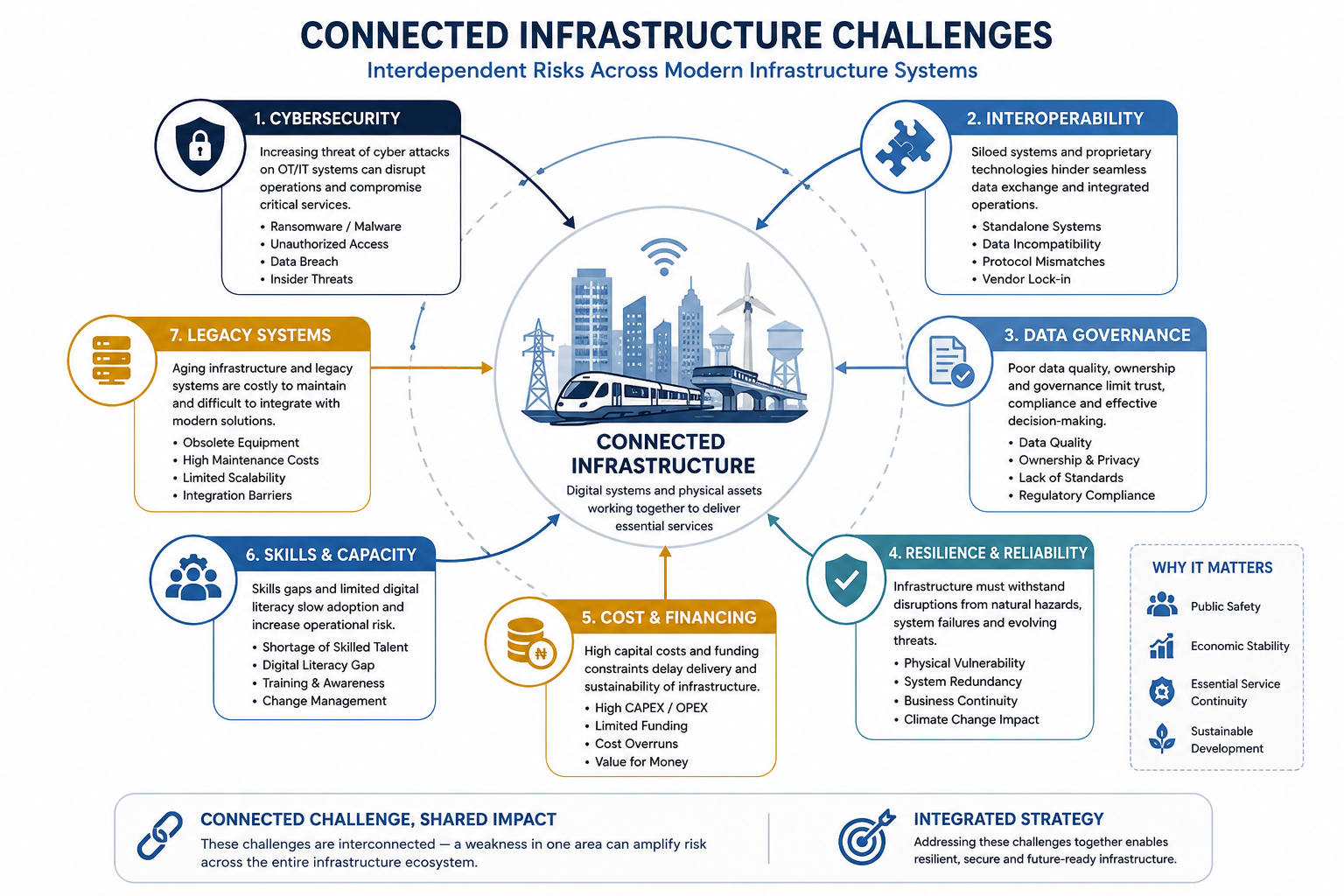
A water utility in a mid-sized city installs 40,000 smart meters over eighteen months. Within a year, three separate vendor platforms cannot exchange pressure data with the SCADA system that runs the pumping stations, and the utility’s IT team discovers that half the meter firmware has no patching path at all. This is not a hypothetical. It is the pattern that repeats across roads, rail, water, and power networks whenever connected infrastructure moves from pilot project to citywide deployment. The promise is real — sensors that flag a failing bridge bearing before it cracks, traffic signals that respond to actual flow rather than fixed timers — but the connected infrastructure challenges that come with it are structural, not incidental. This article sets out what those challenges are, why they recur across sectors, and how engineering teams in the UK, UAE, and West Africa are addressing them in live projects.
Connected infrastructure challenges: Quick Answer
Connected infrastructure challenges are the technical, financial, and governance obstacles that arise when physical assets — roads, water networks, buildings, power grids — are fitted with sensors and networked control systems. The core issues are cybersecurity exposure, interoperability between vendor platforms, unclear data ownership, high retrofit cost, and a shortage of engineers who understand both civil systems and networked technology.

What Connected Infrastructure Actually Means
Connected infrastructure is physical infrastructure — bridges, water mains, substations, traffic corridors — instrumented with sensors, actuators, and communication links so that condition data flows to a control system in near real time. A traditional culvert has no data output beyond what an inspector records on a site visit. A connected culvert carries a water-level sensor reporting to a flood-monitoring platform every five minutes. The distinction matters because it changes what an engineer is responsible for: not just the concrete and steel, but the sensor network, the data pipeline, and the software that turns readings into decisions.
Three layers make up any connected infrastructure system. The physical layer is the asset itself — the bridge, the pipe, the substation. The sensing and communication layer covers the devices that measure condition (strain gauges, flow meters, vibration sensors) and the network that carries readings back — often a mix of cellular IoT, LoRaWAN, or fibre depending on asset location. The analysis and control layer is where readings become alerts, dashboards, or automated actions, such as a valve closing when pressure exceeds a threshold.
Why the Layered Model Matters for Design
Most connected infrastructure challenges originate at the boundary between layers, not within a single layer. A sensor can be correctly specified and a control system correctly programmed, and the project can still fail if the communication layer between them was not designed for the site’s actual radio environment. Engineers who treat connected infrastructure as three separate procurement packages — hardware, network, software — routinely find the packages do not fit together on delivery.
Where This Shows Up in Practice
On a rail electrification project in the UK, track circuit sensors reported correctly in isolation testing but failed intermittently once 400 units were live, because the cellular network could not sustain the aggregate data rate during peak reporting windows. The fix required renegotiating the data plan and reducing reporting frequency for non-critical sensors — a lesson that belongs in the design brief, not the commissioning report.
The Core Connected Infrastructure Challenges
Five challenge categories account for most of the friction in connected infrastructure projects: cybersecurity, interoperability, data governance, cost, and skills. Each deserves separate treatment because the mitigation for one does not solve another.
Cybersecurity Exposure
Every sensor added to a physical asset is a network endpoint, and every network endpoint is a potential attack surface. A 2023 water utility case in the United States demonstrated the risk clearly: attackers gained access to a SCADA interface through an unpatched remote access tool and briefly altered chemical dosing at a treatment plant. The equivalent risk exists wherever a pumping station, traffic signal controller, or substation relay is connected without segmented networks and enforced patching. Engineers specifying IoT devices for infrastructure should require, at minimum, encrypted communication, unique device credentials (not shared factory defaults), and a documented firmware update path with a defined end-of-support date.
Interoperability Between Systems
Cities and utilities rarely buy one vendor’s complete stack. A traffic management authority might run signal controllers from one supplier, CCTV analytics from another, and a parking sensor network from a third. Without a common data standard — such as MQTT for messaging or OGC SensorThings for spatial data — these systems store information in incompatible formats, and integration becomes a custom software project for every new vendor added. This is the single most common cause of connected infrastructure projects stalling after the pilot phase: the pilot works because it involves one vendor, and the citywide rollout fails because it involves five.
Data Ownership and Governance
A sensor mounted on a public bridge or a private developer’s pumping station generates a data stream, and someone has to own it. On many projects, ownership is never written down: the sensor supplier retains the data by default because their platform hosts it, the asset owner assumes they own it because they paid for installation, and the local authority assumes it owns anything generated on public land. This ambiguity surfaces at the worst possible moment — when a supplier’s contract ends and the asset owner discovers that historical condition data, sometimes years of it, sits on a platform they no longer have access to. Data governance for connected infrastructure should specify, in the contract, who owns raw sensor readings, who owns derived analytics, how long data is retained after contract termination, and in what format it can be exported. Absent that clause, switching suppliers means starting the monitoring history from zero.
Workforce and Skills Gap
Civil and structural engineering training rarely covers network protocols, device provisioning, or data pipeline architecture, and IT departments rarely understand load ratings, settlement, or the consequence of a false sensor reading on a live structure. Connected infrastructure sits in the gap between these two professions, and few organisations have staff fluent in both. The practical consequence shows up at design review: a structural engineer specifies a sensor without accounting for its communication range limitations, or a network engineer designs a communication architecture without understanding that a bridge expansion joint moves the sensor’s mounting point by several millimetres under thermal load — enough to affect a poorly specified strain gauge. Closing this gap requires deliberate pairing of disciplines at concept design stage, not a training course delivered after the system is already specified.
Regional Context and Regulatory Considerations
In the UK, connected infrastructure projects touching public assets fall under the Network and Information Systems Regulations for operators of essential services, and any structural monitoring system feeding into asset management decisions should align with BS ISO 55000 for asset management and, where structural sensors inform maintenance intervals, with the Eurocodes governing the structure itself. CDM 2015 continues to apply to the installation works, even where the deliverable is a sensor network rather than a structural element — cabling, access, and working-at-height risks do not disappear because the equipment is electronic.
In the UAE, smart infrastructure rollouts in Dubai typically sit within frameworks coordinated by Dubai Municipality and, for specific sectors, the Roads and Transport Authority’s own technology standards. Projects connecting to municipal networks generally require data-sharing agreements specifying who owns sensor data generated on public assets — a point that is frequently left unresolved until late in the project and causes delay at handover.
In Nigeria and wider West Africa, connected infrastructure work sits within the professional oversight of COREN for the engineering scope and NCC guidance where telecommunications spectrum is involved, particularly for projects using licensed cellular bands for IoT backhaul. NESREA’s environmental compliance requirements apply where sensor installation involves excavation or works near water bodies, which is common for flood-monitoring and water network projects in Lagos and Port Harcourt. Power reliability is a design constraint here that rarely appears in UK or UAE briefs: sensor nodes intended for continuous monitoring need battery or solar backup sized for realistic grid downtime, not the theoretical uptime quoted by the local utility.
Cellular coverage also varies more within a single Nigerian state than it does across an entire UK county, and a connectivity survey at the specific installation points — not a general coverage map — should precede any sensor procurement decision in Lagos, Abuja, or Port Harcourt. A design that assumes uniform 4G coverage across a flood-monitoring network spanning several drainage catchments will produce dead zones the moment installation begins, and retrofitting a LoRaWAN gateway after the fact costs more than specifying one from the outset. Projects that budget a site-specific connectivity survey as a discrete line item, rather than assuming national coverage figures apply locally, avoid this failure mode.
Cost Factors and Common Mistakes
Connected infrastructure budgets consistently underestimate three line items: network connectivity fees over the asset’s operating life, sensor replacement cycles, and integration labour. A sensor with a five-year rated battery life in a laboratory setting frequently returns two to three years in field conditions where temperature swings, moisture ingress, or vandalism shorten the interval. Budgeting for a single procurement of sensors without a replacement reserve is the most common cost mistake on public-sector connected infrastructure projects.
Retrofit cost is consistently higher than new-build integration. Installing structural health monitoring sensors on an existing bridge — drilling mounting points, running cable conduit, and integrating with an existing SCADA system built a decade earlier — costs more per sensor than specifying the same monitoring package into a new structure’s design from the outset. Clients comparing retrofit quotes against new-build sensor costs are often comparing figures that are not equivalent, and this mismatch drives disputes at tender stage.
A further cost factor is often missed entirely: the cost of doing nothing. A pumping station without pressure monitoring that fails without warning can cost a utility far more in emergency repair and service interruption than the monitoring system would have cost over its full operating life. Engineers building the business case for connected infrastructure investment should quantify this counterfactual explicitly rather than treating monitoring as a discretionary add-on.
Procurement teams also tend to compare hardware unit cost across suppliers without normalising for total cost of ownership, which includes data plan fees, cloud hosting charges, and the labour required to maintain the analytics platform. A sensor priced 15% below a competitor’s unit but locked to a proprietary cloud platform with per-device monthly fees can cost more over a ten-year asset life than the higher-priced sensor with an open data export path and a one-time licence fee. Building a simple ten-year total cost of ownership model at tender stage — hardware, connectivity, hosting, and integration labour combined — surfaces these differences before contract award, when they are still negotiable.
Best Practices for Managing Connected Infrastructure Challenges
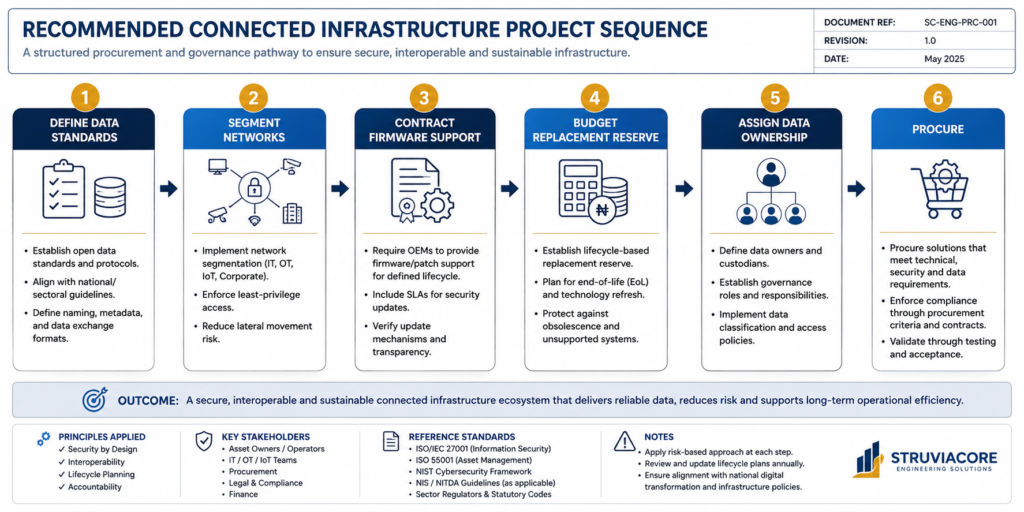
You reduce the risk of connected infrastructure projects stalling by applying a small number of disciplines consistently across procurement, design, and operation. The following sequence reflects what has worked on delivered projects rather than theoretical best practice.
- Specify data standards before selecting vendors. Decide on the messaging protocol and data schema the system must support, then evaluate vendors against that requirement — not the reverse.
- Separate operational technology networks from corporate IT networks. Segmentation limits how far a breach on one side can spread to control systems on the other.
- Write firmware update obligations into the contract. A supplier commitment to patch for five years is worth writing down; a verbal assurance is not.
- Budget a sensor replacement reserve at 20–25% of initial hardware cost per year. This figure reflects observed field failure rates rather than manufacturer specification sheets.
- Assign data ownership in writing before installation begins. Determine who owns readings generated on public assets, who can access them, and how long they are retained.
On the skills side, the practical fix is pairing, not retraining from zero. Structural and civil engineers do not need to become network engineers; they need enough working knowledge of IoT communication and data pipelines to specify systems correctly and to ask suppliers the right questions at design review. Pairing a structural engineer with a systems integrator at the concept design stage, rather than bringing network expertise in only at commissioning, catches interoperability and cybersecurity issues while they are still cheap to fix.
Governance discipline matters as much as technical discipline. A steering group that includes the asset owner, the network integrator, and the maintenance team — meeting at each design milestone rather than only at project kickoff and handover — catches the gaps that a purely technical review misses, such as who answers an alert at 2am or which team owns the budget for firmware updates three years after installation. Projects that treat connected infrastructure as a one-time capital purchase, rather than an ongoing operational commitment with a named owner, are the ones where sensors go dark within eighteen months and nobody notices until an asset fails.

Frequently Asked Questions About Connected Infrastructure
Q: What is connected infrastructure in civil engineering?
A: Connected infrastructure refers to physical civil assets — roads, bridges, water networks, power substations — fitted with sensors and communication systems that report condition or performance data to a control platform in near real time. It differs from traditional infrastructure primarily in the addition of a sensing and data layer on top of the physical structure.
Q: What are the biggest connected infrastructure challenges for a city-wide rollout?
A: The five recurring challenges are cybersecurity exposure, interoperability between vendor platforms, unclear data ownership, underestimated retrofit and connectivity cost, and a shortage of engineers who understand both civil systems and networked technology. Interoperability is typically the first challenge to surface once a pilot expands beyond a single vendor.
Q: How much does it cost to add connected infrastructure sensors to an existing bridge or pumping station?
A: Retrofit costs vary by asset condition and access, but structural health monitoring retrofits on existing assets typically run 30–60% higher per sensor point than integrating the same monitoring package during new-build design, due to drilling, cabling, and integration with legacy control systems.
Q: What is the difference between connected infrastructure and a digital twin?
A: Connected infrastructure is the sensor and communication layer that generates real-time data from a physical asset. A digital twin is a separate, virtual model of that asset that consumes the sensor data to simulate behaviour and predict future performance. A digital twin depends on connected infrastructure as its data source; the two are not interchangeable terms.
Q: How does connected infrastructure work with existing SCADA systems?
A: New IoT sensors typically feed into existing SCADA systems through a middleware layer that translates sensor protocols into formats the SCADA historian can accept. Direct integration without middleware is possible but usually requires the SCADA vendor’s proprietary driver, which limits future flexibility to add other sensor types.
Connected infrastructure challenges are not a reason to avoid instrumenting civil assets — the water utility that never installs pressure sensors still pays for pipe failures, just later and at higher cost. The challenges are a reason to design deliberately: fix data standards before vendor selection, segment networks, contract for firmware support in writing, and budget realistically for replacement and integration labour. Projects that treat these five areas as part of the engineering brief, rather than as IT afterthoughts, are the ones that survive the transition from pilot to citywide deployment. StruviaCore’s engineering teams work through this sequence on live projects across the UK, UAE, and West Africa — get in touch if you are scoping a connected infrastructure investment and want the technical risks identified before they reach site.
Related reading: what connected infrastructure means for civil assets, our connected infrastructure guide, an overview of IoT in construction and infrastructure, the fundamentals of smart cities, and how smart utilities fit into the wider network.
Leave a Reply