
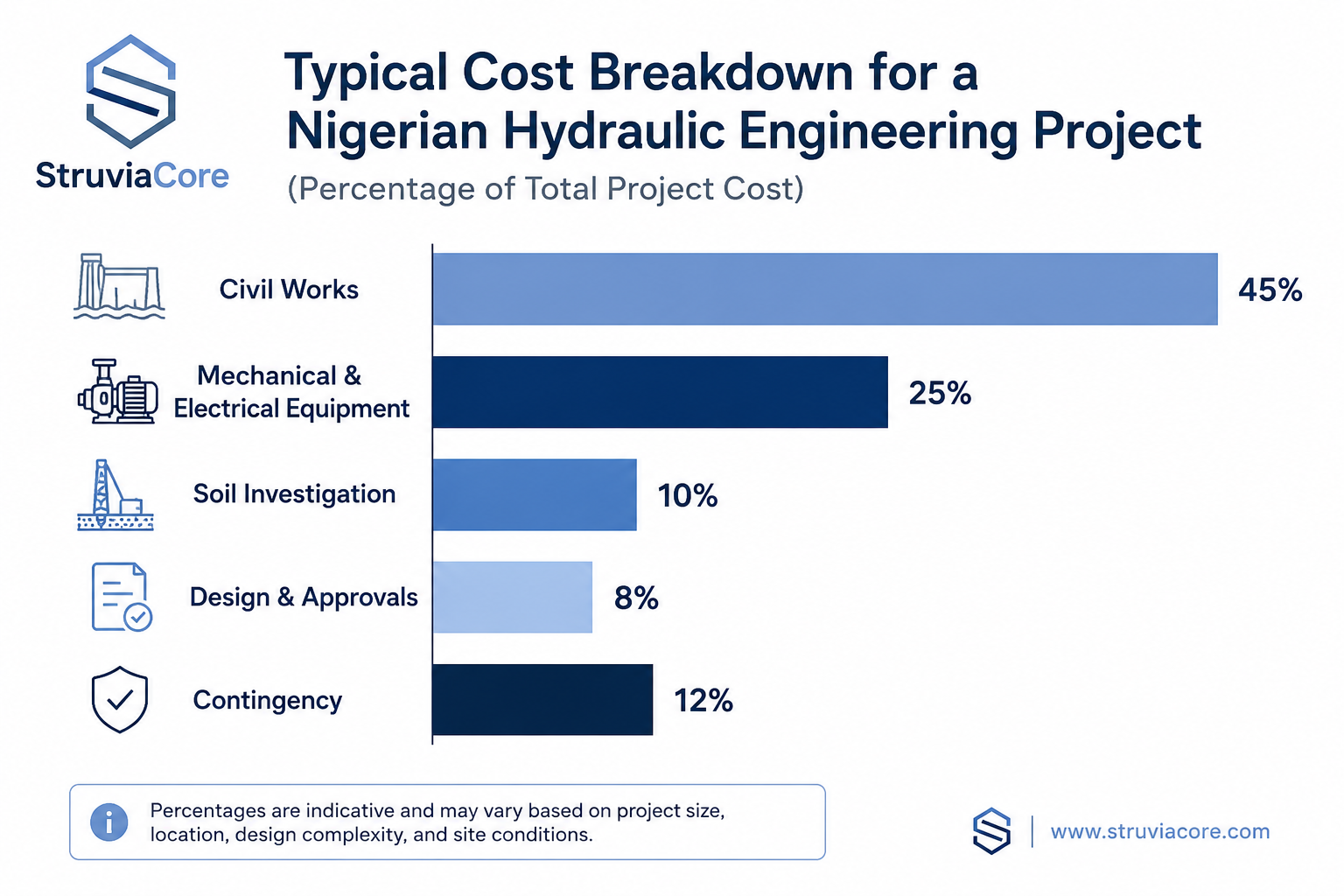
On a drainage upgrade project along the Abule-Egba axis of Lagos in 2023, the contractor’s piling rig hit soft marine clay nearly four metres deeper than the preliminary soil report indicated. The pump house foundation design had to be revised mid-construction, the piling subcontractor remobilised, and the client absorbed a cost variation that pushed the project 22% over its original budget. Stories like this repeat across Nigerian water infrastructure work, and they explain why hydraulic engineering cost factors deserve as much attention at feasibility stage as the hydraulic design itself. This breakdown covers what actually drives the cost of hydraulic engineering projects in Nigeria — from soil investigation and imported mechanical equipment to regulatory approvals and design contingencies — and shows you where the budget typically gets tested on site.
Hydraulic Engineering Cost Factors: Quick Answer
Hydraulic engineering cost factors in Nigeria include soil and groundwater conditions, hydrological data quality, design return periods, imported mechanical equipment such as pumps and sluice gates, site access in the rainy season, regulatory approvals, and dredging volume. Soft clay sites in Lagos and Port Harcourt commonly add 30–50% to substructure costs compared with firmer ground in Abuja.
What Is Hydraulic Engineering?
Hydraulic engineering is the branch of civil engineering concerned with the design, analysis, and construction of structures that convey, store, or control water — drainage channels, flood embankments, pumping stations, culverts, weirs, sluice gates, and water intake structures. Structural engineering deals with how a building carries load; hydraulic engineering deals with how water moves through and around the infrastructure you build, and how that infrastructure survives the water it manages. The two disciplines meet constantly on Nigerian sites, because a pump station or a box culvert still needs a foundation, reinforced concrete walls, and a structural design check before it can do its hydraulic job.
In Nigeria, the discipline sits at the centre of three recurring problems: seasonal urban flooding in cities like Lagos and Port Harcourt, drainage capacity that lags behind rapid development in places like Abuja’s satellite towns, and water conveyance for municipal and industrial clients who depend on rivers, boreholes, or treated supply networks. A hydraulic engineer registered with the Council for the Regulation of Engineering in Nigeria (COREN) must seal the design of any drainage, flood control, or water conveyance structure submitted for state approval. State ministries of works and water resources routinely reject submissions that lack this seal, which means the cost of professional design fees is not a line item you can shop down — it is mandated by law.
Where Hydraulic Engineering Fits in Nigerian Infrastructure
Hydraulic engineering overlaps with geotechnical and structural work, but its starting point is always hydrology: how much water has to move, how fast, and to where. A road project needs culverts sized for a design discharge; a real estate development on reclaimed land needs a drainage masterplan before the first building permit is issued; a riverine community water scheme needs an intake structure designed against seasonal flow variation. For a fuller breakdown of how the discipline is structured and where it applies, see our core principles of hydraulic engineering guide.
This is also where cost planning starts going wrong. Clients frequently treat hydraulic works as an add-on to a building or road contract rather than as a standalone engineering scope with its own investigation, design, and construction risk profile. Pricing it as a percentage of the main works — a common shortcut on Nigerian sites — produces budgets that bear little relation to the actual ground conditions, hydrology, or equipment specification involved.
How Hydraulic Engineering Costs Are Calculated
A realistic hydraulic engineering budget is built from five components: investigation and survey, design and approvals, civil construction, mechanical and electrical (M&E) equipment, and contingency. Mapping a project against these five components, rather than pricing it as a single lump sum, is the fastest way to see which hydraulic engineering cost factors actually apply to your site and which do not.
Design and Investigation Costs
Before a single drawing is produced, you need topographic survey, hydrological data, and a geotechnical investigation. Hydrological data quality is a genuine constraint in Nigeria — functioning rain-gauge and river-gauging stations are sparse outside the networks run by the Nigeria Hydrological Services Agency (NIHSA) and a handful of river basin development authorities, so engineers frequently rely on regional rainfall-intensity-duration-frequency (IDF) data that may be decades old or extrapolated from a distant catchment. This pushes engineers toward higher design contingencies, which raises both design time and downstream construction quantities.
Geotechnical investigation — boreholes, standard penetration tests, and laboratory classification — typically runs 1.5–3% of estimated construction cost on a hydraulic structure, but skipping or under-scoping it is the single most common false economy on Nigerian water projects. A borehole programme that stops at 6 metres on a Lagos lagoon-fringe site, when soft clay extends to 14 metres, produces a foundation design that has to be redone once piling exposes the real profile. For the investigation methodology itself, see our geotechnical engineering guide.
Materials, Equipment, and Construction Costs
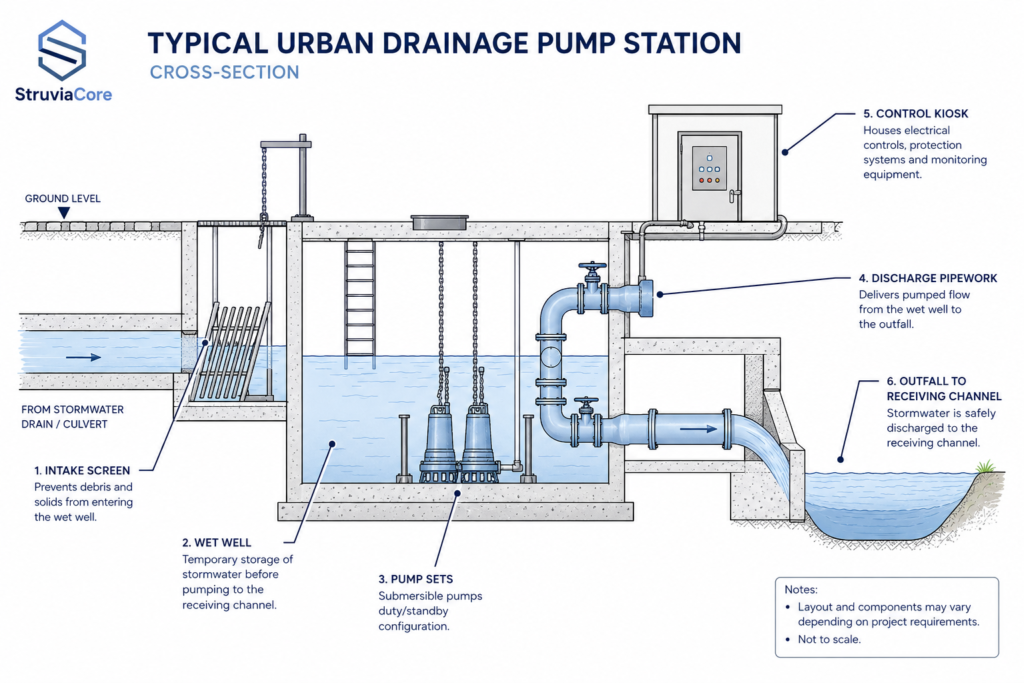
Civil works — reinforced concrete channels, box culverts, retaining walls, sheet piling for cofferdams — follow familiar Nigerian construction cost patterns: cement, reinforcement, formwork, and labour, priced against NIS 444 (cement) and BS EN 1992 (Eurocode 2) design requirements for reinforced concrete, which most Nigerian structural engineers still apply alongside legacy BS 8110 detailing conventions. Where hydraulic projects diverge sharply from buildings is in mechanical and electrical content. A flood control pumping station can carry M&E costs — pumps, electrical control panels, automation, standby generation, sluice gates, penstocks — equal to 35–55% of total project cost, and almost all of that equipment is imported. Naira depreciation against the US dollar and the euro therefore has a direct, line-by-line effect on hydraulic project budgets in a way it does not on a typical office building, where imported content is a smaller share of the total.
Regulatory and Site Context Driving Costs in Nigeria
Hydraulic engineering in Nigeria operates inside a regulatory layer that adds time and cost most clients underestimate at proposal stage. Federal oversight runs through the Federal Ministry of Water Resources and Sanitation and river basin development authorities for works affecting major watercourses, while state-level approval — particularly in Lagos, through the Ministry of the Environment and Water Resources and the Lagos State Drainage Law — adds a second layer of design review, drainage masterplan compliance checks, and, for larger works, an Environmental Impact Assessment administered under National Environmental Standards and Regulations Enforcement Agency (NESREA) guidelines. An EIA alone can add three to six months to a programme and a budget line that ranges from a few million naira for a localised drainage scheme to a significant seven-figure sum for a river-impacting or dredging project.
Site conditions vary enough across Nigeria’s main commercial centres that the same drainage structure can cost materially different amounts depending on where it sits. Lagos sites near the lagoon and on reclaimed land in areas like Lekki and Victoria Island typically present soft marine clay and silt to significant depth, a high water table, and a need for sheet-pile cofferdams and dewatering during construction — all of which raise substructure cost and schedule risk. Abuja sites more often present lateritic and residual soils with shallower competent strata, sometimes including granite outcrops that require controlled blasting for deep excavations — a different cost driver, but a cost driver nonetheless. Port Harcourt and the wider Niger Delta present some of the most demanding ground conditions in the country: soft alluvial clay and peat, a near-surface water table, and mangrove terrain that pushes designers toward piled substructures even for relatively light hydraulic works. A geotechnical report that does not explicitly address these regional conditions is not a complete report, regardless of how detailed its borehole logs appear.
Design standards add a further layer. Most Nigerian hydraulic structures are still designed to British Standards — BS 6349 for maritime and harbour works, BS EN 1997-1 (Eurocode 7) for geotechnical design, and BS 8007 for water-retaining concrete structures — though Eurocode adoption is increasingly standard practice among engineers trained or registered after the mid-2010s. Clients comparing quotations should confirm which code basis a consultant is actually using, because design to a higher partial factor of safety under Eurocode can produce a 5–10% increase in reinforcement and concrete quantities compared with older BS 8110-based detailing, with a corresponding cost difference that has nothing to do with contractor margin. Regulatory layering and site-specific ground conditions, taken together, are often the two largest hydraulic engineering cost factors on a Nigerian project — larger, in many cases, than the cost of the hydraulic structure’s core concrete and steel.
Hydraulic Engineering Cost Factors That Inflate Nigerian Project Budgets
Beyond the structural components of cost, four recurring mistakes consistently inflate hydraulic engineering budgets on Nigerian projects. Recognising them early protects your budget more than any amount of post-award value engineering. For a fuller list of project-level pitfalls, see our hydraulic engineering challenges guide.
Site and Soil Conditions: Hydraulic Engineering Cost Factors in Lagos, Abuja, and Port Harcourt
Under-investigating soil and groundwater conditions is the costliest mistake on Nigerian hydraulic projects, because it surfaces mid-construction, when remobilisation, redesign, and idle-plant costs are all running simultaneously. A pump house or sluice structure on soft clay needs a piled or raft foundation sized for actual bearing capacity and settlement tolerance, not an assumed value carried over from a nearby project. For the underlying cost mechanics of substructure design, see our foundation design cost factors guide — the same soil-investigation discipline that governs building foundations governs hydraulic structure foundations, and the consequences of skipping it are larger on hydraulic works because the structure also has to resist hydrostatic uplift and seepage.
Imported Equipment and Currency Exposure
Pumps, valves, sluice gates, geomembranes, and SCADA control equipment are priced in foreign currency even when the invoice arrives in naira. A budget fixed at award and not hedged or contractually indexed against exchange rate movement is exposed to swings that have, in recent years, moved 20–40% within a single project’s construction period. Contracts that fix M&E pricing without an agreed exchange-rate adjustment clause transfer that risk entirely onto whichever party absorbs the variation claim later — usually the client.
Hydrological Data Gaps and Design Contingencies
Where rainfall and river-flow records are thin, engineers size structures against a higher design contingency to cover the uncertainty — a defensible decision technically, but one that increases concrete volume, pipe diameters, and pump capacity, and therefore cost. Clients who push back on contingency without addressing the underlying data gap are not reducing risk; they are relocating it from the design stage to the day the structure floods. A 1-in-25-year design storm and a 1-in-50-year design storm can differ in conveyance capacity requirements by 30% or more on the same catchment, so the return period selected at brief stage is itself a major cost decision, not a technical footnote.
Best Practices to Control Hydraulic Engineering Costs
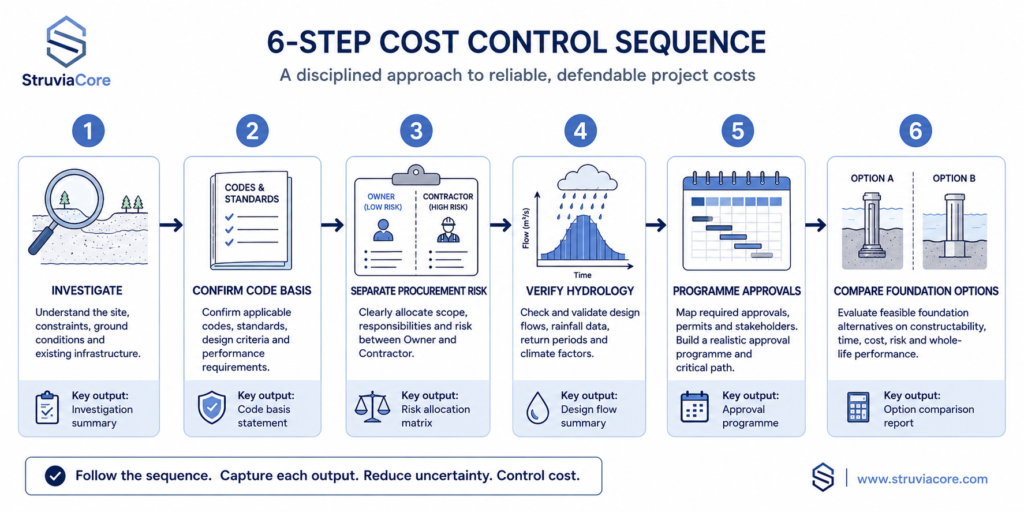
You control hydraulic engineering costs by sequencing decisions correctly and refusing to let design shortcuts substitute for investigation. The following practices reflect what consistently keeps Nigerian hydraulic projects within 10% of their original budget rather than 30% over it.
- Commission geotechnical investigation before, not alongside, detailed design. A borehole programme run concurrently with design locks you into assumptions that are expensive to unwind later.
- Confirm the design code basis in writing at proposal stage. Specify whether the consultant is working to BS or Eurocode, and require that choice to be stated in the fee proposal so quotations are comparable.
- Separate M&E procurement risk from civil works risk in the contract. Index imported equipment pricing against a named exchange rate benchmark rather than fixing it in naira at tender date.
- Verify hydrological inputs against more than one data source. Cross-check NIHSA records, river basin authority data, and site-specific rain gauge readings where available, rather than relying on a single regional dataset.
- Budget EIA and state approval timelines into the programme, not just the cost plan. A six-month NESREA review that was not programmed in delays mobilisation and adds idle-cost exposure even when the fee itself was anticipated.
- Request a soil-condition-specific foundation option, not a generic one. Ask your consultant to price at least two substructure options — for example, piled versus raft — so you can see the cost trade-off rather than accepting a single default.
Applying these practices in sequence — investigate, confirm standards, separate procurement risk, verify hydrology, programme approvals, compare foundation options — is the same discipline our team follows on every Nigerian hydraulic commission. For a step-by-step version of this process, see our best practices for hydraulic engineering guide.
Frequently Asked Questions About Hydraulic Engineering
Q: What is hydraulic engineering in civil engineering?
A: Hydraulic engineering is the civil engineering discipline focused on designing structures that convey, store, or control water, including drainage channels, culverts, pumping stations, weirs, and flood embankments. It differs from structural engineering in that its primary design driver is hydrology and fluid behaviour rather than dead and live load alone, though the two disciplines combine in almost every hydraulic structure.
Q: How much does a hydraulic engineering project cost in Nigeria?
A: Cost varies widely by scope and site, but a localised urban drainage upgrade in Lagos can range from tens of millions to several hundred million naira depending on length, pipe or channel size, and soil conditions, while a pumping station with significant mechanical and electrical content can run into the billions once imported equipment, civil works, and approvals are included. Soil conditions and design return period are usually the two largest swing factors.
Q: What is the difference between hydraulic engineering and water resources engineering?
A: Hydraulic engineering focuses on the structures that convey and control water — pipes, channels, pumps, gates — while water resources engineering takes a broader catchment or basin-level view, covering supply planning, allocation between competing users, and long-term yield analysis. In practice, a single project, such as an irrigation scheme, often requires both: water resources analysis to confirm available supply, and hydraulic engineering to design the conveyance infrastructure that delivers it.
Q: How does soil condition affect hydraulic structure costs?
A: Soil condition determines foundation type, dewatering requirements, and construction sequencing, all of which carry direct cost. Soft marine clay typical of Lagos lagoon-fringe sites usually requires piled foundations and sheet-pile cofferdams, while firmer lateritic soils common in parts of Abuja allow shallower, less expensive substructures. The difference in substructure cost alone between these two conditions commonly exceeds 30% on comparable structures.
Q: What approvals are required for hydraulic engineering projects in Nigeria?
A: Requirements depend on scale and location, but commonly include design certification by a COREN-registered engineer, state ministry of works or water resources approval, compliance with the relevant state drainage law where one exists, and an Environmental Impact Assessment under NESREA guidelines for projects affecting watercourses or involving significant earthworks or dredging. Projects on or near federal waterways may also require clearance from the relevant river basin development authority.
Conclusion
Hydraulic engineering cost factors in Nigeria come down to a small set of decisions made early: how much you invest in soil and hydrological investigation, which design code basis you adopt, how you allocate currency risk on imported equipment, and how realistically you programme regulatory approval timelines. Projects that get these decisions right at feasibility stage hold their budgets; projects that treat hydraulic works as a percentage add-on to a building or road contract almost always discover the real cost once piling rigs or pump deliveries expose the gap between assumption and ground truth. If you are scoping a drainage, flood control, or water conveyance project anywhere in Nigeria, talk to StruviaCore before your design brief is finalised — getting the investigation and cost-planning sequence right from the start is the difference between a contingency line you never use and a variation order you cannot avoid.
Leave a Reply