

Walk onto any large construction site today — a bridge rehabilitation in Lagos, a high-rise in Abuja’s Maitama district, or a port expansion in Port Harcourt — and you will likely find at least one IoT device running in the background. A vibration sensor on a formwork frame. A soil moisture probe in a temporary dewatering system. A GPS tracker on a concrete mixer. The promise is real: fewer surprises, better data, safer sites. But so are the problems. Engineers who have tried to deploy Internet of Things systems on active construction projects know that the gap between the pilot demonstration and reliable, scalable operation is considerable.
This article examines the principal IoT challenges that structural and civil engineers face when deploying connected sensor networks on construction and infrastructure projects. It covers connectivity, data management, cybersecurity, interoperability, power supply, and cost — and it addresses the practical realities of deploying these systems in environments where dust, vibration, intermittent power, and limited broadband are everyday conditions.
IoT challenges in construction refer to the technical, logistical, and financial barriers that prevent reliable deployment of connected sensor systems on sites and infrastructure assets. Core obstacles include poor wireless connectivity, heterogeneous device ecosystems, data security vulnerabilities, limited power supply in remote locations, and the difficulty of integrating real-time sensor data with existing project management workflows.
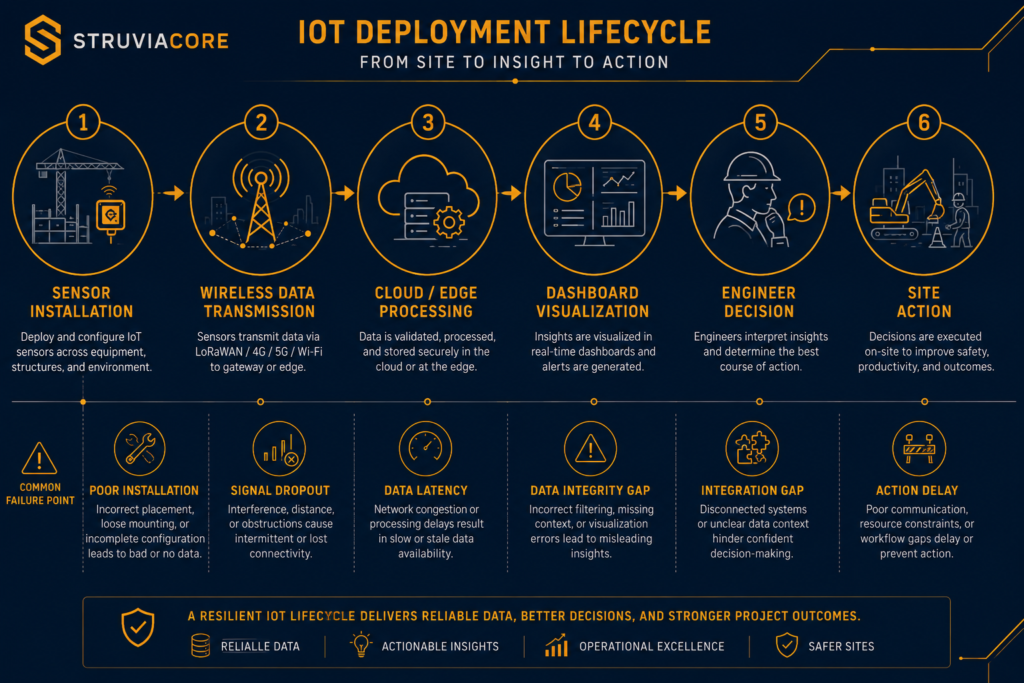
What IoT Actually Involves in a Construction Context
The Internet of Things is a network of physical devices embedded with sensors, processors, and communication modules that collect and transmit data over wired or wireless networks — typically without continuous human intervention. In construction, that definition expands to include wearables, structural health monitoring nodes, telematics units on plant and equipment, environmental sensors, and embedded probes in concrete or earthworks. The data those devices generate feeds dashboards, alerts, and — in more advanced deployments — digital twin models that mirror the physical asset in near real time.
Understanding what IoT is in an engineering context is the starting point. The next step — deploying it reliably on a live site — is where the engineering work begins. Construction presents conditions that consumer IoT products are not designed for: ambient temperatures regularly exceeding 45°C in the Nigerian dry season, corrosive dust from concrete grinding operations, constant physical vibration from compaction equipment, intermittent generator power, and a workforce that may not have been trained on device maintenance protocols.
The Gap Between IoT in Theory and IoT on Site
Laboratory-grade sensor specifications rarely survive first contact with a construction environment. A vibration sensor rated to IP67 (dust-tight, temporary immersion) may still fail within weeks if concrete slurry infiltrates the cable gland during formwork striking. A wireless mesh node with a quoted range of 300 metres under open-sky conditions may deliver only 40–60 metres inside a reinforced concrete basement under construction, where rebar and wet concrete absorb and scatter radio-frequency signals. These are not edge cases — they are typical conditions, and they represent the first major IoT challenge: environmental robustness.
Sensors intended for long-term structural health monitoring face additional constraints. A sensor node embedded in a pile cap at foundation level must operate for 20–50 years. Battery technology cannot currently sustain that lifespan without periodic replacement — which is impractical once the concrete has cured. This pushes engineers toward energy harvesting solutions (piezoelectric or thermal) or wired power arrangements, both of which add design complexity and cost before the first data point is even recorded.
Connectivity and Network Reliability
Wireless connectivity is the nervous system of any IoT deployment. Without it, even the most accurate sensor is simply an isolated data logger. Construction sites — particularly those in peri-urban areas or on linear infrastructure projects (roads, pipelines, power transmission corridors) — present consistent connectivity challenges that go beyond what standard telecom infrastructure can solve.
Protocol Fragmentation
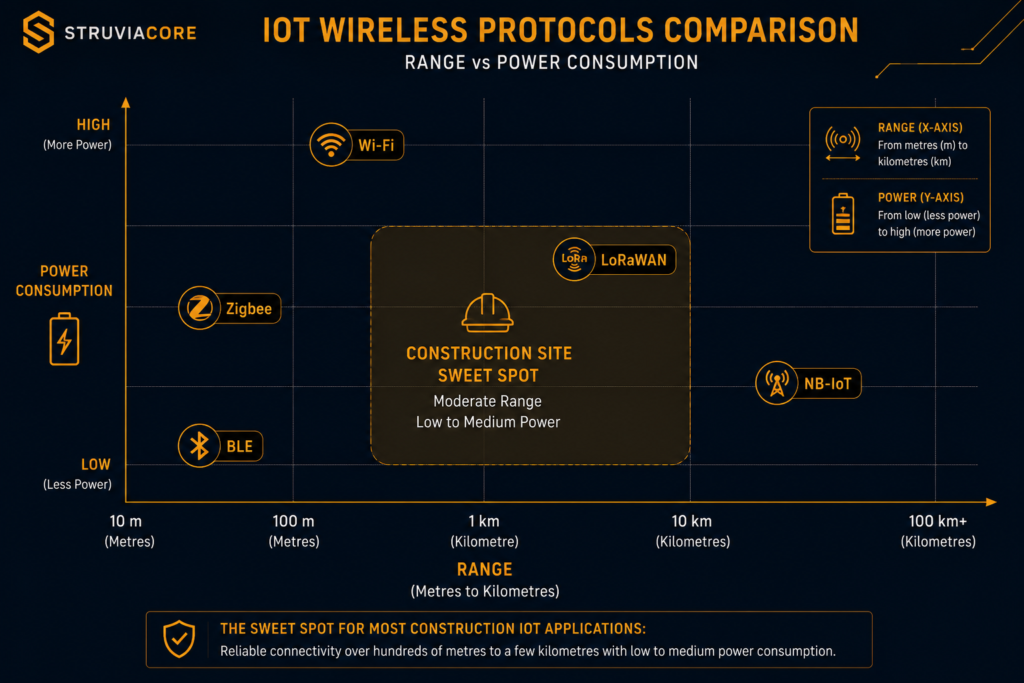
There is no single dominant IoT communication protocol, and this creates immediate interoperability problems when assembling a sensor network from multiple vendors. The main contenders in construction IoT include LoRaWAN (long-range, low power, low data rate), Zigbee (short-range mesh, well-suited to dense sensor arrays), NB-IoT (narrowband cellular, requires operator SIM and coverage), Wi-Fi (high bandwidth, high power consumption), and Bluetooth Low Energy (very short range, suitable for wearables). Each has a distinct power budget, range profile, data throughput limit, and infrastructure requirement. A project that deploys soil sensors using LoRaWAN, structural monitors using Zigbee, and equipment trackers using cellular NB-IoT will need a gateway architecture capable of aggregating three separate protocol streams — and that gateway itself becomes a single point of failure.
In parts of Lagos, Kano, or Enugu where 4G LTE cellular coverage is inconsistent and fibre broadband non-existent on site, the only viable low-power wide-area option may be LoRaWAN, but that demands the contractor deploy and maintain their own LoRa gateway infrastructure. On a project with a 24-month programme, that infrastructure needs to be mobile and weather-hardened — adding cost and logistics overhead that the original budget may not have included.
Bandwidth and Latency for Safety-Critical Monitoring
Certain IoT applications in construction are safety-critical rather than merely operational. A slope stability monitoring system on a cut face adjacent to a building must transmit tilt and pore-water pressure readings with sufficient frequency that an engineer can issue a site evacuation order before a failure mechanism becomes irreversible. If the sensor transmits every 15 minutes via a congested cellular link with a 5-minute latency window, that system offers marginal safety value over traditional manual instrumentation readings. For safety-critical applications, the minimum acceptable data transmission frequency, the acceptable latency, and the required uptime SLA need to be defined before sensor procurement — not after. This is a governance failure as much as a technical one, and it is one of the most common IoT challenges encountered on live projects.
Data Management, Integration, and the Interoperability Problem
An IoT network on a large infrastructure project can generate millions of sensor readings per day. A single vibrating wire strain gauge on a bridge girder sampling at 10Hz produces 864,000 readings in 24 hours. Multiply that across a network of 80 sensors on a multi-span structure and you have 69 million data points per day — before you add geotechnical, environmental, and equipment telemetry streams. Volume is one problem. Structure is another.
Most IoT platforms store sensor data in proprietary formats or vendor-specific schemas. When a project changes IoT vendor mid-contract (due to procurement rules, vendor insolvency, or equipment failure), the historical dataset may be locked in a format that the new system cannot ingest without a costly conversion exercise. This data portability problem is widely recognised in enterprise software — but construction has been slower than other industries to mandate open data standards in IoT procurement contracts.
The integration of IoT data with existing project management tools adds a further layer of complexity. Building Information Modelling platforms can theoretically ingest real-time sensor feeds to create live-updating digital models, but the middleware required to connect a LoRaWAN sensor gateway to a BIM environment is rarely out-of-the-box. It typically requires bespoke API development, ongoing maintenance, and a qualified software engineer who understands both the IoT stack and the BIM schema — a skill combination that remains rare in the Nigerian engineering market and expensive everywhere.
The data quality problem compounds all of this. A sensor that drifts 5% from calibration over six months will produce readings that look plausible but are systematically wrong. Without automated anomaly detection and regular field calibration checks (typically every 3–6 months for vibrating wire instruments under BS 7361 guidance), data quality degrades silently. Engineers who rely on that data for structural assessment decisions are building conclusions on a faulty foundation.
Cybersecurity Risks in Connected Construction
Construction IoT systems are attractive targets for two reasons: they control physical infrastructure with safety consequences, and they are routinely under-secured. A compromised sensor network on a dam or retaining wall does not just leak data — it can deliver falsified readings that suppress legitimate safety alerts. This is not hypothetical. Multiple academic studies published between 2019 and 2023 have demonstrated that common industrial IoT protocols, including unencrypted Modbus and legacy SCADA implementations, are vulnerable to man-in-the-middle attacks that can inject false sensor readings without detection by standard monitoring dashboards.
The specific vulnerabilities on construction sites include default or unchanged device credentials (the single most common entry point across all IoT breach reports), unencrypted data transmission over public cellular networks, and firmware that cannot be updated over-the-air, leaving known vulnerabilities permanently unpatched. Contractors who source IoT devices from low-cost suppliers — particularly for short-term site monitoring applications where budget pressure is intense — frequently deploy devices with these characteristics without recognising the risk.
For projects with public-interest implications — water treatment plants, major bridges, hospitals, government buildings — cybersecurity requirements for IoT systems should be specified in the project brief and evaluated during procurement. In the UK, the Product Security and Telecommunications Infrastructure Act 2022 introduced minimum security requirements for connected devices. Nigeria’s National Information Technology Development Agency (NITDA) has issued IoT policy guidelines, though enforcement mechanisms remain limited. Engineers specifying IoT systems on sensitive infrastructure should treat cybersecurity as a structural design requirement, not an IT afterthought.
The smart cities frameworks being developed for Lagos and Abuja explicitly acknowledge IoT security as an infrastructure risk — but translating that policy intent into site-level security protocols on a contractor-managed construction project still requires deliberate specification by the design and supervision team.
Power Supply, Maintenance, and Total Cost of Ownership
IoT devices need power. On a construction site, that sounds straightforward — there is a generator. In practice, generator power is intermittent, voltage is unstable, and power supply to sensor locations is rarely planned during the early design stages when cabling routes and distribution boards are sized. The result is that IoT sensors are frequently powered by batteries or solar panels that are added as an afterthought, with no provision for replacement access or maintenance logistics.
Battery-powered sensors in tropical climates face accelerated capacity degradation. Lithium-ion cells operating at 40°C sustained ambient temperature lose capacity roughly twice as fast as at 20°C, which means a 12-month rated battery may require replacement at 6 months under Nigerian site conditions. For a sensor array of 200 nodes distributed across a large earthworks site, that maintenance burden is substantial — and if it is not factored into the operational budget from the outset, sensors simply go offline and data gaps accumulate.
Solar-powered sensor nodes are theoretically attractive in West Africa’s high-irradiance environment. However, dust accumulation on panels in the dry season, shading from adjacent construction activities, and panel theft on unsecured sites all reduce real-world energy harvesting performance significantly below the specification assumptions. A 10W solar panel with a stated 95% efficiency under STC conditions may deliver 30–40% of that in a dusty site environment without weekly cleaning — a maintenance task that rarely appears in any IoT deployment plan.
The total cost of ownership for a construction IoT system is routinely underestimated. The hardware cost — the sensors, gateways, and connectivity modules — is often the smallest component over a three-year project lifecycle. Connectivity fees (SIM cards and data plans for cellular-connected devices), software subscription costs for cloud IoT platforms, integration development, calibration and maintenance visits, and the staff time required to interpret and act on the data collectively dwarf the upfront hardware expenditure. Engineers evaluating IoT proposals should require a full lifecycle cost breakdown, not just a hardware quote.

Best Practices for Managing IoT Challenges on Engineering Projects
The challenges outlined above are real — but none of them is a reason to avoid IoT in construction. They are reasons to approach deployment with engineering rigour rather than marketing optimism. The following practices are drawn from deployments on infrastructure projects in West Africa, the UK, and the Gulf, where teams have worked through these problems systematically.
Define the use case before selecting hardware. Before any sensor is specified, write a one-page use case document that states: what decision will this data inform, how frequently, and at what acceptable latency. That document drives every subsequent hardware, connectivity, and software decision. A slope monitoring system that needs to trigger an evacuation has different requirements from a concrete curing temperature sensor that simply confirms a pour record.
Conduct a site radio survey. Before committing to a wireless protocol, survey the signal environment at sensor locations. Use a spectrum analyser or a purpose-built IoT site survey tool to assess signal strength, interference sources, and multipath conditions. This prevents the most common deployment failure: selecting a protocol based on its theoretical range rather than its actual performance in the specific built environment.
Specify open data standards in procurement contracts. Require that all IoT data be exportable in a documented, non-proprietary format — JSON or CSV at minimum, with clear API documentation. This protects the client’s data asset and reduces vendor lock-in.
Treat cybersecurity as a structural requirement. Mandate that all deployed devices use unique credentials, support encrypted data transmission (TLS 1.2 minimum), and have an over-the-air firmware update path. Document this in the project specification and verify it during pre-installation inspection. The IoT implementation guide for infrastructure projects should include a security checklist as a standard annex.
Plan maintenance logistics from day one. For every sensor node, identify the maintenance access route, the battery replacement schedule, the calibration frequency, and the responsible person. Build these into the project’s Operation and Maintenance plan, not as an addendum, but as a first-class deliverable alongside the structural drawings.
Pilot before you scale. Deploy a 5–10 node pilot network for 60–90 days before committing to a full deployment. Use that period to identify actual connectivity performance, data quality issues, and maintenance burdens. Scale the specification based on evidence, not on vendor assurances.
These practices connect directly to how IoT data eventually feeds higher-order analytical tools. A well-structured sensor network with clean, time-stamped data in an open format is the prerequisite for meaningful integration with digital twin platforms and advanced analytics — and those integrations are where the real operational value of IoT investment is eventually realised.
Frequently Asked Questions About IoT
Q: What are the biggest IoT challenges in construction today?
A: The four most significant IoT challenges in construction are: wireless connectivity in RF-hostile built environments, cybersecurity vulnerabilities in under-secured device deployments, data integration between proprietary IoT platforms and existing project management or BIM systems, and the underestimation of total cost of ownership — particularly maintenance, connectivity fees, and calibration. Each is manageable with proper specification and planning, but rarely resolved once equipment has been procured and installed.
Q: How does IoT work on a structural health monitoring project?
A: Structural health monitoring using IoT typically involves sensors — vibrating wire strain gauges, tilt meters, crack displacement sensors, or piezometers — installed at critical structural locations. Each sensor transmits readings at a set frequency via a wireless or wired network to a local gateway, which forwards the data to a cloud or edge processing platform. Engineers access aggregated readings via a dashboard or API, and automated alerts are triggered when readings breach pre-defined thresholds. The reliability of the system depends on the quality of the sensor calibration, the stability of the data transmission path, and the appropriateness of the alert thresholds — all of which must be specified before installation.
Q: What IoT protocols are best suited to construction site deployments?
A: Protocol selection depends on the application. LoRaWAN is widely used for low-power, long-range sensor networks on large earthworks and linear infrastructure sites because it can cover 1–5km with a single gateway and requires minimal power. NB-IoT is preferable where cellular coverage is available and data payloads are small, since it uses existing operator networks without additional gateway infrastructure. Zigbee suits dense, short-range sensor meshes inside buildings or enclosed structures. Wi-Fi is appropriate for high-bandwidth applications (video, rapid-sampling vibration analysis) but at the cost of significantly higher power consumption. No single protocol dominates; most serious deployments use a hybrid architecture.
Q: How much does an IoT monitoring system cost for a construction project?
A: Hardware costs for a basic 20-node LoRaWAN sensor network start at approximately £8,000–£15,000 (around ₦15–28 million at mid-2025 exchange rates), excluding installation. Over a three-year deployment, connectivity, software platform subscriptions, calibration, and maintenance typically add 150–200% of the hardware cost — meaning the total cost of ownership for that 20-node system is likely £20,000–£45,000. Larger deployments on infrastructure projects (100+ sensors, multi-site integration, custom software development) routinely exceed £200,000 over a 5-year lifecycle. Engineers should require full lifecycle cost models before approving IoT procurement.
Q: What is the difference between IoT and SCADA in civil engineering?
A: SCADA (Supervisory Control and Data Acquisition) is an established industrial control system architecture used in water treatment plants, pump stations, and process facilities. It uses hardwired or proprietary radio links to poll field instruments at set intervals, with local control logic handled by PLCs (Programmable Logic Controllers). IoT systems, by contrast, use internet-protocol networks, are typically lower cost per node, support a wider range of communication protocols, and are more readily integrated with cloud analytics platforms. Modern infrastructure deployments increasingly use IoT-connected sensors alongside legacy SCADA architectures — a hybrid approach that introduces its own integration and cybersecurity challenges.
Managing IoT Challenges Starts With the Right Specification
IoT in construction is not a plug-and-play technology. The IoT challenges that derail deployments — connectivity failures, cybersecurity vulnerabilities, data integration problems, cost overruns — are predictable, and most are preventable with proper engineering specification from the project outset. The sensor technology itself is mature. What fails, repeatedly, is the systems engineering around it: the network design, the power planning, the data governance, and the maintenance logistics.
Engineers who approach IoT deployment with the same rigour they apply to structural or geotechnical design — defining requirements first, selecting solutions second, and validating performance against those requirements throughout the project — consistently achieve better outcomes than those who purchase hardware based on vendor presentations and figure out the rest later.
StruviaCore works with clients across structural engineering, infrastructure, and construction technology to specify, evaluate, and supervise IoT deployments on complex projects. If your team is assessing IoT for a current project or establishing a monitoring strategy for an existing asset, contact StruviaCore to discuss the engineering requirements.
Leave a Reply