
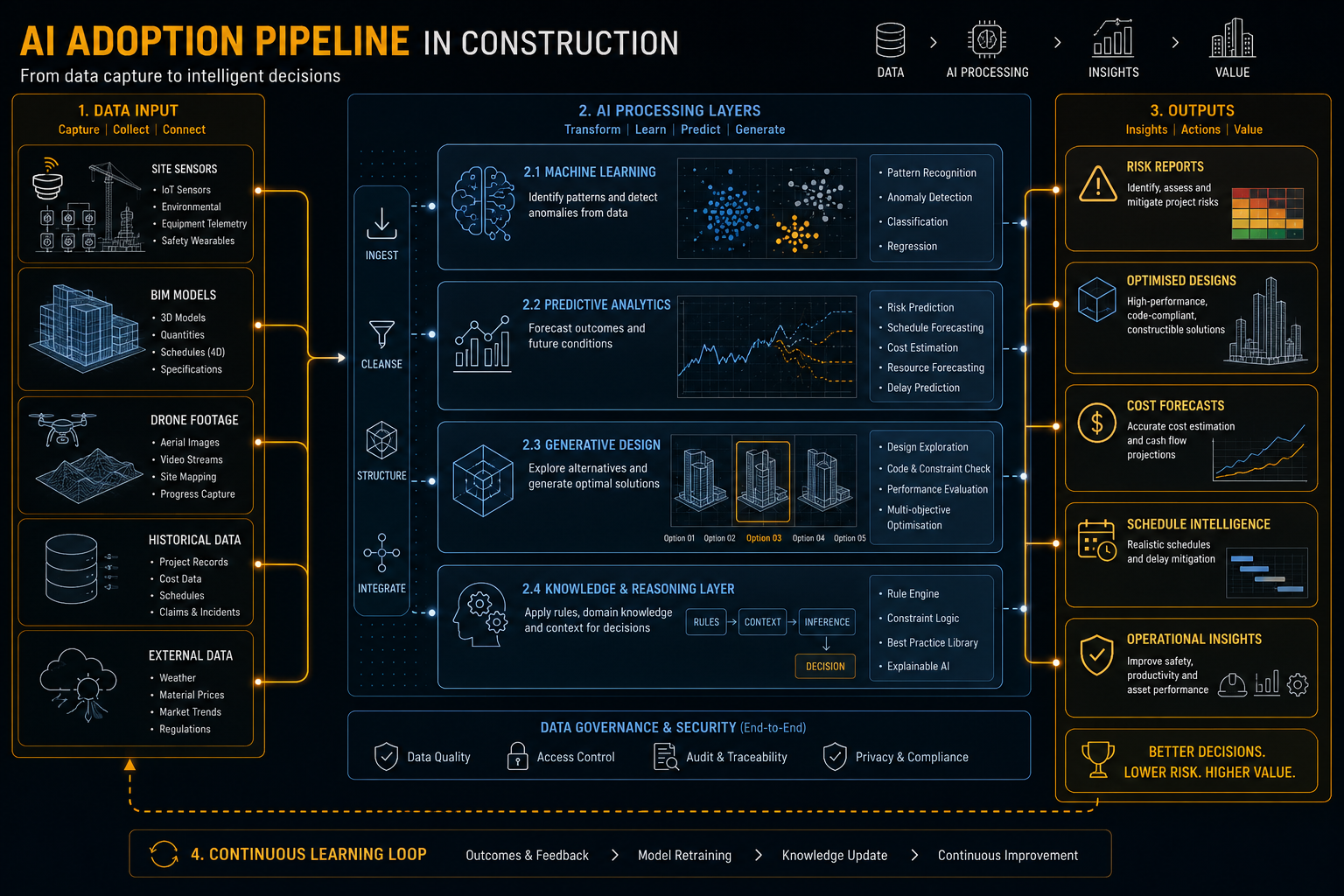
Walk onto any major infrastructure site in 2026 and the evidence is hard to ignore. Project managers are reviewing AI-generated risk reports before the morning briefing. Structural engineers are running load optimization algorithms that would have taken a dedicated team three days to process manually. Quantity surveyors are validating material estimates against machine-learning models trained on thousands of comparable projects. The technology has moved from concept papers to site offices, and the pace of change is accelerating rather than stabilising.
This article covers the AI trends reshaping civil and structural engineering practice right now — not as future speculation, but as documented shifts in how projects are designed, procured, monitored, and delivered. Whether you are managing a road rehabilitation programme in Abuja, overseeing structural design for a Lagos high-rise, or running a consultancy operation in Port Harcourt, understanding where artificial intelligence is heading in 2026 will determine whether your practice leads or follows.
AI Trends 2026: Quick Answer
AI trends in 2026 centre on predictive analytics, generative design, real-time site monitoring, and large language model integration across engineering workflows. These tools reduce design cycles by up to 40%, improve defect detection accuracy to above 90% on instrumented sites, and are being adopted across project management, structural analysis, geotechnical assessment, and procurement functions in the civil engineering sector globally.
How AI Is Being Applied in Civil and Structural Engineering in 2026
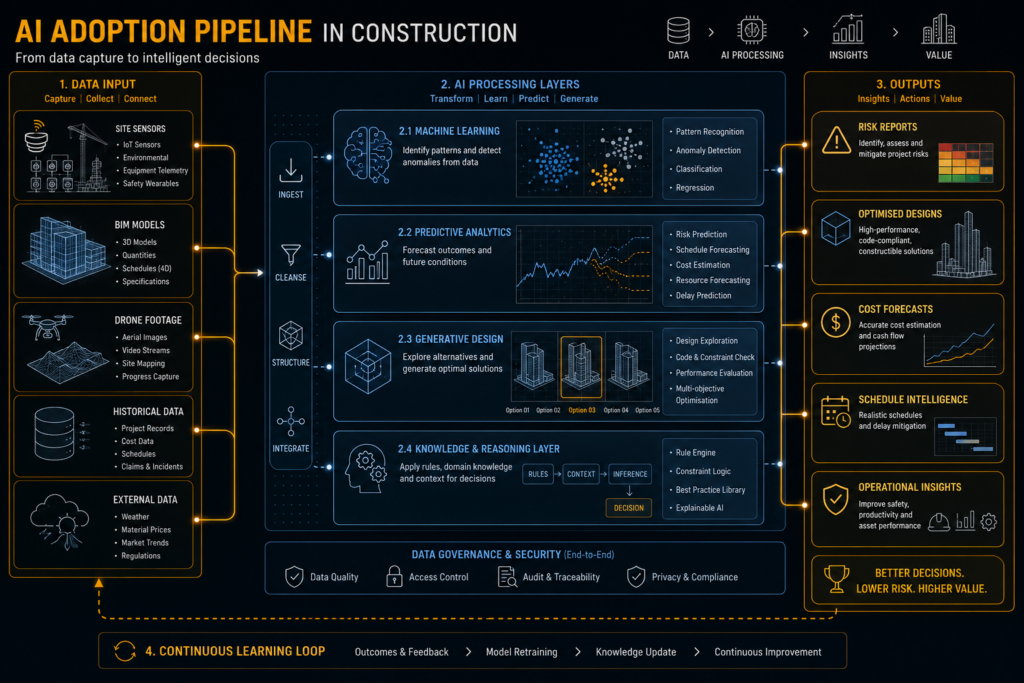
Artificial intelligence in construction is the application of machine learning algorithms, computer vision, natural language processing, and predictive modelling to engineering design, site operations, project management, and infrastructure maintenance. In 2026, the distinction that matters is not whether a firm uses AI, but where in the project lifecycle it is embedded.
The most significant shift over the past 18 months is the move from isolated tools — a standalone structural analysis plugin, a single drone survey platform — to integrated AI systems that feed into one another. A structural design model generated in a BIM environment now feeds directly into a machine-learning cost estimator, which updates the project programme, which triggers a procurement alert. That closed loop did not exist at scale in 2023. It is operational on projects above £20 million today.
Generative Design and Structural Optimisation
Generative design is the most immediately visible AI trend for structural engineers. The process works by defining performance constraints — load requirements, material grades, site footprint, budget envelope — and allowing an algorithm to produce multiple compliant design iterations simultaneously. A structural engineer reviewing output from a generative design platform in 2026 may receive 40 or 50 viable structural configurations ranked by material efficiency, carbon footprint, and construction programme.
The practical value is not that the algorithm replaces the engineer’s judgement. It is that the algorithm expands the solution space far beyond what manual iteration can cover in a realistic project programme. On a multi-storey reinforced concrete frame, for example, generative tools can optimize column spacing, slab depth, and beam sizing against BS 8110 or Eurocode 2 compliance simultaneously — a process that would otherwise require several design cycles and QA reviews. Engineers in practice are reporting time savings of 30–40% on structural scheme design phases where these tools are fully integrated.
The qualification remains important: the outputs require engineer verification. Generative design is a design acceleration tool, not a sign-off mechanism. COREN-registered practitioners in Nigeria retain full professional responsibility for the structural adequacy of designs, regardless of how they were produced.
Computer Vision and Site Monitoring
Computer vision — AI systems trained to interpret images and video feeds — has moved firmly into construction site monitoring. High-resolution cameras combined with trained models now detect formwork displacement, rebar positioning errors, concrete pour inconsistencies, and PPE non-compliance in real time. On instrumented sites, defect detection accuracy above 90% has been reported, with alerts generated in under 60 seconds of a fault condition emerging.
This has direct implications for quality assurance under BS 8000 (Workmanship on Building Sites) and similar standards. Rather than relying on periodic inspection visits, site supervisors receive continuous visual data, with AI flagging conditions that warrant immediate attention. The record-keeping implications are equally significant: AI-generated site logs create an audit trail that traditional site diaries cannot match for completeness or objectivity.
For construction automation workflows, computer vision is the sensing layer that makes autonomous or semi-autonomous site operations possible. Without reliable visual interpretation of site conditions, robotic systems and autonomous plant cannot function safely.
The Five AI Trends Defining Construction Practice in 2026
Several distinct directions are shaping how AI is being adopted across the engineering and construction sector this year. They are not competing trends — most mature project operations will draw on all of them to varying degrees.
1. Predictive Analytics for Project Risk and Programme Management
Predictive analytics uses historical project data, current site performance metrics, and external variables to forecast likely outcomes. In 2026, this is most actively deployed in programme management. AI systems trained on thousands of comparable projects can identify, at a statistical level, that a particular combination of design change frequency, subcontractor mobilisation delay, and weather pattern correlates with a 65% probability of a four-week programme slip by month three.
The value for project managers is the ability to intervene before a risk materialises rather than after. Early warning indicators identified by AI — supply chain lead time anomalies, concrete cube test trends, productivity rate deviations — can trigger proactive management responses within the existing programme. Projects running predictive risk systems have reported a reduction in final account overruns of 15–25% compared to projects managed on conventional reporting cycles.
2. Large Language Models Integrated into Engineering Workflows
Large language models (LLMs) — the technology underlying tools like GPT-4 and similar systems — are being embedded directly into engineering software environments in 2026. The application is not conversational assistance. It is the ability to query structured data in natural language, generate specification text from structured inputs, cross-reference contract documentation against scope of works, and summarise geotechnical investigation reports in format-ready output.
A geotechnical engineer on a commercial project in Lagos can now query a borehole database in plain language (“show me all sections where SPT N-values fall below 10 within the top 3 metres”) and receive a structured output without writing a single line of code or running a separate database query. This compresses the data review phase of a site investigation from days to hours. The integration of AI into BIM environments extends this capability further, enabling engineers to interrogate model data, generate drawing schedules, and produce QA reports directly from the model environment.
3. Digital Twins Powered by Real-Time AI Analysis
A digital twin — a live virtual model of a physical asset continuously updated by sensor data — becomes meaningfully more powerful when AI handles the data processing. In 2026, AI-powered digital twins are operational on major infrastructure assets including bridges, water treatment facilities, and high-rise structures. The AI layer processes the volume of sensor inputs — strain gauges, accelerometers, settlement monitors, thermal sensors — that would otherwise overwhelm a human analyst team.
For digital twin applications in structural engineering, the AI component performs three functions: anomaly detection (identifying sensor readings outside expected thresholds), predictive maintenance scheduling (estimating when a structural component is likely to require intervention based on degradation trends), and scenario modelling (running hypothetical load cases or climate events against the current structural state). On a long-span bridge monitored by 200 or more sensors, none of this is practical without automated AI analysis.
4. AI-Driven Geotechnical and Site Investigation Support
Geotechnical engineering is data-intensive and interpretation-dependent — two characteristics that make it well-suited to AI augmentation. Machine learning models trained on regional soil data can now correlate surface geology, borehole logs, CPT profiles, and existing foundation performance records to produce probabilistic bearing capacity assessments and settlement predictions.
In the Lagos coastal belt, where variable soft clay deposits, high groundwater tables, and heterogeneous fill present consistent foundation challenges, AI-assisted site investigation tools allow engineers to flag zones of differential settlement risk before physical investigation begins. This does not replace the ground investigation required by BS 5930 or the site-specific assessment a geotechnical engineer must perform. It prioritises where investigation effort is focused and reduces the risk of under-sampling in critical zones.
5. Autonomous and Semi-Autonomous Plant and Surveying
Drone-based surveying integrated with AI photogrammetry and LiDAR processing has reached operational maturity. Platforms currently in field use can process a 50-hectare site survey to topographic model in under four hours, with accuracy to ±25mm without ground control points, improving to ±10mm with GCP networks. AI handles the point cloud processing, model generation, and change detection comparison with previous surveys automatically.
The construction robotics space is less mature but moving rapidly. Autonomous rebar tying machines, concrete dispensing systems, and bricklaying platforms are in commercial deployment on selected project types. Full site autonomy remains well beyond current capabilities — the integration challenge of coordinating multiple autonomous systems in a dynamic site environment is substantial. Construction robotics in 2026 operates best in defined, repetitive task environments: slab screeding, prefabrication assembly, façade installation on regular grid patterns.
AI Adoption in the Nigerian and West African Engineering Context
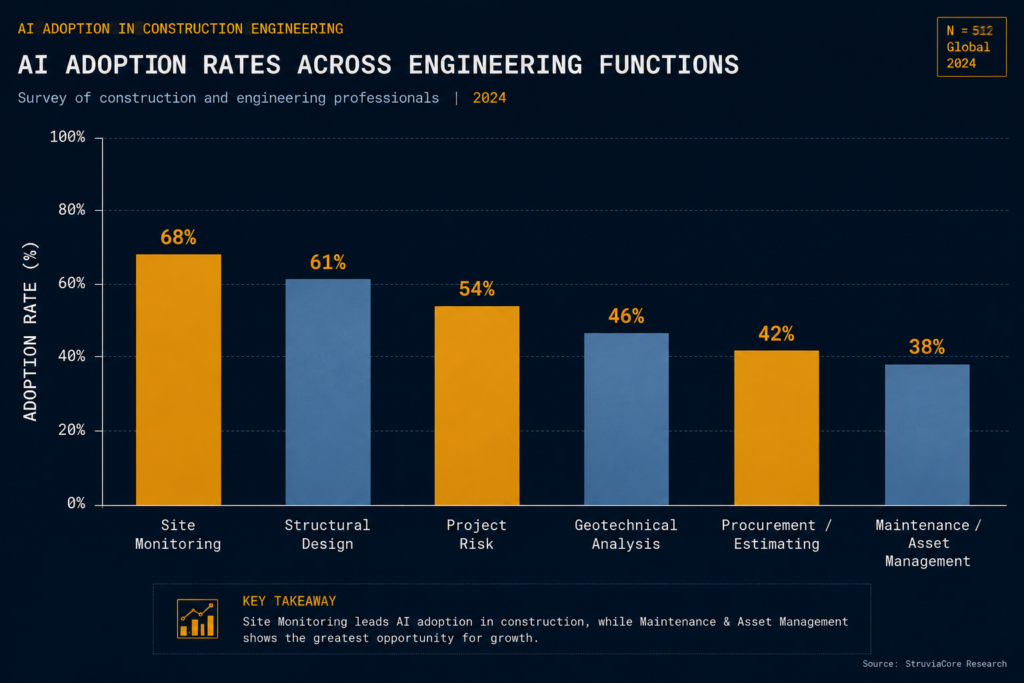
The global AI trends described above do not land uniformly across markets. In Nigeria and West Africa, several structural factors shape how and how quickly these tools are being adopted — and practitioners need to understand the gap between what the technology can do and what the local practice environment currently supports.
Data infrastructure is the first constraint. AI systems — particularly predictive analytics and machine-learning-based design tools — require clean, structured, and historically consistent datasets to train and validate against. The Nigerian construction sector has historically maintained fragmented project records, with limited standardisation of as-built documentation, geotechnical databases, or cost benchmarks. Building the data foundations that AI tools require is a prerequisite, not an assumption.
Connectivity is the second factor. Cloud-based AI platforms require reliable high-bandwidth internet access for real-time data exchange. On sites in remote project locations — road contracts in the North-West, dam rehabilitation projects in the Middle Belt — the connectivity assumption that underpins many AI tools does not hold. Edge computing solutions, which run AI processing locally on site hardware rather than in the cloud, are gaining traction in this context but add cost and specialist support requirements.
Professional regulation is a third dimension. COREN and the Nigerian Institute of Architects have not yet issued formal guidance on AI use in design sign-off processes. This creates interpretive uncertainty: when a COREN-registered engineer uses an AI-generated structural scheme as the basis for a signed drawing, the professional liability framework is clear — the engineer carries full responsibility. What is less clear is whether firms have documented their AI tool validation processes in a way that would satisfy an inquiry if a design failure occurred. Establishing internal AI governance protocols now, ahead of formal regulatory guidance, is prudent practice.
None of these constraints mean AI adoption should wait. They mean the adoption strategy needs to be sequenced. Start with the tools that deliver value without requiring perfect data infrastructure: LLM-assisted specification drafting, AI-enhanced drone survey processing, computer vision for site safety monitoring. Build data discipline as you build capability. The firms that establish AI-competent workflows now will be significantly better positioned when the data foundations mature.
Common Implementation Challenges and Where Firms Get It Wrong
Engineering firms adopting AI tools in 2026 consistently encounter a predictable set of implementation problems. Understanding them in advance saves both time and money.
Treating AI output as final output. The most frequent and consequential error. AI-generated structural designs, cost estimates, and risk assessments require engineer review and professional sign-off. They are decision-support inputs, not decisions. Firms that short-circuit the verification step — under programme pressure or through misplaced confidence in the tool — accumulate errors that compound over the project lifecycle.
Buying platform capability without building internal competency. A firm that subscribes to an advanced AI design platform but does not train its staff to interrogate the tool’s assumptions, validate its outputs, and understand its failure modes has not gained capability — it has gained a liability. The tool is only as useful as the engineer’s ability to critically interpret what it produces.
Underestimating data preparation requirements. AI tools require structured, consistent input data. A machine-learning cost estimator trained on industry benchmarks performs poorly when fed project data with inconsistent unit rates, mixed specification references, and incomplete scope descriptions. Before deploying AI on live projects, audit the quality of the data you plan to feed it.
Neglecting cybersecurity for connected site systems. AI-powered site monitoring systems, IoT sensor networks, and cloud-based project platforms create attack surfaces that conventional construction operations did not have. IoT-connected site infrastructure requires a cybersecurity protocol that most engineering firms have not historically needed to consider. Project data — including structural drawings, geotechnical reports, and programme schedules — stored on cloud AI platforms requires the same access controls and encryption standards as any sensitive business asset.
Failing to document AI use for professional liability purposes. When AI tools contribute to design decisions, the professional audit trail should record which tool was used, what version, what inputs were provided, and what validation the engineer performed on the output. Without this record, demonstrating due diligence in a future dispute becomes difficult.

Best Practices for Integrating AI into Engineering Practice
The following approach reflects what is working for engineering firms that have moved beyond pilot projects to embedded AI use across multiple project functions. Apply it in sequence rather than simultaneously — the staged approach builds competency and catches problems before they scale.
Start with a data audit. Before selecting any AI tool, catalogue what project data your firm currently holds, in what formats, and with what consistency. If your cost data lives across 15 different spreadsheet formats and your geotechnical records are filed as scanned PDFs, establish a data standardisation protocol before investing in AI platforms that require structured inputs.
Select tools that match your current project types. A small to medium structural design practice does not need a full-stack AI platform designed for a tier-one contractor running 50 simultaneous projects. Match tool complexity and cost to your current workflow. Generative design plugins for your existing structural analysis software, AI-assisted spec drafting tools, and drone survey processing platforms are high-value, manageable entry points.
Train before you deploy. Allocate training time before putting AI tools on live project programmes. Engineers need to understand not just how to operate the tool but how to stress-test it — what happens at the edges of its training data, where its outputs are least reliable, and what validation steps confirm the output is fit for purpose.
Run a structured pilot on a low-risk project. Apply the selected tool on a project where AI-generated outputs are checked against conventional methods in parallel. The parallel run is not wasted effort — it generates the performance data that builds confidence in the tool and identifies any calibration issues specific to your project types.
Document your governance framework. Write down your firm’s AI use policy: which tools are approved, how outputs are validated, who signs off on AI-informed design decisions, and how AI use is recorded in the project file. This document is your professional liability protection and your quality management evidence. Review it annually as the tools evolve.
Build feedback loops. When an AI-generated estimate diverges from the final account, or a risk prediction fails to match the actual outcome, record the deviation and understand why. This feedback discipline improves how you use the tools and, over time, generates the project-specific data that makes AI outputs more accurate for your practice context.
Frequently Asked Questions About AI in Construction
Q: What is AI in civil engineering and how is it different from standard structural analysis software?
A: AI in civil engineering refers to systems that learn from data and improve their outputs with experience, as distinct from conventional software that applies fixed rules or equations. A finite element analysis package applies defined physics — it does not adapt based on historical project outcomes. An AI-based risk prediction system, by contrast, trains on thousands of completed projects and identifies patterns that static models cannot detect. The distinction matters because AI outputs are probabilistic and context-dependent, requiring professional interpretation rather than direct application.
Q: How much does AI software cost for a structural engineering practice in 2026?
A: Costs vary substantially by tool type and scale. AI-enhanced BIM plugins and spec drafting tools typically run between $50–$300 per user per month on subscription models. Full-stack AI project management platforms for mid-to-large firms range from $2,000–$15,000 per month. Drone survey AI processing platforms are often priced per-project, with costs of $200–$1,500 depending on site area and output specification. Nigerian firms should also factor in data connectivity costs, which can add 20–35% to operational costs in locations with limited fibre infrastructure.
Q: Can AI replace a structural engineer’s professional judgement?
A: No. AI tools generate outputs within the parameters they were trained on and cannot exercise the contextual judgement, professional responsibility, or ethical accountability that defines engineering practice. Under the COREN Act, a COREN-registered engineer is legally responsible for the structural adequacy of any design they sign off on, regardless of how that design was produced. AI tools reduce the time and effort required for certain analytical tasks, but professional judgement — the ability to recognise when a tool’s output does not make physical sense, or when site conditions fall outside the tool’s applicable range — remains entirely the engineer’s domain.
Q: What is the difference between AI and Building Information Modelling (BIM) in construction?
A: BIM is a process and data standard for creating and managing digital representations of physical assets, defined under ISO 19650. AI is a set of computational techniques that can be applied to the data BIM generates. They are complementary, not interchangeable. A BIM model stores structured project data; AI analyses that data to generate insights, predictions, or optimised outputs. The most capable construction technology environments in 2026 use BIM as the data foundation and AI as the analytical layer operating on top of it.
Q: Is AI adoption mandatory for engineering firms to remain competitive in 2026?
A: Mandatory is too strong a word for 2026, but the competitive gap is widening. Firms deploying AI tools are quoting faster, winning projects with lower design fee bids underpinned by efficiency gains, and delivering more accurate cost estimates and programme forecasts. Firms that are not adopting these tools are taking longer to produce comparable outputs at higher cost. The window for deliberate, planned adoption — rather than reactive catch-up — is closing.
Where AI in Construction Heads From Here
The AI trends active in 2026 are not the end state. They are the foundational layer on which the next phase of construction technology will be built. Firms that embed AI capability into their practice now — not as a technology experiment but as a core workflow competency — position themselves to absorb subsequent advances without disruption.
The near-term trajectory points toward deeper integration between AI trends and physical site systems: more autonomous plant, more continuous structural health monitoring, and AI-managed supply chains that reduce material waste and procurement lead times. The firms that are ready for those advances are the ones building their data foundations, training their engineers, and establishing governance frameworks today.
StruviaCore works with engineering practices and project developers navigating the practical realities of construction technology adoption — from structural design to project delivery and digital integration. If you are assessing how AI tools fit your current workflow or need technical guidance on a specific project challenge, our structural engineering team is available to discuss your requirements.
Leave a Reply