

A site manager on a mixed-use tower in Lekki recently asked why a vibration-monitoring sensor network quoted at $40,000 for twelve months had ballooned to $67,000 by handover. The answer wasn’t the sensors. It was cellular data charges in a low-coverage zone, a platform license renegotiated mid-project, and calibration visits nobody had budgeted for. This is the pattern behind most IoT cost factors in civil and structural projects: the visible hardware line item is rarely where the money actually goes.
This article breaks down what actually drives IoT spending on construction and infrastructure projects — from sensor procurement through to five-year total cost of ownership — and gives you a framework for pricing a deployment before you commit to one.
[IOT COST FACTORS]: Quick Answer
IoT cost factors in construction include hardware (sensors, gateways, edge devices), connectivity (cellular, LoRaWAN, or wired data plans), software platforms and licensing, installation and calibration labour, and ongoing maintenance. A mid-size structural health monitoring deployment on a single building typically ranges from $15,000 to $150,000 annually, depending on sensor density and data frequency requirements.
What IoT Cost Factors Actually Cover
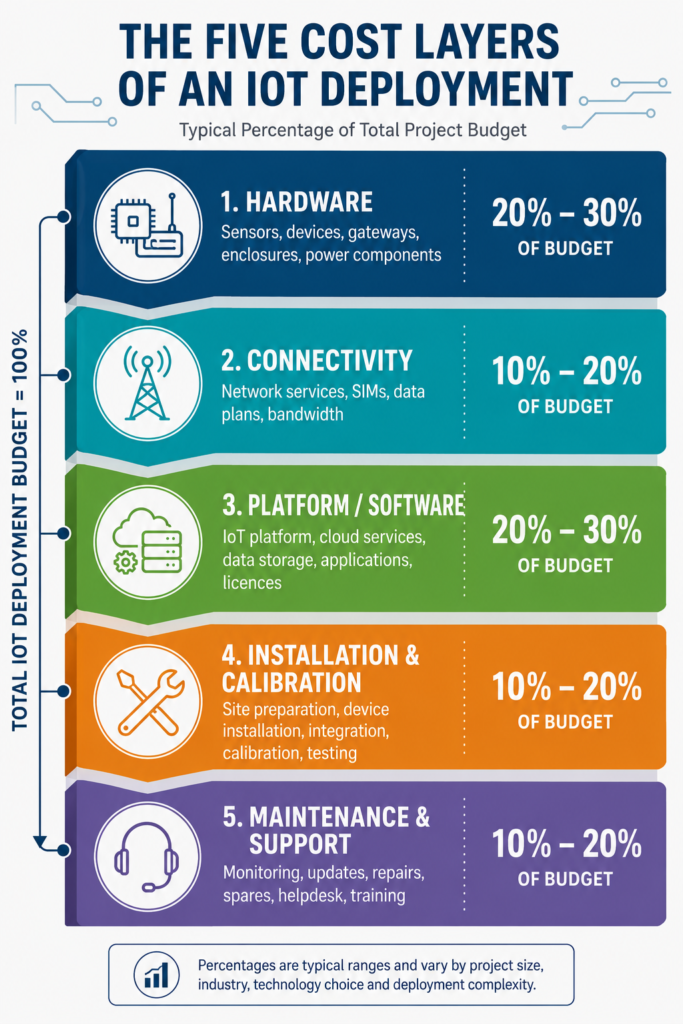
IoT in a construction context is a network of sensors, gateways, and connected devices that collect structural, environmental, or operational data and transmit it to a platform for analysis. When engineers talk about IoT cost factors, they mean the full set of variables that determine what a deployment costs to specify, install, and run — not just the unit price of a sensor.
Five layers make up nearly every deployment budget: hardware procurement, connectivity, software and platform licensing, installation and calibration labour, and ongoing maintenance. Each layer scales differently. Hardware cost is largely fixed once you’ve chosen a sensor density. Connectivity and platform costs are recurring and tend to be the layer clients underestimate most, because they’re billed monthly or annually rather than as a single capital line item.
Hardware: Sensors, Gateways, Edge Devices
Structural sensors — strain gauges, tiltmeters, accelerometers, crack meters — range from $150 to $2,500 per unit depending on precision class and environmental rating (IP67 or IP68 for exposed marine or coastal applications, common on projects along the Lagos and Port Harcourt waterfronts). Gateways that aggregate data from multiple sensors before transmission cost $800 to $4,000 each and typically serve 20 to 50 sensor nodes, so gateway count is a function of your site footprint, not sensor count alone.
Edge computing devices, which process and filter sensor data on-site before transmission, add $500 to $3,000 per gateway but reduce data transmission volume by 60% to 80% in continuous-monitoring applications. This trade-off matters most on projects where cellular cost is the dominant expense: paying more upfront for edge processing often costs less over a three-year monitoring period than transmitting raw, unfiltered readings continuously. Teams evaluating this trade-off should model it alongside decisions already being made for site automation systems, since edge devices frequently serve both monitoring and automated control functions on the same network.
Sensor selection also depends on the measurement class required. A general-purpose accelerometer suitable for vibration screening during piling costs a fraction of a research-grade unit calibrated for long-term fatigue analysis on a bridge deck. Specify the measurement class against the actual engineering question you’re answering — over-specifying precision on a short-term monitoring programme is a common way projects overspend on hardware without gaining useful additional accuracy.
Connectivity: The Recurring Cost Everyone Underestimates
Cellular data plans for remote monitoring run $10 to $60 per device per month depending on data volume and carrier coverage. On a project with weak cellular signal — common on rural transportation corridors or deep excavation sites — you’ll need signal boosters or a LoRaWAN mesh network instead, which shifts cost from monthly data charges into upfront gateway infrastructure. Run a coverage survey before specifying connectivity type; retrofitting a mesh network after cellular fails on site adds 15% to 25% to the connectivity budget.
Wired connectivity remains the lowest-cost option per data point on projects where cabling is already part of the build, such as new-build structures with monitoring specified at design stage rather than retrofitted onto an existing asset. The trade-off is flexibility: wired sensor networks are cheap to run but expensive to relocate once the concrete is poured, whereas wireless networks cost more per sensor but let you adjust placement as the monitoring programme evolves. Projects that combine wired backbone infrastructure with wireless edge sensors — a hybrid approach increasingly common on BIM-coordinated builds — tend to get the best balance of cost and flexibility, because the wired network handles high-volume, fixed-location data while wireless sensors cover areas where requirements might shift.
Technical Depth: How Deployment Scale Drives Cost
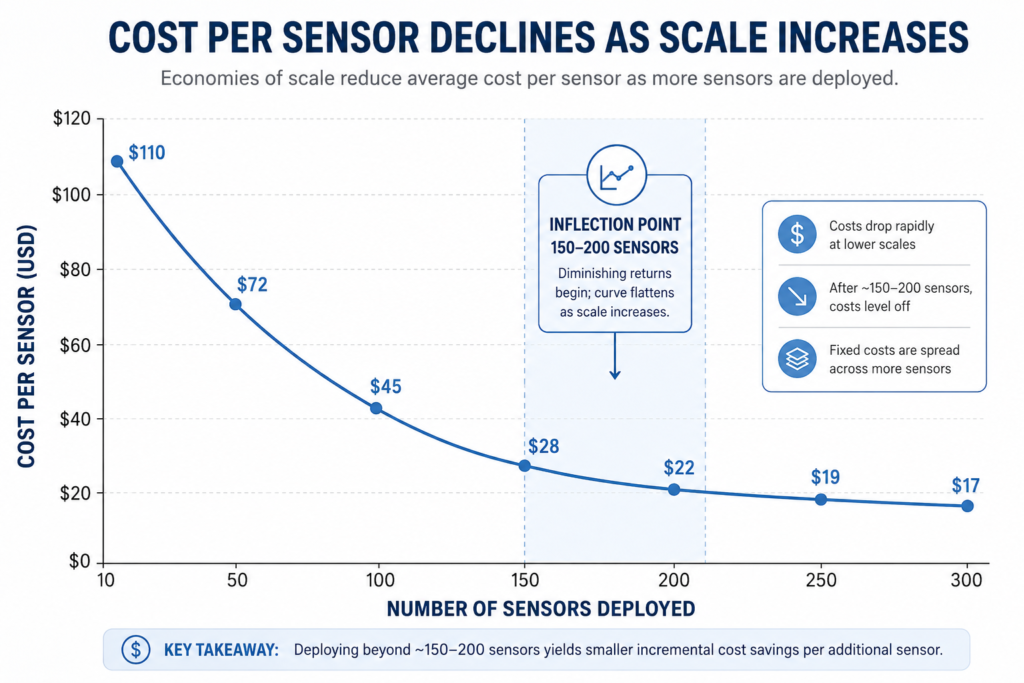
Cost per data point drops as deployment scale increases, but only up to a point. A single-building structural health monitoring system with 30 sensors costs more per sensor than a campus-wide deployment with 300 sensors, because fixed costs — platform licensing, initial calibration, engineer commissioning time — get spread across more devices. Beyond a certain density, however, gateway and connectivity costs scale linearly again, so the economy-of-scale curve flattens after roughly 150 to 200 sensors on a typical site.
Sensor Density and Data Frequency
Data frequency is the single largest hidden cost driver. A sensor sampling once per hour generates a fraction of the data — and cellular cost — of one sampling every second. High-frequency vibration monitoring during piling or blasting operations near sensitive structures might require 100Hz sampling for short windows, which spikes data transmission cost temporarily. Specify variable sampling rates where the platform allows it: continuous low-frequency baseline monitoring with automatic high-frequency triggering during specific events (an exceedance threshold, a piling operation) keeps average data cost down without sacrificing the readings that matter.
Sensor placement density directly affects both hardware cost and the quality of the engineering conclusions you can draw. Spacing tiltmeters too widely on a long-span structure leaves gaps in the deflection profile that no amount of data analysis can fill in afterward. As a working rule, structural monitoring on beams and slabs benefits from sensor spacing tied to the span-to-depth ratio rather than a fixed distance: shorter, stiffer spans need proportionally fewer sensors than long, flexible ones to capture the same resolution of movement data. This is the same principle that governs instrumentation decisions in foundation design cost planning, where sensor density on piles or rafts is driven by settlement risk rather than an arbitrary sensor count.
Platform and Software Licensing Models
Most IoT platforms charge per-device annual licensing ($50 to $300 per sensor per year), a flat platform fee ($5,000 to $50,000 annually regardless of device count), or a hybrid of both. Per-device pricing favours small deployments; flat-fee platforms become more economical once you cross roughly 100 connected devices. Before signing a multi-year platform contract, confirm data export rights and API access in writing — vendor lock-in on structural monitoring data is a genuine risk if the platform becomes the only place your historical readings live.
Analytics and alerting features sit on top of raw IoT data storage and are usually priced separately. Basic threshold alerting — a notification when a strain reading crosses a defined value — is typically included in standard licensing. Predictive analytics, trend forecasting, and integration with structural modelling software cost extra, often 20% to 40% more than the base platform fee. Decide early whether your monitoring programme needs predictive capability or whether threshold alerting with periodic engineer review satisfies the project’s risk management requirements; paying for predictive analytics you don’t act on is a common source of budget waste.
Regulatory and Regional Context
In the UK, structural monitoring on projects governed by CDM 2015 increasingly forms part of the principal designer’s risk management documentation, particularly on temporary works and deep basements where Eurocode-based movement predictions need field verification. Network Rail projects specify monitoring requirements directly in their technical approval process, and non-compliant sensor specifications get rejected at design review — factor re-submission time into your programme, not just your budget.
In Nigeria, COREN-registered engineers signing off on structural health monitoring reports for high-rise or infrastructure projects need documentation trails that satisfy both COREN’s professional liability standards and, where applicable, NESREA environmental monitoring requirements on projects near sensitive water bodies. Lagos and Port Harcourt sites frequently combine structural sensors with groundwater and settlement monitoring given the region’s soft clay and reclaimed land conditions — this dual monitoring scope adds 20% to 35% to a standard structural-only IoT budget.
UAE projects under Dubai Municipality and Abu Dhabi authority oversight often mandate real-time monitoring on any excavation within a defined proximity of existing infrastructure — Dubai Municipality’s deep excavation guidelines are a common trigger. GCAA-regulated airside works add a further layer: any sensor network with a physical footprint near active runways requires separate aviation safety sign-off, which extends procurement lead time by four to eight weeks and should be priced into the project schedule, not just the cost sheet.
Regulatory-driven monitoring requirements also change who pays. On UK Network Rail projects, monitoring specified as a condition of technical approval is typically a contractor cost absorbed into the works package. On UAE excavation projects near existing infrastructure, the monitoring requirement often sits with whichever party’s works triggered the proximity rule, which can shift cost allocation between contractor and client depending on how the contract defines the trigger. Clarify this allocation at tender stage — disputes over who funds regulatory monitoring are a recurring source of variation claims once works are underway.
Common Cost Mistakes and Where Budgets Actually Break
The most expensive mistake in IoT deployment is specifying sensor density before running a coverage and connectivity survey. Teams that order hardware first and discover signal dead zones afterward end up paying for both the original cellular-based plan and a retrofit mesh network — a cost that a two-day site survey would have avoided entirely.
Calibration and recalibration is the second most underbudgeted item. Strain gauges and tiltmeters drift over time and require periodic recalibration, typically every six to twelve months depending on manufacturer specification and environmental exposure. Budget $80 to $250 per sensor per calibration visit, and factor in access cost — sensors mounted on bridge soffits or deep excavation shoring cost significantly more to recalibrate than those at ground level because of the access equipment required.
A third common mistake: treating the platform subscription as a fixed cost when negotiating the initial contract, then discovering usage-based overage charges once data volume exceeds the plan’s included allowance. Read the platform contract’s data volume clauses before signing, not after the first invoice arrives.
A fourth, less obvious mistake is procuring IoT hardware and software from separate vendors without confirming interoperability first. A sensor manufacturer’s hardware warranty and a platform vendor’s software support agreement rarely align on response times or fault liability, and when a reading goes wrong mid-project, unclear accountability between two vendors can delay the diagnosis by weeks. Where possible, procure hardware and platform as a single package with one point of accountability, or write interoperability testing into the procurement contract as a pre-installation milestone.
A fifth issue shows up on projects where IoT monitoring is added late, after the structural design is finalised. Retrofitting sensors onto an existing structure costs more than specifying mounting points and cable routes at design stage, because access, drilling, and cable containment all have to work around completed finishes rather than being built in. Where the scope allows it, involve the monitoring specifier during design development rather than after practical completion.
- Underestimated connectivity in low-signal zones — run a site survey before finalising sensor count or type
- Skipped recalibration budgeting — build a 12-month recalibration line item into every proposal from day one
- Platform overage charges — confirm included data volume and per-unit overage rates in writing before signing
- Vendor lock-in on historical data — verify export rights and API access before committing to a multi-year platform contract
- Underscoped installation labour — sensors on inaccessible structural elements (bridge soffits, deep shoring, tank interiors) cost 2 to 3 times more to install and maintain than ground-level units
Best Practices for Budgeting an IoT Deployment
Start with a defined monitoring objective, not a sensor catalogue. If your objective is settlement monitoring on a raft foundation adjacent to an existing structure, that determines sensor type, density, and sampling frequency — and from there, connectivity and platform requirements follow logically rather than being guessed at. Skipping this step is the most common reason IoT budgets grow mid-project: teams procure a generic IoT package sized for a different use case, then pay again to reconfigure it once the actual monitoring objective becomes clear.
Run a connectivity survey before finalising your hardware order. A half-day site visit with a cellular signal meter costs a fraction of what a mid-project connectivity retrofit costs, and it tells you definitively whether you need cellular, LoRaWAN, or a hybrid approach.
Model total cost of ownership over the full monitoring period, not just year one. A three-year structural health monitoring programme on a bridge or high-rise should be priced as hardware plus (connectivity × 36 months) plus (platform licensing × 3 years) plus (recalibration visits × 3 to 6 occurrences) plus installation and decommissioning labour. Clients evaluating IoT quotes on hardware cost alone consistently underestimate total spend by 40% to 60%, which is the single biggest gap between initial budget approval and final project cost reconciliation.
Negotiate platform contracts with clear exit terms. Ask what happens to historical data if you switch vendors, whether the platform charges data extraction fees, and whether sensor hardware is proprietary to that platform or works with alternative software. A platform that locks your sensors to its own ecosystem removes your negotiating leverage at renewal.

For projects layering IoT into a broader digital delivery strategy, understanding how sensor networks feed into digital twin models and how they connect to wider connected infrastructure systems helps justify the platform investment beyond single-project monitoring.
Frequently Asked Questions About IoT
Q: What is IoT in civil engineering?
A: IoT in civil engineering refers to networks of connected sensors and devices that collect structural, environmental, or operational data in real time and transmit it to a software platform for analysis. Common applications include structural health monitoring, groundwater level tracking, and equipment utilisation monitoring on construction sites.
Q: How much does IoT monitoring cost on a construction project?
A: A mid-size structural health monitoring deployment typically costs $15,000 to $150,000 annually, depending on sensor count, data frequency, and connectivity type. Larger infrastructure projects with hundreds of sensors can exceed $300,000 annually once platform licensing and multi-year maintenance are included.
Q: What is the difference between cellular and LoRaWAN connectivity for IoT sensors?
A: Cellular connectivity uses existing mobile networks and charges per device per month, typically $10 to $60, making it simple to deploy but costly at scale. LoRaWAN uses a private mesh network with a higher upfront gateway cost but near-zero recurring data charges, making it more economical for large, long-term deployments in areas with weak cellular coverage.
Q: How often do IoT sensors need recalibration?
A: Most structural sensors, including strain gauges and tiltmeters, require recalibration every six to twelve months depending on manufacturer specification and environmental exposure. Sensors in harsh marine or high-vibration environments typically need more frequent recalibration than those in stable, sheltered locations.
Q: What factors increase IoT deployment cost the most?
A: Low cellular coverage requiring a mesh network retrofit, high-frequency data sampling, difficult sensor access for installation and calibration, and platform data-volume overage charges are the four factors most likely to push an IoT budget significantly above initial estimates. A pre-deployment connectivity and access survey addresses the first two before they become expensive.
Conclusion
IoT cost factors on a construction or infrastructure project are rarely dominated by hardware. Connectivity, platform licensing, calibration labour, and installation access typically account for more of the total three-year cost than the sensors themselves. Price the full monitoring period, run a connectivity survey before ordering hardware, and negotiate platform exit terms before you sign — not after. StruviaCore’s engineering team specifies and budgets IoT monitoring systems for structural health, geotechnical, and infrastructure projects across the UK, UAE, and West Africa. Get in touch to scope a deployment budget for your project before you commit to hardware.
Leave a Reply