
Utility Infrastructure Explained: What Site Teams Need to Know
A project manager pricing a new distribution warehouse outside Ibadan treats “utilities” as a single line item: connect water, connect power, done. Six weeks into earthworks, the team discovers a buried telecom duct nobody priced for, a water main whose owner takes a month to respond to correspondence, and a power connection that needs a substation upgrade the original budget never anticipated. Utility infrastructure is not one connection point. It is every existing water, power, telecom, and, in some corridors, gas or fuel service that already occupies the ground your project needs, plus every new connection your project will require once it is built. Understanding the difference between those two things, and planning for both, is what separates a utilities budget that holds from one that does not.
Utility Infrastructure: Quick Answer
Utility infrastructure refers to the physical networks, existing and new, that deliver water, electricity, telecommunications, and in some cases gas or fuel to a site. On a construction project it covers two distinct tasks: identifying and protecting services already buried or overhead on the site, and designing new connections between the site and each utility owner’s network.
What Counts as Utility Infrastructure on a Nigerian Site
Utility infrastructure splits into two planning problems that too many project teams treat as one. The first is existing infrastructure: services already in the ground or overhead before your project starts, which you need to locate, protect, and sometimes divert. The second is new infrastructure: the connections your finished building or road will need, which you need to design, apply for, and pay to install. A site can have heavy existing-utility risk and light new-connection needs, or the reverse, and pricing them as a single “utilities” allowance is how budgets go wrong before excavation even starts.
The Four Main Utility Categories
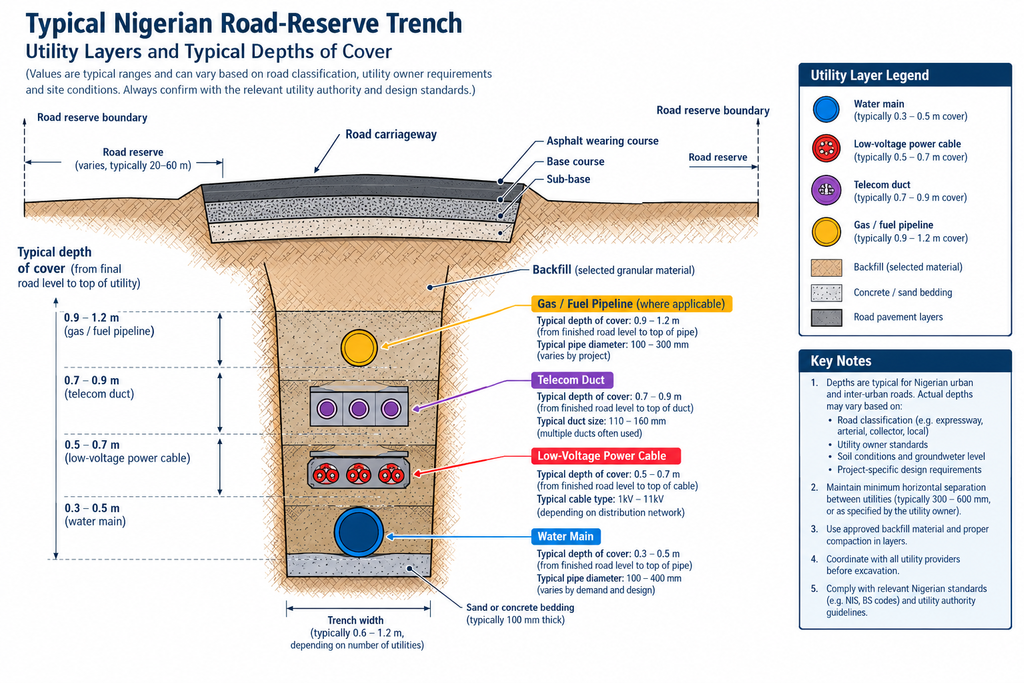
Water infrastructure includes mains, service connections, and drainage or sewer lines, typically owned by the relevant State Water Corporation, though boreholes and private distribution networks serving nearby estates are increasingly common in areas where public supply is unreliable. Power infrastructure covers overhead and underground cables from low-voltage site connections up to 33kV distribution lines, owned by the local Distribution Company (Discos) under Nigeria’s post-unbundling electricity market structure, with the Transmission Company of Nigeria (TCN) responsible for the higher-voltage backbone that feeds them. Telecom infrastructure is largely privately owned duct and fibre networks run by operators such as MTN, Globacom, and Airtel, plus smaller regional ISPs whose routes rarely appear on any consolidated public register. Gas and fuel infrastructure is the narrowest category geographically but the highest-consequence one, concentrated in and around Niger Delta pipeline corridors and regulated directly by the Nigerian Upstream Petroleum Regulatory Commission (NUPRC).
Public vs. Privately Owned Networks
The ownership distinction matters more than the physical distinction, because it determines your notification process. Public and statutory utilities, water corporations, Discos, and NUPRC-regulated pipelines, generally require a formal wayleave or permit-to-work application with a defined (if sometimes slow) process behind it. Privately owned infrastructure, telecom ducts especially, often has no standardised application process at all; a call to the operator’s local engineering office, followed by a written confirmation, is frequently the only mechanism available. Treat private-network coordination as informal but not optional. A telecom operator whose duct gets damaged without prior notice can still pursue a damages claim even though no formal permit existed to breach.
Rail and highway corridors add a third ownership layer worth planning for separately: utilities that run within a transport agency’s right-of-way but are not owned by the transport agency itself. StruviaCore’s own work on utility coordination within rail corridors found that these crossing agreements, negotiated between the utility owner and the corridor authority rather than the project directly, can take longer to close than either party’s own internal process would suggest, simply because two separate organisations have to align before either signs off.
How Utility Infrastructure Shapes Project Planning
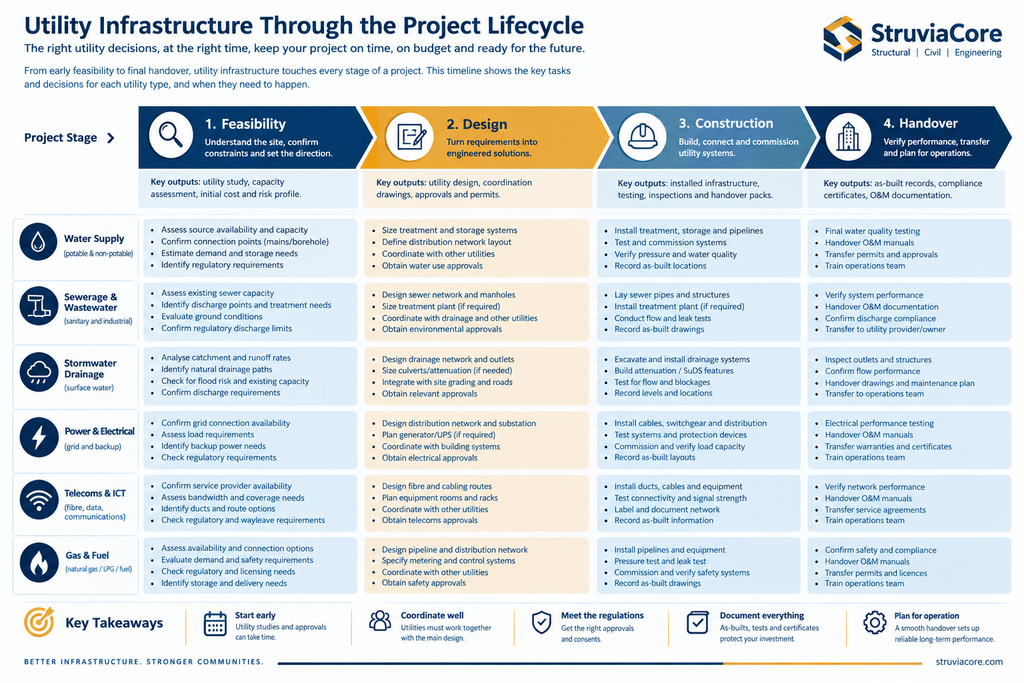
Utility infrastructure decisions belong at the feasibility stage, not the construction stage, because both the existing-service risk and the new-connection lead time shape what a site can actually accommodate. A site with a 33kV overhead line crossing it may have real constraints on building height and crane operation that affect the entire layout, not just the foundation design near the line itself.
The lead time question deserves more weight than most feasibility studies give it. A Discos capacity upgrade, where one is needed, can take considerably longer to deliver than the civil works it is meant to support, particularly where a new or upgraded substation is involved. Projects that treat the power connection as a task to start once the building shell is complete routinely find that the connection, not the construction, becomes the critical path item determining the handover date. Pulling the utility lead-time question into the very first programme draft, rather than adding it once other trades are sequenced, is the single change most likely to prevent that outcome.
Early-Stage Utility Assessment
Before layout design starts, request preliminary records from each statutory utility owner covering the site boundary and immediate surroundings. This early pass will not give you the detailed confidence-graded data a full utilities checklist requires before excavation, but it flags the constraints that actually shape design decisions: a major transmission line ruling out a tall structure in one corner of the site, or a trunk water main setting a hard offset line for foundations. Catching these at feasibility stage costs a few weeks of correspondence. Catching them during detailed design costs a redesign.
Utility Infrastructure and Design Coordination
New-connection design, sizing the incoming power supply, routing the water connection, and agreeing telecom duct entry points, needs to happen alongside structural and architectural design, not after it. Discos in Nigeria generally require a load assessment before confirming what capacity they can supply to a given site, and where the answer comes back lower than the project needs, the alternative is either an embedded generation solution or a substation upgrade that the Discos may require the developer to fund. Building this question into your foundation design guide process at an early stage, rather than treating it as a separate services workstream, keeps the civil and electrical designs consistent with what the site can actually receive.
Utility Infrastructure Within Nigeria’s Regulatory Landscape
Nigeria’s utility sector does not operate as a single coordinated system, and understanding why helps explain some of the friction project teams encounter. The 2013 unbundling of the former National Electric Power Authority split generation, transmission, and distribution into separate entities, with TCN retaining the transmission grid as a federal government asset while eleven privatised Discos each hold distribution rights in their own franchise area. This means your power utility contact, application process, and even tariff structure change depending on which state and Discos franchise area your site sits in.
Water follows a more fragmented pattern still. Most states operate their own Water Corporation with its own separate application and permit process, and coverage and service reliability vary enormously between states. Telecom infrastructure has no state-level regulatory layer at all; the Nigerian Communications Commission licenses operators nationally, but individual duct routing and wayleave coordination happens directly between the project and the operator.
This fragmentation means a project spanning two states, or even two local government areas within Lagos, cannot assume the same utility process applies uniformly across the site. A consultant who has coordinated utility infrastructure successfully in Lagos will still need to rebuild those relationships and confirm the process from scratch when the next project sits in Ogun or Rivers State, because the Water Corporation, the Discos franchise area, and the state building control agency’s expectations all change at the state boundary. Budgeting the same utility coordination timeline for every state, rather than confirming it locally, is a quiet but common source of programme slippage.
Building approval itself runs through the National Building Code and the relevant state building control agency, LASBCA in Lagos State being the most established example, and increasingly expects utility coordination to be documented as part of the approved site plan rather than resolved separately. An engineer certifying any utility-related design element, from a diversion detail to a substation foundation, needs current COREN registration in the applicable discipline, the same requirement that applies to structural and geotechnical sign-off elsewhere in the project.
Why Utility Infrastructure Gets Underestimated
Three planning habits explain most of the utility-related cost overruns StruviaCore sees on Nigerian projects. The first is pricing utility connections from a generic allowance rather than a site-specific assessment, which works fine until the site turns out to need a substation upgrade or a long water main extension that a generic allowance never covered. The second is assuming existing-service risk and new-connection cost are the same conversation; they require different specialists, different timelines, and often different consultants, and treating them as one line item hides which one is actually driving the budget. The third is deferring utility engagement until a detailed design is complete, at which point a Discos capacity constraint or a water corporation routing requirement can force changes to a design that is already too far along to absorb them cheaply.
The cost of getting this wrong compounds because utility delays are rarely isolated. A late power connection can hold up commissioning even when every other trade has finished on time, turning a utility problem into a project-wide delay claim. Teams that have already worked through the site’s broader urban infrastructure examples context tend to catch these dependencies earlier, because they are thinking about the site’s utility position relative to its surroundings rather than in isolation.
A fourth habit worth naming separately, because it is less about planning process and more about contract structure, is leaving utility risk allocation ambiguous in the contract itself. Where the contract does not state clearly who carries the cost and delay risk of an undocumented existing service, disputes over responsibility for a strike or a delayed connection tend to default to whichever party has the weaker negotiating position rather than whoever actually controlled the risk. Naming utility infrastructure risk explicitly in the contract, including which party commissions the early records request and which party carries the cost of an unforeseen diversion, removes that ambiguity before it becomes a live dispute.
Getting Utility Infrastructure Right From Project Start
You do not need a specialist utilities consultant on every project, but you do need to ask the right questions early. Start every new project by separating existing-service risk from new-connection planning explicitly in your programme, rather than budgeting both under a single “utilities” heading. Request preliminary records from every statutory utility owner as soon as the site boundary is fixed, even before detailed design starts, since response times are often the longest-lead item in the whole utility workstream. Confirm Discos supply capacity in writing before finalising the electrical design, and build the answer into your programme risk register if it comes back lower than expected.
Assign a single named person, whether an in-house project manager or an external consultant, to own utility coordination for the life of the project. Utility correspondence that gets distributed across several team members without a single owner tends to stall, because each utility owner’s response goes to whoever sent the original request, and follow-up falls through when that person moves on to another task. A named owner also gives your utility owners a consistent point of contact, which in practice speeds up response times more than the formal content of the request itself.
Where the site sits near a water resources network of any scale, coordinate directly with the relevant authority early; a project team that has already reviewed a water resources guide for the region understands the broader network context that a single-site records request will not reveal on its own. Finally, once design is far enough along to define excavation limits, move from this general assessment into the detailed, confidence-graded process a full utilities checklist requires, rather than relying on the feasibility-stage records alone.
Frequently Asked Questions About Utilities
Q: What is utility infrastructure in construction?
A: Utility infrastructure is the combined network of water, power, telecom, and in some areas gas or fuel services that a site either already contains or will need to connect to. It covers both existing services that must be identified and protected during construction and new connections that must be designed and applied for before the project can operate.
Q: Who owns utility infrastructure in Nigeria?
A: Ownership is split across several bodies. State Water Corporations generally own water infrastructure, Distribution Companies (Discos) own local power distribution networks with the Transmission Company of Nigeria (TCN) owning the transmission backbone, private telecom operators own duct and fibre networks, and NUPRC regulates oil and gas pipeline infrastructure, mainly concentrated in the Niger Delta.
Q: How does utility infrastructure affect a project budget?
A: It affects budget in two separate ways: the cost of protecting or diverting existing services that conflict with new works, and the cost of new connections, including any capacity upgrades a utility owner requires before it can supply the project. Projects that price these as a single generic allowance rather than assessing the specific site tend to see the largest overruns.
Q: What is the difference between utility infrastructure and smart utilities?
A: Utility infrastructure refers to the physical delivery networks themselves, water mains, power cables, telecom ducts, regardless of how they are managed. Smart utilities refers to IoT-enabled and data-driven systems layered on top of that physical infrastructure for monitoring and management. A project can have extensive utility infrastructure with no smart-utility technology at all, and the two should not be treated as the same subject.
Q: When should utility infrastructure planning start on a project?
A: As early as feasibility stage, before detailed design is locked in. Preliminary records requests and Discos capacity checks take time to come back, and constraints they reveal, such as a transmission line affecting building height or a capacity shortfall requiring a substation upgrade, are far cheaper to design around early than to retrofit later.
Q: How do I find out what utility infrastructure exists on my site?
A: Start with a written records request to every statutory and known private utility owner covering your site boundary, then follow with a physical detection survey once design is far enough along to define excavation areas. A full utilities checklist sets out the complete process, including how to grade the confidence of what the survey finds.
Utility infrastructure is not a single procurement item, and treating it as one is where Nigerian project budgets and programmes most often come under pressure. Separate the existing-service question from the new-connection question from the earliest planning stage, engage statutory utility owners before detailed design locks in, and confirm supply capacity in writing rather than assuming it. Once your design reaches the point where excavation limits are defined, move into the detailed checklist process that protects your site during construction itself. If your project is at feasibility or early design stage and you want a clear-eyed read on its utility infrastructure exposure before the budget is fixed, StruviaCore’s engineering team can review the site and the surrounding network with you.
Leave a Reply