
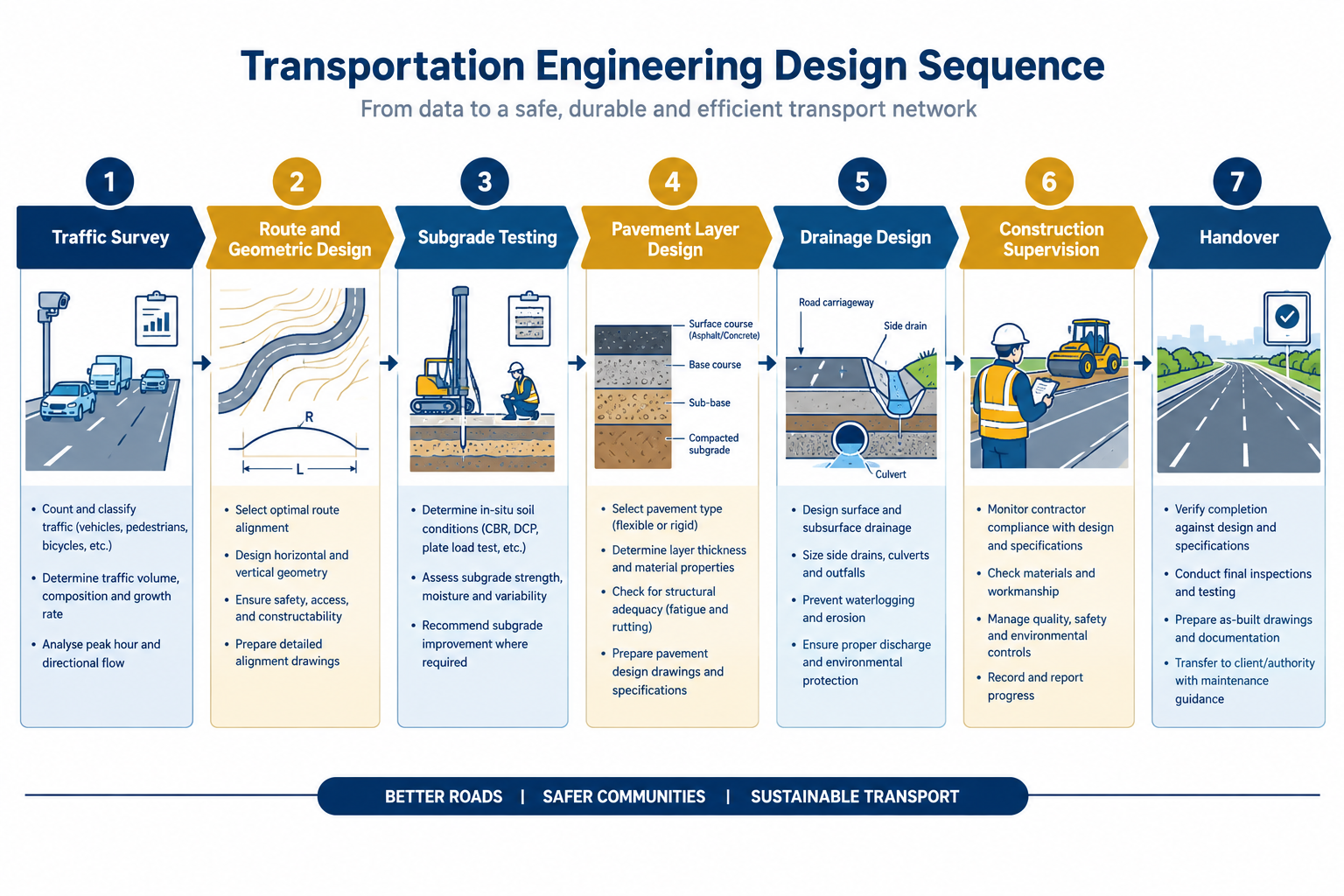
A newly resurfaced feeder road outside Ibadan starts rutting and ponding water within eight months of handover, long before its design life should allow. The contractor blames the rains. The consultant who reviews the failure finds a subgrade that was never tested for California Bearing Ratio and a camber that falls short of the 2.5% minimum needed to shed water off the carriageway. This is the gap that transportation engineering best practices exist to close — the difference between a road that carries traffic for fifteen years and one that needs patching before its second rainy season. This guide sets out how transportation engineers plan routes, design pavements, manage drainage, and work within Nigerian regulatory structures, so that site engineers, project managers, and developers can recognise a properly specified road project before construction starts rather than after it fails.
Transportation Engineering Best Practices: Quick Answer
Transportation engineering best practices combine traffic-based route planning, geometric design to a named standard, layered pavement design supported by subgrade CBR testing, and drainage sized for local rainfall intensity. In Nigeria, these practices must also satisfy COREN registration requirements and the specifications set by FERMA or the relevant state road agency before a contractor can legally build.
What Transportation Engineering Best Practices Actually Cover
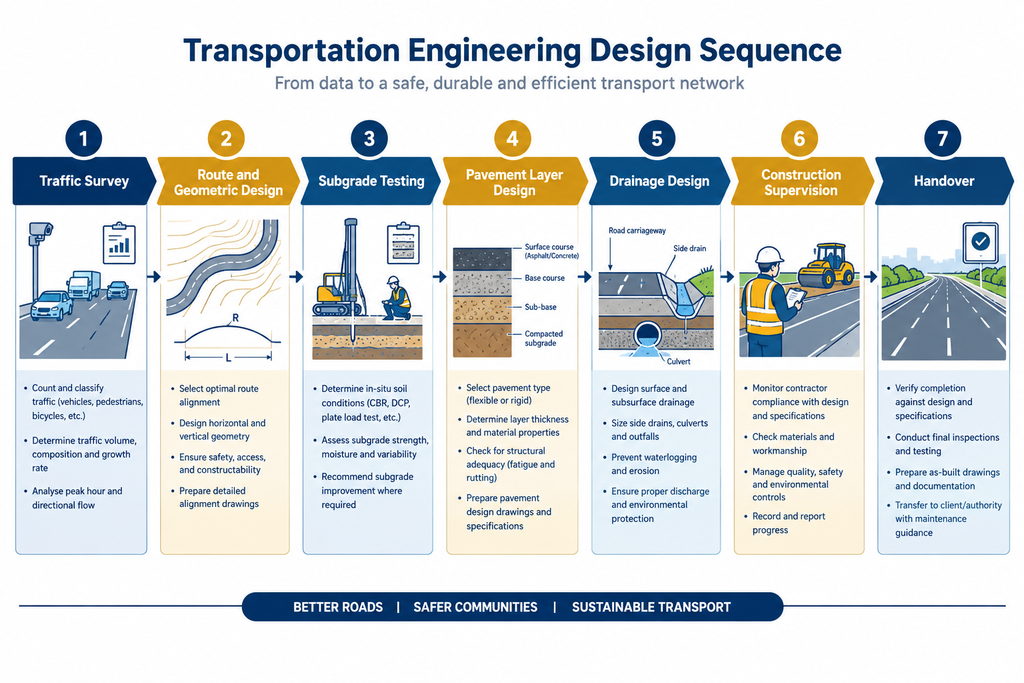
Transportation engineering is the branch of civil engineering responsible for planning, designing, and maintaining the systems that move people and goods — roads, junctions, drainage corridors, and the pavement structures beneath them. Good road design rests on three linked decisions: how much traffic the facility must carry, what geometric standard it should be built to, and how the pavement and drainage will perform under Nigeria’s rainfall and axle loading over a defined design life, typically 15 to 20 years for a paved rural or urban road. Skipping any one of the three does not save time; it just moves the cost to the maintenance budget a few years later.
Route Planning and Traffic Analysis
Every credible design starts with a traffic survey — classified vehicle counts taken over at least a 12- to 16-hour period, extrapolated to an Average Daily Traffic figure and projected forward using a growth rate appropriate to the corridor, often 4–6% annually for growing Nigerian urban routes. This figure converts into an equivalent standard axle load count, since a single fully loaded articulated truck can do the pavement damage of several thousand cars — a relationship road authorities describe using a fourth-power law linking axle weight to pavement wear. Route planning also has to account for land use along the corridor: a road serving a market town needs wider shoulders and pedestrian provision that a purely rural bypass does not. Engineers who skip the traffic survey and design from assumption alone routinely undersize pavements for the trucks that actually use the route, which is one of the most common and expensive road-design failures on record.
Geometric Design Standards
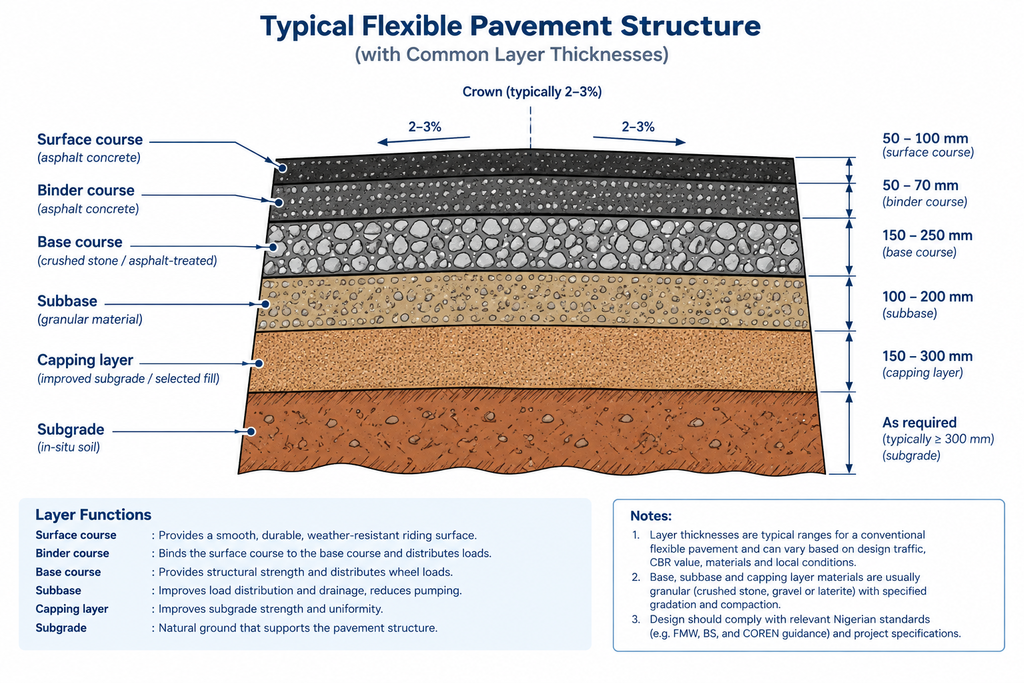
Geometric design covers horizontal alignment, vertical alignment, cross-section, and sight distance — the physical shape drivers actually experience. Nigerian practice draws on the Federal Ministry of Works’ Highway Manual Part I (Design), which sets minimum curve radii, gradient limits, and sight distance requirements by design speed class. A rural single carriageway designed for 100km/h typically needs a minimum horizontal curve radius well above 400m and a maximum gradient held under 6% wherever terrain allows, while urban collector roads with lower design speeds can use tighter geometry safely. Cross-fall — the camber that sheds rainwater off the running surface — should sit at a minimum of 2.5% on a standard two-lane carriageway; anything flatter leaves water standing long enough to strip bitumen from the surface course over repeated wet seasons. Getting this stage wrong is difficult to fix later, because correcting alignment after earthworks are complete means re-excavating rather than resurfacing.
Technical Best Practices: Materials, Drainage and Pavement Design
Once the route and geometry are fixed, attention shifts to what actually sits beneath and around the running surface. This is where most of a project’s construction budget goes, and where corner-cutting produces the ruts, potholes, and washouts that define a poorly built Nigerian road within its first few rainy seasons.
Subgrade, Subbase and Base Layer Design
Pavement design in Nigeria commonly follows the CBR-based method set out in TRL Overseas Road Note 31, which links subgrade strength to the thickness of subbase and base layers needed above it. A weak subgrade — common in the swampy sections of the Niger Delta and low-lying parts of Lagos, where in-situ CBR can fall below 3% — needs either a thick capping layer of selected fill or a full subgrade improvement using lime or cement stabilisation before subbase placement even starts. Lateritic subgrades common across much of central and northern Nigeria typically test at CBR values of 15–30% once properly compacted, which allows thinner pavement structures for the same traffic loading. The base course, usually crushed stone or a well-graded lateritic gravel compacted to at least 100% of maximum dry density under BS 1377 testing, carries the bulk of the load-spreading duty before the surfacing goes down. Specifying materials against soil test results rather than against whatever gravel pit is nearest the site is the single change that prevents the most premature pavement failures.
Drainage, Camber and Culvert Placement
Water is the enemy of every pavement layer, and drainage design deserves the same rigour as the pavement structure itself. Side drains need capacity sized against local rainfall intensity-duration-frequency data, not a standard cross-section copied from another project — a corridor in Port Harcourt receiving over 2,500mm of annual rainfall needs drain capacity that a route through Kano’s semi-arid climate does not. Culverts should sit at natural drainage low points with inlet and outlet aprons to prevent scour, spaced according to catchment area rather than at arbitrary regular intervals. You should also check that side drains actually connect to a functioning outfall; a beautifully built drain that empties into a blocked culvert or a dead-end simply relocates the flooding problem instead of solving it. For a closer look at how these layers combine into a complete pavement structure, see our pavement engineering best practices guide.
Applying These Practices Within Nigeria’s Regulatory Framework
Technical knowledge only carries a transportation project part of the way — Nigeria’s institutional structure shapes who can design what, and who signs off before construction. The Council for the Regulation of Engineering in Nigeria (COREN) requires that highway and transportation designs above a defined scale be prepared and certified by a COREN-registered engineer, the same requirement that governs structural and geotechnical work. For federal roads, the Federal Roads Maintenance Agency (FERMA) sets maintenance and rehabilitation standards and increasingly reviews design submissions for routes under its mandate, while new federal trunk roads fall under the Federal Ministry of Works’ direct design and procurement process. State roads answer to state ministries of works or dedicated public works corporations — Lagos State Public Works Corporation and the Rivers State Ministry of Works are among the more active examples — and each can layer additional local requirements on top of federal specifications, particularly around drainage tie-ins to existing urban stormwater systems.
Material specification runs through the Standards Organisation of Nigeria (SON), which enforces the Nigerian Industrial Standards covering bitumen grades (commonly 60/70 or 80/100 penetration grade for surface courses) and aggregate quality used in road construction. The Federal Ministry of Works’ General Specification for Roads and Bridges remains the reference document most Nigerian contracts cite for material tolerances, compaction targets, and testing frequency, and a bill of quantities that departs from it without explicit justification is usually a sign the design was not properly checked against the governing specification. Contractors who assume “the last road we built” sets the standard for the next one frequently fall foul of this, because subgrade conditions, traffic loading, and drainage catchments rarely repeat exactly from one corridor to the next. Our guide to how transportation engineering works covers this design-to-construction handoff in more depth.
Land and environmental clearance add a further layer that project schedules often underestimate. Right-of-way acquisition under the Land Use Act requires formal compensation to affected landowners before earthworks start, and disputes over valuation are a common source of delay on corridors passing through built-up areas. Projects above a defined length or crossing sensitive terrain — wetlands, forest reserves, or water crossings — need an Environmental Impact Assessment cleared through the National Environmental Standards and Regulations Enforcement Agency (NESREA) before FERMA or a state ministry will approve construction to proceed. Building this clearance timeline into the project programme from the outset avoids the common scenario where design and procurement finish on schedule but construction stalls for months waiting on land or environmental sign-off.
Common Challenges, Mistakes and Cost Factors in Transportation Engineering
The recurring failures on Nigerian road projects trace back to a short list of avoidable decisions, and naming them directly is more useful than a general warning to “be careful.” Skipping or reducing the traffic survey to save time produces pavements sized for the wrong axle load spectrum, and the resulting rutting typically shows within two to three rainy seasons rather than the intended design life. Substituting subbase or base material with whatever is locally cheapest, without retesting CBR and grading against specification, is the second most common cause of early failure, and it is frequently difficult to detect until the surface has already begun to deform. Poor drainage tie-in — building a road to specification but failing to connect its side drains to a working outfall — turns an otherwise sound design into a flooding liability the first time rainfall exceeds an ordinary storm event. A deeper look at these patterns sits in our article on transportation engineering cost factors, which breaks down where budgets typically go wrong.
Cost factors follow a predictable structure once you separate design fees from construction cost. Design and supervision fees in Nigeria commonly run between 3% and 6% of construction value for road projects, higher than typical building work because of the survey, geotechnical testing, and drainage design involved. Earthworks and pavement materials usually account for 55–65% of total construction cost, with bitumen price volatility — driven largely by crude oil price swings, since bitumen is a refinery by-product — the single biggest source of budget movement between tender and completion. Reducing pavement thickness or skipping a subbase layer to hit a lower headline price is a false saving; it shifts cost into early rehabilitation, which typically costs more per kilometre than getting the original layer thicknesses right.
Maintenance funding is the challenge that surfaces years after handover, once the original contractor has moved on. Routine maintenance — drain clearing, pothole patching, and shoulder repair — costs a small fraction of reconstruction per kilometre when carried out on schedule, yet it is the line item most often cut when state maintenance budgets tighten. A road built to specification but left without scheduled maintenance still fails early, just later than one built with substandard materials. Building a realistic maintenance allocation into the project’s whole-life cost, rather than treating handover as the end of the engineer’s involvement, is what separates a road that reaches its design life from one that needs full reconstruction after eight or nine years instead of fifteen.
A Transportation Engineering Best Practices Checklist for Every Project
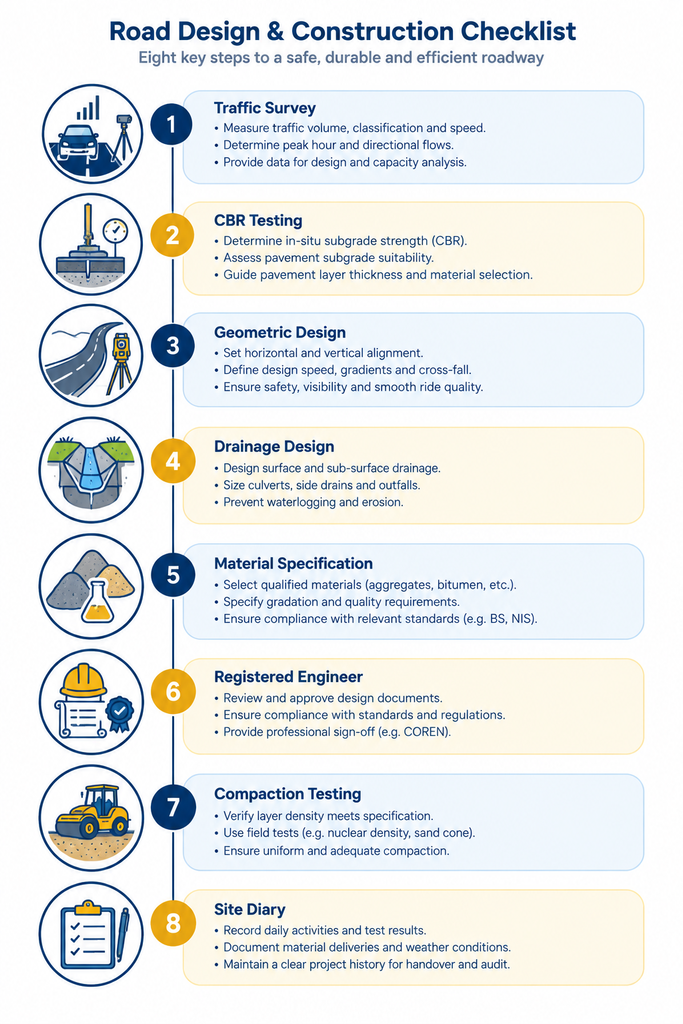
You reduce the risk of premature road failure by working through the same sequence an experienced highway engineer applies before signing off a design. Treat each item below as a decision point rather than a box to tick without checking the evidence behind it.
- Commission a classified traffic survey and project growth rates before sizing the pavement, rather than assuming traffic volumes from a similar-looking corridor.
- Test subgrade CBR at representative intervals along the route and design layer thicknesses against Overseas Road Note 31 or an equivalent recognised method, not a fixed standard section.
- Confirm geometric design — curve radii, gradients, and camber — against the Federal Ministry of Works’ Highway Manual Part I for the chosen design speed.
- Size drainage against local rainfall intensity-duration-frequency data and verify that every side drain connects to a functioning outfall before construction starts.
- Specify bitumen grade and aggregate quality against SON’s Nigerian Industrial Standards, and require test certificates before material goes into the works, not after.
- Engage a COREN-registered transportation or highway engineer to prepare and certify design drawings and calculations.
- Require compaction testing at each pavement layer against BS 1377 density targets before the next layer is placed on top of it.
- Keep a site diary recording any deviation from the approved drawings the moment it happens, so material or geometry changes go back through design review rather than staying informal.
Work through this sequence in order and you catch most of the failure modes described earlier while correction is still cheap — a subgrade problem found before subbase placement costs a redesign; the same problem found after surfacing costs a full reconstruction.
Frequently Asked Questions About Transportation Engineering
Q: What is transportation engineering in civil engineering?
A: Transportation engineering is the branch of civil engineering that plans, designs, and maintains roads, junctions, and the drainage and pavement systems that support them, so that people and goods move safely and efficiently. It combines traffic analysis, geometric design, and pavement engineering into a single discipline.
Q: How does pavement design work for Nigerian roads?
A: Pavement design typically follows the CBR-based method in TRL Overseas Road Note 31, which uses subgrade strength and projected traffic loading in equivalent standard axles to determine subbase, base, and surfacing layer thicknesses. Weak subgrades, common in the Niger Delta, require thicker capping layers or chemical stabilisation before the pavement structure can be built up.
Q: What are the geometric design requirements for a Nigerian highway?
A: The Federal Ministry of Works’ Highway Manual Part I sets minimum curve radii, maximum gradients, and sight distance by design speed class, with a minimum carriageway camber of around 2.5% required to shed rainwater effectively. These requirements vary by road classification, from rural single carriageways to urban collector roads.
Q: How much does a transportation engineering design cost in Nigeria?
A: Design and supervision fees typically range from 3% to 6% of total construction value for road projects, reflecting the traffic surveys, geotechnical testing, and drainage design involved. Construction cost itself is dominated by earthworks and pavement materials, which together commonly make up 55–65% of the total budget.
Q: What is the difference between transportation engineering and pavement engineering?
A: Transportation engineering is the broader discipline covering route planning, traffic analysis, geometric design, and pavement, while pavement engineering is a specialised subset focused specifically on the layered structure that carries traffic loads on the road surface. Every pavement engineer works within a transportation engineering project, but transportation engineers also handle geometry, drainage, and traffic beyond the pavement itself.
Q: Who approves transportation engineering designs in Nigeria?
A: Designs must be prepared and certified by a COREN-registered engineer, with federal roads reviewed against Federal Ministry of Works and FERMA specifications and state roads reviewed by the relevant state ministry of works or public works corporation. Approval requirements can include additional local conditions, particularly for drainage tie-ins to existing urban systems
Transportation engineering best practices come down to a consistent sequence: survey the traffic honestly, design geometry to a named standard, size the pavement against tested subgrade strength, and drain the road properly before the first vehicle drives on it. The Ibadan example at the start of this article failed for a reason that recurs across the country — a test that should have happened before construction got skipped in the interest of speed. Treat the checklist above as the minimum standard for any road project you brief or review, and bring in an independent geotechnical and pavement check whenever traffic loading or ground conditions sit outside routine experience. If you are scoping a road or drainage project and want a COREN-registered team to take it from traffic survey through construction supervision, StruviaCore’s transportation engineering and road design services are a reasonable place to start the conversation.
Leave a Reply